WengYang Industriegebiet Yueqing Wenzhou 325000
Arbeitszeiten
Montag bis Freitag: 7AM - 7PM
Am Wochenende: 10AM - 5PM
WengYang Industriegebiet Yueqing Wenzhou 325000
Arbeitszeiten
Montag bis Freitag: 7AM - 7PM
Am Wochenende: 10AM - 5PM

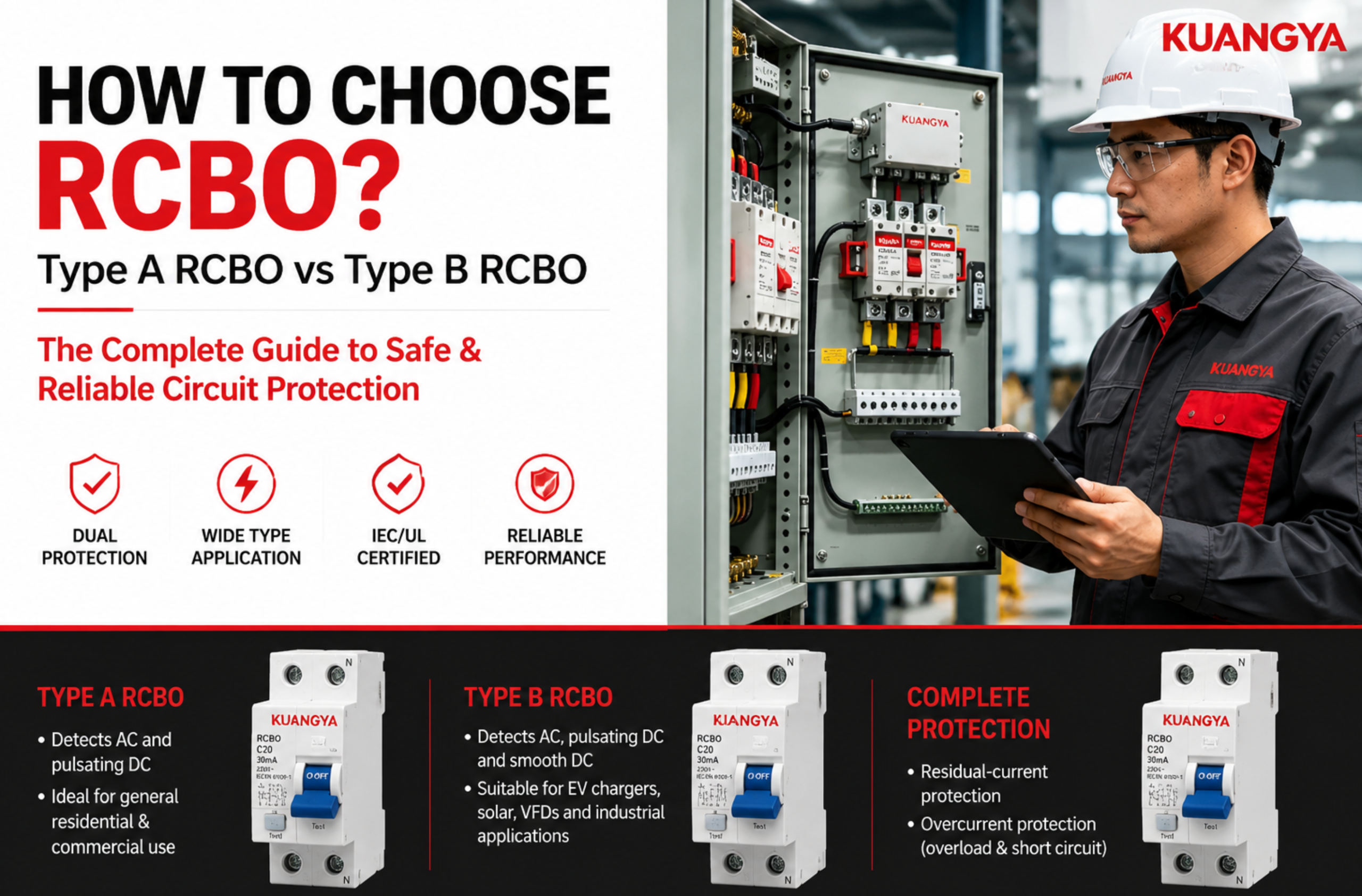
Type A vs Type B RCBO—quick answer: Type A RCBOs detect sinusoidal AC and pulsating DC residual currents. Type B RCBOs additionally cover smooth DC and mixed-frequency residual currents within the device’s specified range. Type B is not a universal upgrade: select the RCBO type according to the connected equipment, DC monitoring arrangement, manufacturer instructions, circuit design and local requirements.
This guide compares RCBO types, explains Type A or Type B selection, and covers poles, current rating, sensitivity, breaking capacity and application-specific checks for EV chargers, PV inverters and motor drives.
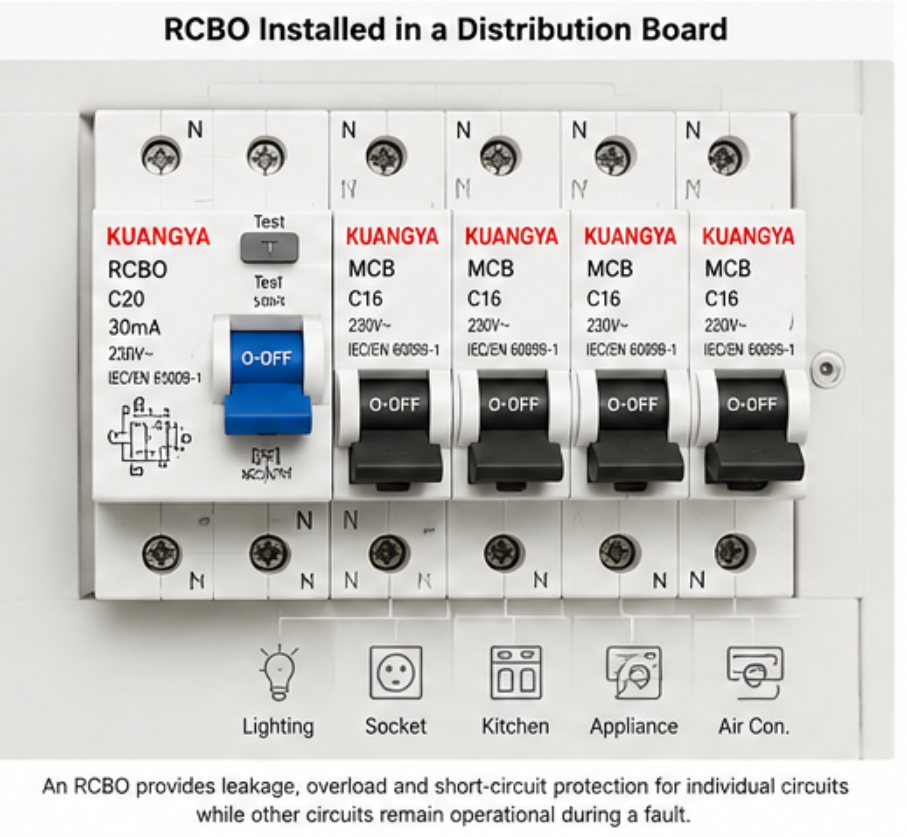
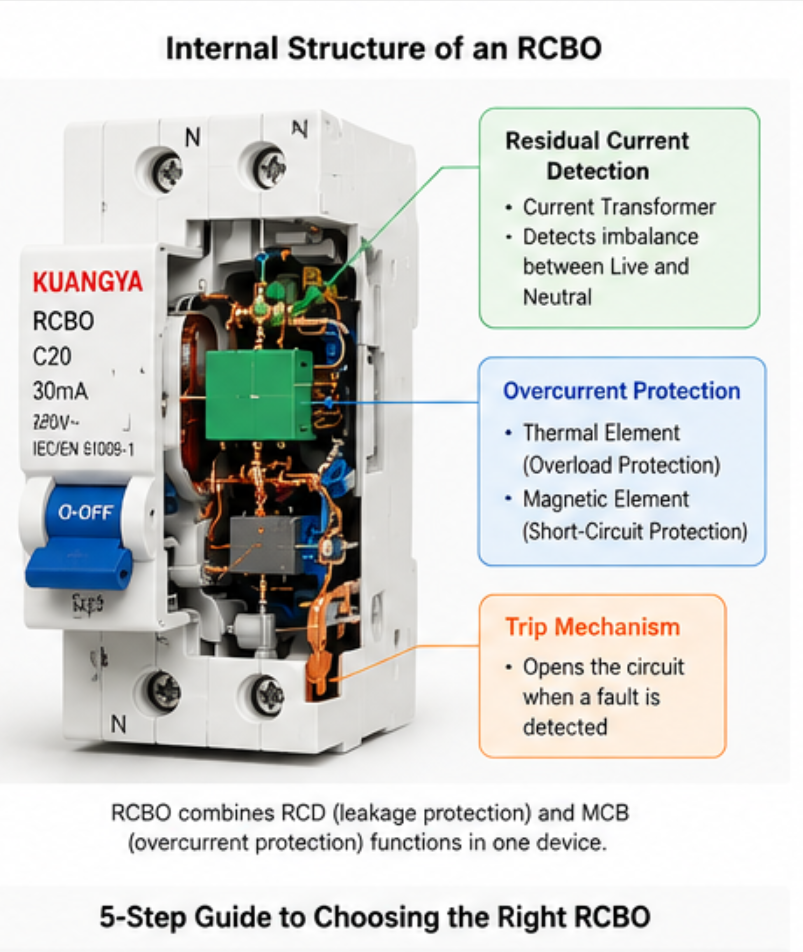
Ein FI-Schutzschalter bietet sowohl Fehlerstromschutz als auch Überstromschutz in einem einzigen Gerät. Die Wahl des falschen RCBO-Typs kann jedoch die Wirksamkeit des Schutzes verringern und zu Fehlauslösungen oder zur Nichterkennung bestimmter Fehlerbedingungen führen.
Deshalb ist es wichtig, den Unterschied zwischen RCBO Typ A und RCBO Typ B zu kennen, wenn man elektrische Systeme entwirft oder aufrüstet.
Viele Installateure konzentrieren sich darauf:
Diese Spezifikationen sind zwar wichtig, aber die Art des Fehlerstroms ist ebenso entscheidend.
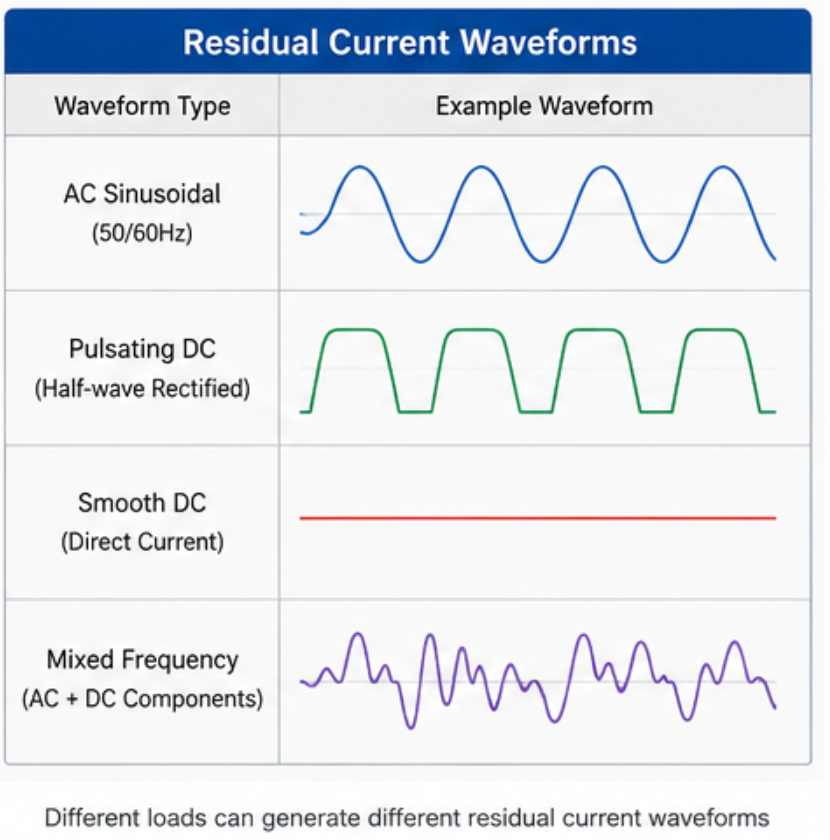
Verschiedene elektrische Lasten können unterschiedliche Leckstrom-Wellenformen erzeugen. Nicht jeder RCBO ist dafür ausgelegt, alle zu erkennen.
Wenn der falsche RCBO-Typ gewählt wird, werden gefährliche Erdschlussströme möglicherweise nicht richtig erkannt.
Ein RCBO vom Typ A ist für die Erkennung ausgelegt:
Dadurch eignen sich Geräte des Typs A für die meisten modernen Installationen in Wohn- und Geschäftsräumen, in denen elektronische Geräte vorhanden sind.
RCBOs des Typs A werden üblicherweise verwendet für:
Da viele moderne Geräte elektronische Komponenten und Gleichrichter enthalten, werden RCBOs vom Typ A zunehmend gegenüber älteren Geräten vom Typ AC bevorzugt.
| Fehlerstrom Typ | Erkannt durch Typ A RCBO |
|---|---|
| AC Sinusförmig | Ja |
| Pulsierender DC | Ja |
| Glatter DC | Nein |
| Hochfrequenz-DC-Komponenten | Begrenzt |
Type A is commonly used for many residential and commercial electronic loads, but suitability still depends on the connected equipment and applicable requirements.
Ein RCBO vom Typ B ist für die Erkennung ausgelegt:
Geräte des Typs B bieten unter den gängigen RCBO-Typen die umfangreichste Fehlerstromerfassungsfähigkeit.
Dadurch eignen sie sich für Anlagen, in denen Gleichfehlerströme auftreten können.
RCBOs des Typs B werden üblicherweise verwendet in:
Diese Anwendungen können glatte Gleichstromfehlerströme erzeugen, die herkömmliche Geräte vom Typ A blenden oder sättigen können.
| Fehlerstrom Typ | Erkannt durch Typ B RCBO |
|---|---|
| AC Sinusförmig | Ja |
| Pulsierender DC | Ja |
| Glatter DC | Ja |
| Gemischte Frequenz | Ja |
| Hochfrequenz-Komponenten | Ja |
Aufgrund seines breiteren Erfassungsbereichs wird der Typ B RCBO häufig für fortschrittliche elektrische Systeme spezifiziert.
Dies ist der wichtigste Vergleich bei der Auswahl eines RCBO.
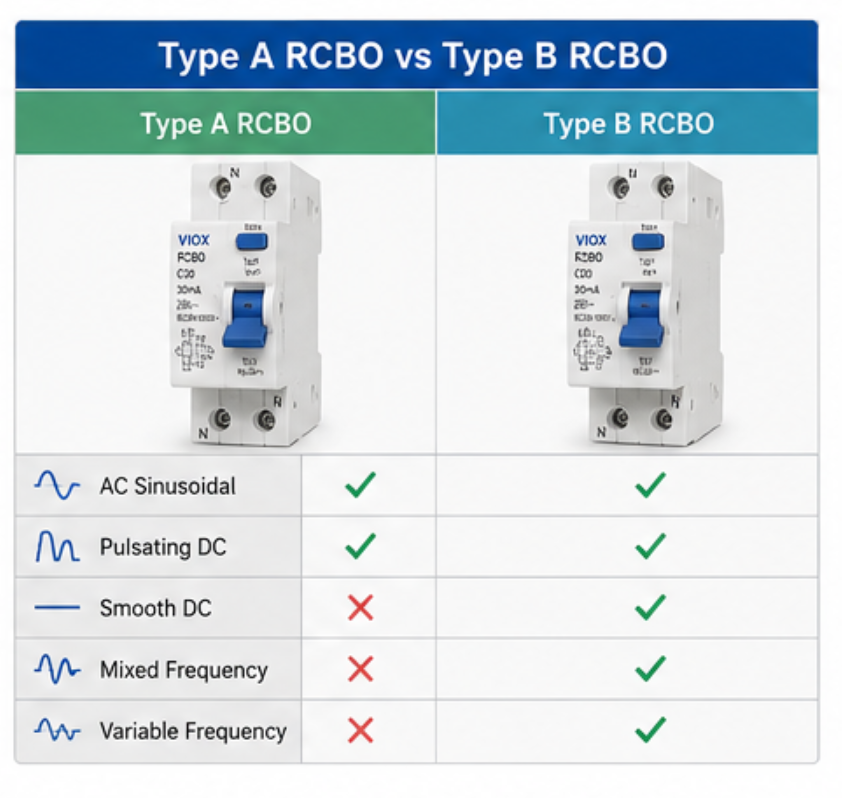
| Merkmal | Typ A RCBO | Typ B RCBO |
|---|---|---|
| AC-Fehlerstrom-Erkennung | Ja | Ja |
| Erkennung von pulsierendem DC | Ja | Ja |
| Glatte DC-Erkennung | Nein | Ja |
| Mixed-Frequency Residual Currents | Verify waveform and device specification | Covered only within the device’s specified frequency range |
| EV-Ladegeräte-Anwendungen | Possible with verified DC protection where permitted | Use when required by the charger manual or applicable rules |
| PV-Solaranlagen | Verify inverter manual and DC monitoring | Use when required by the inverter manual or applicable rules |
| Industrielle Antriebe | Begrenzt | Verify equipment manual and applicable rules |
| Kosten | Unter | Höher |
The key difference is residual-current waveform coverage. Type A detects sinusoidal AC and pulsating DC residual currents, while Type B additionally detects smooth DC and mixed-frequency components within the manufacturer’s specified range.
Do not treat Type B as automatically better. For EV chargers, PV inverters and variable-speed drives, follow the equipment manual and applicable rules to determine whether Type A with verified DC detection, Type F or Type B is required.
Use the tool below to organize a preliminary RCBO specification. It highlights missing parameters and unsafe combinations, but it does not replace engineering verification or local requirements.
How to use this RCBO selector: choose the known circuit and equipment conditions. The result organizes a preliminary specification and highlights information that still requires verification.
Preliminary selection only. This tool does not approve a circuit or replace the equipment manual, product datasheet, coordination study, qualified designer, or local rules.
Die Wahl des richtigen RCBO beginnt mit der Kenntnis der angeschlossenen Last.
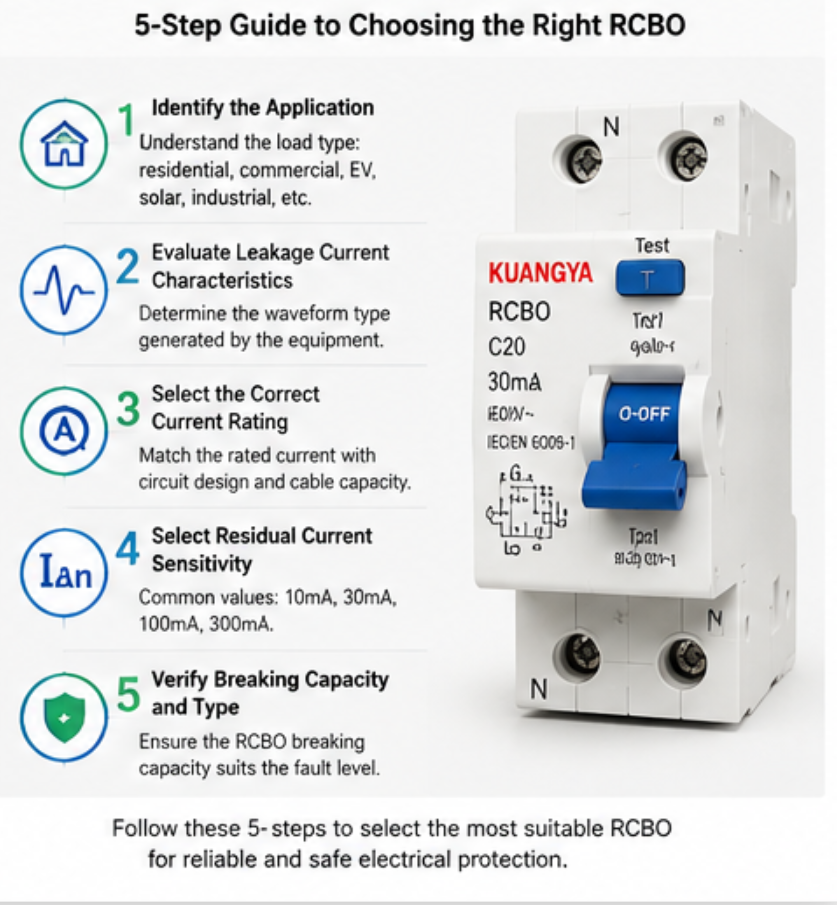
Fragen Sie:
Die Antworten werden die Auswahl des RCBO-Typs bestimmen.
Verschiedene Geräte erzeugen unterschiedliche Fehlerstromwellenformen.
| Gerätetyp | Empfohlener RCBO-Typ |
|---|---|
| Beleuchtungsstromkreise | Typ A |
| Steckdosen | Typ A |
| Haushaltsgeräte | Typ A |
| Büroausstattung | Typ A |
| EV-Ladegeräte | Follow the EVSE manual: Type A with verified DC monitoring or Type B, as required |
| Solar-Wechselrichter | Follow the inverter manual and applicable rules |
| VFD-Motorantriebe | Verify leakage waveform, frequency behavior and drive manual |
| Batteriespeichersysteme | Follow the converter/BESS manual and applicable rules |
Der Nennstrom sollte übereinstimmen:
Zu den üblichen Bewertungen gehören:
Zu den üblichen Empfindlichkeitsbewertungen gehören:
| Empfindlichkeit | Typische Anwendung |
|---|---|
| 10mA | Verbesserter persönlicher Schutz |
| 30mA | Standard-Personenschutz |
| 100mA | Schutz der Ausrüstung |
| 300mA | Brandschutzanwendungen |
30 mA sind nach wie vor die häufigste Wahl für Endstromkreise.
Der RCBO muss in der Lage sein, den verfügbaren Fehlerstrom zu unterbrechen.
Typische Bewertungen sind:
Der erforderliche Wert hängt von der Höhe der Störung an der Einbaustelle ab.
Viele Spezifikations- und Beschaffungsfehler beruhen darauf, dass die RCBO-Typen falsch verstanden werden.
Häufige Fehler sind:
Der RCBO-Typ sollte immer nach dem tatsächlichen Lastverhalten und nicht allein nach dem Preis ausgewählt werden.
| Parameter | What to confirm | Warum das wichtig ist |
|---|---|---|
| System | Single/three phase, voltage, frequency and neutral | Determines pole arrangement and operating voltage |
| Load | Electronic, motor/VFD, EVSE, PV inverter, UPS or resistive | Influences waveform type and trip curve |
| Nennstrom | Design current, cable capacity and derating | A higher ampere rating is not automatically safer |
| RCBO type | AC, A, F or B required by the equipment manual | Determines detectable residual-current waveforms |
| Empfindlichkeit | 10/30/100/300 mA as permitted | Must match protection objective and selectivity |
| Trip curve | B, C or D after inrush and loop checks | Controls magnetic response to overcurrent |
| Ausschaltvermögen | Prospective short-circuit current at installation point | Catalogue values cannot replace a fault-level calculation |
| Markt | Required standard edition and certificate scope | IEC reference does not prove approval in every country |
Stop condition: If breaking capacity, leakage characteristics, pole arrangement or local requirements are unknown, do not finalize the RCBO selection.
| Ergebnis | When to use it | Next action |
|---|---|---|
| Preliminary match | Every parameter is known and no obvious conflict exists | Compare exact datasheets and certificates; obtain engineering approval |
| Benötigt Überprüfung | Breaking capacity, waveform, curve, poles or certification is unknown | Collect the missing data before ordering |
| Noch nicht auswählen | Phase/poles conflict, EV/PV uses unverified Type AC, or the equipment manual contradicts the choice | Stop and review the circuit and equipment requirements |
System phase and voltage:
Load or equipment:
Rated current:
Poles and neutral requirement:
Residual-current type (AC/A/F/B):
Sensitivity (mA):
Trip curve (B/C/D):
Required breaking capacity (kA):
Frequency:
Target market and certification:
Quantity and purchase stage:
OEM/ODM requirement:
Required delivery date:
Also compare RCCB product families and read the RCCB vs RCBO guide. Final selection must use the exact product documentation and applicable local rules.
Bei der Wahl des richtigen Fehlerstromschutzschalters geht es nicht nur um die Wahl des richtigen Nennstroms. Der Fehlerstrom-Typ ist ein entscheidender Faktor, der sich direkt auf die Schutzleistung auswirkt.
Für die meisten privaten und gewerblichen Stromkreise bietet ein FI-Schutzschalter vom Typ A einen wirksamen Schutz gegen Wechsel- und pulsierende Gleichfehlerströme.
For EV chargers, solar installations, battery storage systems and inverter-driven equipment, follow the exact equipment manual. Some designs allow Type A with verified DC monitoring; others require Type F or Type B.
Das Verständnis des Unterschieds zwischen RCBO Typ A und RCBO Typ B trägt dazu bei, die Einhaltung von Vorschriften zu gewährleisten, die Sicherheit zu verbessern und einen zuverlässigen Schutz für moderne elektrische Systeme zu bieten.
RCBO (Fehlerstromschutzschalter mit Überstrom) | Sicher & Zuverlässig Kuangya
IEC 61009-1:2024 gives general requirements and tests for RCBOs for household and similar uses within its stated scope. Always verify the applicable national adoption, installation rules, equipment manual and certificate scope of the exact product model.
Type A is common for many residential and commercial electronic circuits. EV, PV, storage and variable-frequency applications require verification against the equipment manual and local rules; do not assume one residual-current type fits every design.
RCBO des Typs A kann pulsierende Gleichfehlerströme erkennen, aber keine gleichmäßigen Gleichfehlerströme zuverlässig erkennen.
Der RCBO des Typs B verfügt über eine fortschrittlichere Sensortechnologie, mit der ein breiteres Spektrum von Fehlerstromwellenformen, einschließlich glatter Gleichstromfehler, erkannt werden kann.
Viele EV-Ladeanwendungen erfordern entweder einen Schutz des Typs B oder gleichwertige Maßnahmen zur Erkennung von Gleichstromfehlern, je nach den örtlichen Normen und der Konstruktion des Ladegeräts.
Do not treat Type B as a universal upgrade. The selected type must match the residual-current waveform, equipment instructions, coordination requirements and certification scope of the exact device.

