منطقة ونغ يانغ الصناعية يويتشينغ ونتشو 325000
ساعات العمل
من الاثنين إلى الجمعة: 7 صباحاً - 7 مساءً
عطلة نهاية الأسبوع 10 صباحاً - 5 مساءً
منطقة ونغ يانغ الصناعية يويتشينغ ونتشو 325000
ساعات العمل
من الاثنين إلى الجمعة: 7 صباحاً - 7 مساءً
عطلة نهاية الأسبوع 10 صباحاً - 5 مساءً

What does a blown-fuse indicator on a PV fuse holder really mean? Learn why a dark lamp is not a continuity test and how to check the circuit safely.
إجابة سريعة: On a fuse holder specifically designed with a blown-fuse indicator, an illuminated indicator can identify an open fuse link. It does not establish why the fuse opened, prove the remaining strings are safe, or replace electrical testing. Indicator behavior varies by model and by the voltage available across the open fuse. Check the exact holder instructions before interpreting a dark lamp.
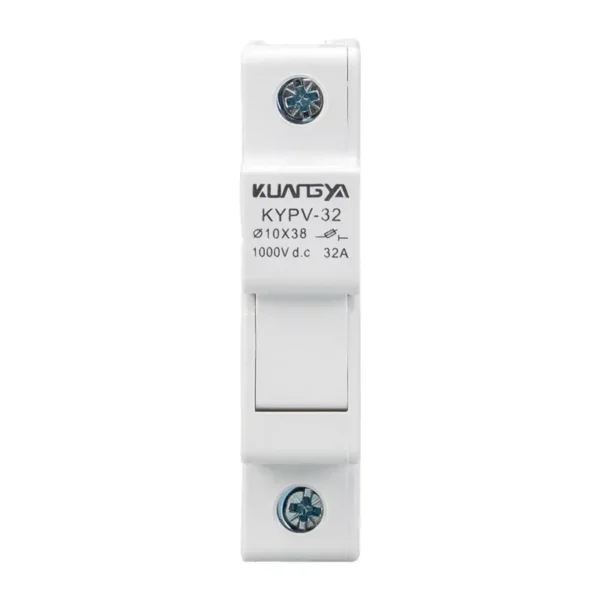
Several string fuses may sit side by side. A visual indicator can help maintenance personnel locate a suspect circuit, but replacing the link without investigating the cause risks another failure. A gPV fuse protects against specified fault conditions; the indicator is a diagnostic aid, not a protective device.
Mersen describes a PV fuse-holder option whose indicator light turns on when the fuse is open. Its published HP6M/HP10M brochure specifies an operating voltage range of 220–1000 V DC for that indicator option. That range belongs to those Mersen products; it must not be copied to another holder. KUANGYA lists optional indicator versions for its KYPV-32 10×38 holder و 14×51 PV fuse holder. Ask for the exact variant’s indication method and operating range before specifying it.
The holder may be a non-indicating variant, the indicator may need a minimum circuit voltage, or the PV string may have insufficient voltage under the current conditions. A damaged lamp or wiring fault is another possibility. Therefore, a dark indicator alone is not a continuity test. Compare the circuit against its wiring diagram and approved test procedure.
Never open a loaded DC fuse holder or bridge a fuse to keep the system running. For recurrent operation, see the PV string fuse troubleshooting guide و fuse-holder overheating guide.
Provide the system’s maximum DC voltage, expected voltage across an open fuse, fuse-link size and gPV rating, operating current, enclosure temperature, terminal and conductor details, and whether local indication or a remote alarm is needed. Confirm that the holder and fuse link are an approved pairing. The indicator must suit the actual installation; an optional lamp does not change the fuse’s protective rating.
First confirm the model-specific meaning of the light and investigate why the fuse opened. Replacement alone may leave the underlying fault in place.
No. The circuit may lack the voltage needed to operate that indicator, or the holder may not include one. Use the prescribed electrical checks.
No. It can help identify an open-fuse position. It cannot distinguish a wiring fault from reverse current, component damage or another cause.

