منطقة ونغ يانغ الصناعية يويتشينغ ونتشو 325000
ساعات العمل
من الاثنين إلى الجمعة: 7 صباحاً - 7 مساءً
عطلة نهاية الأسبوع 10 صباحاً - 5 مساءً
منطقة ونغ يانغ الصناعية يويتشينغ ونتشو 325000
ساعات العمل
من الاثنين إلى الجمعة: 7 صباحاً - 7 مساءً
عطلة نهاية الأسبوع 10 صباحاً - 5 مساءً



Spain does not have a simple rule stating that every circuit protected by an RCD must use Type A. The correct device depends on the residual-current waveform that can be produced by the connected equipment, the installation’s earthing and protection design, the manufacturer’s instructions, and the Spanish low-voltage rules that apply to the project.
إجابة سريعة: Spain’s REBT requires suitable protection against electric shock and recognises the use of residual-current devices. The Ministry’s ITC-BT-24 application guide explains Type AC, A, F and B characteristics. Type A is a common choice for modern single-phase electronic loads because it detects sinusoidal AC and specified pulsating DC residual currents, but Type F or Type B may be required for other waveforms. Type AC remains a defined category; its suitability must be assessed rather than assumed.
| المستند | Role in an installation | Why it matters for RCD selection |
|---|---|---|
| REBT — Royal Decree 842/2002 | Spain’s low-voltage regulatory framework | Sets protection principles and technical instructions for low-voltage installations |
| ITC-BT-24 | Protection against direct and indirect contact | Defines protection measures and requirements for automatic disconnection |
| Ministry Guide BT-24 | Non-binding application guidance for ITC-BT-24 | Explains RCD types and typical residual-current waveforms |
| UNE-HD 60364-5-53 | Selection and installation of switchgear | Provides current technical guidance for choosing protective devices |
| UNE-EN 61008 series | RCCBs without integral overcurrent protection | Product requirements for household and similar RCCBs |
| UNE-EN 61009 series | RCBOs with integral overcurrent protection | Product requirements for household and similar RCBOs |
The consolidated REBT text published by Spain’s BOE is the primary legal reference. The Ministry’s BT-24 guide helps designers interpret device characteristics, but the guide itself states that it is not binding. Project specifications and autonomous-community procedures may add practical documentation requirements.
There is no support in the general REBT text for the blanket statement that “all circuits requiring RCD protection must use Type A.” The correct conclusion is narrower: an RCD must be suitable for the expected residual-current waveform and the relevant installation requirements. As electronic loads become more common, Type A is often selected because its waveform capability extends beyond Type AC.
| Statement | Accurate interpretation |
|---|---|
| “Type A is mandatory everywhere in Spain” | Too broad. Check the circuit, connected equipment, REBT/ITC requirements and applicable UNE standards. |
| “Type AC is illegal in Spain” | Too broad. Type AC is described in official technical guidance, but it may be unsuitable for many modern electronic loads. |
| “Type A protects every inverter or charger” | Incorrect. Type F or Type B, or Type A/F with a compliant DC-detection arrangement, may be needed. |
| “30 mA is required for every possible RCD function” | Incorrect. 30 mA is widely used for additional protection where required; upstream fault or fire-protection designs can use other values. |
| RCD type | Residual-current capability in simplified terms | Typical selection question |
|---|---|---|
| نوع التكييف | Sinusoidal AC residual current | Does the load produce only the waveform Type AC is designed to detect, and is its use permitted? |
| النوع أ | Type AC waveforms plus specified pulsating DC residual currents | Does the circuit contain common single-phase rectifier or electronic loads? |
| النوع F | Type A capabilities plus specified composite-frequency waveforms for certain single-phase converters | Does the equipment use a single-phase variable-frequency drive or similar converter? |
| النوع ب | Type F capabilities plus specified smooth DC and additional residual-current waveforms | Can the equipment produce smooth DC, multi-phase rectified or broader-frequency residual currents? |
Type A is sometimes described as detecting “up to 6 mA DC.” That wording can be misleading. The official guide describes Type A operation for specified waveforms with a superimposed smooth DC component up to 0.006 A. This is not the same as saying that a Type A RCD is a general-purpose smooth DC protective device.
List appliances, power supplies, dimmers, heat pumps, variable-speed motors, EV chargers, PV inverters and battery systems. Use the equipment manufacturer’s specified RCD type when provided.
The circuit topology matters more than the marketing category of the appliance. A rectifier, inverter or frequency converter can produce waveforms that require Type A, F or B characteristics.
Choose the rated residual operating current for the required protection function and disconnection time. A 30 mA device is widely used for additional protection where required, while other sensitivities can be used for suitable upstream, fault or fire-protection functions. Follow the applicable ITC and project design.
أن RCCB provides residual-current protection and normally needs coordinated overload and short-circuit protection. An RCBO combines residual-current and overcurrent protection for one circuit.
If RCDs are installed in series, the REBT requires selectivity between them. Check sensitivity grading, time delay, manufacturer coordination data and the required disconnection times. Circuit subdivision or individual RCBOs can reduce unnecessary loss of supply.
| التطبيق | Useful starting point | Critical check |
|---|---|---|
| General socket and appliance circuits | Type A is commonly considered for modern electronic loads | National and project requirements, load waveform and 30 mA protection |
| LED lighting and electronic drivers | Type A may be appropriate | Normal leakage, inrush, driver topology and unwanted tripping |
| Heat pump or variable-speed appliance | Type A or Type F depending on equipment | Manufacturer instruction and converter waveform |
| Mode 3 EV charging | Type B or Type A/F with suitable 6 mA RDC-DD where permitted | IEC 62955 DC detection, EVSE manual and ITC-BT-52 |
| العاكس الكهروضوئي | No universal RCD type | Inverter topology, internal monitoring and manufacturer specification |
| Battery storage or industrial converter | Type B may be required | Smooth DC and multi-frequency residual currents |
| Circuits needing high continuity | Correct type plus coordinated subdivision | Do not use immunity features to conceal a real insulation fault |
Terms such as SI, super-immunised or high-immunity are often manufacturer-specific designations. They generally describe improved resistance to unwanted tripping from transients or high-frequency disturbances, but the exact performance must be read from the manufacturer’s documentation. They do not automatically add Type B smooth-DC detection.
A Type S RCD is a selective or time-delayed device used in suitable upstream arrangements. “SI” and “S” should not be treated as interchangeable. The device still needs the correct residual-current type—AC, A, F or B—and must comply with required disconnection times.
AENOR certification can be requested by a client or tender, but it should not be described as universally mandatory for every RCD sold in Spain. The exact conformity route and documentation should be checked for the product and project.
The general REBT does not establish a simple universal ban. Official BT-24 guidance describes Type AC as a recognised type, but it may be unsuitable for circuits that can produce pulsating DC or other residual-current waveforms.
Do not assume a blanket mandate. Type A is often selected for modern electronic loads, but the correct device follows the circuit, equipment instructions and applicable REBT/UNE requirements.
Type AC responds to sinusoidal AC residual currents. Type A also responds to specified pulsating DC residual currents and conditions defined by its standard.
It may be used in an approved arrangement when the EVSE includes suitable 6 mA DC residual-current detection and the equipment instructions and ITC-BT-52 requirements are satisfied. Otherwise Type B may be required.
No universal answer applies. Follow the inverter manufacturer’s instructions because topology and internal residual-current monitoring differ.
63 A is the rated current In. 30 mA is the rated residual operating current IΔn. They describe separate characteristics.
No. Improved immunity to unwanted tripping does not by itself provide the smooth-DC detection characteristics of Type B.
A competent designer or authorised installer should apply the current REBT, relevant ITCs, UNE standards, equipment instructions and any regional or project requirements.
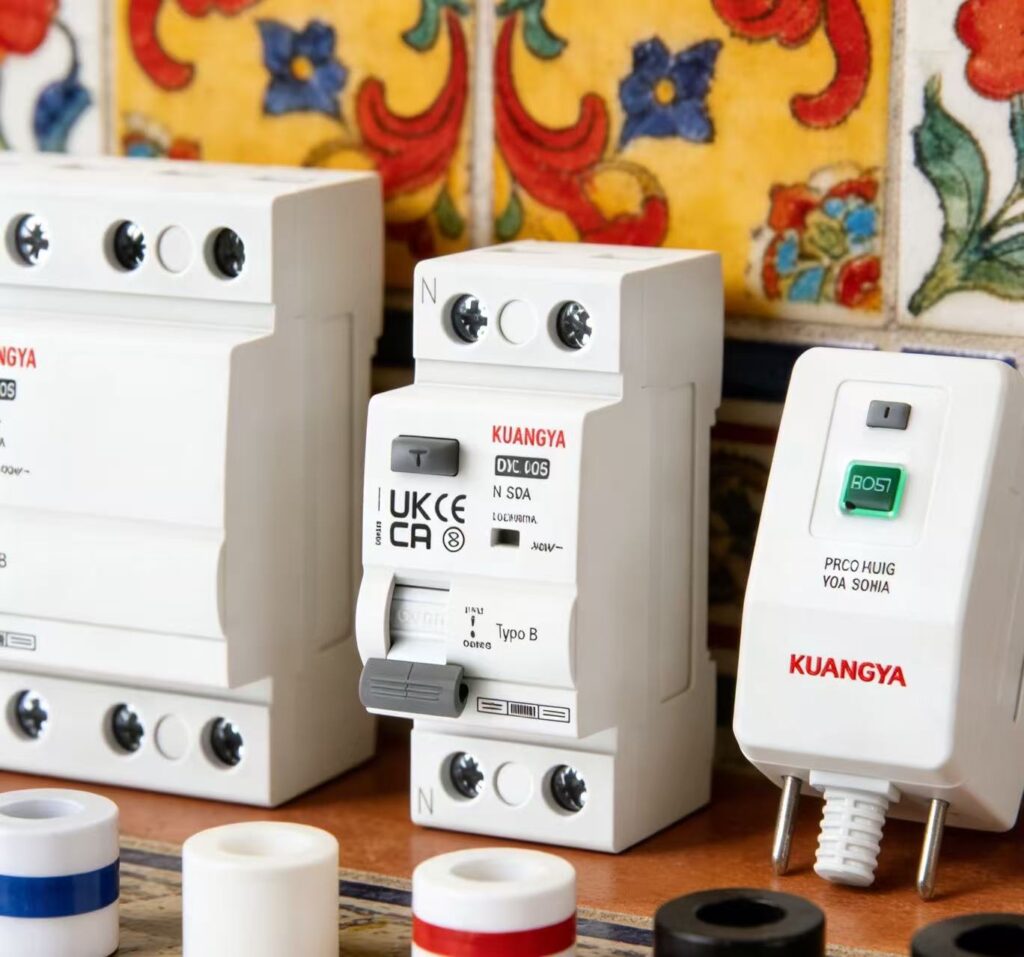
KUANGYA supplies Type A and other residual-current device options for residential, commercial and OEM projects. Product selection should start with the required waveform type, poles, In, IΔn, overcurrent arrangement and documentation—not with a general claim that one RCD type fits every circuit.
| المتطلبات | Information to send for selection |
|---|---|
| دائرة كهربائية | Single-phase or three-phase, voltage, frequency and earthing arrangement |
| Load | Equipment type and manufacturer RCD requirement |
| RCD function | RCCB or RCBO, additional protection, fault protection or upstream coordination |
| Ratings | Poles, In, IΔn and RCBO curve/breaking capacity where applicable |
| الامتثال | Required EU declaration, certificate, tender and language documents |
| تجاري | Quantity, destination, delivery date, Incoterm and OEM packaging |

For model-specific selection, certification documents and quotations, review the RCCB product range أو اتصل بـ KUANGYA. Always confirm the final installation design with a qualified professional familiar with the current Spanish rules.

