منطقة ونغ يانغ الصناعية يويتشينغ ونتشو 325000
ساعات العمل
من الاثنين إلى الجمعة: 7 صباحاً - 7 مساءً
عطلة نهاية الأسبوع 10 صباحاً - 5 مساءً
منطقة ونغ يانغ الصناعية يويتشينغ ونتشو 325000
ساعات العمل
من الاثنين إلى الجمعة: 7 صباحاً - 7 مساءً
عطلة نهاية الأسبوع 10 صباحاً - 5 مساءً

آخر تحديث: يوليو 2026
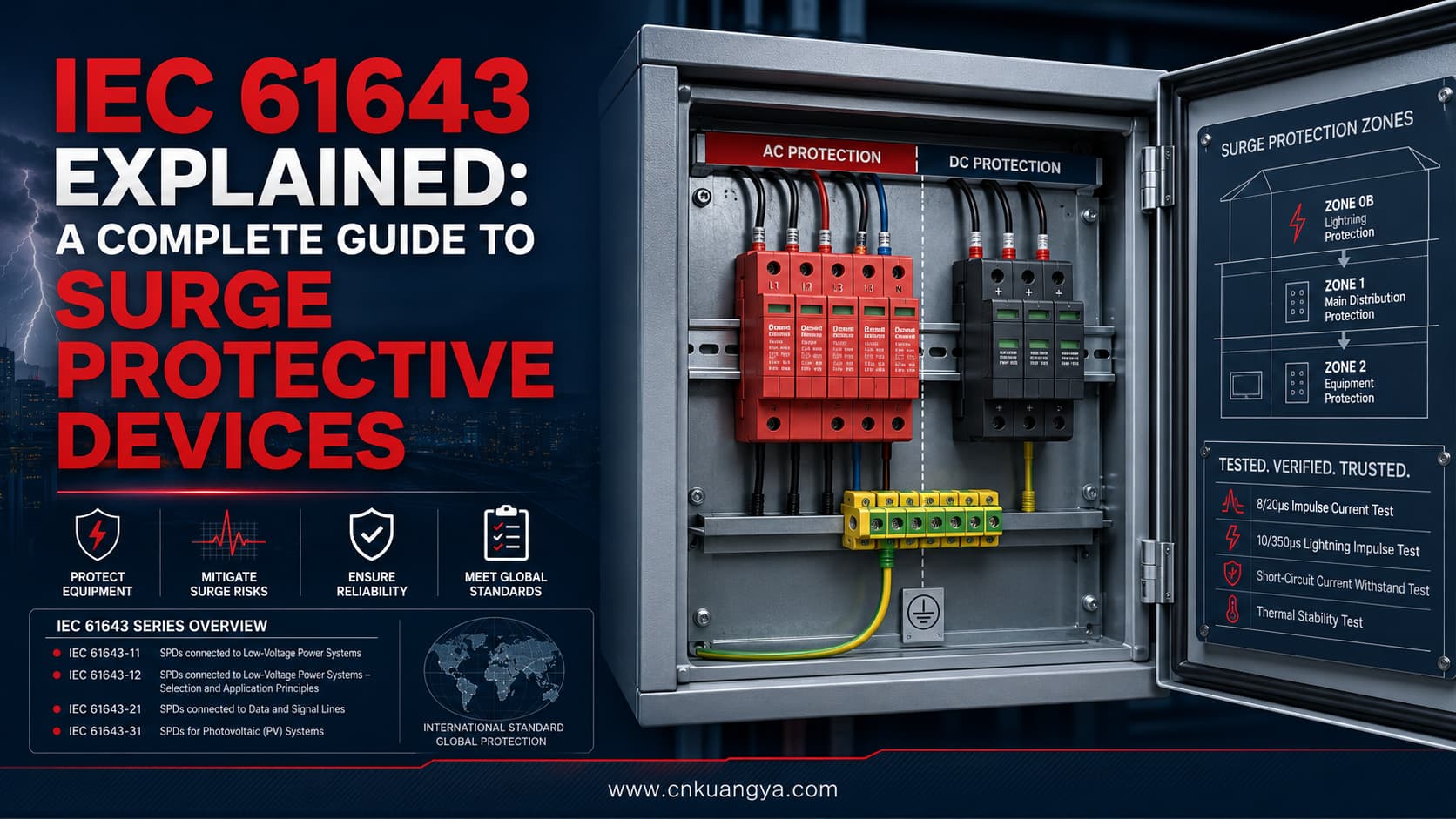
IEC 61643 is one of the most important international standard families for Surge Protective Devices, also known as SPDs.
For engineers, EPC contractors, solar installers, EV charging station manufacturers, telecom cabinet designers, and industrial electrical teams, IEC 61643 helps answer one key question:
How should surge protective devices be tested, selected, installed, and coordinated for low-voltage electrical systems?
بعبارات بسيطة:
For modern electrical infrastructure, IEC 61643 is especially important in:
A properly selected SPD can help reduce lightning surge damage, switching transient damage, control board failure, inverter failure, charger downtime, and communication equipment failure.
IEC 61643 is a family of international standards for low-voltage surge protective devices.
A Surge Protective Device, or SPD, is used to protect electrical and electronic equipment against transient overvoltages. These transient overvoltages may come from lightning activity, grid switching, transformer switching, inductive loads, fault events, or other electrical disturbances.
IEC 61643-01 contains common requirements for SPDs and applies to surge protective devices connected to circuits or equipment rated up to 1,000 V AC RMS or 1,500 V DC. It also specifies performance and safety requirements, tests, and ratings for SPDs.
This is why IEC 61643 is highly relevant to modern electrical protection projects. Many electrical systems today include sensitive components such as:
These devices are more sensitive to transient voltage than traditional electrical loads. A short surge event may not destroy a cable, but it can damage a control board, communication module, inverter, charger module, sensor, or monitoring device.
IEC 61643 helps engineers and project teams evaluate SPDs in a more standardized way.
It does not mean every project uses the same SPD. Instead, it helps define how SPDs should be classified, tested, and selected according to the system and risk level.
Electrical systems are exposed to transient overvoltages in many situations.
The most common sources include:
| Surge Source | السبب النموذجي | النتائج المحتملة |
|---|---|---|
| Lightning | Direct or nearby lightning strikes | Equipment breakdown, insulation stress, control board failure |
| Grid switching | Utility switching, capacitor bank switching | Transient overvoltage entering distribution system |
| Transformer switching | Energization or de-energization | Voltage spikes and electromagnetic disturbance |
| Motor loads | Large inductive loads switching on or off | Transient voltage in local electrical network |
| Long cable runs | Outdoor cabling, rooftop PV arrays, remote cabinets | Induced surge voltage |
| Poor grounding | High impedance grounding path | Increased overvoltage stress |
| Internal faults | Electrical fault or insulation failure | Secondary transient disturbance |
A surge may last only microseconds, but the energy can be high enough to damage electronics.
In solar PV systems, surges can enter through PV strings, inverter AC terminals, communication lines, or grounding paths.
In EV charging stations, surges can enter through utility input, charger cabinets, long cable routes, communication networks, or outdoor installations.
In telecom cabinets, surges can enter through power lines, antenna systems, signal cables, or grounding systems.
In data centers, even a short transient can affect UPS systems, distribution panels, monitoring systems, and network equipment.
That is why IEC 61643 is not only a standard for component manufacturers. It is also a practical reference for system designers.
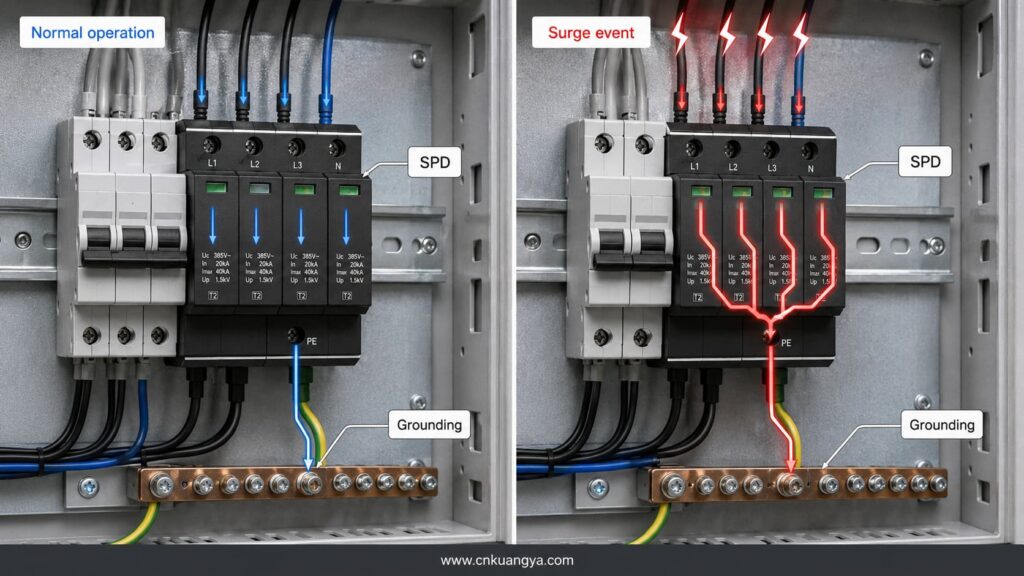
An SPD is designed to limit transient overvoltage and divert surge current away from protected equipment.
In normal operation, the SPD remains in a high-impedance state. It does not carry significant current.
When a transient overvoltage occurs, the SPD changes state and provides a lower-impedance path. This allows surge current to be diverted toward the grounding system or protective path, reducing the voltage stress on downstream equipment.
After the surge event, a properly functioning SPD returns to its normal state.
IEC descriptions of several SPD standards emphasize that SPDs contain at least one nonlinear component and are intended to limit surge voltages and divert surge currents. For example, IEC 61643-31 applies this principle to SPDs for photovoltaic installations, while IEC 61643-41 applies it to SPDs for DC power circuits.
Common SPD technologies include:
Each technology has different characteristics. In real applications, SPD design may combine different components to balance response time, discharge capacity, leakage current, and protection level.
An SPD should not be treated like a normal switch or circuit breaker. It does not interrupt load current in the same way as a breaker. It does not replace fuse protection. It does not solve overload problems.
Its job is specific:
Limit transient voltage and divert surge current.
For a deeper technical explanation, this مبدأ عمل جهاز الحماية من التيار المستمر (DC SPD) guide explains how a DC surge protective device detects a voltage surge and diverts excess energy away from sensitive equipment.
For complete electrical protection, SPD should work together with:
IEC 61643 is not only one document. It is a standard family covering different SPD applications.
Important parts include:
| IEC Standard | التطبيق الرئيسي | ما أهمية ذلك |
|---|---|---|
| IEC 61643-01 | General SPD requirements | Common requirements for SPDs |
| IEC 61643-11 | AC low-voltage power system SPDs | Commonly used for AC power distribution |
| IEC 61643-12 | Selection and application principles for AC SPDs | Helps with SPD location and coordination |
| IEC 61643-21 | Telecom and signalling network SPDs | Important for signal and communication lines |
| IEC 61643-22 | Selection and application of telecom and signalling SPDs | Helps protect communication systems |
| IEC 61643-31 | SPDs for photovoltaic installations | Important for PV DC-side surge protection |
| IEC 61643-32 | Selection and coordination of PV SPDs | Important for PV system design |
| IEC 61643-41 | SPDs for DC power circuits | Important for DC electrical systems up to 1,500 V DC |
Not every project needs every part of IEC 61643.
على سبيل المثال:
The key is to match the correct IEC 61643 part to the real electrical system.
IEC 61643-01:2024 is important because it provides common requirements for SPDs.
According to the IEC official description, IEC 61643-01:2024 applies to devices for surge protection against indirect and direct effects of lightning or other transient overvoltages. It applies to SPDs intended to be connected to circuits or equipment rated up to 1,000 V AC RMS or 1,500 V DC, and it specifies performance and safety requirements, tests, and ratings.
For engineers and procurement teams, this means IEC 61643-01 should be understood as a base document.
It helps create a common framework for SPD evaluation, including:
This is important because different industries use different SPD applications.
A PV DC SPD, an AC distribution SPD, a data line SPD, and a DC power circuit SPD may not be the same product, but they all belong to the broader surge protection logic.
When a supplier says an SPD complies with IEC 61643, engineers should ask:
A professional SPD selection process should not stop at the words “IEC 61643 compliant.”
It should verify the correct part, rating, and application.
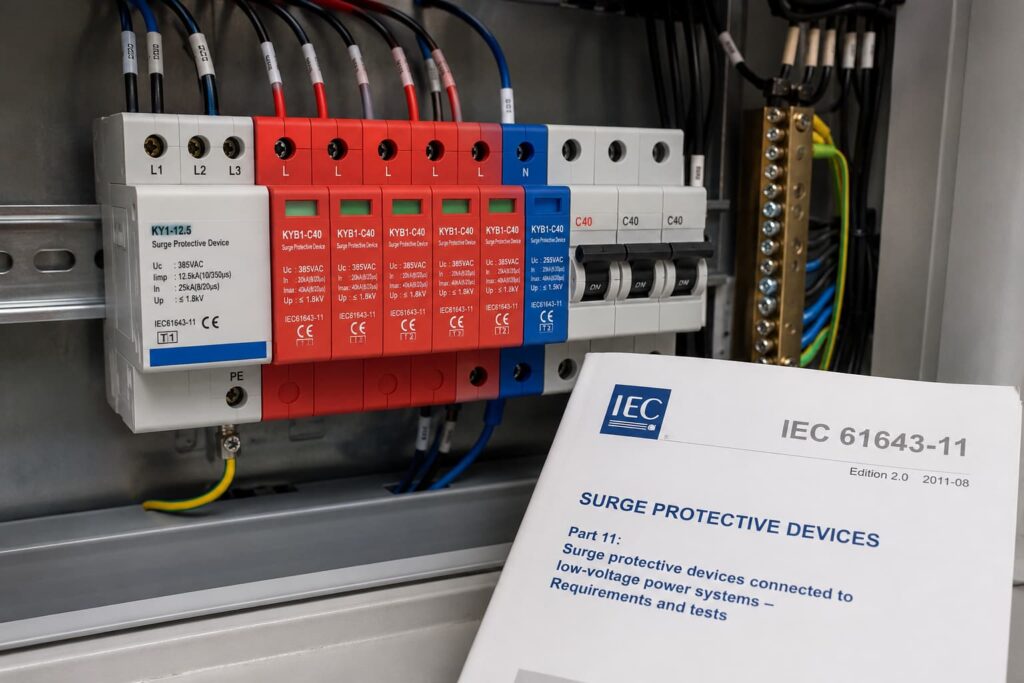
IEC 61643-11 is one of the most commonly referenced standards for AC surge protective devices used in low-voltage AC power systems.
The IEC official page states that IEC 61643-11:2025 applies to devices for surge protection against indirect and direct effects of lightning or other transient overvoltages.
The earlier IEC 61643-11:2011 version applied to SPDs packaged to be connected to 50/60 Hz AC power circuits and equipment rated up to 1,000 V RMS. It also stated that such devices contain at least one nonlinear component and are intended to limit surge voltages and divert surge currents.
For practical engineering, IEC 61643-11 is relevant to:
AC SPDs are often installed at:
When selecting an AC SPD, engineers should check:
| المعلمة | ما أهمية ذلك |
|---|---|
| الجهد الاسمي | Must match system voltage |
| أقصى جهد تشغيل مستمر | Must tolerate normal voltage conditions |
| SPD type | Type 1, Type 2, or Type 3 according to installation and risk |
| تيار التفريغ الاسمي | Shows repeated surge handling ability |
| أقصى تيار تفريغ | Shows high surge capacity |
| مستوى حماية الجهد | Lower value means better downstream protection, if properly selected |
| نظام التأريض | TN, TT, IT systems require different protection design |
| تصنيف تيار الدائرة القصيرة | Must match installation conditions |
| Backup protection | Fuse or breaker coordination may be required |
| تلامس إشارة عن بعد | Useful for monitoring in critical systems |
| Visual indicator | Helps maintenance teams identify end-of-life status |
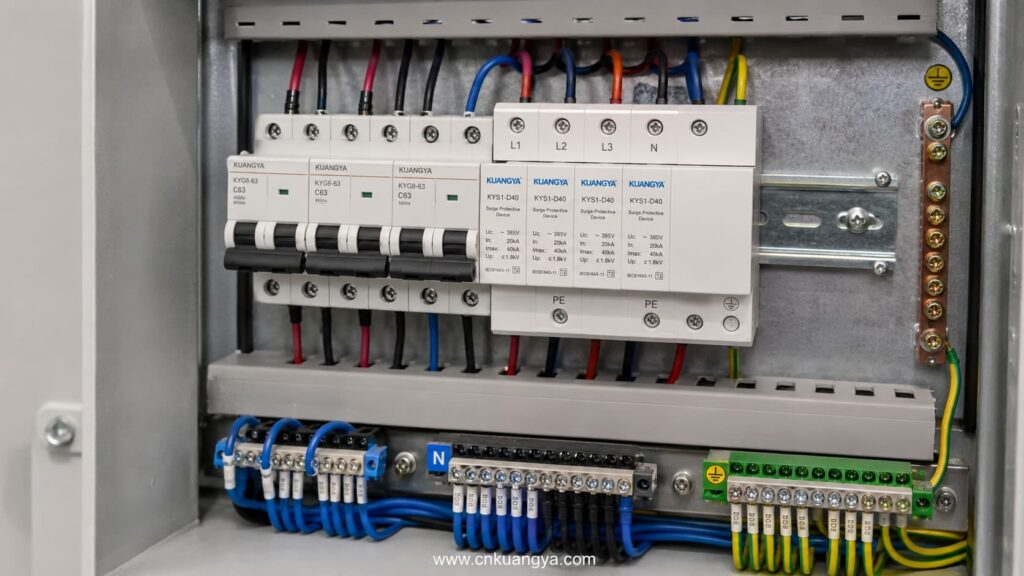
For commercial distribution panels, industrial facilities, EV charger input cabinets, and data center power systems, an AC surge protective device is commonly used to reduce grid-side overvoltage and switching surge damage.
AC SPDs are especially important in outdoor cabinets, EV charging stations, industrial equipment, and energy infrastructure because these systems often face grid disturbance and environmental exposure.
Solar PV systems require special attention because PV arrays are usually installed outdoors and connected through long DC cable runs.
IEC 61643-31 applies to surge protective devices connected to the DC side of photovoltaic installations rated up to 1,500 V DC. These devices are designed for connection to the DC side of photovoltaic installations rated up to 1,500 V DC.
IEC 61643-32:2017 describes principles for selection, installation, and coordination of SPDs used in PV systems up to 1,500 V DC and for the AC side of PV systems rated up to 1,000 V RMS.
This is very important for solar PV protection.
A PV system may experience surges from:
PV surge protection should usually consider both DC and AC sides:
| PV System Area | Protection Consideration |
|---|---|
| PV string side | DC SPD near combiner box or inverter input |
| صندوق التجميع | DC SPD, fuse, isolation |
| مدخلات التيار المستمر العاكس | DC SPD coordination |
| خرج التيار المتردد العاكس | AC SPD |
| Monitoring system | Signal line surge protection where needed |
| Grounding system | Proper bonding and low impedance path |
In many PV projects, a صندوق التجميع الكهروضوئي integrates DC SPD, gPV fuse protection, grounding, and DC isolation before the inverter.
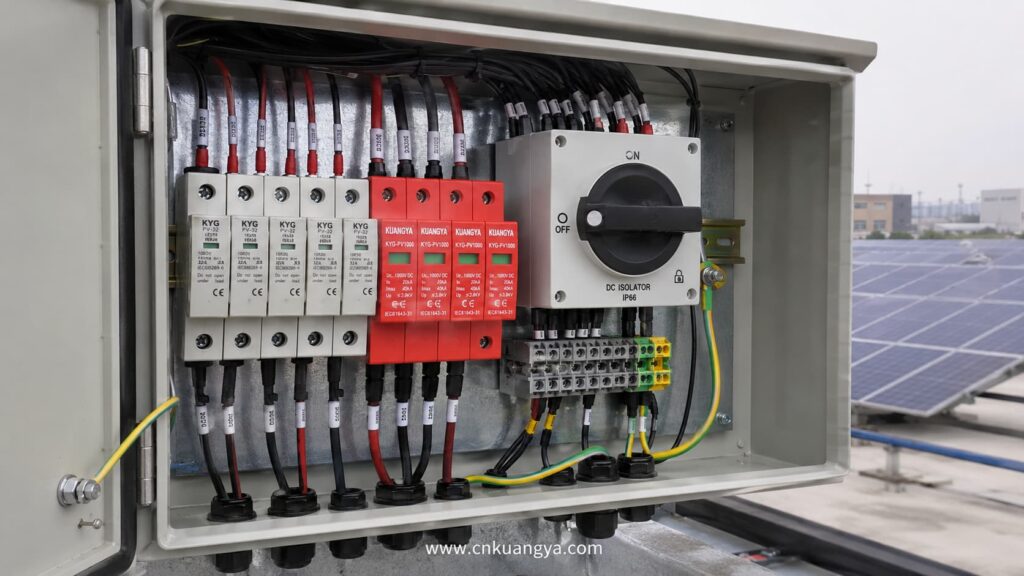
A DC SPD for PV systems is not the same as a general AC SPD.
For PV arrays, combiner boxes, and energy storage DC circuits, a properly selected جهاز حماية من زيادة التيار المستمر (DC SPD) helps reduce lightning-induced transient overvoltage risk.
PV systems may operate at high DC voltages such as 1,000 V DC or 1,500 V DC. DC circuits also have different arc behavior compared with AC circuits.
Because of this, engineers should use SPDs designed and tested for PV DC applications, not simply use an AC SPD in a DC PV circuit.
For KUANGYA’s target customers, this topic is especially important because solar PV systems, inverters, combiner boxes, BESS, and EV charging infrastructure often share similar protection logic.
A strong PV SPD article can support many internal links across the website.
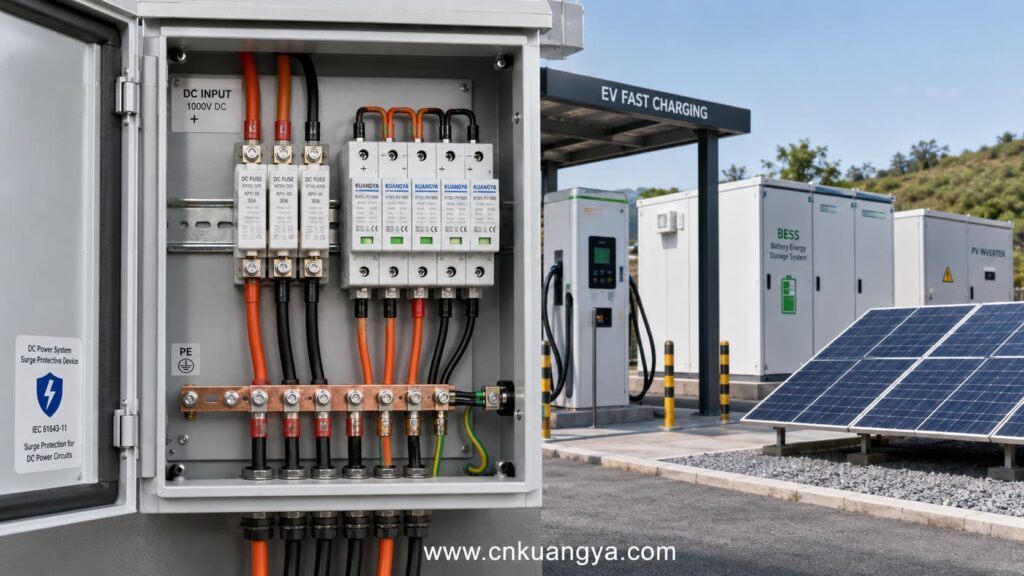
As DC systems become more common, DC surge protection is becoming more important.
IEC 61643-41 applies to surge protective devices connected to DC power circuits and equipment rated up to 1,500 V DC. These devices are intended to be connected to DC power circuits and equipment rated up to 1,500 V DC. The standard specifies performance and safety requirements, tests, and ratings.
This is highly relevant to modern applications such as:
DC power systems are becoming more common because many modern energy systems are based on DC conversion and storage.
على سبيل المثال:
For these systems, surge protection design must consider:
DC SPD selection is especially important because using the wrong SPD can create safety and reliability problems.
A DC circuit should be protected with products designed for DC applications.
Modern electrical systems are not only power circuits.
They also include:
IEC 61643-21 applies to surge protective devices connected to telecommunications and signalling networks, including networks that may also provide power on the same line such as PoE. The IEC description states that these devices are intended to be connected to telecommunications and signalling networks and equipment rated up to 1,000 V RMS and 1,500 V DC. It also notes that these networks can provide power on the same line, such as Power over Ethernet.
IEC 61643-22:2015 describes principles for selection, operation, location, and coordination of SPDs connected to telecommunication and signalling networks with nominal system voltages up to 1,000 V RMS AC and 1,500 V DC. It also covers multiservice SPDs that include protection for signalling lines and power lines in the same enclosure.
This matters because a surge can damage a system through the communication side even when the power side is protected.
على سبيل المثال:
Therefore, complete surge protection should review both power lines and signal lines.
SPD selection requires more than choosing a voltage and price.
Engineers should understand the following parameters.
Maximum continuous operating voltage is the voltage the SPD can continuously withstand without operating incorrectly.
If the value is too low, the SPD may age quickly or fail under normal operating conditions.
If the value is too high, the voltage protection level may not be suitable for sensitive equipment.
Voltage protection level indicates the residual voltage that remains during surge discharge under test conditions.
A lower protection level can help protect downstream equipment, but it must be selected together with the system voltage, SPD type, and installation conditions.
Long cable length and poor installation may increase the actual voltage seen by protected equipment.
Nominal discharge current represents the surge current level the SPD can handle under specified test conditions.
It is important for repeated surge exposure.
Maximum discharge current indicates a higher surge current capability.
This parameter is often highlighted in product marketing, but engineers should not select an SPD only by the biggest number. The correct value depends on site risk, installation level, and coordination.
Impulse current is especially relevant for Type 1 SPDs, which are used where lightning current may be expected.
This is important in installations with external lightning protection systems or high lightning exposure.
SPD type indicates where and how the SPD is usually applied.
Common classifications include:
Each type has different test conditions and application purposes.
The SPD must be suitable for the available short-circuit current at the installation point.
If the short-circuit capability is not suitable, failure conditions may become unsafe.
Some SPD installations require upstream fuse or circuit breaker protection.
The backup protection must be coordinated with the SPD according to manufacturer requirements.
A visual indicator helps maintenance teams identify whether an SPD module is still functional or has reached end of life.
A remote signal contact is useful in critical systems such as:
It allows the SPD status to be monitored remotely.
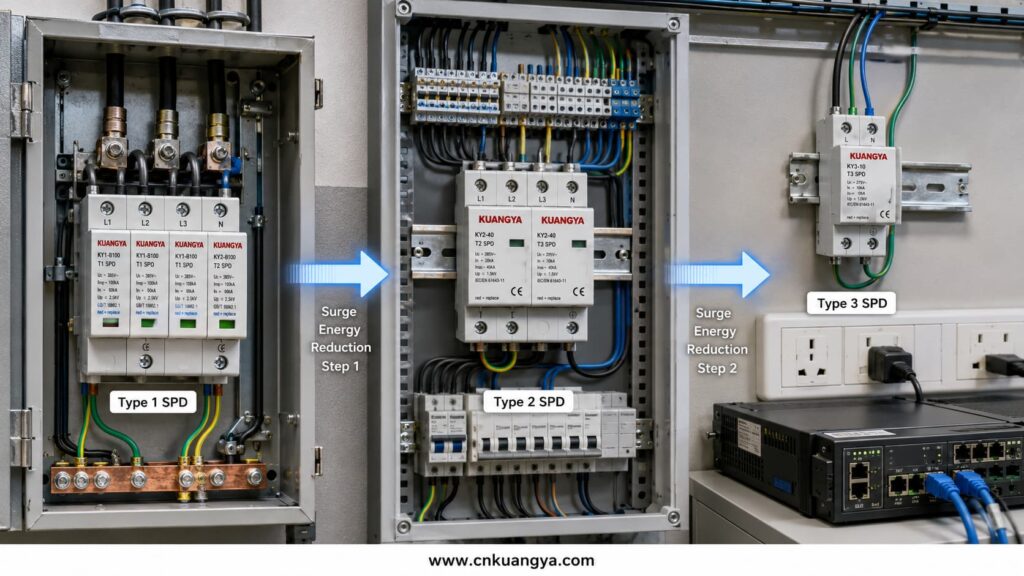
SPD type is one of the most important concepts in IEC 61643-related discussions.
Type 1 SPDs are designed to handle high-energy lightning current components.
They are usually installed near the service entrance or main distribution board where lightning current may enter the electrical system.
Typical use cases:
Type 1 SPD is not automatically required for every installation. It depends on lightning risk, building design, local electrical rules, and project requirements.
Type 2 SPDs are widely used in low-voltage distribution systems to protect against switching surges and induced lightning surges.
They are often installed in:
For many solar PV and industrial applications, Type 2 SPD is the most commonly used protection level.
Type 3 SPDs are usually installed close to sensitive equipment.
They provide local protection, often after upstream Type 1 or Type 2 protection.
Typical use cases:
Type 3 SPDs should not be used as the only protection layer in high-risk installations.
Type 1, Type 2, and Type 3 SPDs may be used together in a coordinated protection system.
The goal is to reduce surge energy step by step:
Main entrance protection → Distribution protection → Equipment-level protection
This layered design is important in large facilities such as data centers, factories, telecom sites, and EV charging stations.
A practical SPD selection process should follow a structured method.
First, confirm the system type:
Different systems may need different IEC 61643 references.
Check:
Incorrect voltage selection is one of the most common SPD mistakes.
SPD location affects its type and rating.
Typical locations include:
Consider:
High-risk sites may need stronger SPD coordination.
Choose Type 1, Type 2, or Type 3 according to installation point and risk level.
على سبيل المثال:
Select the discharge current rating according to risk level and application.
Do not choose only based on the largest advertised current.
A balanced design should consider:
The voltage protection level should be suitable for downstream equipment.
Sensitive electronics may require lower residual voltage, but installation cable length and coordination must also be considered.
Check whether the SPD requires backup fuse or breaker protection.
The backup protection must follow product datasheet requirements.
SPD is not a “set and forget” device.
Maintenance teams should check:
For critical systems, remote signal contacts are recommended.
This is a serious mistake.
AC SPDs and DC SPDs are not always interchangeable. DC circuits have different characteristics, and DC-rated SPDs should be used for DC systems.
For PV systems, use SPDs intended for photovoltaic DC applications.
For DC power circuits, use SPDs designed for DC power applications.
A large maximum discharge current number does not automatically mean better protection.
Engineers should also check:
SPD performance depends heavily on grounding and bonding.
Poor grounding can reduce protection effectiveness.
A good SPD needs a suitable discharge path.
Long SPD connection leads can increase residual voltage at the protected equipment.
Short, straight, and properly routed connections are important for surge protection performance.
If multiple SPDs are used, they should be coordinated.
Poor coordination may cause the wrong device to operate, reduce protection effectiveness, or increase maintenance problems.
SPD modules may age after repeated surge events.
A visual indicator or remote signal contact helps maintenance teams identify failed modules.
Without inspection, a failed SPD may remain unnoticed until the next surge damages equipment.
An SPD is not a fuse.
An SPD is not a circuit breaker.
Engineers comparing protection functions can read this مصهر التيار المستمر (DC Fuse) مقابل جهاز الحماية من الصواعق للتيار المستمر (DC SPD) دليل لفهم سبب حماية المصهرات (Fuses) من التيار الزائد، بينما تحمي أجهزة الحماية من زيادة التيار المفاجئ (SPDs) من الجهد الزائد العابر.
An SPD limits transient overvoltage and diverts surge current. It does not replace overcurrent protection.
Complete electrical protection should include SPD, fuse, circuit breaker, grounding, cable protection, and thermal safety where needed.
Solar inverters are exposed to both DC-side and AC-side surges.
For a complete application example, read this solar inverter protection guide covering DC SPD, AC SPD, PV fuse coordination, arc faults, and cabinet safety.
A typical protection strategy may include:
For EV infrastructure projects, this EV charging station electrical protection guide explains how SPD, fuse protection, grounding, cabinet fire safety, and maintenance work together.
A complete DC photovoltaic protection design should coordinate DC SPD, gPV fuse protection, DC circuit breakers, disconnectors, and grounding inside PV combiner boxes or inverter input circuits.
PV systems should refer to IEC 61643-31 for PV SPD requirements and IEC 61643-32 for selection, installation, and coordination principles.
EV charging stations include AC input, power modules, DC output circuits, communication systems, and outdoor cabinets.
A typical protection strategy may include:
IEC 61643 helps engineers evaluate SPD selection for both AC and DC parts of the charging system.
Battery Energy Storage Systems contain high-value DC equipment, power conversion systems, control boards, battery management systems, and communication modules.
A typical protection strategy may include:
For BESS projects, SPD selection should be part of a broader electrical and fire safety strategy.
Battery storage projects should also review battery energy storage fire protection because surge events, overcurrent faults, thermal conditions, and cabinet safety must be evaluated together.
Telecom cabinets may include AC input, DC power supply, batteries, communication equipment, signal lines, and outdoor enclosures.
A typical protection strategy may include:
IEC 61643-21 and IEC 61643-22 are especially relevant when protecting telecommunication and signalling networks.
Data centers require high availability.
Surge events can affect:
A data center surge protection strategy may include:
For lightning electromagnetic impulse protection inside structures, IEC 62305-4:2024 provides requirements for surge protection measures for electrical and electronic systems to reduce the risk of permanent failures due to lightning electromagnetic impulse.
IEC 61643 and IEC 62305 are related, but they are not the same.
IEC 61643 focuses on surge protective devices.
IEC 62305 focuses on lightning protection of structures and the related risk management and protection measures.
IEC 62305-1:2024 provides general principles for protection of structures against lightning, including their installations, contents, and persons.
IEC 62305-4 provides requirements for surge protection measures for electrical and electronic systems inside structures, helping reduce the risk of permanent failures caused by lightning electromagnetic impulse.
In practical projects:
For large projects, both may be considered.
على سبيل المثال:
For customers selecting KUANGYA surge protective devices, the first step should be application matching.
For PV projects, this Solar PV protection strategy explains how SPD systems, DC fuse coordination, and fire suppression work as a layered protection chain.
Recommended product direction:
Recommended product direction:
Recommended product direction:
Recommended product direction:
Recommended product direction:
The correct SPD is not simply the most expensive one or the one with the largest current rating.
The correct SPD is the one that matches:
Before ordering SPDs, engineers and buyers should confirm the following information:
| سؤال | ما أهمية ذلك |
|---|---|
| Is the system AC or DC? | AC and DC SPDs are not always interchangeable |
| What is the nominal voltage? | SPD voltage must match the system |
| What is the maximum operating voltage? | SPD must tolerate normal voltage conditions |
| What is the installation location? | Main panel, sub-panel, inverter, cabinet, or equipment side |
| What SPD type is required? | Type 1, Type 2, Type 3, or combined type |
| What is the surge risk level? | Determines discharge capacity and coordination |
| Is there an external lightning protection system? | May require higher-level protection |
| What is the earthing system? | Affects SPD configuration |
| Is backup protection required? | Fuse or breaker coordination may be necessary |
| Is remote monitoring required? | Important for critical infrastructure |
| Is the environment outdoor or indoor? | Affects enclosure and durability requirements |
| Is the application PV, EV, BESS, telecom, or industrial? | Different standards and ratings may apply |
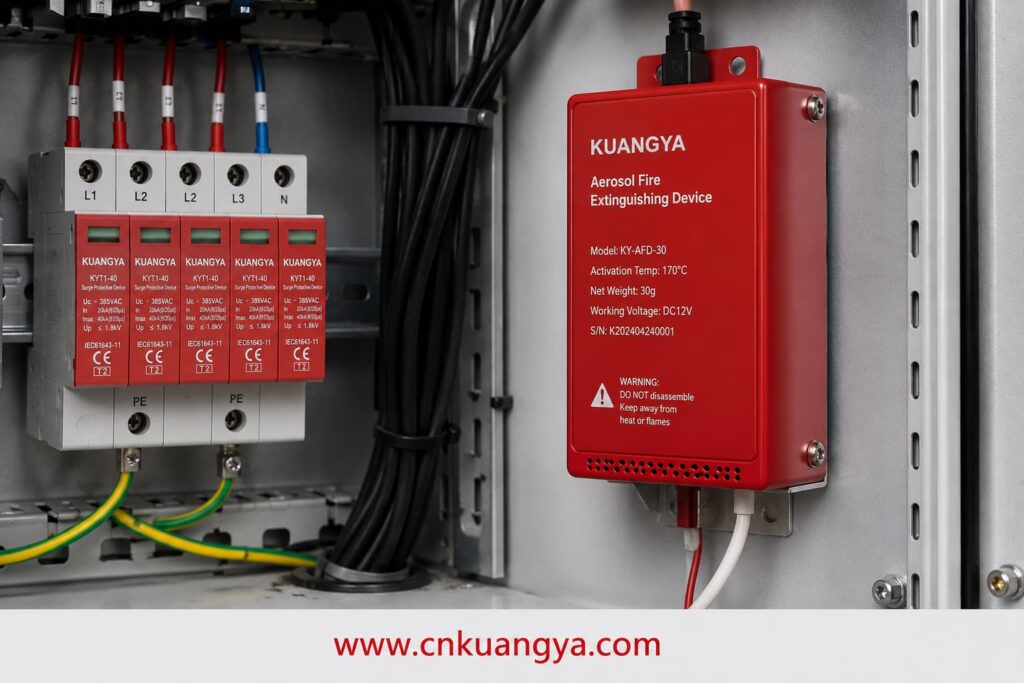
This checklist helps reduce wrong purchases and improves project reliability.
For EPC contractors, it is better to confirm these details before quotation.
For distributors, this checklist helps prevent customers from selecting the wrong SPD model.
For end users, it helps explain why a cheaper SPD may not be suitable for a high-risk installation.
IEC 61643 is a family of international standards for surge protective devices. It covers requirements, test methods, selection principles, and application rules for SPDs used in low-voltage AC systems, DC systems, photovoltaic systems, and communication networks.
An SPD limits transient overvoltage and diverts surge current away from protected equipment. It helps reduce damage caused by lightning surges, grid switching, and other transient electrical disturbances.
No. IEC 61643 includes different parts for AC power systems, DC power circuits, PV installations, and telecommunications or signalling networks. The correct part depends on the application.
IEC 61643-11 is commonly associated with SPDs for AC low-voltage power systems. IEC 61643-31 applies to SPDs for the DC side of photovoltaic installations rated up to 1,500 V DC.
No. A DC solar system should use an SPD designed for PV DC applications. AC and DC circuits have different voltage and fault characteristics, and using the wrong SPD may create safety and reliability risks.
Type 1 SPDs are typically used where lightning current may enter the electrical system, such as at the main distribution entrance. Type 2 SPDs are widely used in distribution panels and equipment cabinets to reduce induced lightning and switching surges.
No. SPDs do not replace fuses or circuit breakers. An SPD limits transient overvoltage and diverts surge current. Fuses and breakers provide overcurrent and short-circuit protection.
An SPD needs a proper path to divert surge current. Poor grounding or long connection wires can reduce protection effectiveness and increase residual voltage at the protected equipment.
SPD location depends on the system design. Common locations include main distribution boards, sub-distribution boards, PV combiner boxes, inverter inputs, EV charger cabinets, telecom cabinets, and near sensitive equipment.
SPDs should be inspected regularly as part of electrical maintenance. Maintenance teams should check the visual indicator, remote alarm status, terminals, grounding, and signs of overheating or damage.
You should provide system voltage, AC or DC type, installation location, earthing system, expected surge risk, equipment type, required SPD type, short-circuit level, and whether remote monitoring is required.
IEC 61643 helps EPC contractors select SPDs according to recognized requirements and application principles. It reduces the risk of wrong product selection and supports more reliable electrical protection design.
IEC 61643 is not just a standard number on a datasheet. It is a practical framework for selecting and applying surge protective devices in real electrical systems.
For modern energy and industrial infrastructure, surge protection is no longer optional. Solar PV systems, EV charging stations, BESS cabinets, telecom sites, data centers, and industrial control panels all contain sensitive electronic equipment that can be damaged by transient overvoltage.
A complete surge protection design should consider:
KUANGYA provides surge protective devices for solar PV systems, EV charging stations, industrial cabinets, telecom equipment, data centers, and other electrical infrastructure projects.
For project selection, OEM cooperation, or technical datasheets, contact KUANGYA for SPD solutions designed for real electrical protection applications.

