منطقة ونغ يانغ الصناعية يويتشينغ ونتشو 325000
ساعات العمل
من الاثنين إلى الجمعة: 7 صباحاً - 7 مساءً
عطلة نهاية الأسبوع 10 صباحاً - 5 مساءً
منطقة ونغ يانغ الصناعية يويتشينغ ونتشو 325000
ساعات العمل
من الاثنين إلى الجمعة: 7 صباحاً - 7 مساءً
عطلة نهاية الأسبوع 10 صباحاً - 5 مساءً


Suggested SEO Title: AFDD vs. AFCI: Ultimate Guide to Modern Arc Fault Protection for Your Home
الوصف التعريفي: Confused by AFDD and AFCI? Discover why the latest AFDD technology is revolutionizing home electrical safety by protecting against hidden fire risks that older devices miss. Learn how to choose the best AFDD for residential use.
As a Senior Application Engineer with over 15 years of field experience, I’ve seen firsthand how the fear of a hidden electrical fire can keep homeowners and engineers awake at night. You may have installed the best circuit breakers money can buy, but there’s a specific type of fire—caused by arc faults—that conventional devices are often blind to.
The market is filled with terms like AFCI and AFDD, leading to a common and critical point of confusion: Are they just regional names for the same thing, or does one offer fundamentally better protection for a modern home?
This isn’t just academic. Choosing the wrong technology can leave dangerous gaps in your home’s fire safety net.
Let’s cut through the noise. While both devices aim to prevent electrical fires, AFDD (Arc Fault Detection Device) and AFCI (Arc-Fault Circuit Interrupter) are built on different technical philosophies and standards. The choice between them dictates the level of protection you’re installing.
For a quick, authoritative comparison, refer to the table below:
| الميزة | AFCI (Arc-Fault Circuit Interrupter) | AFDDD (جهاز كشف أعطال القوس الكهربائي) | ما أهمية ذلك |
|---|---|---|---|
| Core Protection Goal | Primarily targets parallel arc faults (line-to-line, line-to-neutral). | Protects against both parallel AND series arc faults, plus earth leakage currents. | Series arcs from loose connections are a major fire risk in homes. AFDD closes this safety gap. |
| Governing Standard | UL 1699 (North American Standard). | IEC 62606 (International Electrotechnical Commission Standard). | IEC 62606 is a more recent, globally recognized standard with stricter, more comprehensive test requirements for arc detection. |
| Detection Principle | Analyzes current waveform for high-frequency noise signatures indicative of an arc. | Employs advanced algorithms analyzing both current AND voltage waveforms. Can differentiate between hazardous arcs and normal operational arcs (e.g., from brushed motors). | Superior discrimination drastically reduces التعثر المزعج, increasing user trust and device effectiveness. |
| Integrated Functions | Typically a single-function device or an add-on to a standard breaker (MCB). | A fully integrated unit combining Overload (O), Short-Circuit (S), Arc Fault (A), and often Residual Current (RCD/GFCI) protection in one module. | Simplifies design, reduces installation space, minimizes wiring points (and potential errors), and enhances overall system reliability. |
| Primary Market | Predominant in أمريكا الشمالية, driven by the NEC (National Electrical Code). | The standard for new and retrofit installations across Europe, Asia-Pacific, and other IEC-based regions. | If you’re working on global projects or specifying for the highest international benchmark, AFDD is the definitive choice. |
| Analogy | A specialized “stethoscope” listening for one specific type of dangerous “heart murmur” in your electrical system. | A complete “intelligent diagnostic suite”monitoring the system’s vital signs (current, voltage, leakage) to provide a holistic health assessment. | AFDD offers a more complete, intelligent, and proactive safety solution. |
🎯 Key Takeaway 1: An AFDD is not merely a “European AFCI.” It represents a next-generation safety device with broader fault coverage, smarter analytics, and a higher degree of integration. Specifying an AFDD means deploying a more intelligent and comprehensive fire prevention network.
For residential applications, the demands are clear: “Comprehensive Protection” و “Zero Nuisance.” AFDD excels on both fronts.
Most electrical fires in homes don’t start with dramatic short circuits. They smolder from “bad connections” you can’t see:
These create series arc faults—current must “jump” a gap, generating sustained, extremely high-temperature arcs (exceeding 3000°C) capable of ignitating surrounding insulation, dust, or wood. Traditional AFCIs have limited ability to detect these, while AFDDs are specifically designed to identify and interrupt these dangerous series arcs.
📊 Real-World Scenario: Imagine aging cable insulation inside a wall chafing against a metal conduit. This might cause only a slight, intermittent flicker in lights—completely unnoticed. A standard breaker will never trip. An AFDD, however, will detect the unstable arc signature and disconnect the circuit long before heat builds up to a fire.
This is where AFDD technology truly shines. Many household appliances (vacuum cleaners, power tools, dimmer switches) create arcs during normal operation. Early arc-fault devices were prone to “nuisance tripping” on these, leading frustrated users to disable them—defeating the purpose entirely.
🎯 Key Takeaway 2: The microprocessor in an advanced AFDD uses sophisticated algorithms to analyze multiple parameters (arc duration, stability, relationship to load current). It acts like an experienced electrician, accurately distinguishing dangerous fault arcs from harmless operational arcs, ensuring reliability and user acceptance.
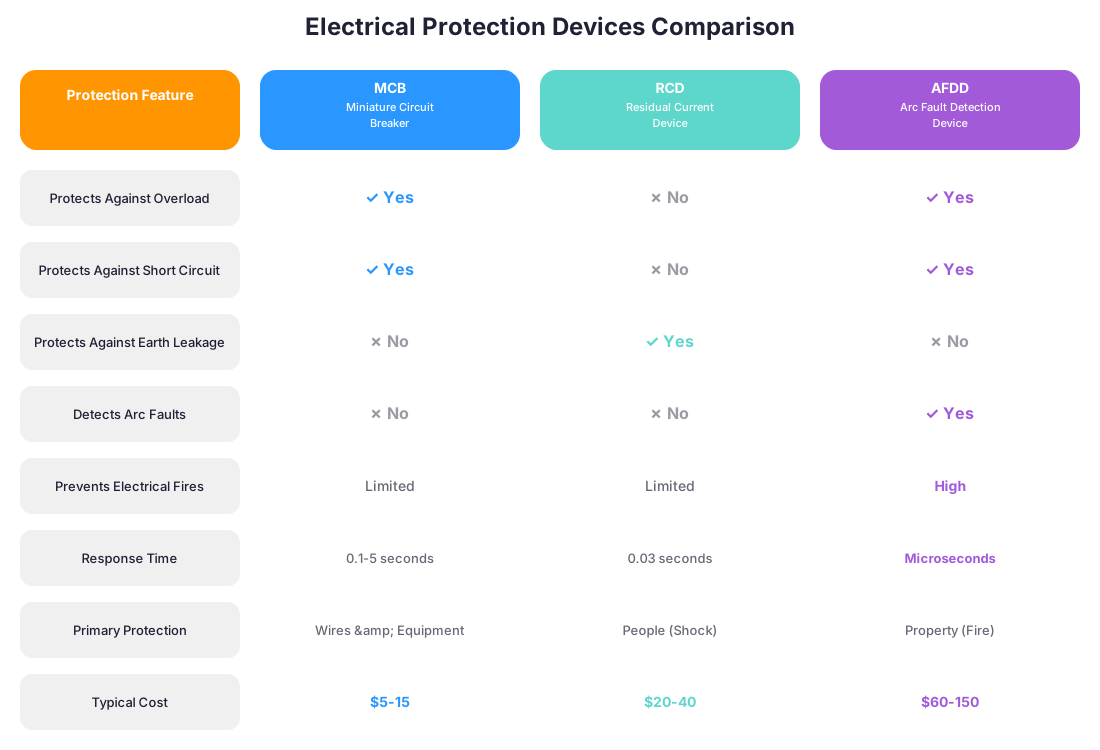
For engineers, contractors, and homeowners, AFDD offers an elegant solution. Historically, achieving full protection for a circuit could require: a Miniature Circuit Breaker (MCB) + a Residual Current Device (RCD) + an Arc Fault Protector. That’s three devices, more wiring, and a larger consumer unit.
A single AFDD module integrates all these critical safety functions. This streamlines design, reduces the potential for installation errors, and saves valuable panel space and labor time.
🎯 Key Takeaway 3: The integrated design of an AFDD enhances overall system reliability and represents a future-proof approach to residential electrical safety, simplifying every stage from design to maintenance.
Navigate the market with confidence using this structured selection process.
This is non-negotiable. Ensure the AFDD carries the IEC 62606 mark. This is its foundational certification for arc detection performance. Next, confirm compliance with regional installation standards for your market (e.g., م for Europe, relevant approvals for other regions).
Arc detection is algorithm-intensive. Prioritize manufacturers with decades of proven expertise in protective devices and advanced electronics. They invest in:
The ideal residential AFDD should be a direct, form-fit replacement for a standard MCB or RCBO in the distribution board. Verify its physical dimensions, DIN-rail mounting (standard 35mm), and wiring terminals are compatible with your existing system. Tool-free connection systems can significantly speed up installation.
🎯 Key Takeaway 4: Selecting the best AFDD is a systematic process. Start with the non-negotiable (IEC 62606), match specifications to your needs, trust in proven technical heritage, and ensure installation simplicity.
Q1: My home has “smart breakers” that monitor energy. Do I still need an AFDD?
A: Likely, yes. Most “smart breakers” focus on energy metering and remote control. Their core protection typically relies on standard thermal-magnetic tripping without dedicated arc fault analysis. An AFDD is a specialized, active fire prevention device. The functions are complementary, and we may see them converge in future products.
Q2: Is the investment in AFDD technology justified for a typical home?
A: View an AFDD not as an expense, but as “active property insurance.” It protects against a low-probability, high-consequence event (catastrophic fire). For new builds or major renovations, installing AFDDs on higher-risk circuits (bedrooms, living rooms, attics) is a cost-effective way to significantly enhance safety and may also increase property value.
Q3: Should I install AFDDs on every circuit in my house?
A: Full coverage is ideal. For a cost-effective strategy, prioritize higher-risk areas:
Q4: My AFDD has tripped. What should I do?
A: Do not immediately reset it repeatedly. An AFDD trip is a diagnostic warning. Follow this procedure:
نبذة عن المؤلف With over 15 years as a Senior Application Engineer in electrical automation, I specialize in translating complex product specifications into trusted, practical guides for professionals. For more in-depth technical insights, visit cnkuangya.com.

