Промышленная зона Вэньян Юэцин Вэньчжоу 325000
Рабочие часы
Понедельник - пятница: 7AM - 7PM
Выходные: 10AM - 5PM
Промышленная зона Вэньян Юэцин Вэньчжоу 325000
Рабочие часы
Понедельник - пятница: 7AM - 7PM
Выходные: 10AM - 5PM

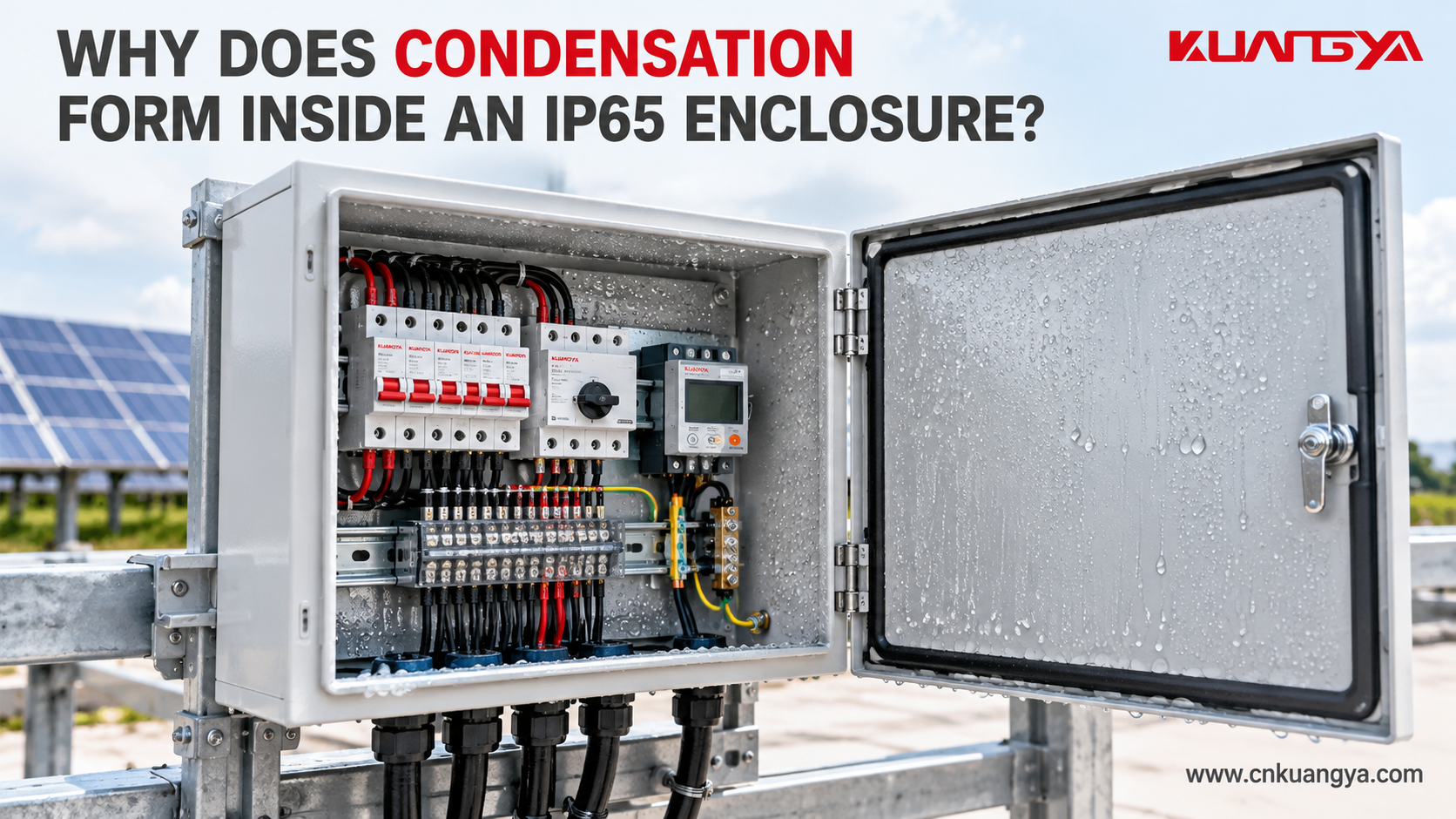
Электрический шкаф имеет степень защиты IP65. Его дверца плотно закрыта, кабельные вводы выглядят правильно установленными, и нет видимых признаков утечки дождевой воды.
Тем не менее, во время плановой проверки технический персонал обнаруживает капли воды на внутренней стороне дверцы шкафа.
В более серьезных случаях влага может появиться вокруг клеммных колодок, металлических монтажных пластин или электронных компонентов.
Как может образовываться конденсат внутри электрического шкафа со степенью защиты IP65, если шкаф разработан для защиты от проникновения пыли и воды?
Ответ заключается в разнице между защитой от проникновения воды и контролем внутренней влажности.
Конденсат в корпусе IP65 может образовываться, когда влажный воздух внутри шкафа контактирует с поверхностью ниже точки росы, даже если снаружи не попала вода.
Это различие особенно важно для уличных электрических шкафов, фотоэлектрических распределительных коробок, промышленных шкафов управления и электрооборудования, установленного в тропическом климате.
В данном руководстве мы объясним, почему образуется конденсат, как отличить конденсат от протечки воды, какие проблемы может вызвать влага и какие методы предотвращения работают для различных применений.
Да. Конденсат может образовываться внутри электрического корпуса IP65 без видимых нарушений его внешней гидроизоляции.
Класс защиты IP и риск образования конденсата описывают два разных аспекта производительности корпуса.
Согласно IEC 60529: Степени защиты, обеспечиваемые корпусами, коды IP классифицируют защиту от доступа, посторонних твердых предметов и проникновения воды в определенных условиях испытаний.
Для корпуса со степенью защиты IP65:
Ни одна из цифр не гарантирует, что воздух внутри корпуса останется сухим.
| Сравнение | Защита IP65 | Предотвращение конденсации |
|---|---|---|
| Основная цель | Ограничить проникновение пыли и влаги извне | Ограничить накопление влаги внутри |
| Основная проблема | Воздействие окружающей среды | Влажность и температура |
| Связанный стандарт | IEC 60529 | Специальная тепловая и влажностная конструкция для конкретного применения |
| Предотвращает образование внутренней точки росы? | Нет | Может снизить риск |
| Основные решения | Уплотнения, конструкция корпуса, подходящие кабельные вводы | Обогрев, управление влажностью, вентиляционные отверстия для выравнивания давления |
| Типичная проблема | Попадание дождевой воды или пыли в шкаф | Образование капель воды на внутренних поверхностях |
Вот почему модернизация корпуса с IP65 до IP66 автоматически не решает проблему внутреннего конденсата.
Более высокий рейтинг может обеспечить дополнительную защиту от другого вида внешнего воздействия воды, но он не устраняет физический процесс, вызывающий конденсацию водяного пара.
Для получения дополнительной информации о степени защиты корпуса от проникновения, см. наше отдельное руководство: IP65 против IP66 против IP67 для солнечных распределительных коробок.
Конденсация возникает, когда воздух, содержащий влагу, контактирует с поверхностью, температура которой равна точке росы или ниже.
Точка росы — это температура, при которой воздух насыщается водяным паром при условии сохранения его влагосодержания.
Когда поверхность охлаждается ниже этой точки, водяной пар может превратиться в жидкие капли.
Процесс прост:
Теплый влажный воздух → Охлаждение поверхности → Достижение точки росы → Конденсация воды
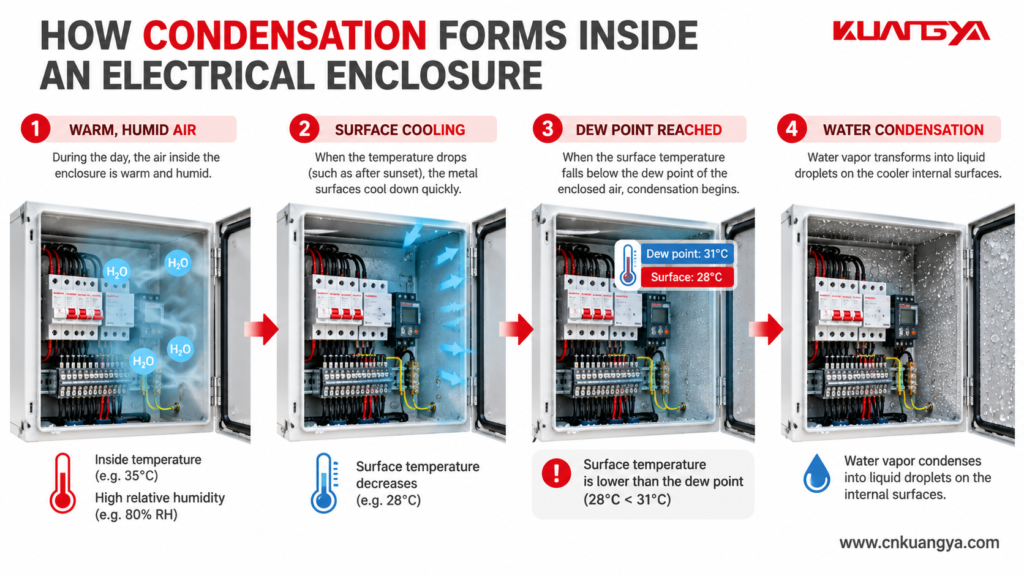
Например, уличный электрический шкаф может быть относительно теплым в течение дня.
После захода солнца металлические стенки корпуса могут быстро остыть.
Если внутренние поверхности станут холоднее точки росы находящегося внутри воздуха, на этих поверхностях может начать скапливаться влага.
Этот механизм конденсации основан на взаимосвязи между температурой воздуха, относительной влажностью и точкой росы. Когда поверхность корпуса охлаждается ниже точки росы, влага может образовываться даже без проникновения воды извне.
Рассмотрим электрический корпус со следующими гипотетическими условиями.
| Параметр | Примерное значение |
|---|---|
| Внутренняя температура воздуха | 35°C |
| Внутренняя относительная влажность | 80% |
| Приблизительная точка росы | 31°C |
| Температура внутренней стенки корпуса после охлаждения | 28°C |
| Риск конденсации | Высокий |
При 35°C и 80% относительной влажности приблизительная точка росы составляет 31°C.
Если температура стенки упадет до 28°C, в то время как влажность воздуха в корпусе останется примерно такой же, может произойти конденсация.
Корпус не должен иметь видимой утечки, чтобы это произошло.
Пример представляет собой психрометрический расчет, а не сообщение о сбое в полевых условиях. Реальная внутренняя влажность и точка росы изменяются по мере обмена корпуса теплом и влагой с окружающей средой.
Хотя образование точки росы является основным физическим процессом, несколько факторов установки и окружающей среды делают конденсацию более вероятной.
Наружные электрические корпуса подвергаются постоянным изменениям температуры.
В дневное время солнечное излучение нагревает поверхность корпуса. Внутренние электрические компоненты также могут выделять тепло.
Ночью шкаф теряет тепло в окружающую среду.
Если внутренний воздух остается влажным, а поверхности корпуса охлаждаются, может образовываться конденсат.
Эта закономерность особенно актуальна для открытых установок на крышах и наземных фотоэлектрических систем.
Влажность является основным фактором риска образования конденсата.
Чем выше содержание влаги во внутреннем воздухе, тем ближе его точка росы, вероятно, будет к фактической температуре воздуха.
Электрический корпус, установленный во влажной среде, может содержать влажный воздух с момента закрытия его двери.
Даже если уплотнения корпуса установлены правильно, эта пойманная влага может конденсироваться при охлаждении корпуса.
Не вся влага попадает внутрь после ввода в эксплуатацию.
Водяной пар может остаться внутри во время первоначальной сборки, монтажа на месте, инспекции или технического обслуживания.
Возможные обстоятельства включают:
Правильно герметизированный корпус может удерживать внутреннюю влагу при отсутствии подходящего механизма для ее удаления.
Когда воздух внутри корпуса нагревается, он расширяется. Когда воздух охлаждается, он сжимается.
Эти изменения создают разницу давлений между внутренней и внешней частью корпуса.
Если разница давлений возникает повторно, уплотнения корпуса и кабельные вводы могут подвергаться дополнительным механическим нагрузкам.
Со временем ослабление в этих интерфейсах может способствовать проникновению влаги.
Специально разработанный вентиляционный клапан для выравнивания давления может помочь уменьшить эти перепады давления.
Согласно Техническое руководство GORE по защитным вентиляционным клапанам, выравнивание давления может снизить нагрузку на уплотнение и помочь минимизировать скопление конденсата.
Однако вентиляционное отверстие не гарантирует, что внутренняя часть корпуса всегда останется сухой.
Cable glands are potential moisture-entry points if they are incorrectly selected or installed.
Common problems include:
In these cases, the problem may be actual liquid-water ingress rather than condensation alone.
A cable gland carrying its own IP rating does not automatically make the completed enclosure assembly IP65.
The installed configuration must maintain the required protection.
Installation position affects both solar heating and direct exposure to rain.
A cabinet installed in strong sunlight may experience higher daytime temperatures.
The same enclosure may subsequently cool during the evening.
Cable routing can also influence moisture movement.
For example, poorly positioned cable entries may allow water to collect around sealing interfaces or travel toward an entry point.
Suitable mounting positions, cable routing, and enclosure orientation should be included in the design.
Some enclosure designs focus heavily on preventing external water from entering but provide little consideration for internal humidity.
Potential weaknesses include:
The appropriate solution depends on the cabinet’s size, environmental conditions, electrical contents, and installation requirements.
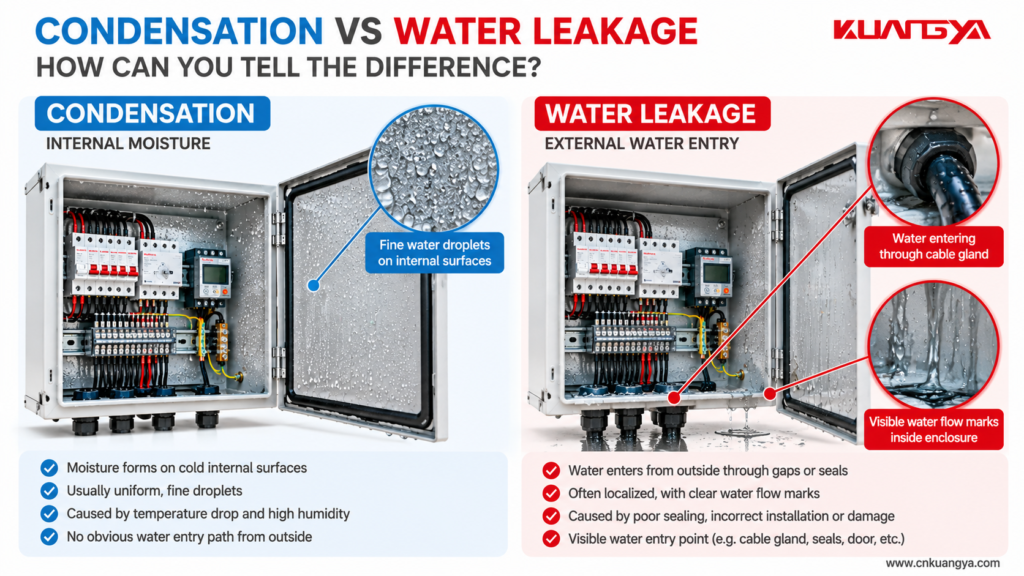
Finding water inside an enclosure does not automatically mean that its sealing system has failed.
Equally, it would be unsafe to assume that every moisture problem is harmless condensation.
The first troubleshooting task is to distinguish between condensation, external water ingress, and other possible moisture sources.
| Наблюдение | Possible Condensation | Possible Water Ingress |
|---|---|---|
| Fine droplets on cool internal surfaces | Common indication | Also possible |
| Moisture appears after nighttime cooling | Consistent with condensation | Not conclusive |
| Water concentrated below a cable entry | Less characteristic | Check cable gland or entry |
| Water appears immediately after heavy rain | Possible, depending on cooling | Leakage should be investigated |
| Visible water track from a door gasket | Less likely to be pure condensation | Strong leakage indication |
| Repeated moisture without rainfall | Possible | Also possible from trapped water or cable pathways |
| Corrosion concentrated near a penetration | Possible | Inspect for a local leak |
These observations are diagnostic clues, not definitive tests.
Step 1: Make the equipment safe.
Only qualified personnel should inspect electrical cabinets. Follow the applicable isolation, lockout/tagout, and verification procedures.
For photovoltaic installations, remember that DC circuits may remain energized whenever the solar array is illuminated, even if some switches are open.
Step 2: Inspect the enclosure exterior.
Look for damage to the housing, door seals, hinges, latches, cable glands, and unused openings.
Step 3: Inspect moisture distribution.
Check whether droplets are distributed across cool surfaces or concentrated around a specific penetration.
Step 4: Review environmental conditions.
Record ambient temperature, internal temperature, relative humidity, recent rainfall, and relevant operating conditions.
Step 5: Check the dew point.
Compare the calculated internal-air dew point with the measured temperature of the surfaces where moisture appears.
Step 6: Identify the source before modifying the enclosure.
Do not drill drainage or ventilation holes into an IP65 enclosure without a properly engineered solution. Unapproved modifications can compromise ingress protection.
Small water droplets may appear insignificant, but repeated moisture exposure can create serious reliability problems.
The consequences depend on the electrical system, contamination levels, component materials, and duration of exposure.
| Affected Component | Potential Moisture-Related Problem | Possible Consequence |
|---|---|---|
| Клеммные колодки | Corrosion or contamination | Increased contact resistance |
| Metal mounting plate | Surface corrosion | Reduced service life |
| Electronic PCB | Leakage paths and corrosion | Malfunction or communication failure |
| Fuse holder connections | Contact degradation | Локальный перегрев |
| DC SPD terminals | Corrosion or insulation deterioration | Reduced reliability |
| Monitoring module | Moisture-related electronic faults | Lost or unreliable monitoring |
| Door gasket | Aging or physical deterioration | Increased water-ingress risk |
| Cable gland interface | Seal deterioration | External moisture penetration |
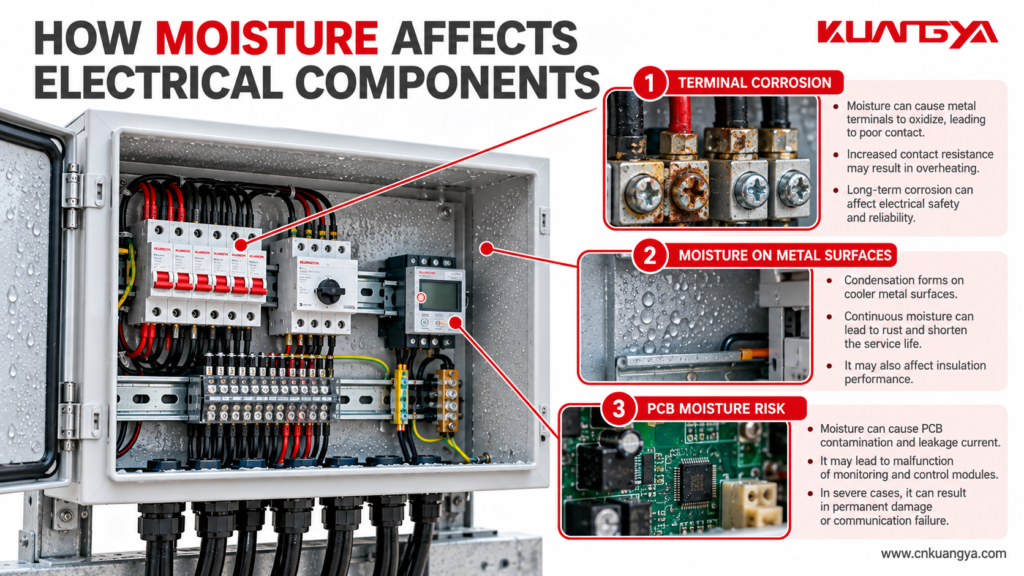
Moisture can accelerate corrosion on susceptible metal surfaces.
Where corrosion affects current-carrying connections, contact resistance may increase.
Higher resistance can produce additional heat during operation.
This does not mean every corroded connection will overheat, but it is a failure mechanism that requires attention.
Moisture and conductive contamination can reduce surface insulation resistance.
Under unfavorable conditions, leakage currents or tracking can develop.
This is particularly important in high-voltage DC installations where appropriate insulation coordination and separation distances are essential.
Modern electrical enclosures may contain sensors, communication interfaces, power supplies, and monitoring modules.
These components can be more sensitive to sustained moisture than simple mechanical structures.
In photovoltaic systems, electronic failures may interrupt data collection or remote monitoring.
For an example of a more complex PV enclosure architecture, see KUANGYA’s 16-String PV Combiner Box with Monitoring and Remote Control.
No single method is suitable for every electrical enclosure.
The correct approach should address the actual moisture source, operating temperature, environmental conditions, and enclosure requirements.
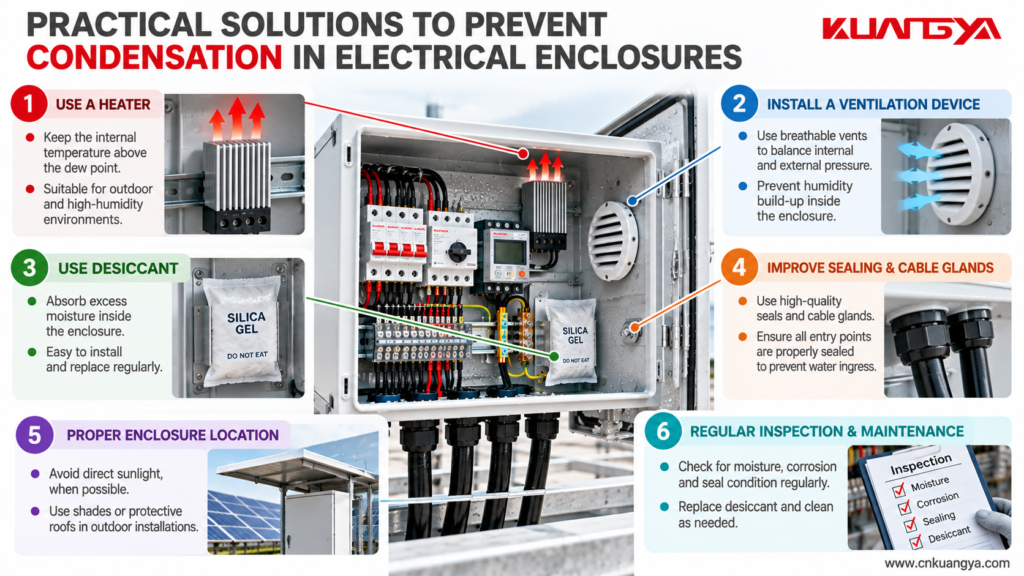
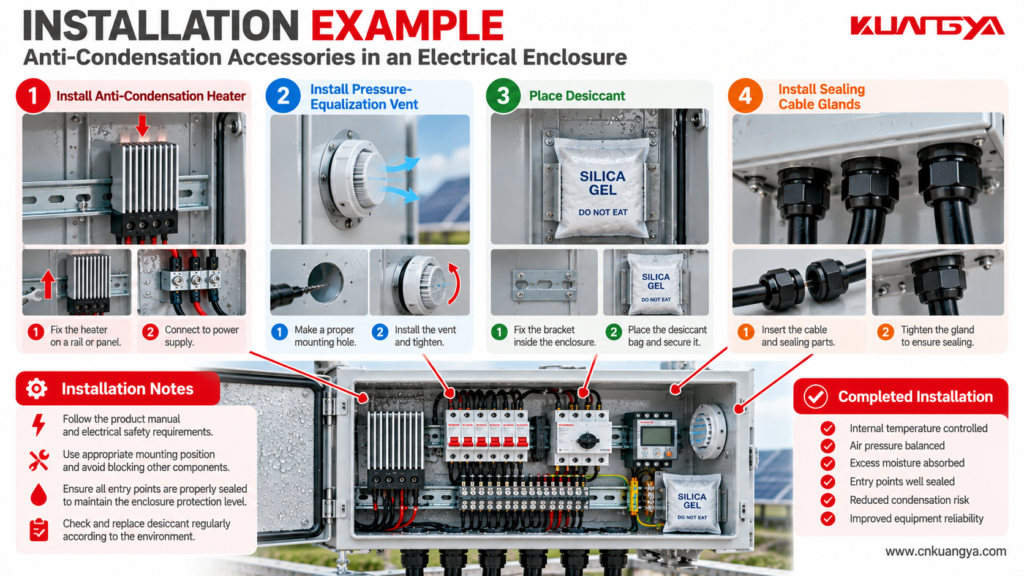
A pressure-equalization vent allows controlled gas exchange between the enclosure interior and external environment.
Certain protective membrane vents can limit entry of liquid water and particles while permitting air and water vapor movement.
Potential benefits include:
For photovoltaic applications, GORE Protective Vents for Solar Energy Systems explains how membrane vents can support pressure equalization and moisture management.
Важно: Water vapor can pass in both directions. A vent is not a dehumidifier, and it does not guarantee a dry interior.
The entire enclosure-and-vent configuration must also be suitable for the required ingress protection.
An anti-condensation heater maintains selected internal surfaces at temperatures that reduce the likelihood of reaching the dew point.
Heaters may be controlled by thermostats, hygrostats, or combined temperature-and-humidity controllers.
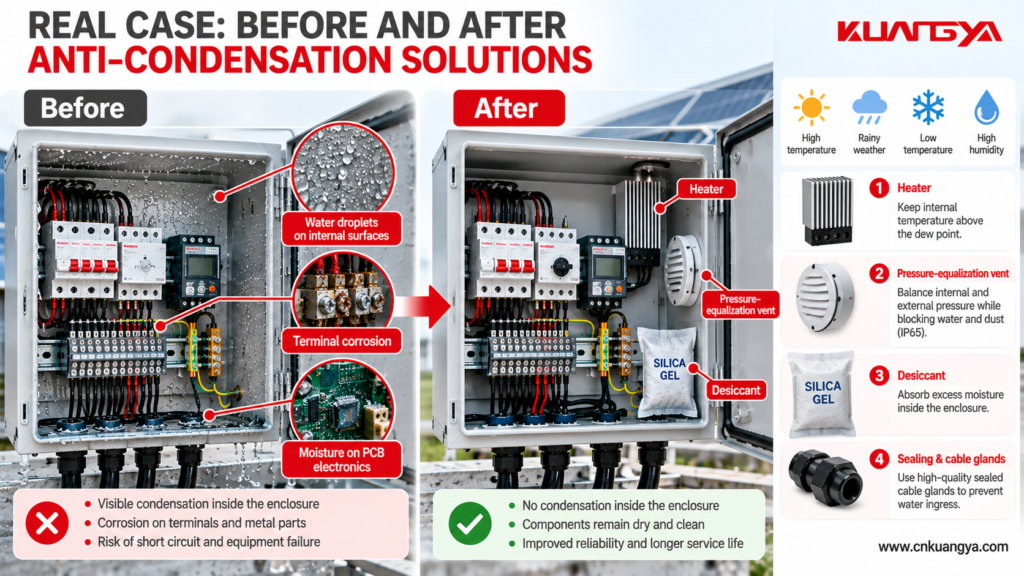
For example, a heater can be activated when the enclosure reaches conditions associated with condensation risk.
Schneider Electric provides dedicated enclosure heating solutions in its ClimaSys CR range.
However, a heater must be correctly sized and controlled.
It also requires a suitable power supply and must not cause internal components to exceed their permitted operating temperatures.
All cable entries should use glands suitable for the cable diameter, enclosure material, and environmental exposure.
Check that:
This primarily addresses external water entry, which can otherwise be confused with condensation.
Direct sunlight can increase cabinet surface temperature.
Where practical, enclosure orientation, location, and suitable shading arrangements can reduce extreme thermal exposure.
However, shading should not obstruct required airflow, compromise maintenance access, or violate product installation requirements.
For enclosures containing significant electrical heat sources, thermal calculations are important.
For critical installations, temperature and relative-humidity sensors can provide useful information.
Continuous or periodic monitoring may help identify conditions in which the internal dew point approaches the temperature of the enclosure walls.
Alarm settings should be based on the actual equipment and environment rather than a universal humidity threshold.
This is particularly useful for remote electrical cabinets that cannot be inspected frequently.
In some applications, approved enclosure drainage devices may help manage liquid water accumulation.
However, drainage is not a universal solution.
A simple open hole can compromise dust and water protection.
Where drainage is needed, use components compatible with the enclosure design and verify the ingress-protection requirements of the completed assembly.
Even a correctly designed enclosure benefits from periodic inspection.
Maintenance should include checking the condition of seals, glands, protective vents, internal moisture indicators, and vulnerable electrical connections.
Any evidence of corrosion, standing water, degraded insulation, or abnormal heating should be investigated.
For photovoltaic installations, additional maintenance information is available in the KUANGYA Solar Combiner Box Protection and Maintenance Guide.
The following table summarizes the advantages and limitations of common solutions.
| Метод | Главная цель | Преимущества | Ограничения |
|---|---|---|---|
| Pressure-equalization vent | Reduce pressure differences and trapped moisture | Passive operation; no electrical power | Does not actively dry the air |
| Anti-condensation heater | Reduce dew-point formation on surfaces | Suitable for controlled thermal management | Requires power and correct sizing |
| Hygrostat or humidity controller | Control based on humidity conditions | Automatic operation | Requires compatible equipment |
| Improved cable sealing | Prevent external water entry | Essential for enclosure integrity | Does not remove trapped humidity |
| Suitable shading | Reduce solar heating effects | Passive thermal benefit | Site and design dependent |
| Humidity monitoring | Detect unfavorable internal conditions | Supports preventive maintenance | Monitoring alone does not remove moisture |
| Engineered drainage | Remove accumulated liquid water | Useful in selected designs | Must preserve required enclosure protection |
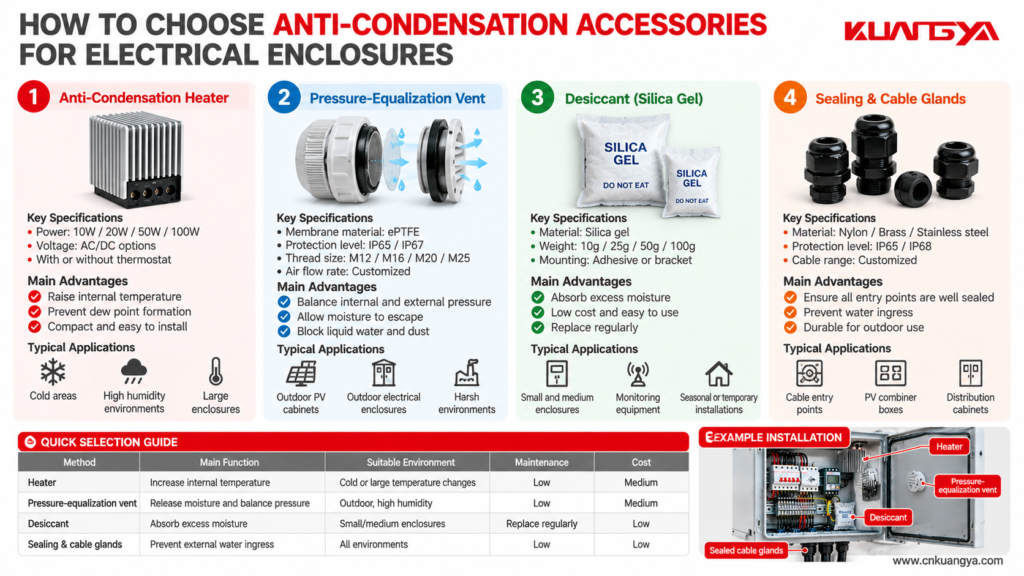
For a relatively small outdoor cabinet with moderate thermal cycling, a suitable pressure-equalization strategy may be worth evaluating.
For an enclosure exposed to low temperatures or persistent condensation risk, a controlled anti-condensation heater may be appropriate.
For complex enclosures containing electronic monitoring equipment, a combined approach involving environmental monitoring, sealing, and moisture control may be preferable.
The best solution is not necessarily the most expensive accessory. It is the solution that addresses the actual failure mechanism without creating a new electrical or environmental risk.
The following examples are illustrative engineering scenarios, not documented KUANGYA customer incidents. They demonstrate how environmental conditions can change the appropriate design response.
Применение: Outdoor photovoltaic system in Southeast Asia.
Operating environment: High relative humidity, frequent rainfall, and daily temperature variations.
Observed condition: Fine moisture droplets appear on the inside of the enclosure after cooler nighttime conditions.
Possible explanation:
Humid air inside the enclosure cools below its dew point.
The source of the moisture could be trapped air, vapor exchange, or another route that requires investigation.
Recommended engineering evaluation:
In this example, simply specifying a higher IP rating would not necessarily eliminate condensation.
Применение: Industrial control cabinet containing monitoring electronics.
Operating environment: Warm daytime conditions followed by substantial nighttime cooling.
Observed condition: Repeated moisture formation on internal metal surfaces.
Possible explanation:
Temperature cycling causes internal surfaces to fall below the dew point.
Recommended engineering evaluation:
A controlled anti-condensation heater may be considered, subject to power availability, internal temperature limits, and enclosure design.
A humidity sensor can also help determine whether the selected approach improves conditions.
Применение: Outdoor electrical control enclosure near a marine environment.
Observed condition: Moisture and corrosion around internal metal connections.
Possible explanations:
Recommended engineering evaluation:
Inspect the enclosure carefully for ingress paths, evaluate material and corrosion resistance, and choose sealing and moisture-management components suitable for the coastal environment.
In a coastal installation, corrosion protection should be considered separately from IP rating.
A solar PV combiner box is more than an outdoor enclosure.
It may contain DC fuse holders, surge protective devices, isolators, busbars, and electronic monitoring equipment.
These components have different thermal, electrical, and environmental requirements.
A moisture-control strategy must therefore be considered alongside the electrical design.
| Design Area | What Should Be Checked? |
|---|---|
| Шкаф | Appropriate IP rating for actual exposure |
| Cable entries | Correctly installed and sealed |
| Internal temperature | Ambient heat, solar gain, electrical heat dissipation |
| Internal humidity | Dew-point risk and monitoring requirements |
| DC fuse holders | Contact integrity and operating temperature |
| DC SPD | Manufacturer’s environmental and installation requirements |
| Оборудование для мониторинга | Humidity and temperature operating limits |
| Vent or heater | Compatibility with enclosure and electrical design |
| Техническое обслуживание | Accessibility and inspection intervals |
For example, a multi-string PV combiner box containing monitoring equipment may have a different thermal profile from a basic enclosure containing only fuse holders and a disconnect device.
Additional components can increase internal heat generation and introduce more environmental requirements.
For larger applications, see KUANGYA’s 16-String PV Combiner Box with Monitoring and Remote Control.
For a broader discussion of DC protection components, see Solar PV Electrical Protection: Complete Guide.
Да.
A sealed enclosure can contain water vapor from the moment it is assembled or closed.
When the temperature changes, that moisture can condense on colder internal surfaces.
Sealing does not remove moisture already present.
Moreover, many practical electrical enclosures are not hermetically sealed.
Their long-term performance depends on the integrity of seals, cable entries, materials, and installation workmanship.
This is one reason why moisture management should be considered during enclosure design rather than treated only as a maintenance issue.
Before replacing an enclosure, use a systematic inspection process.
| Пункт проверки | Что проверить | Possible Next Action |
|---|---|---|
| Door gasket | Damage, distortion, contamination | Replace or restore sealing as specified |
| Кабельные вводы | Correct size, tightness, condition | Правильный монтаж |
| Unused entries | Missing plugs or seals | Install approved sealing accessories |
| Internal water patterns | Droplets, streaks, pooling | Investigate condensation or leakage |
| Температура | Internal and external conditions | Evaluate thermal management |
| Влажность | Internal RH and calculated dew point | Evaluate moisture-control strategy |
| Pressure-equalization vent | Condition, location, suitability | Inspect or select suitable component |
| Electrical connections | Corrosion, discoloration | Qualified electrical inspection |
| Electronic modules | Moisture damage or abnormal operation | Follow manufacturer guidance |
| Maintenance records | Recurring seasonal or weather-related patterns | Revise inspection plan |
Document inspection results before changing the enclosure.
If moisture has affected energized components, the equipment should be evaluated by qualified personnel before it is returned to service.
For OEM buyers, distributors, EPC contractors, and electrical equipment purchasers, condensation prevention should be discussed before confirming the final enclosure specification.
| Вопрос | Почему это важно |
|---|---|
| Where will the enclosure be installed? | Determines environmental exposure |
| What is the required IP rating? | Defines relevant ingress-protection requirements |
| What is the ambient temperature range? | Supports thermal design |
| What humidity conditions are expected? | Helps evaluate dew-point risk |
| Will the enclosure be exposed to direct sunlight? | Influences temperature cycling |
| Are electronic monitoring components included? | Adds environmental requirements |
| Are additional cable entries required? | May affect completed enclosure protection |
| Is pressure equalization needed? | Can help with seal stress and moisture management |
| Is a heater or humidity controller required? | May reduce condensation risk |
| What tests and documentation are available? | Supports purchasing verification |
Buyers should request specifications for the complete assembly rather than relying solely on the nominal IP rating of an empty enclosure.
IP65 indicates dust-tight protection and resistance to water jets under defined test conditions.
It does not mean that an enclosure is suitable for all water exposures, prolonged immersion, or every installation environment.
It also does not guarantee that condensation will never form inside.
Possible causes include internal condensation, damaged gaskets, unsuitable cable glands, unsealed openings, or water entering along a cable.
Inspect the enclosure before determining the cause.
Not automatically.
IP66 and IP67 describe particular external ingress-protection tests.
Condensation depends primarily on the relationship between internal moisture, dew point, and surface temperature.
Нет.
A suitable membrane vent can help equalize pressure and reduce trapped moisture, but it cannot guarantee zero condensation under every environmental condition.
Vent performance also depends on correct selection, positioning, and installation.
Нет.
Heaters require appropriate power, space, control, and thermal design.
They must be suitable for the enclosure contents and application environment.
Desiccants such as silica gel can absorb a limited amount of moisture in suitable applications.
However, they have finite capacity and require replacement or regeneration.
They are not a universal substitute for proper sealing, pressure management, or engineered humidity control.
Да.
Outdoor PV equipment may experience strong solar heating, cooler nighttime conditions, humidity, and weather exposure.
Condensation can affect internal electrical connections and electronic components.
The design should consider moisture risk alongside electrical protection.
Not without an engineered and approved design.
An uncontrolled opening may compromise ingress protection and introduce additional contamination or water-entry risks.
Use compatible drainage components where the application requires them.
Condensation inside an IP65 electrical enclosure is not necessarily evidence of defective waterproofing.
An enclosure may successfully resist external water jets while still containing enough internal water vapor to form droplets during temperature changes.
The key is to understand the actual moisture mechanism.
For reliable long-term operation:
IP protection controls external exposure. Condensation prevention requires attention to the environment inside the enclosure.
Both are important for dependable outdoor electrical installations.
KUANGYA supplies electrical protection components and photovoltaic combiner box solutions for industrial and solar energy applications.
Our product scope includes DC surge protective devices, DC fuse holders, DC circuit breakers, and PV combiner box configurations.
For a project involving an outdoor solar combiner box, buyers can discuss environmental exposure, string count, system voltage, internal electrical components, monitoring requirements, and enclosure specifications before confirming the configuration.
If your project requires a customized photovoltaic combiner box, contact KUANGYA with your electrical and environmental requirements.
Веб-сайт: www.cnkuangya.com
Электронная почта: Please use the contact information published on the official KUANGYA website.
Discuss your PV combiner box requirements with KUANGYA before finalizing your outdoor enclosure design.
Technical note: This article provides general engineering guidance. Final enclosure selection, thermal design, installation, inspection, and maintenance must comply with applicable electrical requirements and the instructions for the specific products used. Illustrative scenarios are not presented as documented field incidents.

