Промышленная зона Вэньян Юэцин Вэньчжоу 325000
Рабочие часы
Понедельник - пятница: 7AM - 7PM
Выходные: 10AM - 5PM
Промышленная зона Вэньян Юэцин Вэньчжоу 325000
Рабочие часы
Понедельник - пятница: 7AM - 7PM
Выходные: 10AM - 5PM

When comparing Type 1 vs Type 2 SPD for solar applications, Type 1, Type 2 and Type 1+2 SPDs should not be treated as three quality levels of the same product.
They are intended for different surge conditions.
In many photovoltaic installations, a Тип 2 DC SPD is used where the main risk comes from induced lightning surges and switching overvoltages.
Где partial lightning current may enter the PV electrical system, however, Type 1 capability should be evaluated. A Type 1+2 SPD can provide both lightning-current and Type 2 surge-protection functions at the same installation point.
For projects in Spain, the decision should therefore be based on:
| Project Condition | SPD to Evaluate | Main Reason |
|---|---|---|
| Induced lightning and switching surges are the main concern | Тип 2 | Ограничивает переходное перенапряжение |
| Partial lightning current may enter the electrical installation | Тип 1 | Provides lightning impulse-current capability |
| Both lightning-current and Type 2 protection are required at one point | Тип 1+2 | Combines the two protection functions |
| Long DC cable between array and inverter | Coordinated SPDs | One SPD may not adequately protect both ends |
| AC output of inverter | Separate AC SPD | DC SPD selection does not replace AC-side protection |
Важный момент заключается в следующем:
Do not select an SPD simply because Type 1+2 sounds “better” than Type 2. Select it according to the surge environment at the installation point.
IEC 61643-31 covers SPDs specifically intended for the DC side of photovoltaic installations rated up to 1500 В пост. тока. IEC 61643-32 covers selection, installation and coordination of SPDs in PV systems up to 1500 В пост. тока, and also considers the AC side up to 1,000 V RMS at 50/60 Hz.
If you are still determining the basic voltage, application and protection requirements, first read our guide on how to choose a DC SPD for solar installations in Spain.
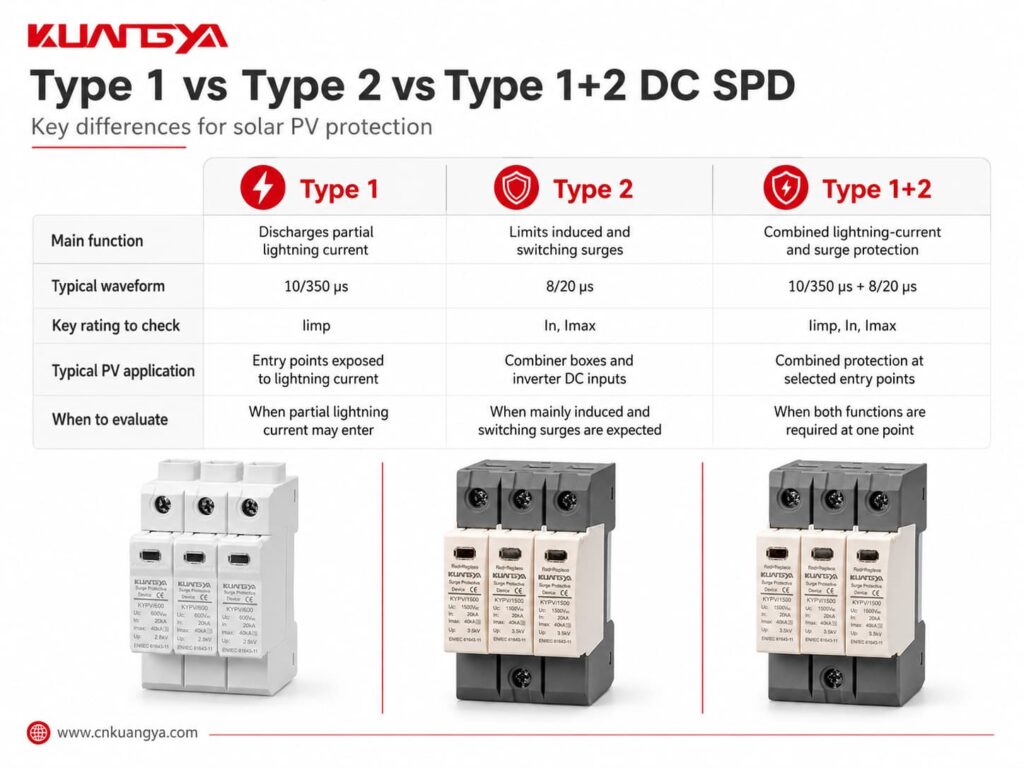
The most useful way to understand Type 1 vs Type 2 SPD for solar applications is to compare the surge conditions they are designed for and the electrical ratings that need to be checked.
| Параметр | Тип 1 | Тип 2 | Тип 1+2 |
| Основное назначение | Partial lightning-current protection | Induced and switching surge protection | Combined protection |
| Typical impulse associated with selection | 10/350 мкс | 8/20 мкс | Both capabilities |
| Important current rating | Iimp | In / Imax | Iimp + In / Imax |
| Up must be checked | Да | Да | Да |
| Ucpv must be checked | Да | Да | Да |
| Suitable for PV DC solely because of Type label? | Нет | Нет | Нет |
| PV-specific product standard should be checked | Да | Да | Да |
One of the most common purchasing mistakes is to compare only the number of kiloamps printed on the front of the device.
Например:
Поэтому:
40 kA Imax does not automatically mean that a Type 2 SPD can replace a Type 1 SPD.
Iimp and Imax describe different surge-performance characteristics.
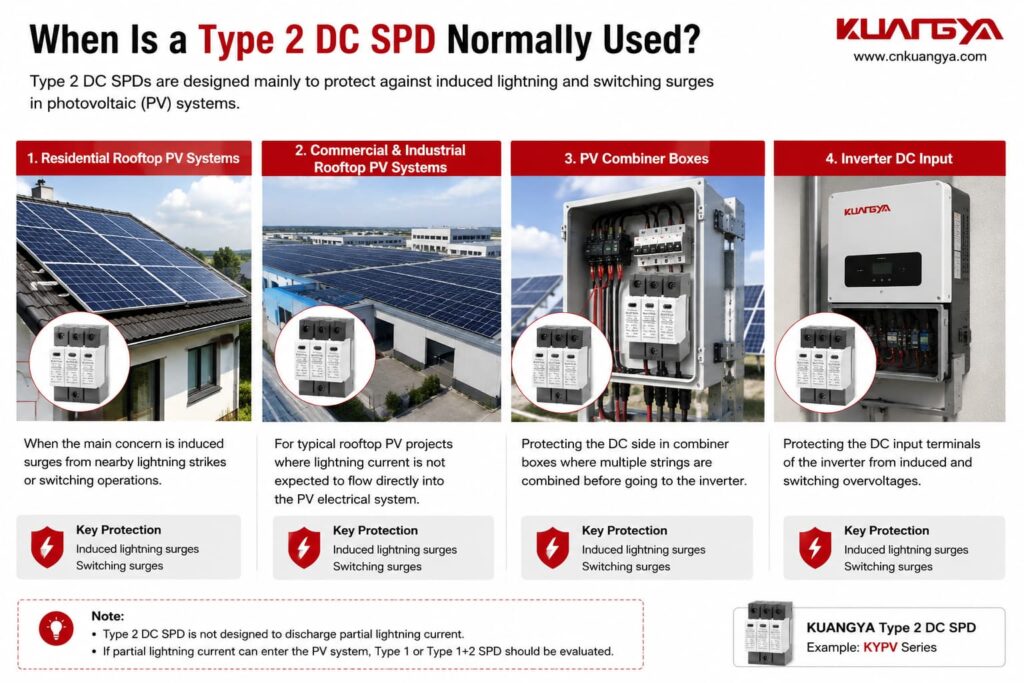
A Type 2 DC SPD is commonly evaluated when the expected surge threat is mainly caused by:
Typical PV applications include:
| Приложение | Type 2 Commonly Evaluated? | Additional Check |
| Residential rooftop PV | Да | Check external lightning protection |
| Коммерческая фотоэлектрическая установка на крыше | Да | Check cable routing and LPS |
| Распределительная коробка | Да | Check exposure and cable length |
| Вход постоянного тока преобразователя частоты | Да | Check Up and inverter withstand level |
| Ground-mounted PV | Possible | Lightning risk requires closer evaluation |
| Building with external LPS | Possible | Type 1 capability may also be required |
This is why the correct statement is:
Type 2 is commonly used where the lightning protection design does not require Type 1 lightning-current capability.
It would be technically unsafe to say:
“Every residential rooftop solar system only needs a Type 2 SPD.”
Two rooftop systems can have very different lightning-protection arrangements.
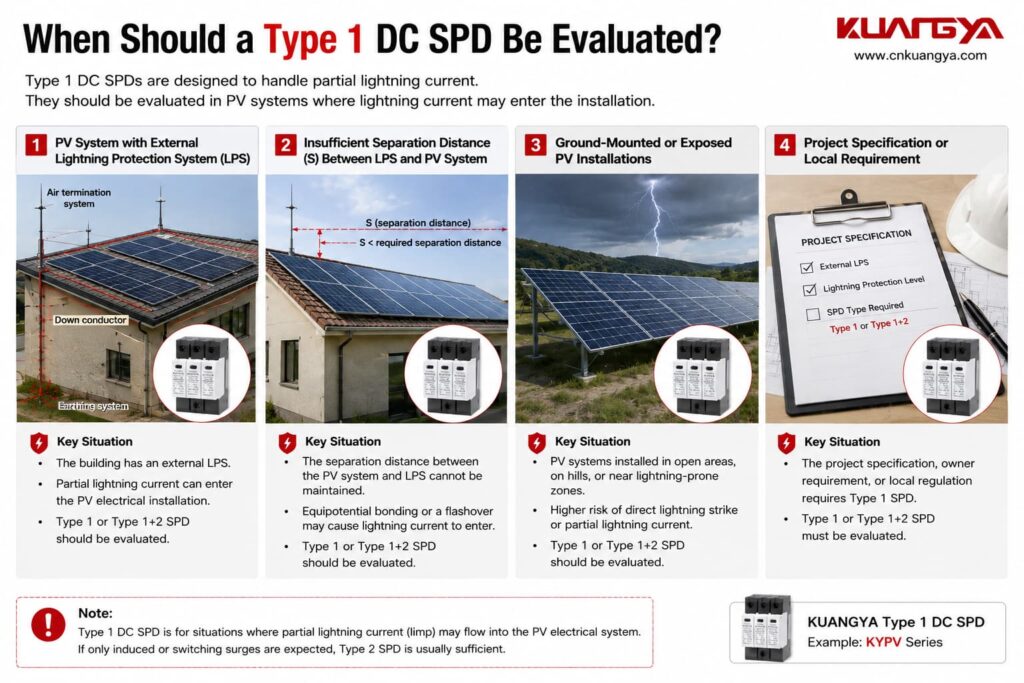
Type 1 should be evaluated when there is a realistic possibility that partial lightning current can enter the PV electrical system.
This can occur under several design conditions.
A building equipped with an external lightning protection system requires the PV array, mounting frame, DC conductors, earthing system and equipotential bonding to be considered as part of the overall lightning-protection design.
However:
External lightning protection does not automatically mean that every PV SPD must be Type 1.
The complete arrangement needs to be examined.
The physical relationship between:
can influence whether lightning current is transferred into the PV installation.
This is one reason that the question:
“Does the building have a lightning rod?”
is not sufficient on its own.
Более правильный вопрос:
“Can the required separation between the external LPS and PV installation be maintained?”
This is one of the most important differences between Type 1 and Type 2 selection.
Where a surge-protection design expects partial lightning current at an SPD location, Iimp becomes a critical specification.
Selecting a high-Imax Type 2 device without checking Iimp does not solve that requirement.
Some EPC drawings and tender documents specify Type 1 directly.
In this case, purchasing should verify more than the words “Type 1.”
Check:
| Параметр | Почему это важно |
| Тип | Protection classification |
| Ucpv | Maximum continuous PV voltage |
| Iimp | Lightning impulse-current capability |
| На сайте | Номинальный разрядный ток |
| Imax | Maximum Type 2 discharge capability |
| Вверх | Voltage remaining across SPD under defined conditions |
| Iscpv | PV short-circuit current capability |
| Poles / modes | Compatibility with PV topology |
| Стандарт | Product test basis |
A Type 1+2 SPD should be considered when the same protection point requires both lightning-current capability and Type 2 surge protection.
Possible situations include:
But Type 1+2 should not be treated as an automatic upgrade.
A Type 1+2 product still has to be evaluated according to:
Iimp + In + Imax + Up + Ucpv + Iscpv
For example, manufacturers offer Type 1+2 products with very different lightning-current capacities. Phoenix Contact’s current Type 1+2 portfolio includes devices with different discharge capabilities rather than treating every Type 1+2 product as electrically identical.
The label alone therefore does not provide enough information.
This is one of the most important points in this article.
There is no technically sound rule that says:
“Every photovoltaic installation in Spain requires a Type 1 SPD.”
Spain’s Reglamento Electrotécnico para Baja Tensión (REBT) includes ITC-BT-23 concerning protection against transient overvoltages in low-voltage installations. However, ITC-BT-23 should not be interpreted as a simple rule directly assigning Type 1 to every PV DC circuit.
PV DC surge protection must instead be evaluated together with:
| Reference | Relevance |
| Spanish REBT / ITC-BT-23 | Spanish low-voltage transient overvoltage framework |
| UNE-EN 61643-31 | PV DC SPD product requirements and testing |
| IEC 61643-31 | PV DC SPD requirements and tests |
| IEC 61643-32 | PV SPD selection, installation and coordination |
| IEC/HD 60364 series | Low-voltage electrical installation principles |
| IEC 62305 series | Lightning protection principles |
| Project specification | Final project-specific engineering requirements |
IEC 61643-31 explicitly applies to SPDs connected to the DC side of PV generators and inverter DC inputs up to 1,500 V DC.
IEC 61643-32 specifically addresses PV systems located both on buildings and in ground-mounted/free-field installations, which is important because the lightning and earthing environment can differ significantly between these applications.
Another mistake is to treat “Spain” as one identical lightning environment.
AEMET maintains national lightning-detection and lightning-climatology information covering Spain and publishes spatial maps, tables and statistical analysis of lightning activity.
Its climatology shows why lightning exposure should be treated geographically rather than assuming the same conditions everywhere in Spain.
AEMET’s operational lightning network also detects lightning across mainland Spain, the Balearic Islands and the Canary Islands.
This means project information such as:
should not be replaced by the simple statement:
“The project is in Spain.”
Project location is one input to the risk assessment, not a direct rule that independently determines the SPD type.
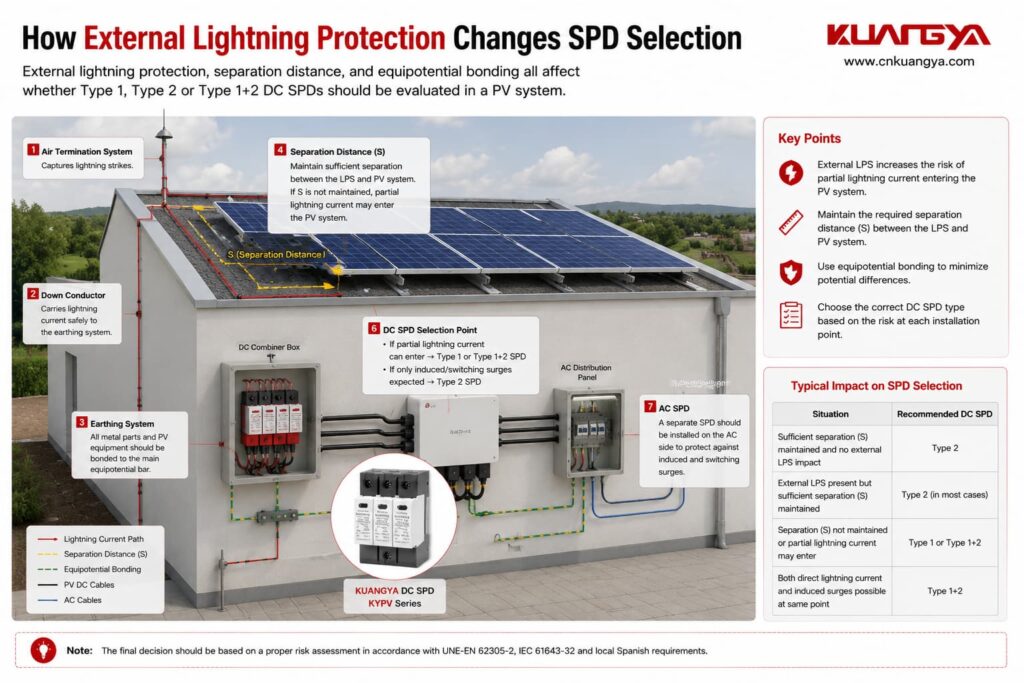
An external lightning protection system and an SPD perform different jobs.
An external LPS is intended to manage lightning effects on the structure.
An SPD is used within the electrical protection concept to:
УЗИП выполняет не replace:
Likewise, an external lightning system does not eliminate the need to evaluate surge protection for electrical circuits.
The two systems need to be coordinated.
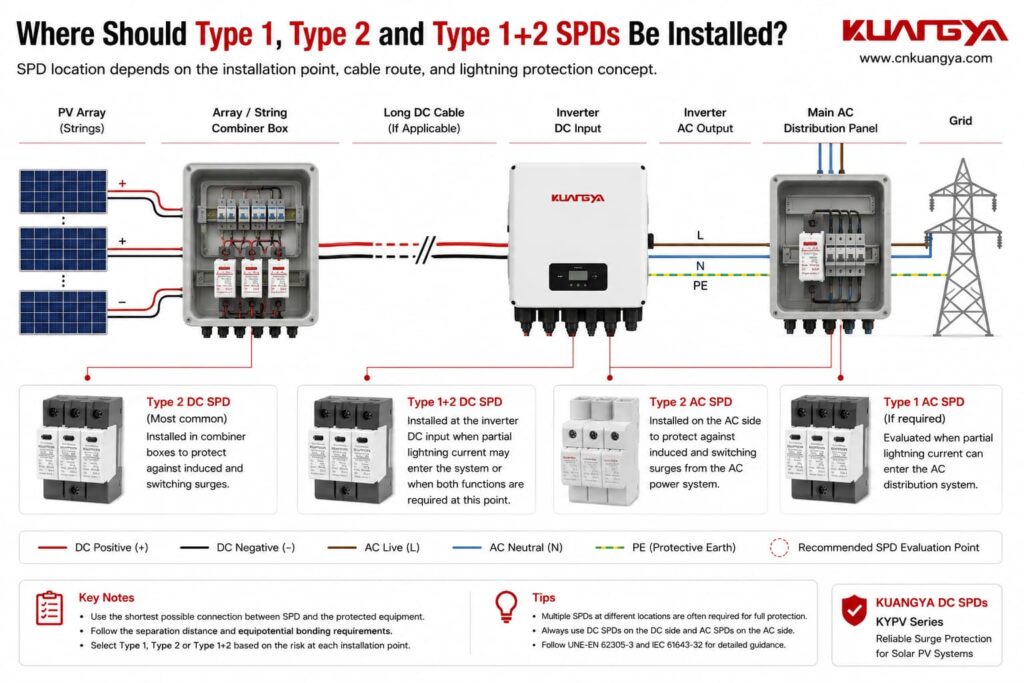
The following table is intentionally labelled “to evaluate.”
It should not be treated as a mandatory configuration for every PV project.
| Место установки | SPD to Evaluate | Main Engineering Question |
| PV string / array | Type 2 or coordinated protection | Is this point exposed to induced surges? |
| Распределительная коробка | Type 2 / Type 1+2 | Can lightning current enter here? |
| Building entry point | Тип 1 / Тип 1+2 | Is partial lightning current expected? |
| Вход постоянного тока преобразователя частоты | Type 2 / Type 1+2 | What Up does the inverter require? |
| Long array-to-inverter cable | SPD at both ends may be evaluated | Is one protection point sufficient? |
| Выход переменного тока инвертора | Separate AC SPD | What protection is required on AC side? |
Outdoor DC conductors may converge at the photovoltaic combiner box, making it a logical location to evaluate surge protection.
But the SPD type depends on the design.
Do not automatically specify Type 2 simply because the SPD is installed in a combiner box.
The SPD closest to the PV array and the SPD closest to the inverter do not necessarily protect exactly the same point.
A long conductor can be exposed to additional induced voltage.
IEC 61643-32 specifically covers the selection, location and coordination of SPDs throughout a PV installation rather than treating an entire PV plant as one protection point.
For projects with long DC runs, evaluate:
| Вопрос | Почему это важно |
| Distance from array to inverter | Long routes affect coordination |
| SPD at combiner box? | Protects array-side equipment |
| SPD at inverter? | Protects sensitive inverter input |
| Are both SPDs coordinated? | Prevents poor protection interaction |
| Cable routing outdoors? | Changes exposure |
| LPS nearby? | May change lightning-current conditions |
Do not use an arbitrary cable-length number without checking the applicable engineering standard and project configuration.
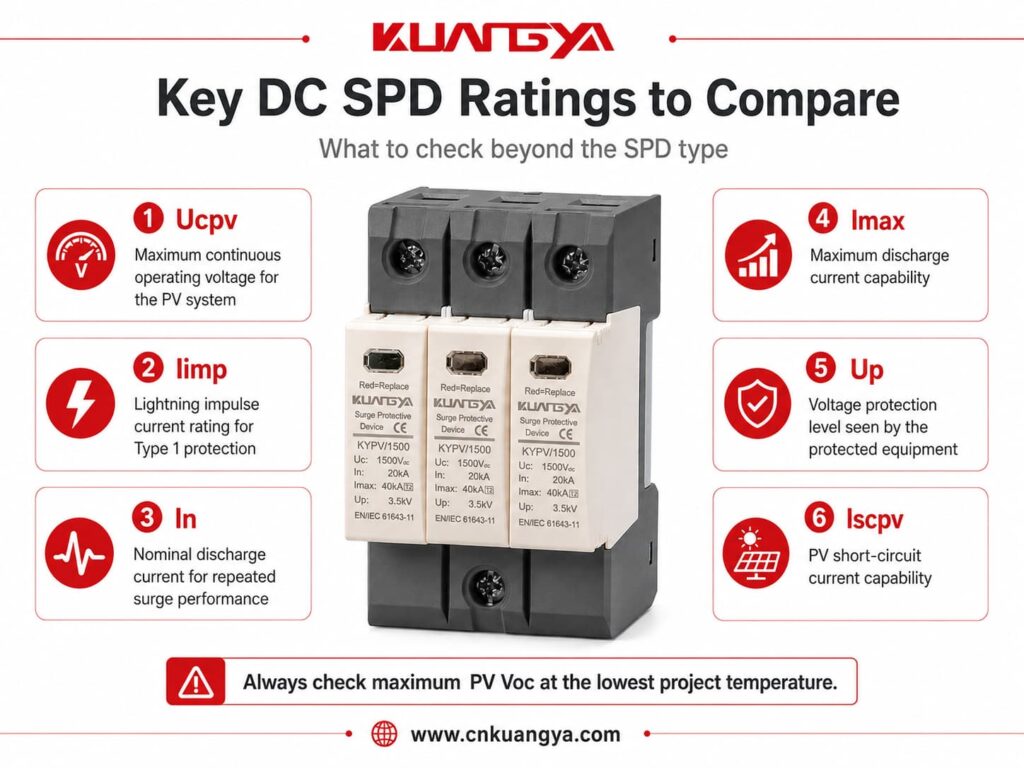
The SPD type alone cannot determine whether a product is suitable.
| Рейтинг | Значение | Typical Selection Error |
| Ucpv | Maximum continuous operating voltage for PV | Selecting from nominal system voltage only |
| Iimp | Lightning impulse-current capability | Ignoring it when Type 1 is required |
| На сайте | Номинальный разрядный ток | Treating it as identical to Imax |
| Imax | Максимальный разрядный ток | Assuming highest Imax = best SPD |
| Вверх | Уровень напряжения защиты | Ignoring protected equipment withstand |
| Iscpv | PV short-circuit capability | Using an unsuitable disconnection arrangement |
| Backup protection | Required upstream protection | Choosing fuse independently of SPD data |
| Количество столбов | Connection configuration | Wrong topology |
| Remote signalling | Monitoring function | Specified but forgotten during purchasing |
This is one of the most commercially important checks.
IEC 61643-31 applies to PV DC SPDs up to 1500 В пост. тока, but that does not mean any 1,500 V-labelled SPD is suitable for every system.
The designer should determine the maximum PV array open-circuit voltage under the project’s lowest expected temperature.
PV module Voc generally rises as cell temperature falls.
Therefore the correct workflow is:
Module Voc → number of modules in series → temperature correction → maximum array Voc → select suitable Ucpv
Not:
“Inverter says 1000V → buy any 1000V SPD.”
This subject deserves a separate article, which is why the next guide in this series will cover:
1000V vs 1500V DC SPD for Solar PV Systems.
One of the most important points in a Type 1 vs Type 2 SPD for solar comparison is understanding the difference between Iimp, In and Imax.
| Рейтинг | Most Relevant To | What It Tells You |
| Iimp | Тип 1 | Lightning impulse-current capability |
| На сайте | Тип 2 | Nominal discharge capability |
| Imax | Тип 2 | Maximum discharge-current capability |
| Вверх | All types | Residual protection level |
A product advertising:
Imax = 40 кА
does not automatically satisfy a project specification requiring:
Type 1 + defined Iimp
because they represent different test and protection concepts.
Manufacturer technical data provides a useful real-world demonstration of this distinction: current lightning/surge products specify separate 10/350 μs and 8/20 μs discharge capabilities rather than presenting them as one interchangeable current rating.
Large current figures are easy to market.
However, the purpose of the SPD is ultimately to prevent damaging voltage from reaching protected equipment.
That makes Up — voltage protection level — a critical selection parameter.
The engineer should compare:
SPD Up
with:
the impulse withstand capability of the protected inverter or other equipment.
A device with an impressive current rating but an unsuitable Up may not provide the desired equipment protection.
Photovoltaic DC circuits have different fault behaviour from conventional AC systems.
The SPD and its disconnection arrangement must therefore be suitable for the available PV short-circuit current.
Check:
The SPD should be coordinated with the system’s Защита предохранителями gPV, rather than selecting the fuse and SPD as unrelated components.
The following are engineering scenarios, not claimed customer case studies.
They are included to show the decision process without inventing project results.
| Сценарий | Conditions | Initial SPD Direction |
| Residential rooftop | No expected partial lightning current; short DC route | Evaluate Type 2 |
| Commercial roof with external LPS | LPS present; separation needs verification | Evaluate Type 1 / Type 1+2 requirement |
| Ground-mounted PV plant | High exposure; long outdoor DC routes | Perform lightning-risk and coordination evaluation |
| Combiner box far from inverter | Long cable between protection points | Evaluate coordinated SPDs at both ends |
| Tender specifies Type 1+2 | Defined Iimp, Ucpv and Up | Match all declared ratings, not label only |
Это различие важно.
We are не saying:
“Ground-mounted PV always requires Type 1.”
We are saying:
Its exposure, earthing and lightning-protection arrangement make a more detailed engineering assessment necessary.
Several mistakes repeatedly appear when engineers and buyers compare Type 1 vs Type 2 SPD for solar projects, especially when selection is based only on SPD type or discharge-current ratings.
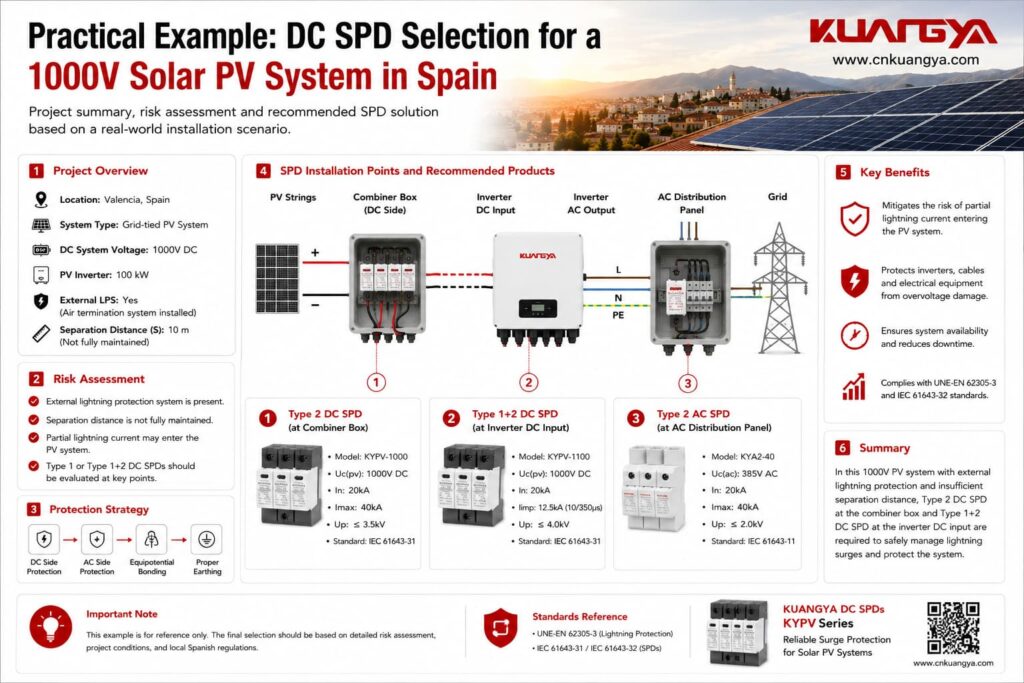
| Ошибка | Why It Is a Problem | Better Approach |
| 1. Type 1 is assumed to be “better” | SPD type is application-specific | Match expected surge condition |
| 2. Only Imax is compared | Does not show Type 1 capability | Compare Iimp, In and Imax |
| 3. Iimp is ignored | Critical when lightning current is expected | Verify declared Iimp |
| 4. Nominal PV voltage is used | Cold Voc may be higher | Calculate maximum Voc |
| 5. AC SPD is used on DC side | PV DC has different requirements | Use PV-rated SPD |
| 6. External LPS is ignored | Changes protection design | Coordinate LPS and SPD |
| 7. One SPD protects a long cable | Protection may not cover both ends | Evaluate coordinated SPDs |
| 8. Connections are unnecessarily long | Installation affects protection | Keep routing compact |
| 9. Up is ignored | Equipment may still see excessive voltage | Coordinate Up with equipment |
| 10. Only the Type label is checked | Products of same Type differ | Read full test data |
Normally, a conventional AC SPD should not be substituted for a PV-specific DC SPD simply because the voltage printed on the device appears similar.
IEC 61643-31 specifically covers SPDs designed for the DC side of PV generators and inverter DC inputs up to 1500 В пост. тока.
The buyer should therefore check:
rather than only checking the voltage value.
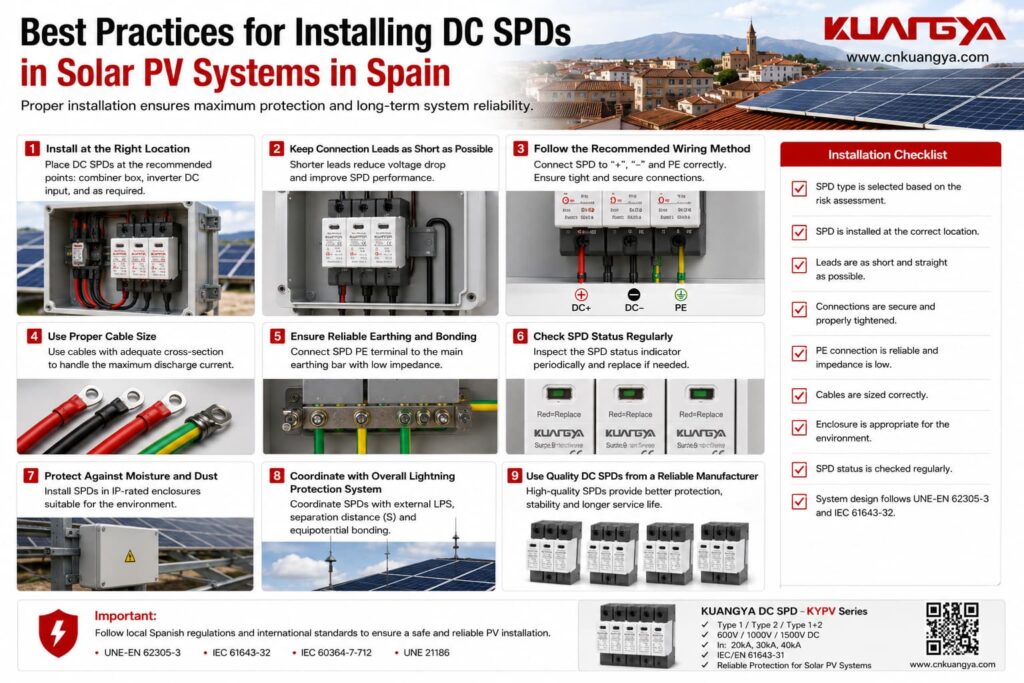
Before requesting a quotation or approving an SPD, collect the following information.
| Категория | Information Required |
| Project | Country, city, roof or ground-mounted |
| PV voltage | Maximum Voc and nominal system voltage |
| Температура | Minimum design temperature |
| Молния | External LPS and risk assessment |
| Separation | Whether required separation can be maintained |
| Расположение | Combiner box, inverter input, entry point |
| Кабель | Length between array, combiner and inverter |
| Тип УЗИП | Type 1, Type 2 or Type 1+2 if specified |
| Current ratings | Iimp, In and Imax |
| Защита | Required Up |
| PV fault current | Iscpv |
| Конфигурация | Poles and earthing arrangement |
| Мониторинг | Remote signalling required or not |
| Документация | Certification and test-report requirements |
| Количество | Required project quantity |
A technically useful RFQ is therefore:
“1500V DC PV project, inverter input protection, external LPS installed, Type 1+2 required, please confirm Ucpv, Iimp, In, Imax, Up, Iscpv, connection configuration and IEC 61643-31 test documentation.”
This gives a manufacturer far more useful information than:
“Please quote 1500V SPD.”
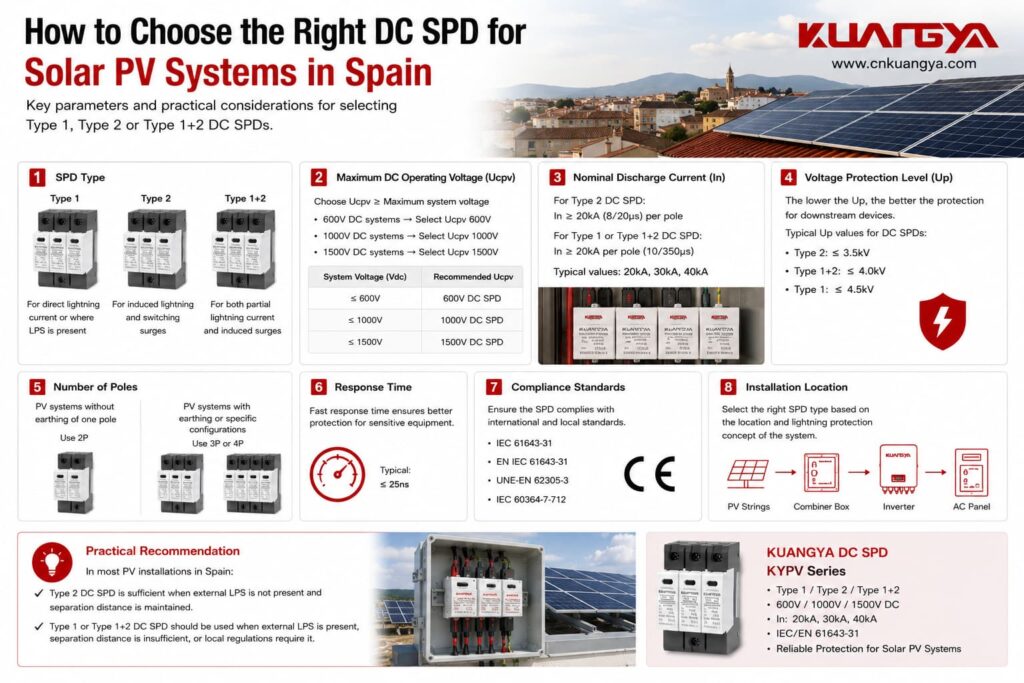
If you only remember one table from this article, use this one.
| Вопрос | If Yes | If No |
| Is partial lightning current expected at this point? | Evaluate Type 1 / Type 1+2 | Continue |
| Is protection mainly against induced and switching surges? | Evaluate Type 2 | Review risk concept |
| Are both functions required at the same point? | Evaluate Type 1+2 | Select required individual function |
| Is Ucpv above maximum corrected PV Voc? | Continue | Select another SPD |
| Is Up suitable for protected equipment? | Continue | Re-evaluate |
| Is Iscpv adequate? | Continue | Re-evaluate |
| Is the cable route long? | Check additional coordinated SPD | Continue |
| Is the product tested for PV DC use? | Continue | Do not substitute blindly |
The difference between Type 1 vs Type 2 SPD for solar cannot be reduced to one product being stronger or better than another.
For most projects, the correct logic is:
Тип 2
→ commonly evaluated for induced lightning and switching overvoltages.
Тип 1
→ evaluated when partial lightning current may enter the PV electrical installation.
Тип 1+2
→ evaluated where both functions are required at the same installation point.
For a solar PV project in Spain, the final decision should consider:
Most importantly:
Do not specify Type 1+2 simply because it appears to offer the highest level of protection. Specify the SPD that matches the actual lightning and surge conditions of the project.
IEC 61643-31 provides the PV-specific product framework for DC-side SPDs up to 1,500 V DC, while IEC 61643-32 addresses their selection, location and coordination within PV systems.
For product selection, you can view KUANGYA Type 2 and Type 1+2 DC SPDs, or send us:
for product-selection support.
Type 2 is commonly evaluated for residential PV installations where the protection requirement is primarily against induced lightning and switching surges.
However, the external lightning protection system, cable arrangement, separation conditions and project requirements must also be checked.
Therefore, Type 2 should not automatically be assumed suitable for every residential installation.
Нет.
The presence of an external lightning protection system is an important design factor, but it does not by itself prove that every DC SPD must be Type 1.
The engineer should also evaluate separation, bonding, cable routing and whether partial lightning current can enter the PV circuit.
Not automatically.
Type 1+2 provides combined lightning-current and surge-protection functions.
If the project only requires Type 2 performance at a particular installation point, selecting Type 1+2 solely because it appears “stronger” does not necessarily improve the overall protection design.
At some installation points, a properly selected Type 1+2 device can provide both functions.
However, this does not mean one Type 1+2 SPD can automatically replace all coordinated SPDs throughout a PV system.
Long cable routes and multiple protection zones may still require additional devices.
Iimp is associated with lightning impulse-current capability and is particularly important when evaluating Type 1 protection.
Imax is associated with the maximum discharge-current capability used for Type 2 performance.
The two values should not be treated as interchangeable.
A high Imax does not automatically provide the Iimp performance required for Type 1 applications.
A conventional AC SPD should not be selected for PV DC use simply because its voltage rating appears suitable.
PV DC SPDs should be designed and tested for the electrical characteristics of photovoltaic DC circuits.
IEC 61643-31 specifically covers SPDs for the DC side of PV systems up to 1,500 V DC.
Long cable routes may require coordinated SPDs at more than one location, such as near the array or combiner box and near the inverter.
The actual arrangement depends on cable length, installation layout, external lightning protection and equipment requirements.
IEC 61643-32 specifically addresses SPD location and coordination in photovoltaic installations.
UNE-EN 61643-31 / IEC 61643-31 is an important product reference for PV DC surge protective devices.
IEC 61643-32 provides principles for selection, installation and coordination.
Spanish electrical regulations, lightning-protection requirements and individual project specifications must also be considered before final selection.
Нет.
SPD type should be determined from the lightning protection concept, installation arrangement and applicable project requirements.
“Spain = Type 1” is not a technically correct selection rule.
At minimum, provide:
This allows the supplier to check the actual technical requirement rather than quoting only according to voltage.

