Промышленная зона Вэньян Юэцин Вэньчжоу 325000
Рабочие часы
Понедельник - пятница: 7AM - 7PM
Выходные: 10AM - 5PM
Промышленная зона Вэньян Юэцин Вэньчжоу 325000
Рабочие часы
Понедельник - пятница: 7AM - 7PM
Выходные: 10AM - 5PM

Краткий ответ: Not every PV string needs its own surge protective device (SPD). Whether DC-side surge protection is required, and whether a second SPD belongs near the array or combiner, depends on the local rules, lightning exposure, cable route, inverter arrangement and the installation’s lightning protection system. A PV-rated SPD near the inverter may be enough for a short DC run; longer runs may need a second device near the array.
Assess the DC side and AC side separately. On the DC side, identify the array, string combiner boxes, inverter inputs, cable lengths and equipotential bonding path. Schneider Electric’s Electrical Installation Guide for PV SPDs describes an SPD near the inverter and, when the array-to-inverter cable route exceeds about 10 m in its design example, an additional SPD near the modules or array box. Apply that guidance with the project’s adopted rules and equipment instructions; the distance is not a universal requirement to fit an SPD on every string.
For the AC output and main distribution board, select AC-rated SPDs for the relevant network and lightning risk. An AC SPD does not substitute for a device rated for the PV DC circuit.
PV modules are often installed on exposed roofs or open ground, while long conductor runs can carry transient overvoltages into inverters and monitoring equipment. A nearby lightning event can induce a surge without a direct strike to the array. The probability and severity depend on the site; no fixed distance from a strike, damage voltage, repair cost or lifetime loss can be promised for every plant.
An SPD limits transient voltage and diverts surge current under its declared test conditions. It cannot prevent all lightning damage, and it does not replace a lightning protection system, bonding, overcurrent protection or safe isolation.
IEC 61643-31 specifies requirements and tests for SPDs intended for the DC side of PV installations up to 1,500 V DC. IEC 61643-32 addresses selection, installation and coordination for PV systems. Read the current editions and local adoption before treating a design guide as a legal requirement.
Calculate the highest possible PV string open-circuit voltage using the module datasheet, series module count and the lowest expected cell temperature. Check that the selected SPD’s declared DC continuous operating voltage is suitable for that value and the circuit configuration. Also confirm the inverter’s maximum DC input voltage; an SPD cannot correct an oversized string.
Compare the declared voltage protection level (Up), including the effect of installation leads, with the impulse withstand of the protected equipment. Use the inverter and SPD datasheets. A fixed Up value for every 1,000 V or 1,500 V system is not reliable.
Type 1 and Type 2 ratings relate to different declared test duties. The selection depends on the lightning protection concept and exposure, not simply whether the array is on a roof or on the ground. Compare Iimp, In and Imax only with their stated test waveforms and the manufacturer’s declared configuration.
Verify the SPD’s declared short-circuit capability, disconnector and required backup fuse or breaker for the available PV fault current. Follow the manufacturer wiring diagram, including its polarity and earthing instructions. Do not assume that MOV, GDT or a combined design is always superior: the complete certified device and its application rating matter.
Keep SPD connections to the protected circuit and bonding bar short and direct. Schneider Electric’s guide illustrates a total connection length of less than 50 cm where practical. Check conductor cross-section, enclosure rating, torque, backup protection and bonding against the device instructions and local rules. The protective-earth arrangement is especially important when external lightning protection is present.
During maintenance, inspect the SPD’s status indication and any remote alarm in accordance with the manufacturer’s schedule. Replace a device when its indicator or testing shows failure, or when the manufacturer requires replacement after an event. There is no universal five-year or ten-year replacement date.
No blanket rule requires one SPD per string. Determine the number and location of devices from the project risk assessment, layout, adopted rules and equipment documentation. Check whether a combiner-side and inverter-side arrangement provides the required protection.
Use only a device explicitly rated by its manufacturer for that PV DC application and voltage. IEC 61643-31 is the relevant product standard for PV DC SPDs in its scope. An AC-only marking is not evidence of PV DC suitability. See our AC versus DC SPD explanation.
No. The test waveform, SPD type, Uc, Up, short-circuit behavior, backup protection and installation leads must all fit the circuit. Compare complete device datasheets rather than a single headline rating.
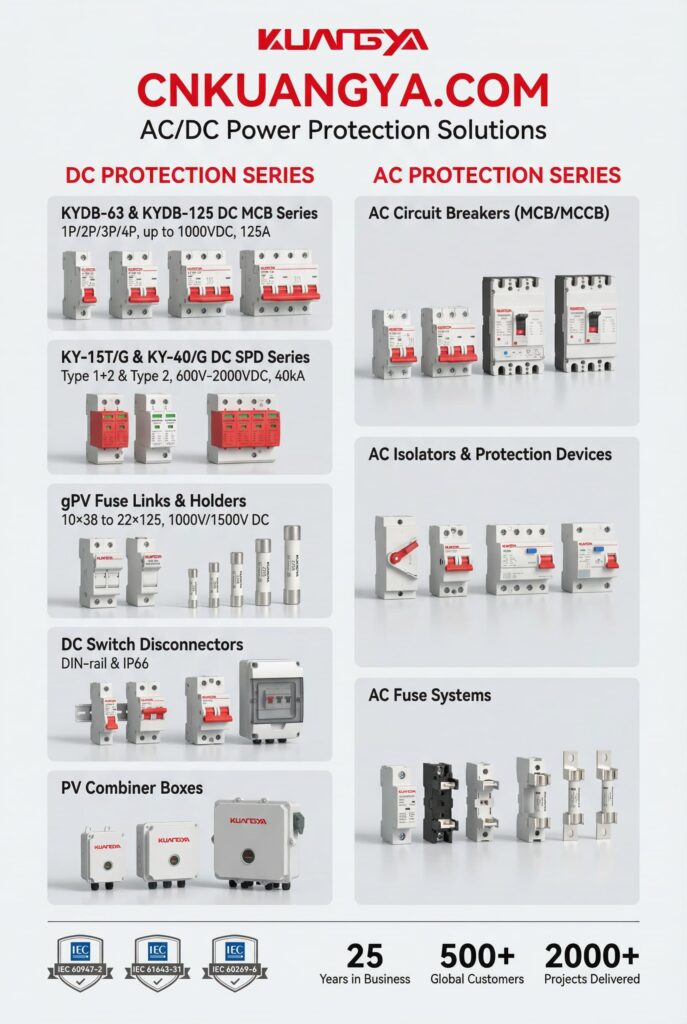
Review Kuangya’s PV DC SPD range и PV combiner box options. For a selection review, send the team the string Voc calculation, system voltage, array-to-inverter cable route, lightning protection arrangement and required SPD location. Selection and installation should be checked by a qualified electrical designer or installer.

