Промышленная зона Вэньян Юэцин Вэньчжоу 325000
Рабочие часы
Понедельник - пятница: 7AM - 7PM
Выходные: 10AM - 5PM
Промышленная зона Вэньян Юэцин Вэньчжоу 325000
Рабочие часы
Понедельник - пятница: 7AM - 7PM
Выходные: 10AM - 5PM

Last Updated: July 4, 2026 | Version 1.0
Автоматическое устройство пожаротушения для электротехнических шкафов | Горячий аэрозоль
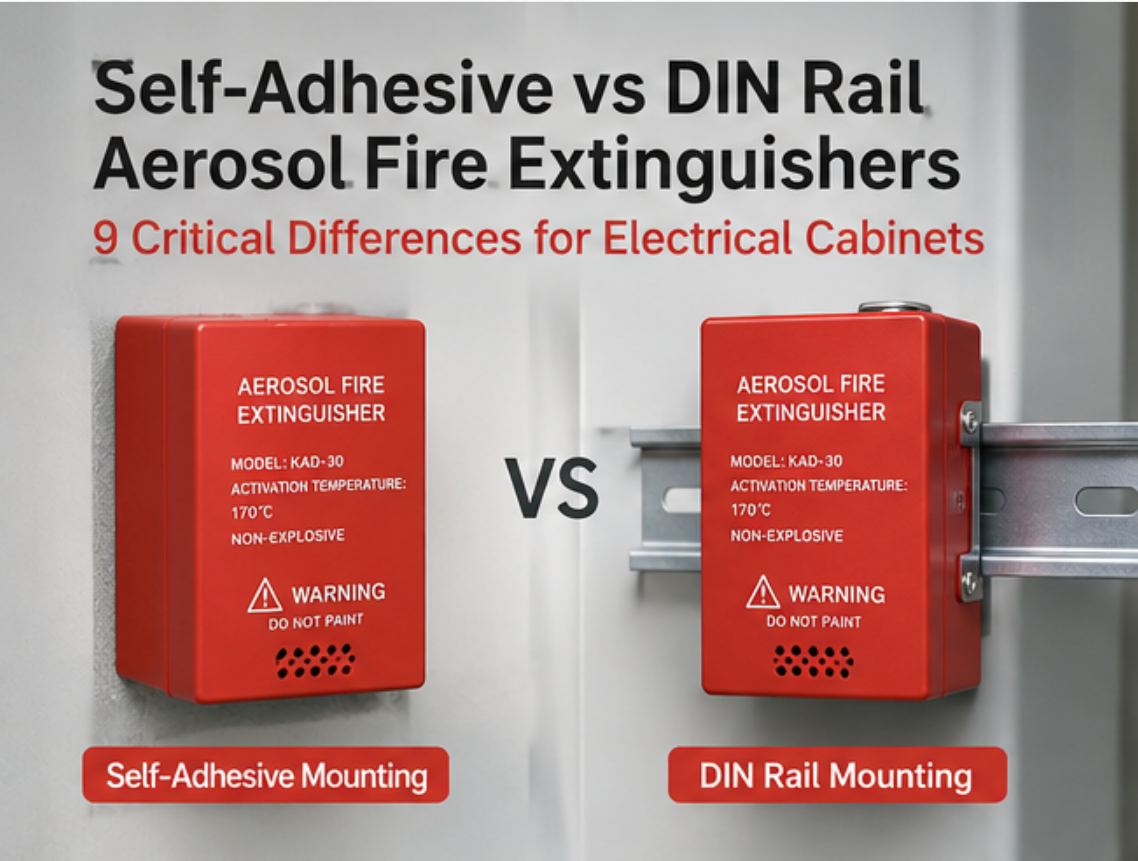
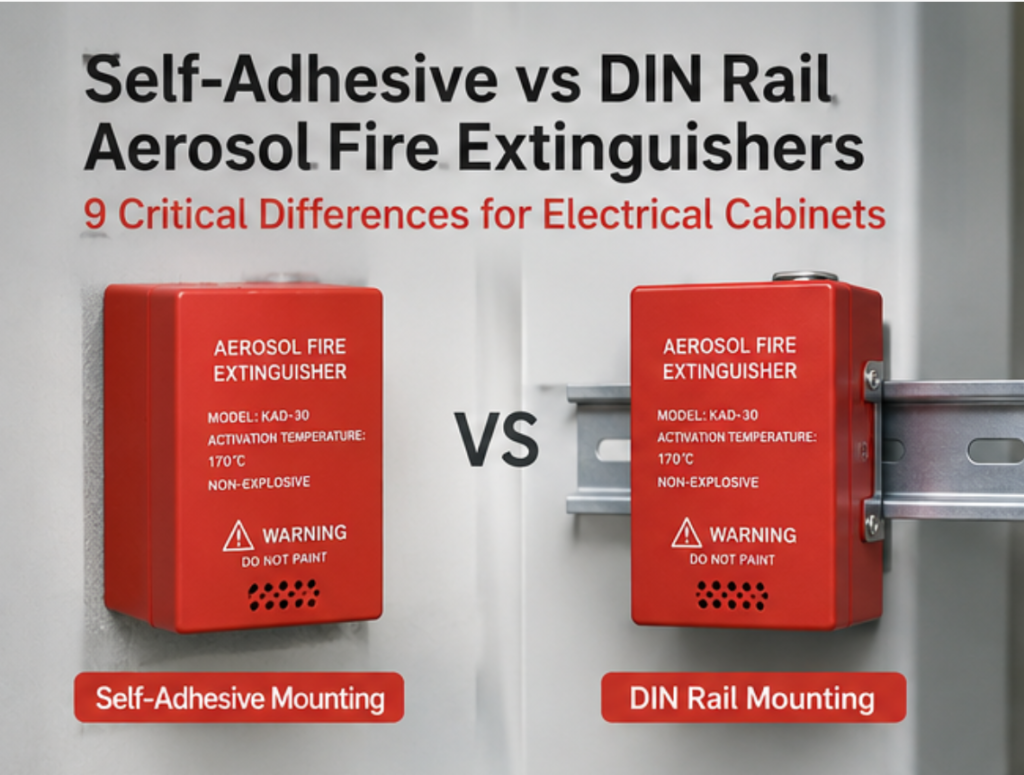
A DIN Rail Aerosol Fire Extinguisher provides mechanically secured, cabinet-level fire protection for electrical enclosures, while a self-adhesive aerosol unit prioritizes fast installation and flexible placement. Neither mounting method is automatically superior. The correct option depends on cabinet construction, available rail space, vibration, surface condition, maintenance requirements, environmental exposure, and project approval standards.
For electrical panel builders, solar EPC contractors, industrial automation companies, telecom operators, and equipment manufacturers, the mounting method is more than a minor installation detail. It affects long-term mechanical reliability, inspection access, retrofit complexity, cabinet layout, and procurement acceptance.
This guide compares self-adhesive and DIN rail aerosol fire extinguishers across nine practical engineering criteria. It also provides a selection matrix, application recommendations, installation checklist, procurement specification, and frequently asked questions.
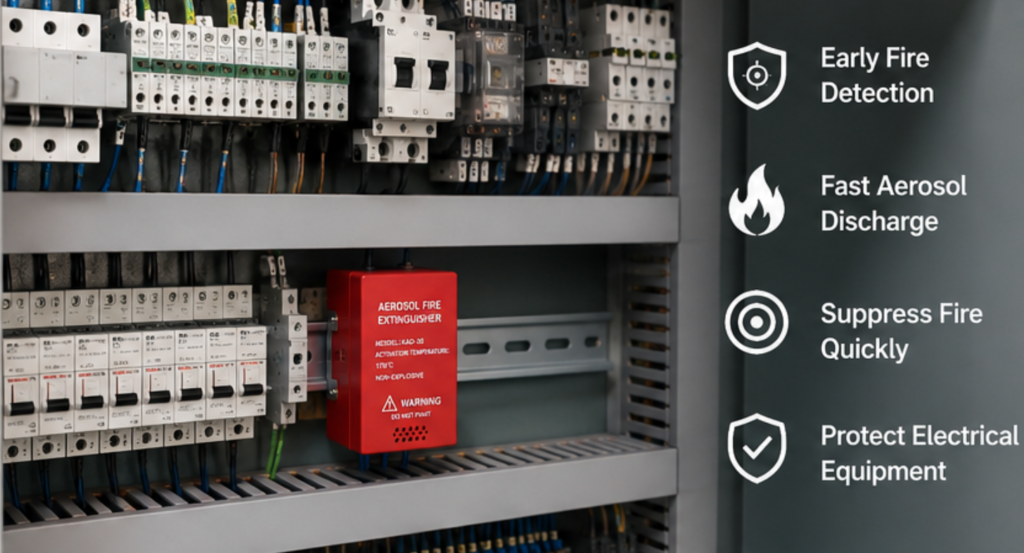
Выберите DIN Rail Aerosol Fire Extinguisher when the cabinet already includes a suitable DIN rail, the installation may experience vibration, the device needs to be removable for inspection, or the project requires a clearly documented mechanical mounting method.
Choose a self-adhesive aerosol fire extinguisher when available installation space is limited, no DIN rail is available, drilling is undesirable, and the mounting surface is clean, stable, compatible with the adhesive, and approved by the device manufacturer.
| Project condition | Recommended mounting method |
|---|---|
| New electrical cabinet production | Монтаж на DIN-рейку |
| OEM panel manufacturing | Монтаж на DIN-рейку |
| Existing cabinet without spare DIN rail | Self-adhesive mounting |
| High vibration environment | Монтаж на DIN-рейку |
| Small sealed PV box | Self-adhesive or compact bracket mounting |
| Frequent inspection or replacement | Монтаж на DIN-рейку |
| Curved, dusty or oily surface | Монтаж на DIN-рейку |
| Fast retrofit with no drilling | Self-adhesive mounting |
| High-temperature outdoor cabinet | Project-specific evaluation required |
| Formal EPC documentation required | DIN rail or manufacturer-approved bracket |
The final decision must follow the manufacturer’s installation instructions, the tested configuration of the device, local fire regulations, and project requirements.
A DIN Rail Aerosol Fire Extinguisher is a compact fixed fire-suppression device designed to mount on a standard DIN rail inside an electrical cabinet.
The unit normally contains a solid aerosol-forming compound and an activation mechanism. When activated, the device generates condensed aerosol particles and gaseous products that interfere with the chemical reactions supporting combustion.ISO 15779 for condensed aerosol fire extinguishing systems
Unlike a handheld fire extinguisher, the device remains permanently installed inside the protected enclosure. It is intended to respond close to the potential ignition source, such as:
The DIN rail mounting structure mechanically locks the unit to the cabinet rail. This makes the installation method familiar to panel builders because many electrical components already use DIN rail mounting.
International standards generally describe these products as fixed condensed aerosol extinguishing systems rather than portable extinguishers. ISO 15779 covers requirements and test methods for condensed aerosol system components and provides recommendations for system design, installation, testing, maintenance, and safety. NFPA 2010 also establishes minimum requirements for fixed aerosol fire-extinguishing systems. Self-Adhesive Aerosol Fire Extinguisher?
A self-adhesive aerosol fire extinguisher uses an adhesive mounting layer, adhesive pad, or manufacturer-supplied bonding system to attach the device to the internal surface of an enclosure.
Common mounting surfaces include:
The main advantage is installation flexibility. The installer does not necessarily need an existing DIN rail, mounting bracket, or drilled hole.
This can be useful in compact retrofit applications where the electrical cabinet is already fully assembled. However, adhesive installation introduces additional factors that must be evaluated carefully, including surface preparation, material compatibility, temperature, moisture, dust, oil, vibration, and long-term bonding strength.
A self-adhesive system should never be treated as a generic “peel and stick” product. The complete mounting arrangement must be approved by the aerosol device manufacturer for the intended cabinet and environment.
| Comparison factor | Self-adhesive unit | DIN rail unit |
|---|---|---|
| Installation speed | Очень быстро | Быстрый |
| Existing DIN rail required | Нет | Обычно да |
| Drilling required | Normally no | Normally no if rail exists |
| Mechanical locking | Adhesive bond | Rail clip or bracket |
| Removal for inspection | May damage adhesive | Usually easier |
| Surface preparation | Критический | Less dependent on surface finish |
| Vibration resistance | Depends on adhesive and surface | Generally more mechanically stable |
| Position flexibility | Очень высокий | Limited by rail position |
| Retrofit suitability | Превосходно | Good if rail space exists |
| OEM panel production | Хорошо | Превосходно |
| Визуальный осмотр | Depends on location | Usually straightforward |
| Reinstallation | May need new adhesive | Usually reusable mounting point |
| Suitability for dusty surfaces | Limited without preparation | Лучше |
| Documentation clarity | Requires adhesive specification | Easy to show on panel drawings |
The first difference is how the device is physically secured.
A DIN Rail Aerosol Fire Extinguisher is normally attached through a rail clip, mechanical bracket, or locking structure. The load is transferred through the metal rail and cabinet mounting system.
A self-adhesive unit depends on the bond between:
Any weakness in these layers can reduce long-term mounting reliability.
For example, a strong adhesive may still fail if it is bonded to loose paint, powder residue, oil, condensation, or a surface coating with low adhesion.
Mechanical DIN rail mounting is therefore often preferred when the cabinet is exposed to:
This does not mean every DIN rail mounting method is automatically safe. The rail itself must be securely fixed, and the mounting clip must be suitable for the weight, discharge forces, and operating conditions of the device.
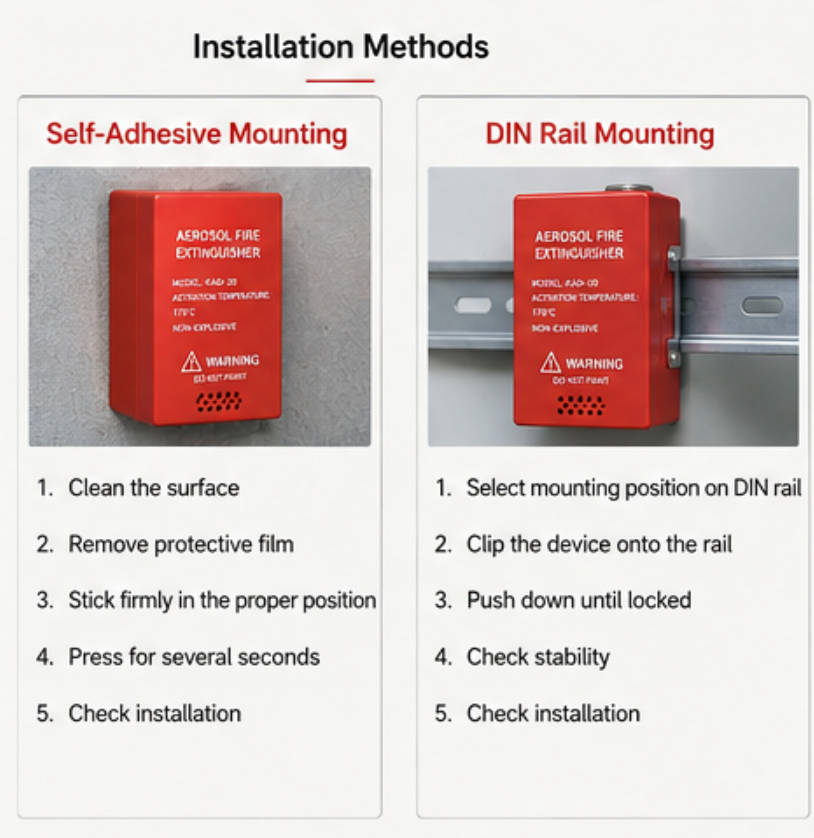
Self-adhesive units are usually faster to install in completed cabinets.
A typical installation process may involve:
A DIN Rail Aerosol Fire Extinguisher can also be installed quickly when suitable rail space is already available. The installer places the unit on the rail, engages the clip, checks the lock, and confirms the required clearance.
The difference becomes more significant when the cabinet has no spare DIN rail.
Adding a new rail may require:
For field retrofits, adhesive mounting may therefore reduce installation time. For newly manufactured panels, DIN rail mounting can be incorporated into the design from the beginning and may be equally efficient.
Electrical cabinet space is limited and valuable.
A self-adhesive device can often be positioned on an unused cabinet surface that would not otherwise hold electrical components. This may include the upper side wall or enclosure ceiling.
A DIN Rail Aerosol Fire Extinguisher occupies DIN rail length that might otherwise be required for:
However, placing the extinguisher on a DIN rail can make the cabinet layout more organized and predictable. It also gives engineers a defined mounting location in the panel drawing.
The correct decision should be based on more than the amount of unused space. The discharge path, thermal activation position, accessibility, electrical clearance, and airflow must also be considered.
The smallest available gap is not always the best installation location.
Vibration is one of the strongest reasons to consider a DIN Rail Aerosol Fire Extinguisher.
Cabinets installed near motors, pumps, compressors, production machinery, diesel generators, railway equipment, or mobile platforms may be exposed to continuous low-level vibration and occasional mechanical shock.
Over time, vibration can affect an adhesive bond through:
DIN rail mounting provides a mechanical connection, but it must still be checked for loosening, clip fatigue, rail deformation, and cabinet vibration.
For high-vibration applications, the project engineer should verify:
Adhesive installation may remain possible in some vibration environments, but only when the complete mounting system has been validated for those conditions.
Electrical enclosures can experience significant temperature variation.
Outdoor PV cabinets, telecom enclosures, EV charging equipment, and desert installations may face high daytime temperatures followed by rapid nighttime cooling. Indoor industrial panels can also experience local heat from drives, transformers, power supplies, and busbars.
Temperature affects both mounting methods differently.
For a self-adhesive unit, engineers must consider:
A DIN Rail Aerosol Fire Extinguisher is less dependent on adhesive performance, but temperature still affects the extinguisher itself, its activation mechanism, the rail clip, nearby wiring, and the cabinet environment.
The activation temperature must not be confused with the normal ambient operating temperature.
An automatic thermal device must be selected so that normal cabinet heat does not cause unwanted activation, while a developing fire can still be detected early enough.
Do not select the activation rating by using the average room temperature alone. Consider the maximum internal cabinet temperature at full electrical load.
A DIN Rail Aerosol Fire Extinguisher is usually easier to remove without damaging the mounting surface.
This is valuable when:
A self-adhesive device may require a replacement adhesive pad or mounting kit after removal. Residual adhesive may also need to be removed without damaging the cabinet coating.
Inspection access should be considered during the design stage.
The label, production date, service-life information, activation indicator, thermal element, wiring, and mounting condition should remain visible or reasonably accessible.
Hiding an aerosol unit behind large cable bundles may save space, but it can make inspection difficult and obstruct aerosol distribution.
Self-adhesive units have a clear advantage in many retrofit projects.
Existing cabinets may have:
In these cases, a manufacturer-approved adhesive unit can provide an installation option without redesigning the entire panel.
However, the installer must still confirm that the selected surface is structurally suitable. Cabinet doors, removable covers, flexible plastic walls, hot components, cable ducts, and heavily curved surfaces may be unsuitable.
A DIN Rail Aerosol Fire Extinguisher remains suitable for retrofit work when spare rail capacity exists and the selected position provides adequate discharge distribution.
Retrofit simplicity must never override the manufacturer’s installation restrictions or the required extinguishing performance.
DIN rail mounting is particularly attractive for OEM cabinet manufacturers.
A panel builder can define the DIN Rail Aerosol Fire Extinguisher in:
The position can be repeated across multiple cabinet models, improving consistency.
Self-adhesive units can also be standardized, but the manufacturing process must clearly specify:
Without these instructions, different workers may install the same device using inconsistent methods.
For volume production, the repeatability of the installation process may be as important as the initial installation speed.
Large EPC projects often require more than a product datasheet.
The contractor, consultant, end user, insurer, or authority having jurisdiction may ask for:
A DIN Rail Aerosol Fire Extinguisher provides an easily recognizable mechanical mounting arrangement, but the mounting method alone does not establish fire-system compliance.
ISO 15779 addresses condensed aerosol system components and system design, installation, testing, maintenance, and safety. NFPA 2010 contains minimum requirements for fixed aerosol fire-extinguishing systems, while UL testing and certification frameworks address the performance and safety evaluation of extinguishing-system units. ferenced as a standard for fixed condensed aerosol extinguishing system units. Project teams should verify the exact certification, listing, and edition required in the destination market rather than assuming that one document is accepted everywhere. ounting Method Change Fire-Suppression Performance?
The mounting method does not directly determine the chemical extinguishing capability of the aerosol compound.
However, it can indirectly affect performance by changing:
A poorly positioned DIN Rail Aerosol Fire Extinguisher may perform worse than a correctly positioned adhesive unit.
Similarly, a properly selected adhesive unit may initially provide good distribution but become unreliable if the mounting surface was not prepared correctly.
The correct engineering objective is not simply to choose a mounting label. It is to maintain the tested and approved device position throughout the required service life.

PV combiner boxes often have limited internal space and may already contain string fuses, fuse holders, SPDs, monitoring equipment, terminals, and a DC isolator.
For small boxes without spare rail space, a compact self-adhesive unit may be easier to position. For larger combiner boxes or new designs, a DIN Rail Aerosol Fire Extinguisher can be integrated into the component layout.
The extinguisher must not obstruct:
IEC 61439-8:2026 specifically addresses low-voltage switchgear and controlgear assemblies for photovoltaic installations with DC voltages up to 1,500 V. The introduction of this dedicated PV assembly standard makes disciplined cabinet design, verification, and documentation increasingly important. tion Cabinets
PLC cabinets usually benefit from organized DIN rail layouts. A DIN Rail Aerosol Fire Extinguisher can fit naturally into new cabinet designs.
The unit should remain separated from sensitive control wiring and should not discharge directly into a tightly packed cable duct unless this arrangement is approved by the manufacturer.
Motor-control centers and power distribution cabinets may contain higher fault energy, larger busbars, contactors, breakers, and power cables.
Mechanical mounting is often preferable because of cabinet size, vibration, maintenance activity, and the need for formal documentation.
Large or compartmentalized cabinets may require more than one unit. A single device should not be assumed to protect several internally separated zones.
Telecom cabinets are frequently deployed outdoors and may have restricted free space. Self-adhesive mounting can be useful for retrofit projects, while DIN rail mounting may be better for standardized equipment production.
Humidity, condensation, dust, temperature cycling, and ventilation must be evaluated.
EV charging equipment combines power electronics, communication equipment, terminals, protective devices, fans, and sometimes separate AC and DC compartments.
A DIN Rail Aerosol Fire Extinguisher may be suitable for control or distribution compartments, but the complete charging cabinet must be assessed zone by zone.
The extinguisher must not interfere with cooling airflow or maintenance access.
Aerosol suppression can be considered for electrical and control compartments associated with battery energy storage systems.
It should not be presented as a method for stopping electrochemical thermal runaway inside a lithium-ion cell. Battery safety still requires cell monitoring, thermal management, isolation, ventilation, detection, and system-level fire engineering.
Mechanical mounting is generally the stronger starting point. A DIN Rail Aerosol Fire Extinguisher with an approved locking mechanism is usually easier to justify than an unverified adhesive installation.
Score each factor from 1 to 5.
| Decision factor | Self-adhesive weighting | DIN rail weighting |
|---|---|---|
| No spare rail space | 5 | 1 |
| Fast retrofit required | 5 | 3 |
| High vibration | 2 | 5 |
| Frequent replacement | 2 | 5 |
| Surface is clean and flat | 5 | 3 |
| Surface is oily or dusty | 1 | 5 |
| OEM repeat production | 3 | 5 |
| Flexible mounting position | 5 | 3 |
| Formal drawing requirement | 3 | 5 |
| No drilling permitted | 5 | 5 |
| High thermal cycling | 2 | 4 |
| Limited cabinet depth | 4 | 3 |
The matrix is a preliminary decision tool, not a substitute for manufacturer instructions or a fire-protection design.
Record:
Do not use the external cabinet dimensions as the protected volume without checking the internal structure.
Обзор:
Identify all locations where the device could be installed without obstructing electrical operation, airflow, or maintenance.
Рассмотрите:
Choose a self-adhesive or DIN Rail Aerosol Fire Extinguisher according to the actual cabinet conditions rather than purchasing the cheapest physical format.
Check that the product documentation and system design meet project, market, insurer, consultant, and authority requirements.
Document:
Dust, grease, moisture, and loose coating can weaken adhesive mounting.
Replacing the manufacturer-supplied adhesive with ordinary double-sided tape can invalidate the installation design.
A thermal actuator placed too close to a transformer, resistor, heater, or hot exhaust may be exposed to abnormal non-fire temperatures.
Cable ducts, busbars, covers, wiring bundles, and large components can prevent effective distribution.
Internal barriers can stop aerosol movement. Each enclosed compartment may require separate analysis.
A loose, short, plastic, damaged, or poorly fixed rail may not provide reliable support.
The unit should not block access to fuses, breakers, terminals, filters, fans, or replaceable SPD cartridges.
A DIN Rail Aerosol Fire Extinguisher is a final containment layer. It does not replace correct fuses, circuit breakers, SPDs, cable sizing, torque control, thermal management, or preventive maintenance.
Compliance should be based on actual test reports, certifications, listings, and project acceptance—not generic statements such as “internationally certified.”
Use the following specification when requesting quotations:
Продукт: Fixed condensed aerosol fire-suppression unit for electrical cabinet protection
Mounting type: DIN rail, self-adhesive, or manufacturer-approved bracket
Protected application: PLC cabinet, MCC panel, PV combiner box, telecom cabinet, EV charger, switchgear, distribution board, or other enclosure
Required information:
Для DIN Rail Aerosol Fire Extinguisher, also request:
For a self-adhesive unit, also request:
A panel builder is producing 200 identical automation cabinets. Every cabinet includes spare DIN rail space and follows the same internal layout.
Recommended approach: DIN rail mounting.
A DIN Rail Aerosol Fire Extinguisher offers repeatable installation, clear documentation, easier inspection, and simpler replacement.
A solar operator wants to retrofit suppression inside existing combiner boxes. There is no spare rail space, and drilling the enclosure may affect its sealing.
Possible approach: Manufacturer-approved self-adhesive mounting.
The surface, temperature, enclosure material, discharge path, and adhesive compatibility must be verified.
The cabinet operates beside a diesel generator and experiences continuous vibration.
Recommended starting point: Mechanically locked DIN rail or approved bracket mounting.
Adhesive mounting should only be used if validated for the vibration and temperature conditions.
The cabinet experiences high humidity, condensation, and large temperature changes.
Required action: Compare both mounting methods using environmental test data. Do not assume adhesive or DIN rail mounting is automatically suitable.
The cabinet has very limited space and forced-air cooling.
Required action: Evaluate airflow, compartment separation, normal operating temperature, discharge direction, and maintenance access before selecting the mounting method.
Aerosol fire-suppression design should be treated as a system-level engineering task.
Important reference areas include:
ISO 15779 provides requirements and recommendations for condensed aerosol extinguishing systems, including components, design, installation, testing, maintenance, and safety. s fixed aerosol fire-extinguishing systems and is intended for parties involved in purchasing, design, installation, testing, inspection, approval, operation, and maintenance. wer switchgear and controlgear assemblies, IEC 61439-2 applies to assemblies rated up to 1,000 V AC or 1,500 V DC. PV project teams should also review IEC 61439-8:2026 for photovoltaic assemblies. reference standard does not mean every product automatically complies. Buyers should ask for documentation covering the exact model, activation method, extinguishing-agent quantity, and mounting configuration being purchased.
Neither mounting method should be ignored after installation.
A maintenance program should inspect:
A DIN Rail Aerosol Fire Extinguisher should be checked for rail movement, clip damage, corrosion, and accidental displacement.
A self-adhesive unit should be checked for edge lifting, bond deterioration, surface-coating separation, moisture, and movement.
Any cabinet redesign should trigger a new review. Adding cable ducts, fans, partitions, or large electrical components may change the protected volume and aerosol distribution.
Select a DIN Rail Aerosol Fire Extinguisher when mechanical retention, standardized panel construction, inspection access, vibration resistance, and project documentation are the priorities.
Select a self-adhesive unit when retrofit flexibility, limited space, and installation without rail modification are more important—and when the surface and environment are fully compatible with the manufacturer-approved adhesive system.
The mounting method is only one part of the fire-protection decision.
A complete electrical cabinet protection strategy should combine:
For OEM panel builders, solar EPC contractors, industrial automation companies, telecom operators, and equipment distributors, KUANGYA can support project-specific aerosol fire-suppression selection, DIN rail and self-adhesive mounting options, OEM customization, technical documentation, and electrical protection component coordination.
Contact KUANGYA with the cabinet dimensions, internal layout, application, ambient temperature, and project requirements to receive a more accurate product recommendation.
A DIN Rail Aerosol Fire Extinguisher is a compact fixed aerosol fire-suppression unit mounted on a standard DIN rail inside an electrical cabinet. It provides automatic or electrically activated fire containment close to internal ignition risks.
Not in every application. DIN rail mounting normally provides stronger mechanical retention and easier removal, while adhesive mounting provides greater location flexibility and simpler retrofit installation.
It can lose adhesion when the surface is dirty, oily, wet, incompatible, poorly coated, exposed to excessive heat, or subjected to vibration beyond the approved conditions. Correct surface preparation and manufacturer-approved adhesive are essential.
Yes, provided the unit is suitable for the protected volume and environment, adequate rail space exists, and it does not obstruct fuses, SPDs, isolators, terminals, cable routing, or heat dissipation.
That depends on the activation method. Some devices use thermal activation without an external power supply, while others may use electrical activation, detection input, or a control system.
It should be installed in a manufacturer-approved position that supports effective distribution, early activation, safe clearance, mechanical security, and inspection access. Avoid obstructed spaces and normal high-temperature zones.
Not automatically. Internal partitions may prevent aerosol distribution. Each compartment should be evaluated according to its volume, openings, hazards, and communication with adjacent spaces.
Suitability depends on the tested product, agent formulation, electrical application, required clearances, and manufacturer documentation. Buyers should request evidence for the exact device rather than relying on a general aerosol claim.
No. A fuse or circuit breaker interrupts electrical fault current. Aerosol suppression is intended to control fire after ignition begins. The technologies perform different functions and should form part of a layered protection strategy.
Provide the cabinet’s internal dimensions, net volume, compartment layout, equipment type, ventilation, maximum internal temperature, potential ignition sources, environmental conditions, mounting space, activation preference, and destination-market certification requirements.
Follow the manufacturer’s instructions, project maintenance plan, applicable standard, and local regulation. Inspection should include mounting integrity, activation condition, environmental damage, service-life date, and cabinet modifications.
A DIN Rail Aerosol Fire Extinguisher is often better for repeatable OEM production because it can be included in drawings, bills of materials, assembly instructions, inspections, and replacement procedures.
A self-adhesive device may be easier when there is no spare DIN rail or drilling is prohibited. A DIN rail model remains preferable when rail space exists and mechanical retention is important.
No. Only the mounting materials and methods specified or approved by the device manufacturer should be used.
The quotation should include the product model, protected volume, aerosol mass, activation method, mounting type, environmental limits, service life, installation manual, test information, certification documents, inspection requirements, and OEM options.

