WengYang Industrial Zone Yueqing Wenzhou 325000
Horas de trabalho
De segunda a sexta-feira: das 7h às 19h
Fim de semana: 10:00 - 17:00
WengYang Industrial Zone Yueqing Wenzhou 325000
Horas de trabalho
De segunda a sexta-feira: das 7h às 19h
Fim de semana: 10:00 - 17:00

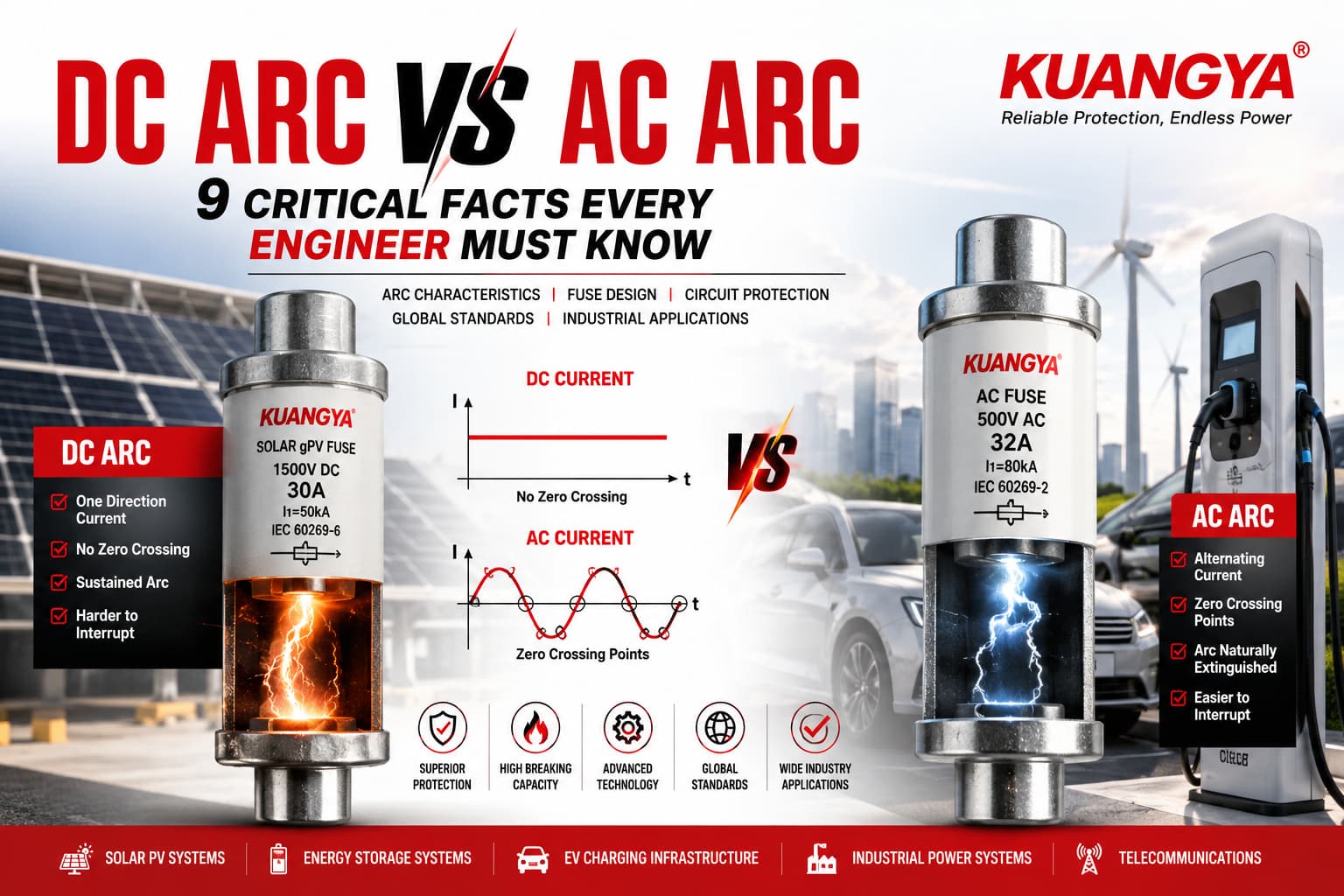
Nos sistemas elétricos modernos, a seleção do fusível correto não é simplesmente uma questão de escolher a classificação de corrente correta. Uma das considerações mais importantes é se o aplicativo opera com corrente alternada (CA) ou corrente contínua (CC).
Muitas falhas elétricas ocorrem porque um fusível de CA é instalado por engano em um circuito de CC, ou vice-versa. Embora ambos os dispositivos tenham sido projetados para interromper condições de sobrecorrente, a física por trás de Arco CC vs. Arco CA são fundamentalmente diferentes.
Para engenheiros, eletricistas, construtores de painéis, instaladores solares, fabricantes de carregamento de veículos elétricos e profissionais de manutenção industrial, entender essas diferenças é essencial para garantir a segurança, a conformidade e a confiabilidade do sistema a longo prazo.
Este guia fornece uma comparação técnica abrangente entre fusíveis CC e fusíveis CA, explica a ciência por trás da interrupção de arco e explora como os padrões e as aplicações elétricas diferem entre as regiões do mundo.
Antes de comparar as aplicações de fusíveis CA e CC, é útil entender a função básica de um fusível em sistemas de proteção elétrica.
Um fusível é um dispositivo sacrificial de proteção contra sobrecorrente projetado para desconectar um circuito quando a corrente excede um nível predeterminado.
O princípio básico é simples:
Embora o princípio de operação seja semelhante para os sistemas CA e CC, o desafio começa depois que o elemento fusível derrete.
A verdadeira questão é:
O fusível pode extinguir o arco elétrico com segurança?
É nesse ponto que o debate sobre Arco CC vs. Arco CA começa.
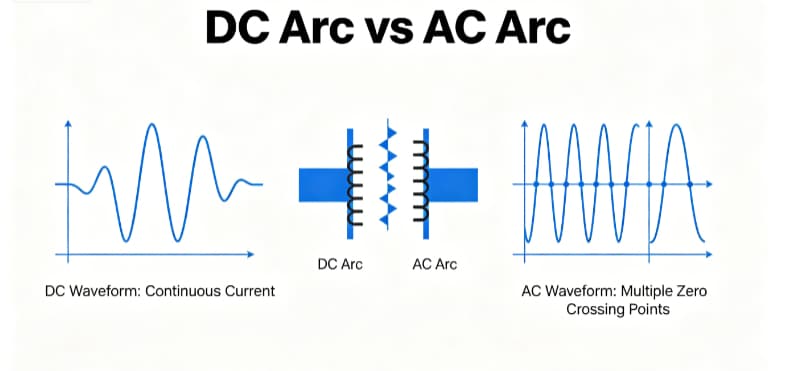
Quando um fusível se abre, o circuito não para imediatamente de conduzir eletricidade.
Quando o elemento fusível se separa, forma-se um arco elétrico entre as duas extremidades do condutor derretido.
Esse arco pode atingir temperaturas superiores a:
| Tipo de arco | Temperatura típica |
|---|---|
| Arco AC | 5.000°C - 10.000°C |
| Arco DC | 10.000°C - 20.000°C |
A capacidade de extinguir esse arco determina se o fusível pode interromper a falha com segurança.
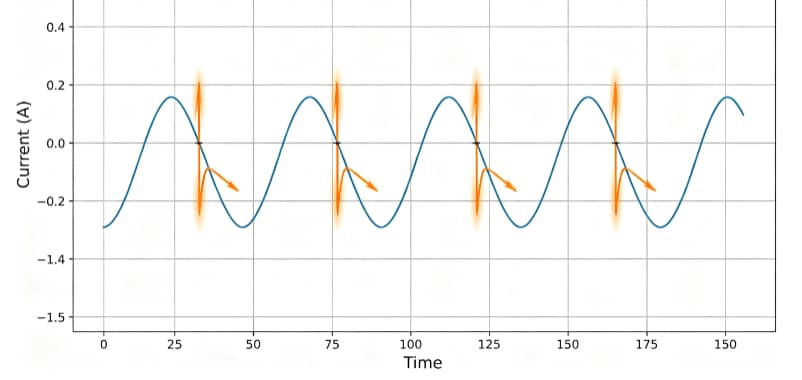
Nos sistemas CA, a corrente muda de direção continuamente.
Por exemplo:
| Frequência | Zero cruzamentos por segundo |
|---|---|
| 50Hz | 100 |
| 60 Hz | 120 |
Toda vez que a corrente passa de zero, o arco se enfraquece naturalmente.
Essa interrupção natural da corrente ajuda a extinguir o arco.
| Característica | Arco AC |
|---|---|
| Auto-extinguível | Sim |
| Mais fácil de interromper | Sim |
| Duração do arco | Curto |
| Complexidade do fusível | Inferior |
| Custo | Inferior |
Como a corrente CA cai repetidamente para zero, os fusíveis CA geralmente exigem menos tecnologia de supressão de arco.
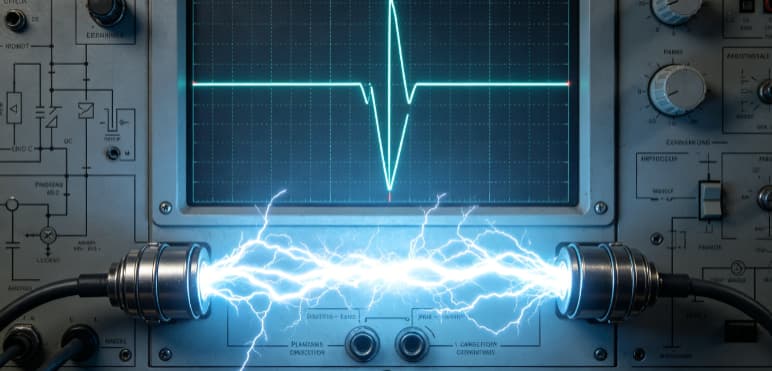
A corrente CC flui continuamente em uma direção.
Ao contrário da CA, não há pontos naturais de cruzamento zero.
Portanto:
O arco permanece sustentado.
O fusível deve forçar o arco a se extinguir mecânica ou quimicamente.
| Característica | Arco DC |
|---|---|
| Auto-extinguível | Não |
| Mais fácil de interromper | Não |
| Duração do arco | Mais longo |
| Complexidade do fusível | Mais alto |
| Custo | Mais alto |
É por isso que a construção do fusível CC é significativamente diferente.
Esse é um dos motivos mais importantes pelos quais a compreensão do arco CC versus arco CA é fundamental para os engenheiros que trabalham com sistemas de energia solar, armazenamento de bateria e infraestrutura de carregamento de veículos elétricos.
Muitos engenheiros subestimam o poder destrutivo dos arcos CC.
Um arco CC pode:
Considere uma cadeia solar fotovoltaica de 1500 V.
Quando ocorre uma falha:
Sem a interrupção adequada do arco CC, pode ocorrer uma falha catastrófica.
Esse é um dos motivos pelos quais os sistemas solares exigem fusíveis gPV dedicados em vez de fusíveis CA padrão.
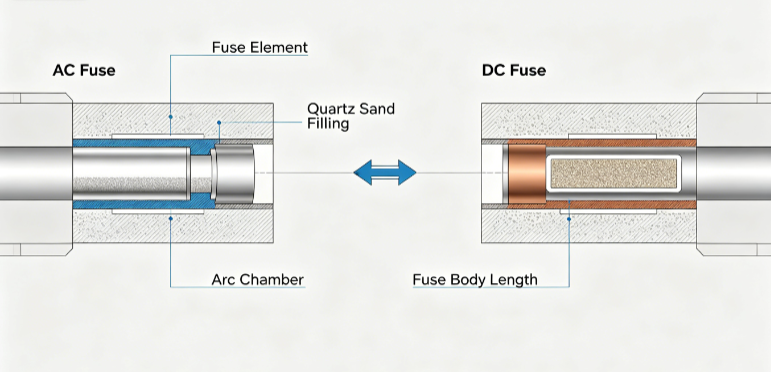
As diferenças estruturais entre os fusíveis CA e CC estão diretamente relacionadas aos desafios apresentados pela interrupção de arco CC versus arco CA.
Embora os fusíveis CC e CA possam parecer semelhantes externamente, sua construção interna difere significativamente.
| Recurso | Fusível CA | Fusível CC |
|---|---|---|
| Elemento fusível | Padrão | Especializado |
| Areia de resfriamento a arco | Básico | Aprimorado |
| Comprimento do corpo | Mais curto | Mais longo |
| Capacidade de ruptura | Inferior | Mais alto |
| Câmara de arco | Simples | Avançado |
| Classificação da tensão | Inferior | Mais alto |
Os engenheiros geralmente notam que os fusíveis CC são fisicamente maiores.
Isso ocorre porque um corpo mais longo aumenta a distância do arco.
Caminhos de arco mais longos facilitam a interrupção.
Por exemplo:
| Tipo de fusível | Comprimento típico |
|---|---|
| Fusível CA | 38 mm |
| Fusível solar CC | 85 mm |
| NH Fusível CC | 150 mm+ |
O comprimento adicional ajuda a suprimir os arcos CC sustentados.
À medida que a energia renovável continua a se expandir, a compreensão do arco CC versus arco CA se torna cada vez mais importante na seleção de dispositivos de proteção para sistemas CC modernos.
Os fusíveis CC são amplamente usados em sistemas modernos de energia renovável.
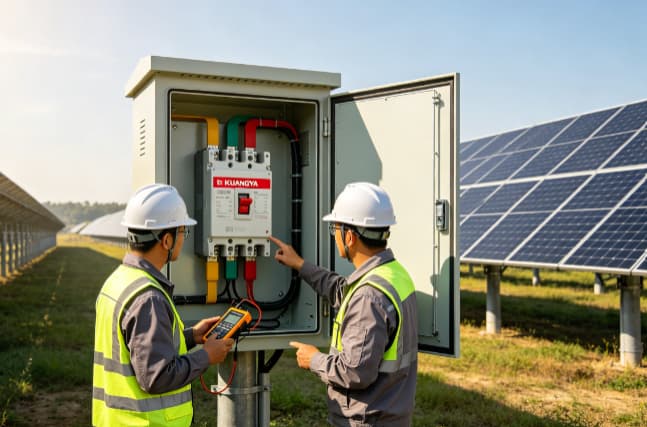
Tensão típica:
| Tipo de sistema | Tensão |
|---|---|
| FV residencial | 600V-1000V CC |
| FV comercial | 1000V-1500V CC |
| Escala de utilidade pública | Até 1500V CC |
Os engenheiros também devem entender os princípios de seleção por trás dos fusíveis gPV dedicados. proteção solar por fusível em sistemas fotovoltaicos.
As instalações de BESS exigem fusíveis de CC porque as baterias produzem inerentemente corrente contínua.
Tensões comuns:
| Aplicativo | Tensão |
|---|---|
| Armazenamento residencial | 48V-200V CC |
| Armazenamento comercial | 600V-1000V CC |
| Armazenamento de utilidades | 1500V CC |
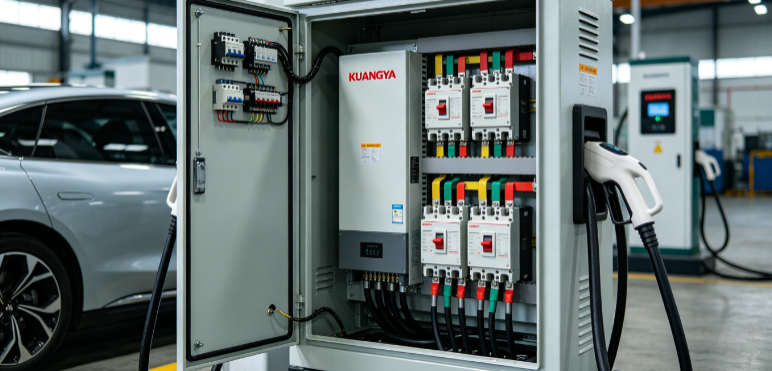
As baterias de EV operam em CC.
A proteção é necessária para:
Os fusíveis CC protegem:
A comparação entre arco CC e arco CA ajuda os engenheiros a entender por que os projetos de fusíveis CA são geralmente mais simples do que os projetos de fusíveis CC.
Os fusíveis de CA permanecem dominantes na distribuição tradicional de energia.
Proteção para:
Proteção para:
Proteção para:
Muitas falhas de instalação ocorrem porque as diferenças entre arco CC e arco CA são ignoradas durante o projeto do sistema.
Esse é um dos erros de instalação mais perigosos.
As possíveis consequências incluem:
| Modo de falha | Resultado |
|---|---|
| Persistência do arco | Risco de incêndio |
| Interrupção Incompleta | Danos ao equipamento |
| Explosão de fusível | Risco pessoal |
| Falha no sistema | Tempo de inatividade prolongado |
Os engenheiros nunca devem presumir que um fusível CA pode substituir um fusível CC.
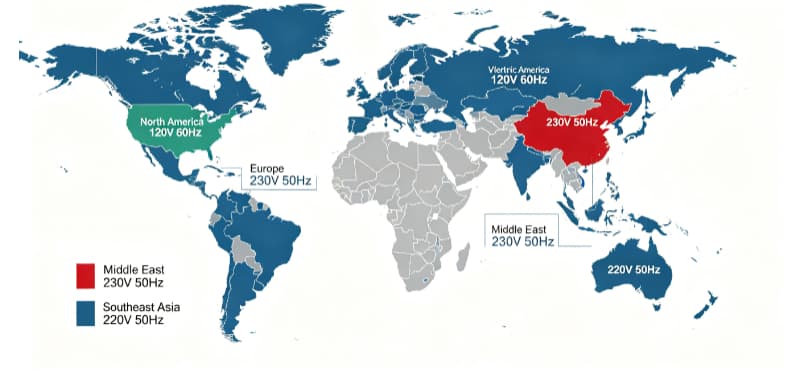
Independentemente do país ou do padrão de tensão, os princípios de arco CC versus arco CA continuam sendo um fator importante na seleção de fusíveis.
Os engenheiros que trabalham em projetos multinacionais devem verificar requisitos de tensão regional e códigos de instalação.
Países diferentes usam padrões de tensão e frequência diferentes.
Isso afeta a seleção do fusível.
Países:
Fornecimento típico:
| Parâmetro | Valor |
|---|---|
| Tensão | 120V / 240V CA |
| Frequência | 60 Hz |
Aplicativos:
Países:
Fornecimento típico:
| Parâmetro | Valor |
|---|---|
| Tensão | 230V / 400V CA |
| Frequência | 50Hz |
Tipos comuns de fusíveis:
Países:
Fornecimento típico:
| Parâmetro | Valor |
|---|---|
| Tensão | 230V / 400V CA |
| Frequência | 50Hz |
Demanda crescente por:
Países:
Fornecimento típico:
| Parâmetro | Valor |
|---|---|
| Tensão | 220V-240V CA |
| Frequência | 50Hz |
Setores de alto crescimento:
A principal diferença entre o arco CC e o arco CA é que a corrente CA passa naturalmente pelos pontos de cruzamento zero, ajudando a extinguir o arco. A corrente CC flui continuamente, tornando a interrupção do arco significativamente mais difícil.
Entender o que é arco CC versus arco CA é essencial em sistemas solares fotovoltaicos porque as matrizes fotovoltaicas geram corrente contínua. A seleção adequada do fusível depende da capacidade de interromper arcos CC com segurança em condições de falha.
Às vezes sim, mas somente se o fabricante certificar explicitamente o fusível para operação em CA. Sempre verifique a folha de dados antes da instalação.
Os sistemas solares fotovoltaicos geralmente operam com altas tensões CC. Os fusíveis solares especializados são projetados para interromper com segurança os arcos de CC nesses níveis de tensão.
Ao contrário da corrente alternada, a corrente contínua não passa naturalmente por zero. Como resultado, o arco pode permanecer energizado por um tempo muito maior e requer métodos especiais de interrupção.
O comportamento dos arcos elétricos e o desempenho da interrupção são amplamente abordados em padrões internacionais de baixa tensão.
Sim. Os fusíveis CC exigem tecnologia de supressão de arco mais avançada, maior capacidade de interrupção e construção interna mais complexa.
Os aplicativos de crescimento mais rápido incluem:
Centros de dados
Sistemas solares fotovoltaicos
Sistemas de armazenamento de energia por bateria (BESS)
Infraestrutura de carregamento de veículos elétricos
Telecomunicações
| Recurso | Arco DC | Arco AC |
|---|---|---|
| Direção atual | One Direction | Alternado |
| Cruzamento Zero | Não | Sim |
| Duração do arco | Longo | Curto |
| Energia do arco | Mais alto | Inferior |
| Dificuldade de interrupção | Alta | Baixa |
| Risco de incêndio | Mais alto | Inferior |
| Complexidade do design do fusível | Alta | Moderado |
| Custo | Mais alto | Inferior |
| Aplicações típicas | Solar, EV, BESS | Edifícios, fábricas |
Às vezes sim, mas somente se o fabricante certificar explicitamente o fusível para operação em CA.
Sempre verifique a folha de dados.
Como os sistemas fotovoltaicos geram altas tensões CC que exigem recursos especializados de interrupção de arco.
Porque a corrente CC nunca cruza o zero naturalmente.
O arco permanece energizado continuamente.
Sim.
Eles exigem:
Os setores de crescimento mais rápido incluem:
Ao selecionar um fusível:
Nunca presuma.
A classificação de tensão do fusível deve ser igual ou superior à tensão do sistema.
As classificações de corrente de falha devem exceder a corrente potencial de curto-circuito.
Os exemplos incluem:
Os sistemas de energia renovável continuam aumentando em tensão e potência.
A seleção de dispositivos de proteção prontos para o futuro reduz os custos de atualização.
Compreender o arco CC versus arco CA é essencial para todo engenheiro, eletricista e projetista elétrico. As diferenças entre arco CC e arco CA influenciam diretamente o projeto do fusível, o desempenho da interrupção de arco e a segurança geral do sistema.
Os engenheiros devem continuar acompanhando a evolução padrões e práticas recomendadas do setor à medida que os aplicativos de corrente contínua se tornam cada vez mais comuns em todo o mundo.
Enquanto os arcos CA se beneficiam de cruzamentos naturais de corrente zero, os arcos CC permanecem sustentados e são muito mais difíceis de extinguir. Essa diferença fundamental orienta o projeto, a construção e a aplicação dos fusíveis modernos.
Como a energia solar fotovoltaica, o armazenamento de energia da bateria, a infraestrutura de carregamento de veículos elétricos e as telecomunicações continuam a se expandir em todo o mundo, a tecnologia de fusíveis CC está se tornando cada vez mais importante.
A escolha do fusível correto não se refere apenas às classificações de corrente, mas também à interrupção segura da energia elétrica em condições de falha.
Um fusível CC ou CA adequadamente selecionado protege o equipamento, aumenta a confiabilidade do sistema, reduz o tempo de inatividade e, o mais importante, ajuda a evitar falhas elétricas catastróficas.
Como a adoção de energia renovável continua a se acelerar, a importância de entender o arco CC versus o arco CA continuará a crescer.
Você também pode se interessar por:
Para obter mais soluções de proteção elétrica, visite www.cnkuangya.com.

