WengYang Industrial Zone Yueqing Wenzhou 325000
Work Hours
Monday to Friday: 7AM - 7PM
Weekend: 10AM - 5PM
WengYang Industrial Zone Yueqing Wenzhou 325000
Work Hours
Monday to Friday: 7AM - 7PM
Weekend: 10AM - 5PM

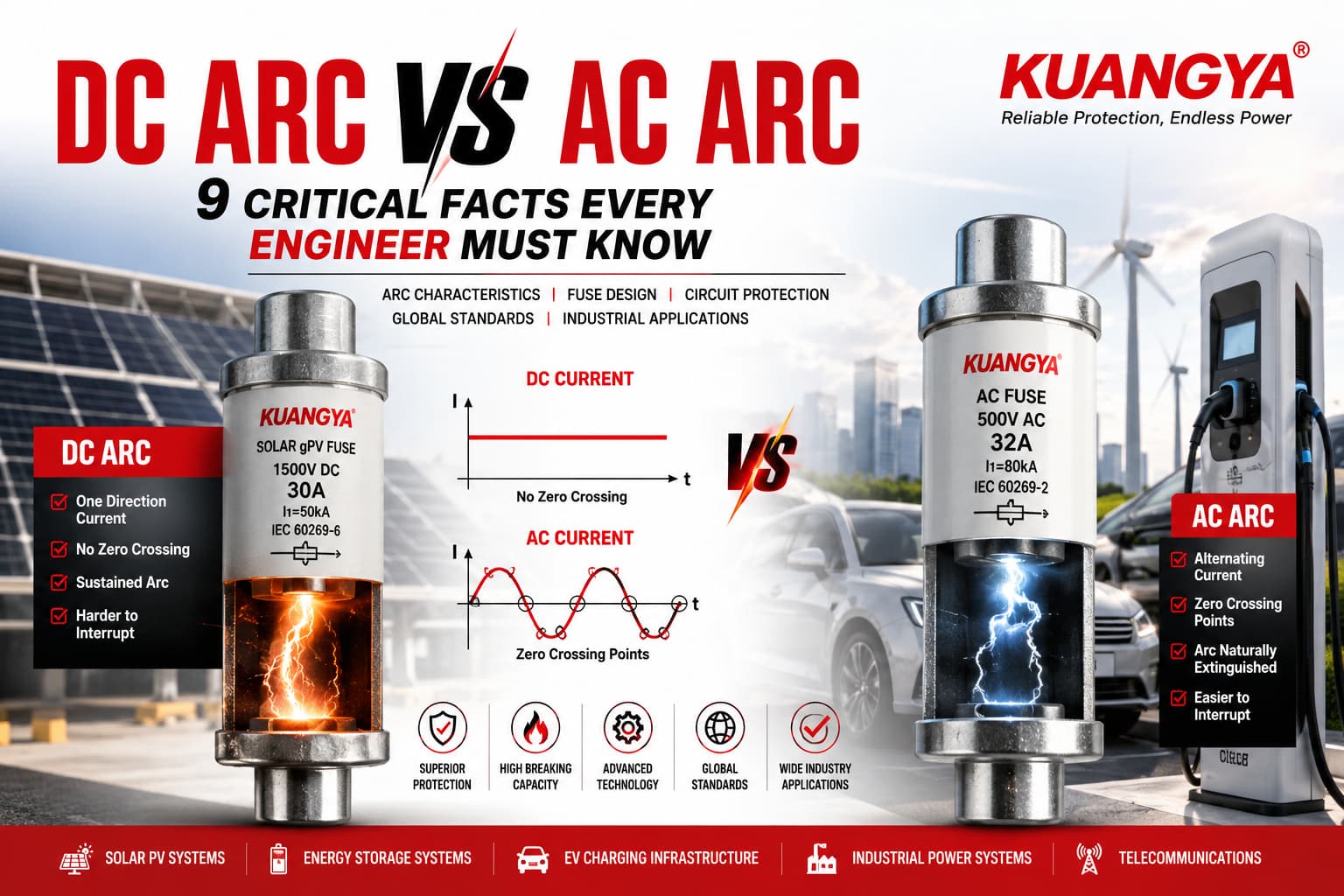
In modern electrical systems, selecting the correct fuse is not simply a matter of choosing the right current rating. One of the most critical considerations is whether the application operates on alternating current (AC) or direct current (DC).
Many electrical failures occur because an AC fuse is mistakenly installed in a DC circuit, or vice versa. While both devices are designed to interrupt overcurrent conditions, the physics behind DC Arc vs AC Arc are fundamentally different.
For engineers, electricians, panel builders, solar installers, EV charging manufacturers, and industrial maintenance professionals, understanding these differences is essential for ensuring safety, compliance, and long-term system reliability.
This guide provides a comprehensive technical comparison of DC fuses and AC fuses, explains the science behind arc interruption, and explores how electrical standards and applications differ across regions worldwide.
Before comparing AC and DC fuse applications, it is helpful to understand the basic function of a fuse in electrical protection systems.
A fuse is a sacrificial overcurrent protection device designed to disconnect a circuit when current exceeds a predetermined level.
The basic principle is simple:
Although the operating principle is similar for both AC and DC systems, the challenge begins after the fuse element melts.
The real question becomes:
Can the fuse extinguish the electrical arc safely?
This is where the debate of DC Arc vs AC Arc begins.
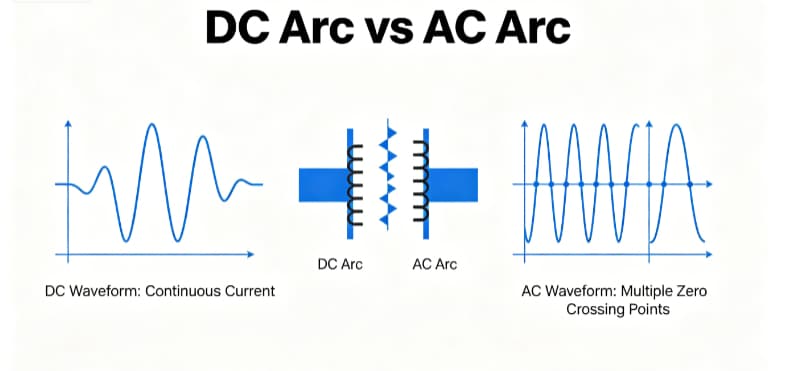
When a fuse opens, the circuit does not immediately stop conducting electricity.
As the fuse element separates, an electrical arc forms between the two ends of the melted conductor.
This arc can reach temperatures exceeding:
| Arc Type | Typical Temperature |
|---|---|
| AC Arc | 5,000°C – 10,000°C |
| DC Arc | 10,000°C – 20,000°C |
The ability to extinguish this arc determines whether the fuse can safely interrupt the fault.
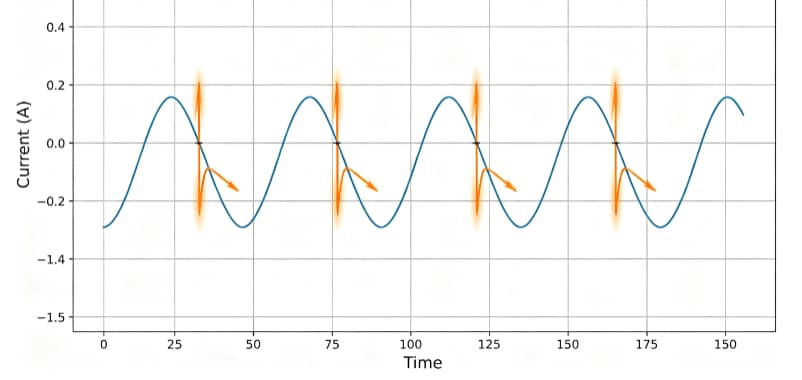
In AC systems, current changes direction continuously.
For example:
| Frequency | Zero Crossings Per Second |
|---|---|
| 50Hz | 100 |
| 60Hz | 120 |
Every time the current crosses zero, the arc naturally weakens.
This natural current interruption helps extinguish the arc.
| Characteristic | AC Arc |
|---|---|
| Self-extinguishing | Yes |
| Easier to interrupt | Yes |
| Arc duration | Short |
| Fuse complexity | Lower |
| Cost | Lower |
Because AC current repeatedly drops to zero, AC fuses generally require less arc suppression technology.
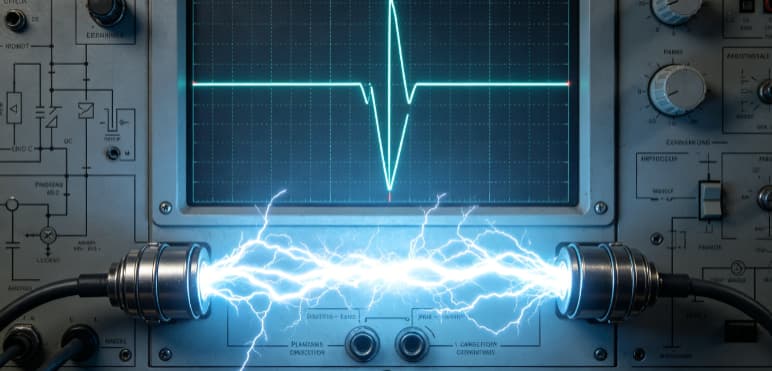
DC current flows continuously in one direction.
Unlike AC, there are no natural zero-crossing points.
Therefore:
The arc remains sustained.
The fuse must force the arc to extinguish mechanically or chemically.
| Characteristic | DC Arc |
|---|---|
| Self-extinguishing | No |
| Easier to interrupt | No |
| Arc duration | Longer |
| Fuse complexity | Higher |
| Cost | Higher |
This is why DC fuse construction is significantly different.
This is one of the most important reasons why understanding DC Arc vs AC Arc is critical for engineers working with solar power systems, battery storage, and EV charging infrastructure.
Many engineers underestimate the destructive power of DC arcs.
A DC arc can:
Consider a 1500V solar PV string.
When a fault occurs:
Without proper DC arc interruption, catastrophic failure may occur.
This is one reason solar systems require dedicated gPV fuses rather than standard AC fuses.
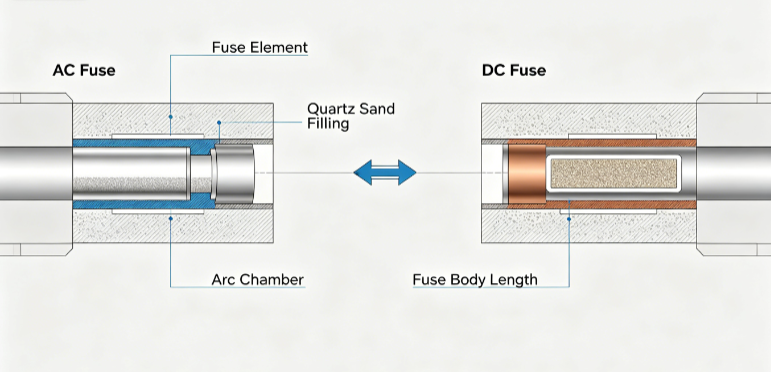
The structural differences between AC and DC fuses are directly related to the challenges presented by DC Arc vs AC Arc interruption.
Although DC and AC fuses may appear similar externally, their internal construction differs significantly.
| Feature | AC Fuse | DC Fuse |
|---|---|---|
| Fuse Element | Standard | Specialized |
| Arc Quenching Sand | Basic | Enhanced |
| Body Length | Shorter | Longer |
| Breaking Capacity | Lower | Higher |
| Arc Chamber | Simple | Advanced |
| Voltage Rating | Lower | Higher |
Engineers often notice that DC fuses are physically larger.
This is because a longer body increases arc distance.
Longer arc paths make interruption easier.
For example:
| Fuse Type | Typical Length |
|---|---|
| AC Fuse | 38mm |
| DC Solar Fuse | 85mm |
| NH DC Fuse | 150mm+ |
The additional length helps suppress sustained DC arcs.
As renewable energy continues to expand, understanding DC Arc vs AC Arc becomes increasingly important when selecting protection devices for modern DC systems.
DC fuses are widely used in modern renewable energy systems.
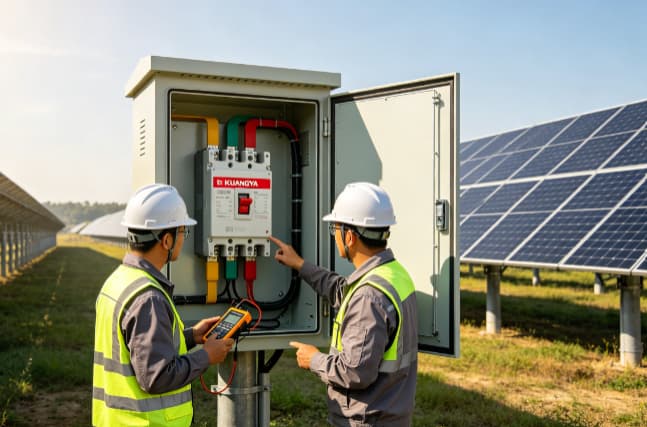
Typical voltage:
| System Type | Voltage |
|---|---|
| Residential PV | 600V-1000V DC |
| Commercial PV | 1000V-1500V DC |
| Utility Scale | Up to 1500V DC |
Dedicated gPV fuses are required.Engineers should also understand the selection principles behind solar fuse protection in photovoltaic systems.
BESS installations require DC fuses because batteries inherently produce direct current.
Common voltages:
| Application | Voltage |
|---|---|
| Residential Storage | 48V-200V DC |
| Commercial Storage | 600V-1000V DC |
| Utility Storage | 1500V DC |
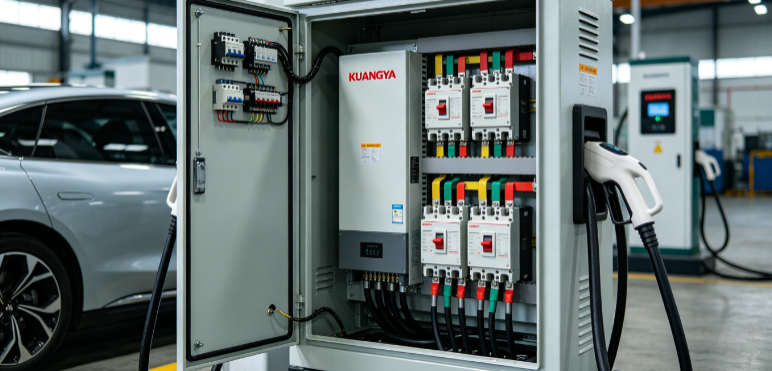
EV batteries operate on DC.
Protection is required for:
DC fuses protect:
Comparing DC Arc vs AC Arc helps engineers understand why AC fuse designs are generally simpler than DC fuse designs.
AC fuses remain dominant in traditional power distribution.
Protection for:
Protection for:
Protection for:
Many installation failures occur because the differences between DC Arc vs AC Arc are overlooked during system design.
This is one of the most dangerous installation mistakes.
Possible consequences include:
| Failure Mode | Result |
|---|---|
| Arc Persistence | Fire Risk |
| Incomplete Interruption | Equipment Damage |
| Fuse Explosion | Personnel Hazard |
| System Failure | Extended Downtime |
Engineers should never assume that an AC fuse can replace a DC fuse.
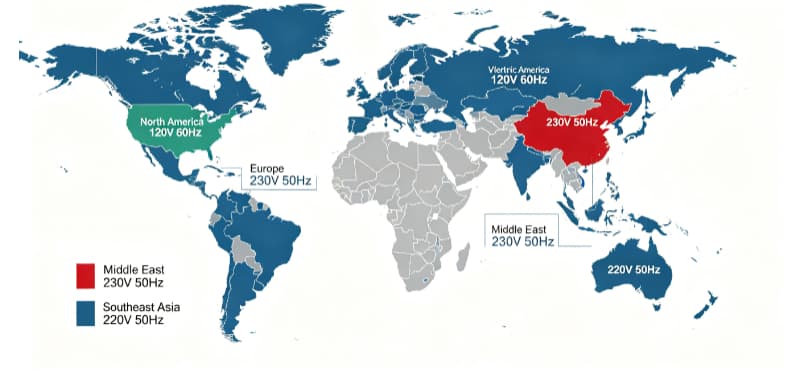
Regardless of the country or voltage standard, the principles of DC Arc vs AC Arc remain a key factor in fuse selection.
Engineers working in multinational projects should verify regional voltage requirements and installation codes.
Different countries use different voltage and frequency standards.
This affects fuse selection.
Countries:
Typical supply:
| Parameter | Value |
|---|---|
| Voltage | 120V / 240V AC |
| Frequency | 60Hz |
Applications:
Countries:
Typical supply:
| Parameter | Value |
|---|---|
| Voltage | 230V / 400V AC |
| Frequency | 50Hz |
Common fuse types:
Countries:
Typical supply:
| Parameter | Value |
|---|---|
| Voltage | 230V / 400V AC |
| Frequency | 50Hz |
Growing demand for:
Countries:
Typical supply:
| Parameter | Value |
|---|---|
| Voltage | 220V-240V AC |
| Frequency | 50Hz |
High growth sectors:
The main difference between DC Arc vs AC Arc is that AC current naturally passes through zero-crossing points, helping extinguish the arc. DC current flows continuously, making arc interruption significantly more difficult.
Understanding DC Arc vs AC Arc is essential in solar photovoltaic systems because PV arrays generate direct current. Proper fuse selection depends on the ability to interrupt DC arcs safely under fault conditions.
Sometimes yes, but only if the manufacturer explicitly certifies the fuse for AC operation. Always check the datasheet before installation.
Solar photovoltaic systems often operate at high DC voltages. Specialized solar fuses are designed to safely interrupt DC arcs at these voltage levels.
Unlike AC current, DC current does not naturally pass through zero. As a result, the arc can remain energized for a much longer time and requires special interruption methods.
The behavior of electrical arcs and interruption performance is extensively covered in international low-voltage standards.
Yes. DC fuses require more advanced arc suppression technology, higher breaking capacity, and more complex internal construction.
The fastest-growing applications include:
Data Centers
Solar PV Systems
Battery Energy Storage Systems (BESS)
EV Charging Infrastructure
Telecommunications
| Feature | DC Arc | AC Arc |
|---|---|---|
| Current Direction | One Direction | Alternating |
| Zero Crossing | No | Yes |
| Arc Duration | Long | Short |
| Arc Energy | Higher | Lower |
| Interruption Difficulty | High | Low |
| Fire Risk | Higher | Lower |
| Fuse Design Complexity | High | Moderate |
| Cost | Higher | Lower |
| Typical Applications | Solar, EV, BESS | Buildings, Factories |
Sometimes yes, but only if the manufacturer explicitly certifies the fuse for AC operation.
Always check the datasheet.
Because photovoltaic systems generate high DC voltages that require specialized arc interruption capabilities.
Because DC current never naturally crosses zero.
The arc remains energized continuously.
Yes.
They require:
The fastest-growing industries include:
When selecting a fuse:
Never assume.
The fuse voltage rating must be equal to or greater than system voltage.
Fault current ratings must exceed potential short-circuit current.
Examples include:
Renewable energy systems continue increasing in voltage and power.
Selecting future-ready protection devices reduces upgrade costs.
Understanding DC Arc vs AC Arc is essential for every engineer, electrician, and electrical designer. The differences between DC Arc vs AC Arc directly influence fuse design, arc interruption performance, and overall system safety.
Engineers should continue following evolving industry standards and best practices as DC applications become increasingly common worldwide.
While AC arcs benefit from natural current zero-crossings, DC arcs remain sustained and far more difficult to extinguish. This fundamental difference drives the design, construction, and application of modern fuses.
As solar PV, battery energy storage, EV charging infrastructure, and telecommunications continue expanding worldwide, DC fuse technology is becoming increasingly important.
Choosing the correct fuse is not just about current ratings—it is about safely interrupting electrical energy under fault conditions.
A properly selected DC or AC fuse protects equipment, improves system reliability, reduces downtime, and most importantly, helps prevent catastrophic electrical failures.
As renewable energy adoption continues to accelerate, the importance of understanding DC Arc vs AC Arc will only continue to grow.
You may also be interested in:
For more electrical protection solutions, visit www.cnkuangya.com.

