웽양 공업구 웨칭 원저우 325000
근무 시간
월요일~금요일: 오전 7시~오후 7시
주말: 주말: 오전 10시 - 오후 5시
웽양 공업구 웨칭 원저우 325000
근무 시간
월요일~금요일: 오전 7시~오후 7시
주말: 주말: 오전 10시 - 오후 5시



Have you ever stopped to wonder how skyscrapers light up entire floors simultaneously? How factories run massive assembly lines 24/7 without interruption? How hospitals keep life-saving equipment operating during power outages? The answer lies in 3-phase voltage – the most efficient and reliable electrical distribution system ever invented.
3-phase voltage is a polyphase alternating current (AC) system that uses three separate voltage waveforms, each offset by exactly 120 electrical degrees. This elegant configuration creates a constant, smooth power delivery that single-phase systems simply cannot match.
While most people only interact with single-phase power in their homes, 3-phase voltage powers approximately 90% of the world’s industrial and commercial load. It is the foundation upon which our modern technological society is built.
From the electric grid that delivers electricity to your neighborhood to the data centers that host the internet, 3-phase voltage is quietly working behind the scenes every second of every day. Without it, our global economy would grind to a halt.
In this comprehensive guide, we will explore every aspect of 3-phase voltage, from its fundamental scientific principles to its real-world applications, global standards, and future innovations. Whether you are an electrical professional, a business owner, or a curious learner, this article will provide you with the most up-to-date and accurate information available.

Before diving into 3-phase voltage, it is essential to grasp the basics of alternating current. Unlike direct current (DC), which flows continuously in one direction, AC periodically reverses direction, creating a sinusoidal waveform.
In a single-phase AC system, there is only one voltage waveform that fluctuates between positive and negative values. This means that the power delivered by a single-phase system is not constant – it drops to zero three times per complete cycle.
This power fluctuation is acceptable for small loads like light bulbs and televisions. However, it creates significant problems for larger motors and machinery, causing vibration, noise, and premature wear.
3-phase voltage solves this fundamental limitation of single-phase power in an ingenious way. By using three separate voltage waveforms offset by 120 degrees, the total power delivered by the system remains perfectly constant at all times.
This constant power delivery is the primary reason why 3-phase voltage is superior to single-phase power for most applications. It allows motors to run more smoothly, produce more torque, and last significantly longer.
To visualize this concept, imagine three people pushing a merry-go-round. If all three push simultaneously (single-phase), the merry-go-round would lurch forward and then slow down between pushes. But if each person pushes 120 degrees apart (3-phase voltage), the merry-go-round would spin continuously and effortlessly.
In a balanced 3-phase voltage system, each phase has identical voltage magnitude and frequency, and they are separated by exactly 120 electrical degrees. The relationship between line voltage and phase voltage is given by:
V_line = V_phase × √3 ≈ V_phase × 1.732
This means that in a standard 208Y/120V system, the phase voltage (between any phase and neutral) is 120V, while the line voltage (between any two phases) is approximately 208V.
The total power in a balanced 3-phase voltage system is calculated as:
P_total = √3 × V_line × I_line × PF
Where PF represents the power factor, a measure of how effectively electrical power is being utilized.

One of the most frequently asked questions in electrical engineering is the difference between 3-phase voltage and single-phase voltage. While both systems deliver AC power, they have distinct characteristics that make them suitable for different applications.
The most significant difference between 3-phase voltage and single-phase voltage is the consistency of power delivery. Single-phase power delivers pulsating power that drops to zero three times per cycle, while 3-phase voltage delivers constant power at all times.
This difference has profound implications for motor performance. 3-phase voltage motors are self-starting, meaning they do not require additional starting components like capacitors or centrifugal switches. They also produce more torque per unit of weight and are generally more efficient.
3-phase voltage systems are significantly more efficient than single-phase systems for transmitting large amounts of power. For the same power capacity, a 3-phase voltage system requires only 75% of the copper wire needed for a single-phase system.
This translates to lower installation costs, reduced energy losses during transmission, and lower operating expenses over the life of the system. However, 3-phase voltage equipment typically has a higher upfront cost than single-phase equipment.

The following table provides a detailed side-by-side comparison of 3-phase voltage and single-phase voltage across all critical parameters:
| 매개변수 | 3-Phase Voltage | Single-Phase Voltage |
|---|---|---|
| Power Delivery | Constant, ripple-free | Pulsating, drops to zero |
| Motor Starting | Self-starting | Requires auxiliary components |
| Typical Efficiency | 90-96% | 70-85% |
| Copper Requirement | 75% of single-phase | 100% |
| Upfront Equipment Cost | 더 높음 | Lower |
| Long-Term Operating Cost | Lower | 더 높음 |
| Maximum Practical Power | Unlimited | ~10-15 HP |
| Standard Voltages (NA) | 208V, 480V, 600V | 120V, 240V |
| Standard Voltages (EU/Asia) | 380V, 400V, 415V | 220V, 230V, 240V |
| 주요 애플리케이션 | Industry, commerce, data centers | Residential, small businesses |
동안 3-phase voltage is often associated with heavy industry, it actually powers many aspects of our daily lives that we take for granted. Let’s explore some of the most common and important applications.
3-phase voltage is the lifeblood of the global manufacturing industry. It powers everything from conveyor belts and assembly lines to robotic arms and CNC machining centers.
For example, a modern automobile manufacturing plant uses thousands of 3-phase voltage motors to power stamping presses, welding robots, and paint systems. Without 3-phase voltage, mass production as we know it would be impossible.
Commercial buildings like offices, shopping malls, and hospitals rely heavily on 3-phase voltage. It powers elevators, escalators, HVAC systems, and large lighting installations.
Hospitals, in particular, depend on 3-phase voltage to power life-saving equipment like MRI machines, CT scanners, and surgical tools. These devices require an uninterrupted, high-quality power supply that only 3-phase voltage can provide.
Data centers, which host the servers that power the internet, are among the largest consumers of 3-phase voltage. A single large data center can consume as much electricity as a small city.
3-phase voltage is the only practical way to deliver this massive amount of power efficiently and reliably. It is also used in telecommunications infrastructure, including cell towers and telephone exchanges.
Renewable energy sources like wind turbines and solar farms also utilize 3-phase voltage technology. Most wind turbines generate 3-phase voltage AC power directly, which is then stepped up to high voltage for transmission to the grid.
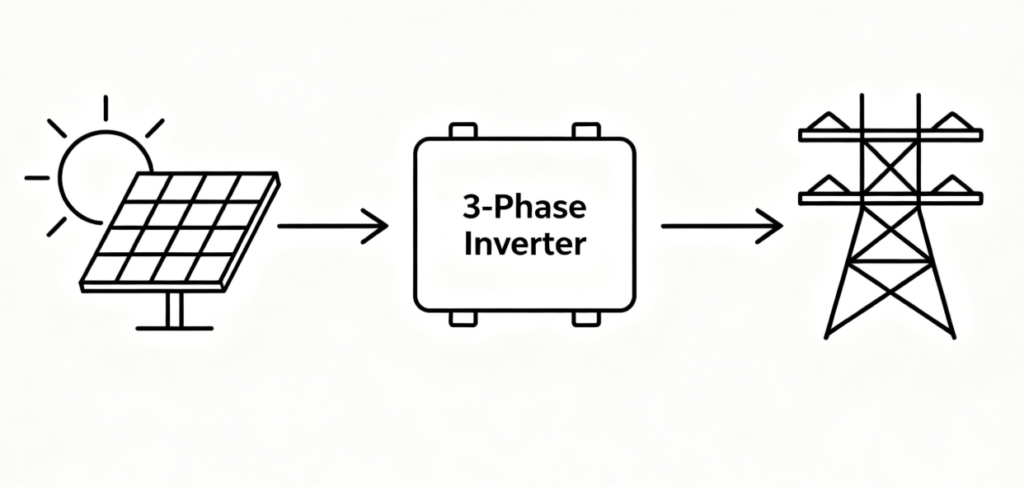
Solar panels produce DC power, which is converted to 3-phase voltage AC power using specialized inverters. www.cnkuangya.com offers a comprehensive range of high-efficiency 3-phase voltage inverters designed specifically for solar energy applications.
3-phase voltage standards vary significantly from country to country, which can create challenges for businesses operating internationally. Understanding these standards is essential for anyone involved in electrical system design or installation.
In North America (United States, Canada, and Mexico), the most common 3-phase voltage standards are:
In Europe and most of Asia, the standard 3-phase voltage is 400V (line-to-line) with a 230V phase-to-neutral voltage. This replaced the previous 380V standard in the European Union in 2004.
Other common 3-phase voltage standards in Asia include:
The International Electrotechnical Commission (IEC) has been working to standardize 3-phase voltage systems globally. The IEC 60038 standard specifies the recommended voltages for AC power systems worldwide.
While complete global standardization is still a long-term goal, most new installations are now being built to comply with IEC standards, reducing compatibility issues and simplifying international trade.
Even the most well-designed 3-phase voltage systems can experience problems from time to time. Understanding how to identify and resolve these common issues can help minimize downtime and prevent costly repairs.
Voltage imbalance is one of the most prevalent problems in 3-phase voltage systems. It occurs when the voltage magnitudes of the three phases are not equal. A voltage imbalance of just 2% can cause a 10% increase in motor temperature, leading to premature failure.
Common causes include uneven distribution of single-phase loads, faulty transformers, damaged wiring, and utility supply issues. To correct voltage imbalance, first identify the root cause and then take appropriate action, such as redistributing loads or repairing faulty equipment.
Phase loss occurs when one of the three phases in a 3-phase voltage system is interrupted. This causes motors to run on two phases, significantly increasing current draw and potentially leading to motor burnout in minutes.
Common causes include blown fuses, tripped circuit breakers, damaged wiring, and faulty contactors. To protect against phase loss, install phase loss protection devices in all critical 3-phase voltage equipment.
Overvoltage and undervoltage are also common issues in 3-phase voltage systems. Overvoltage can damage sensitive electronic equipment, while undervoltage causes motors to draw excessive current, leading to overheating.
Common causes include utility supply fluctuations, load switching, faulty voltage regulators, and lightning strikes. Install surge protectors and voltage regulators to safeguard your 3-phase voltage system. www.cnkuangya.com offers a complete line of protection devices designed specifically for 3-phase voltage applications.
A: In most cases, no. 3-phase voltage equipment is designed to operate on three separate phases, and connecting it to single-phase power will not provide sufficient power. In fact, doing so can damage the equipment and create a serious safety hazard.
However, phase converters are available that can convert single-phase power to 3-phase voltage. These devices come in various types, including rotary, static, and digital phase converters.
A: The easiest way is to examine your electrical panel. A 3-phase voltage panel will have three main circuit breakers or fuses, while a single-phase panel will have only one or two.
You can also use a multimeter to measure the voltage between the different wires. In a 3-phase voltage system, you should measure approximately 208V or 480V between any two hot wires, and 120V or 277V between any hot wire and neutral.
A: 3-phase voltage systems typically operate at higher voltages than single-phase systems, which means they can be more dangerous if not handled properly. However, both systems can be lethal if proper safety precautions are not followed.
The key to working safely with any electrical system is to follow established safety procedures, including de-energizing the system, using appropriate personal protective equipment, and working only on systems you are qualified to handle.
A: Yes, it is possible to convert your home to 3-phase voltage, but it can be expensive. You will need to contact your utility provider to check availability in your area and hire a licensed electrician to install the necessary wiring and equipment.
For most residential applications, 3-phase voltage is not necessary. However, if you have a home workshop with large machinery or require high-power electric vehicle charging, 3-phase voltage may be worth considering.
A: Delta and wye are the two primary configurations for 3-phase voltage systems. In a delta configuration, the three phases are connected in a triangle shape with no neutral wire. In a wye configuration, the three phases are connected to a common neutral point, forming a Y shape.
Delta configurations are typically used for high-power transmission and loads that do not require a neutral. Wye configurations are used for distribution systems and loads that require both line and phase voltage.
As our world becomes increasingly electrified, the demand for efficient, reliable 3-phase voltage systems will continue to grow. Let’s explore some of the key innovations shaping the future of this critical technology.
Smart grids use advanced sensors, communication technologies, and control systems to monitor and manage electricity flow in real-time. 3-phase voltage systems will play a central role in the smart grid of the future, enabling more efficient integration of renewable energy sources and improved demand response management.
Energy storage technologies allow excess electricity generated during periods of low demand to be stored and used during peak demand. 3-phase voltage inverters are essential for connecting energy storage systems to the grid, converting DC power from batteries to usable AC power.
www.cnkuangya.com is at the forefront of this technology, developing advanced 3-phase voltage inverters specifically designed for energy storage applications.
The global shift toward electric vehicles is creating unprecedented demand for high-power charging infrastructure. Most fast-charging stations use 3-phase voltage to deliver the high power required to charge batteries quickly.
As electric vehicle adoption continues to accelerate, the demand for 3-phase voltage charging infrastructure will grow exponentially in the coming years.
3-phase voltage has been the backbone of modern electrical systems for over a century, and it will remain indispensable for decades to come. Its unique combination of efficiency, reliability, and high power capability makes it the ideal choice for powering our modern world.
As we transition to a more sustainable, electrified future, the importance of 3-phase voltage will only increase. It will enable us to integrate more renewable energy sources into the grid, reduce our dependence on fossil fuels, and create a more resilient electrical system.
Whether you are an electrical professional, a business owner, or simply someone who wants to understand how the world works, having a solid understanding of 3-phase voltage is essential. We hope this comprehensive guide has provided you with valuable insights into this remarkable technology.
다음에 대한 자세한 정보 3-phase voltage 제품 및 솔루션, 방문 www.cnkuangya.com today. Their team of experienced professionals can help you find the right 3-phase voltage equipment for your specific needs, from inverters and circuit breakers to complete power distribution systems.

