Zone industrielle WengYang Yueqing Wenzhou 325000
Heures de travail
Du lundi au vendredi : de 7h00 à 19h00
Le week-end : 10H00 - 17H00
Zone industrielle WengYang Yueqing Wenzhou 325000
Heures de travail
Du lundi au vendredi : de 7h00 à 19h00
Le week-end : 10H00 - 17H00



Vous êtes-vous déjà demandé comment les gratte-ciel éclairent simultanément des étages entiers ? Comment les usines font tourner d'énormes chaînes de montage 24 heures sur 24, 7 jours sur 7, sans interruption ? Comment les hôpitaux font fonctionner des équipements vitaux pendant les pannes de courant ? La réponse se trouve dans Tension triphasée - le système de distribution électrique le plus efficace et le plus fiable jamais inventé.
Tension triphasée est un système de courant alternatif (CA) polyphasé qui utilise trois formes d'ondes de tension distinctes, chacune décalée d'exactement 120 degrés électriques. Cette élégante configuration crée une alimentation constante et régulière que les systèmes monophasés ne peuvent tout simplement pas égaler.
Alors que la plupart des gens n'ont affaire qu'à du courant monophasé dans leur maison, Tension triphasée alimente environ 90% de la charge industrielle et commerciale mondiale. C'est la base sur laquelle repose notre société technologique moderne.
Du réseau électrique qui alimente votre quartier aux centres de données qui hébergent l'internet, Tension triphasée travaille discrètement dans les coulisses à chaque seconde de chaque jour. Sans elle, notre économie mondiale s'arrêterait.
Dans ce guide complet, nous allons explorer tous les aspects de la Tension triphasée, L'électricité est l'un des domaines les plus importants de l'économie européenne, depuis ses principes scientifiques fondamentaux jusqu'à ses applications dans le monde réel, en passant par les normes mondiales et les innovations à venir. Que vous soyez un professionnel de l'électricité, un chef d'entreprise ou un curieux, cet article vous fournira les informations les plus récentes et les plus précises qui soient.

Avant de se plonger dans Tension triphasée, Si l'on utilise le courant alternatif, il est essentiel de comprendre les principes de base du courant alternatif. Contrairement au courant continu (CC), qui circule continuellement dans une seule direction, le courant alternatif s'inverse périodiquement, créant une forme d'onde sinusoïdale.
Dans un système CA monophasé, il n'y a qu'une seule forme d'onde de tension qui fluctue entre des valeurs positives et négatives. Cela signifie que la puissance fournie par un système monophasé n'est pas constante - elle tombe à zéro trois fois par cycle complet.
Cette fluctuation de puissance est acceptable pour les petites charges telles que les ampoules électriques et les téléviseurs. Cependant, elle crée des problèmes importants pour les moteurs et les machines de plus grande taille, en provoquant des vibrations, du bruit et une usure prématurée.
Tension triphasée résout cette limitation fondamentale de l'alimentation monophasée d'une manière ingénieuse. En utilisant trois formes d'ondes de tension distinctes décalées de 120 degrés, la puissance totale fournie par le système reste parfaitement constante à tout moment.
Cette puissance constante est la principale raison pour laquelle Tension triphasée est supérieure à l'alimentation monophasée pour la plupart des applications. Elle permet aux moteurs de fonctionner plus régulièrement, de produire plus de couple et de durer beaucoup plus longtemps.
Pour visualiser ce concept, imaginez trois personnes poussant un manège. Si les trois personnes poussent simultanément (phase unique), le manège avance par à-coups, puis ralentit entre les poussées. En revanche, si chaque personne pousse à 120 degrés d'écart (Tension triphasée), le manège tournerait continuellement et sans effort.
Dans un système équilibré Tension triphasée Dans un système à deux phases, chaque phase a une amplitude de tension et une fréquence identiques, et elles sont séparées d'exactement 120 degrés électriques. La relation entre la tension de ligne et la tension de phase est donnée par la formule suivante :
V_line = V_phase × √3 ≈ V_phase × 1,732
Cela signifie que dans un système standard 208Y/120V, la tension de phase (entre n'importe quelle phase et le neutre) est de 120V, tandis que la tension de ligne (entre n'importe quelles deux phases) est d'environ 208V.
La puissance totale d'un Tension triphasée est calculé comme suit :
P_total = √3 × V_line × I_line × PF
Où PF représente le facteur de puissance, une mesure de l'efficacité de l'utilisation de l'énergie électrique.

L'une des questions les plus fréquemment posées dans le domaine de l'électrotechnique est la différence entre Tension triphasée et une tension monophasée. Bien que les deux systèmes fournissent du courant alternatif, ils présentent des caractéristiques distinctes qui les rendent adaptés à des applications différentes.
La différence la plus significative entre les Tension triphasée et la tension monophasée est la constance de la fourniture d'énergie. L'alimentation monophasée fournit une puissance pulsée qui tombe à zéro trois fois par cycle, tandis que l'alimentation monophasée fournit une puissance pulsée qui tombe à zéro trois fois par cycle. Tension triphasée fournit une puissance constante à tout moment.
Cette différence a de profondes implications pour les performances motrices. Tension triphasée sont à démarrage automatique, ce qui signifie qu'ils ne nécessitent pas de composants de démarrage supplémentaires tels que des condensateurs ou des interrupteurs centrifuges. Ils produisent également plus de couple par unité de poids et sont généralement plus efficaces.
Tension triphasée sont nettement plus efficaces que les systèmes monophasés pour la transmission de grandes quantités d'énergie. Pour une même capacité de puissance, un système Tension triphasée ne nécessite que 75% du fil de cuivre nécessaire pour un système monophasé.
Cela se traduit par des coûts d'installation moins élevés, une réduction des pertes d'énergie lors de la transmission et une diminution des frais d'exploitation pendant toute la durée de vie du système. Cependant, Tension triphasée Le coût initial des équipements monophasés est généralement plus élevé que celui des équipements monophasés.

Le tableau suivant présente une comparaison détaillée, côte à côte, des éléments suivants Tension triphasée et la tension monophasée pour tous les paramètres critiques :
| Paramètres | Tension triphasée | Tension monophasée |
|---|---|---|
| Fourniture d'énergie | Constante, sans ondulation | Pulsation, chute à zéro |
| Démarrage du moteur | Démarrage autonome | Nécessite des composants auxiliaires |
| Efficacité typique | 90-96% | 70-85% |
| Besoin en cuivre | 75% en monophasé | 100% |
| Coût initial de l'équipement | Plus élevé | Plus bas |
| Coût d'exploitation à long terme | Plus bas | Plus élevé |
| Puissance maximale pratique | Illimité | ~10-15 HP |
| Tensions standard (NA) | 208V, 480V, 600V | 120V, 240V |
| Tensions standard (UE/Asie) | 380V, 400V, 415V | 220V, 230V, 240V |
| Applications primaires | Industrie, commerce, centres de données | Résidentiel, petites entreprises |
Tandis que Tension triphasée est souvent associée à l'industrie lourde, elle alimente en réalité de nombreux aspects de notre vie quotidienne que nous tenons pour acquis. Examinons quelques-unes des applications les plus courantes et les plus importantes.
Tension triphasée est l'élément vital de l'industrie manufacturière mondiale. Elle alimente tout, des bandes transporteuses et des lignes d'assemblage aux bras robotisés et aux centres d'usinage à commande numérique.
Par exemple, une usine moderne de fabrication d'automobiles utilise des milliers d'ordinateurs. Tension triphasée pour alimenter les presses d'emboutissage, les robots de soudage et les systèmes de peinture. Sans Tension triphasée, La production de masse telle que nous la connaissons serait impossible.
Les bâtiments commerciaux tels que les bureaux, les centres commerciaux et les hôpitaux sont fortement tributaires de l'électricité. Tension triphasée. Il alimente les ascenseurs, les escaliers mécaniques, les systèmes de chauffage, de ventilation et de climatisation, ainsi que les grandes installations d'éclairage.
Les hôpitaux, en particulier, dépendent Tension triphasée pour alimenter des équipements vitaux tels que les appareils d'IRM, les tomodensitomètres et les outils chirurgicaux. Ces appareils ont besoin d'une alimentation ininterrompue de haute qualité qui n'a besoin que d'un minimum d'énergie pour fonctionner. Tension triphasée peut fournir.
Les centres de données, qui hébergent les serveurs qui alimentent l'internet, sont parmi les plus gros consommateurs d'énergie. Tension triphasée. Un seul grand centre de données peut consommer autant d'électricité qu'une petite ville.
Tension triphasée est le seul moyen pratique de fournir cette quantité massive d'énergie de manière efficace et fiable. Il est également utilisé dans les infrastructures de télécommunications, notamment les tours de téléphonie cellulaire et les centraux téléphoniques.
Les sources d'énergie renouvelables, telles que les éoliennes et les fermes solaires, utilisent également l'énergie solaire. Tension triphasée technologie. La plupart des éoliennes produisent Tension triphasée L'électricité est directement produite en courant alternatif, qui est ensuite élevée à haute tension pour être transmise au réseau.
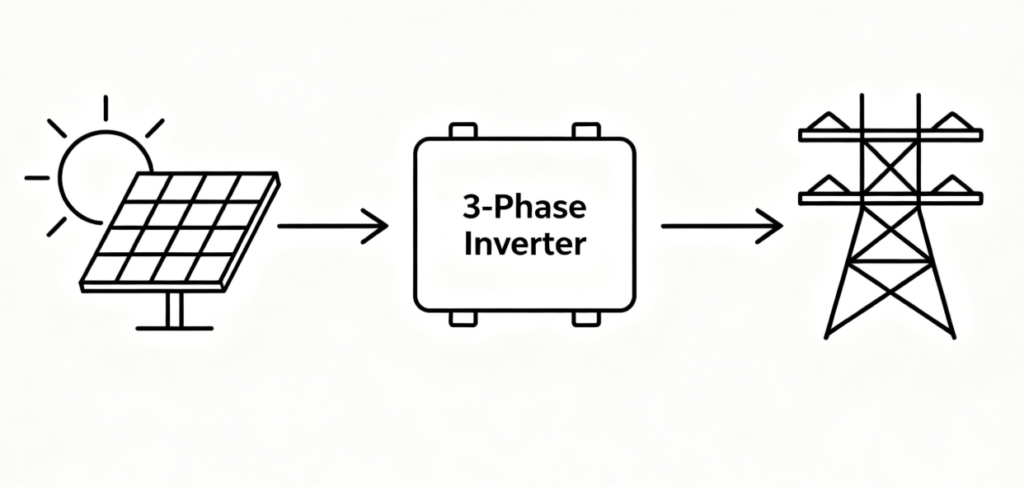
Les panneaux solaires produisent du courant continu, qui est converti en Tension triphasée l'alimentation en courant alternatif à l'aide d'onduleurs spécialisés. www.cnkuangya.com offre une gamme complète de produits à haut rendement Tension triphasée conçus spécifiquement pour les applications d'énergie solaire.
Tension triphasée varient considérablement d'un pays à l'autre, ce qui peut poser des problèmes aux entreprises opérant à l'échelle internationale. La compréhension de ces normes est essentielle pour toute personne impliquée dans la conception ou l'installation d'un système électrique.
En Amérique du Nord (États-Unis, Canada et Mexique), le plus courant est le Tension triphasée sont :
En Europe et dans la plupart des pays d'Asie, la norme Tension triphasée est de 400V (ligne à ligne) avec une tension phase à neutre de 230V. Cette norme a remplacé la norme précédente de 380V dans l'Union européenne en 2004.
Autres cas fréquents Tension triphasée en Asie sont les suivantes :
La Commission électrotechnique internationale (CEI) s'est efforcée de normaliser Tension triphasée à l'échelle mondiale. La norme CEI 60038 spécifie les tensions recommandées pour les systèmes d'alimentation en courant alternatif dans le monde entier.
Bien que la normalisation mondiale complète soit encore un objectif à long terme, la plupart des nouvelles installations sont désormais construites conformément aux normes de la CEI, ce qui réduit les problèmes de compatibilité et simplifie le commerce international.
Même l'outil le mieux conçu Tension triphasée peuvent rencontrer des problèmes de temps à autre. Comprendre comment identifier et résoudre ces problèmes courants permet de minimiser les temps d'arrêt et d'éviter des réparations coûteuses.
Le déséquilibre de la tension est l'un des problèmes les plus fréquents dans le secteur de l'énergie. Tension triphasée systèmes d'alimentation. Il se produit lorsque les amplitudes de tension des trois phases ne sont pas égales. Un déséquilibre de tension de seulement 2% peut provoquer une augmentation de 10% de la température du moteur, entraînant une défaillance prématurée.
Les causes les plus courantes sont une répartition inégale des charges monophasées, des transformateurs défectueux, un câblage endommagé et des problèmes d'approvisionnement en électricité. Pour corriger un déséquilibre de tension, il faut d'abord identifier la cause première, puis prendre les mesures qui s'imposent, comme redistribuer les charges ou réparer l'équipement défectueux.
La perte de phase se produit lorsque l'une des trois phases d'un réseau de distribution d'électricité se trouve en dehors de la zone de couverture. Tension triphasée est interrompu. Les moteurs fonctionnent alors sur deux phases, ce qui augmente considérablement la consommation de courant et peut conduire à une panne du moteur en quelques minutes.
Les causes les plus courantes sont les fusibles grillés, les disjoncteurs déclenchés, le câblage endommagé et les contacteurs défectueux. Pour se protéger contre les pertes de phase, il faut installer des dispositifs de protection contre les pertes de phase dans tous les circuits critiques. Tension triphasée l'équipement.
Les surtensions et les sous-tensions sont également des problèmes fréquents dans le domaine de la santé. Tension triphasée Les surtensions peuvent endommager les équipements électroniques sensibles. La surtension peut endommager les équipements électroniques sensibles, tandis que la sous-tension entraîne un courant excessif dans les moteurs, ce qui provoque une surchauffe.
Les causes les plus courantes sont les fluctuations de l'alimentation électrique, les changements de charge, les régulateurs de tension défectueux et les coups de foudre. Installez des parasurtenseurs et des régulateurs de tension pour protéger votre système d'alimentation électrique. Tension triphasée système. www.cnkuangya.com offre une gamme complète de dispositifs de protection conçus spécifiquement pour Tension triphasée des applications.
R : Dans la plupart des cas, non. Tension triphasée L'appareil est conçu pour fonctionner sur trois phases distinctes, et le fait de le brancher sur une alimentation monophasée ne fournira pas une puissance suffisante. En fait, cela peut endommager l'équipement et créer un grave danger pour la sécurité.
Toutefois, il existe des convertisseurs de phase qui permettent de convertir le courant monophasé en courant alternatif. Tension triphasée. Ces dispositifs sont de différents types, y compris les convertisseurs de phase rotatifs, statiques et numériques.
R : Le plus simple est d'examiner votre tableau électrique. A Tension triphasée Le tableau de distribution monophasé comporte trois disjoncteurs ou fusibles principaux, tandis que le tableau de distribution monophasé n'en comporte qu'un ou deux.
Vous pouvez également utiliser un multimètre pour mesurer la tension entre les différents fils. Dans un Tension triphasée vous devez mesurer environ 208V ou 480V entre deux fils chauds, et 120V ou 277V entre un fil chaud et le neutre.
A : Tension triphasée Les systèmes monophasés fonctionnent généralement à des tensions plus élevées que les systèmes monophasés, ce qui signifie qu'ils peuvent être plus dangereux s'ils ne sont pas manipulés correctement. Cependant, les deux systèmes peuvent être mortels si les précautions de sécurité appropriées ne sont pas respectées.
Pour travailler en toute sécurité sur un système électrique, il est essentiel de respecter les procédures de sécurité établies, notamment de mettre le système hors tension, d'utiliser l'équipement de protection individuelle approprié et de ne travailler que sur des systèmes pour lesquels vous êtes qualifié.
R : Oui, il est possible de convertir votre maison en un immeuble de bureaux. Tension triphasée, mais cela peut s'avérer coûteux. Vous devrez contacter votre fournisseur d'électricité pour vérifier la disponibilité dans votre région et faire appel à un électricien agréé pour installer le câblage et l'équipement nécessaires.
Pour la plupart des applications résidentielles, Tension triphasée n'est pas nécessaire. Toutefois, si vous avez un atelier à domicile avec de grosses machines ou si vous avez besoin de recharger des véhicules électriques de grande puissance, Tension triphasée peut valoir la peine d'être envisagée.
A : Delta et wye sont les deux configurations principales pour les systèmes d'alimentation électrique. Tension triphasée systèmes. Dans une configuration delta, les trois phases sont connectées en triangle sans fil neutre. Dans une configuration en étoile, les trois phases sont connectées à un point neutre commun, formant un Y.
Les configurations en triangle sont généralement utilisées pour les transmissions de grande puissance et les charges qui ne nécessitent pas de neutre. Les configurations en étoile sont utilisées pour les systèmes de distribution et les charges qui nécessitent une tension de ligne et de phase.
À mesure que notre monde s'électrifie, la demande de produits efficaces et fiables s'accroît. Tension triphasée continueront à se développer. Examinons quelques-unes des principales innovations qui façonnent l'avenir de cette technologie essentielle.
Les réseaux intelligents utilisent des capteurs avancés, des technologies de communication et des systèmes de contrôle pour surveiller et gérer les flux d'électricité en temps réel. Tension triphasée joueront un rôle central dans le réseau intelligent de demain, en permettant une intégration plus efficace des sources d'énergie renouvelables et une meilleure gestion de la réponse à la demande.
Les technologies de stockage de l'énergie permettent de stocker l'électricité excédentaire produite pendant les périodes de faible demande et de l'utiliser pendant les périodes de pointe. Tension triphasée Les onduleurs sont essentiels pour connecter les systèmes de stockage d'énergie au réseau, en convertissant le courant continu des batteries en courant alternatif utilisable.
www.cnkuangya.com est à l'avant-garde de cette technologie, en développant des technologies de pointe. Tension triphasée spécialement conçus pour les applications de stockage d'énergie.
La transition mondiale vers les véhicules électriques crée une demande sans précédent d'infrastructures de recharge à haute puissance. La plupart des stations de recharge rapide utilisent des Tension triphasée pour fournir la puissance élevée nécessaire au chargement rapide des batteries.
Alors que l'adoption des véhicules électriques continue de s'accélérer, la demande en Tension triphasée L'infrastructure de recharge connaîtra une croissance exponentielle dans les années à venir.
Tension triphasée est l'épine dorsale des systèmes électriques modernes depuis plus d'un siècle et restera indispensable pour les décennies à venir. Sa combinaison unique d'efficacité, de fiabilité et de puissance élevée en fait le choix idéal pour alimenter notre monde moderne.
Alors que nous nous dirigeons vers un avenir plus durable et plus électrifié, l'importance de l'énergie renouvelable et de l'utilisation de l'énergie renouvelable dans le secteur de l'énergie est reconnue. Tension triphasée ne fera qu'augmenter. Elle nous permettra d'intégrer davantage de sources d'énergie renouvelables dans le réseau, de réduire notre dépendance à l'égard des combustibles fossiles et de créer un système électrique plus résistant.
Que vous soyez un professionnel de l'électricité, un chef d'entreprise ou simplement quelqu'un qui veut comprendre comment fonctionne le monde, une bonne compréhension de la technologie de l'information et de la communication (TIC) est essentielle. Tension triphasée est essentiel. Nous espérons que ce guide complet vous a apporté des informations précieuses sur cette technologie remarquable.
Pour plus d'informations sur Tension triphasée produits et solutions, visitez le site www.cnkuangya.com aujourd'hui. Leur équipe de professionnels expérimentés peut vous aider à trouver la bonne Tension triphasée pour répondre à vos besoins spécifiques, depuis les onduleurs et les disjoncteurs jusqu'aux systèmes complets de distribution d'énergie.

