温州市岳陽工業区 325000
勤務時間
月曜日~金曜日:午前7時~午後7時
週末午前10時~午後5時
温州市岳陽工業区 325000
勤務時間
月曜日~金曜日:午前7時~午後7時
週末午前10時~午後5時

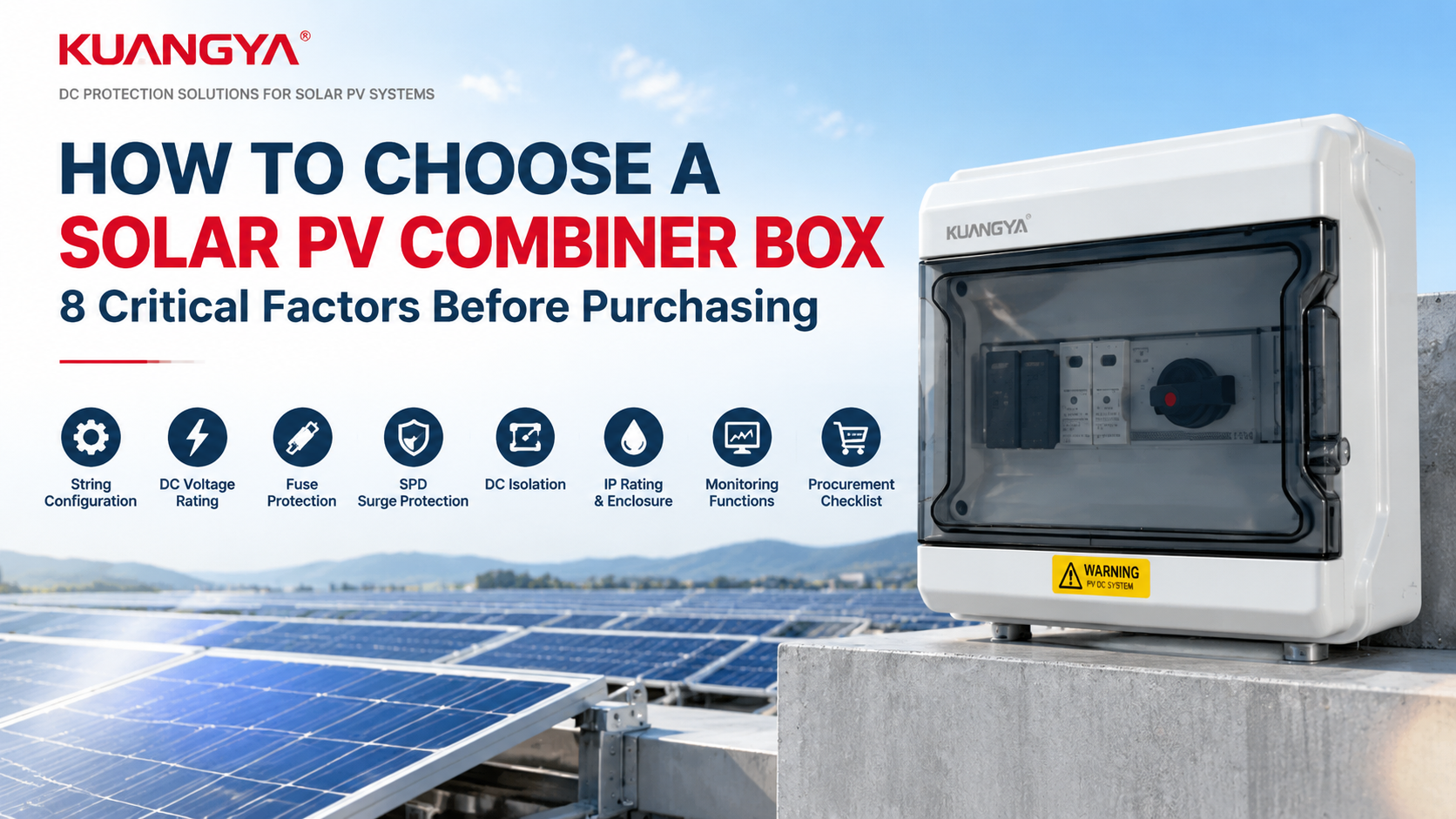
太陽光発電システム用の機器を設計または購入する際、太陽光発電用接続箱の選定は重要な決定事項です。適切な接続箱は、適切な電気的保護、信頼性の高いストリング接続、そしてインバーターや太陽光発電設備全体との互換性を確保するのに役立ちます。.
太陽光発電の施工業者、EPCコントラクター、販売代理店、およびプロジェクト調達チームにとって、接続箱の選定は、単にPVストリングの数を数えたり、1000Vと1500VのDCモデルのどちらかを選択したりする以上の作業を伴います。.
インバーターの構成、最大DC電圧、ストリング電流、ヒューズ保護、サージ保護、DC絶縁、筐体の要件、および監視機能を考慮する必要があります。.
本ガイドでは、8つの重要な要素を検証することで太陽光発電用接続箱の選び方を解説し、技術仕様の評価、メーカーとの調整、そしてより正確な見積依頼の準備を支援します。.
太陽光発電用接続箱が初めての方は、以下も併せてお読みください。 太陽光発電用接続箱の完全ガイド それらの構造、構成部品、および動作原理を理解すること。.
モデルを選択する前に、その太陽光発電システムに個別の接続箱が必要かどうかを判断してください。.
太陽光発電用接続箱は、太陽光発電ストリングからの複数の直流回路を集約し、インバータやその他の後続機器に送る前に1つまたは複数の出力回路にまとめるものです。.
ただし、すべての太陽光発電設備に外部接続箱が必要なわけではありません。.
以下の状況を考慮してください:
| 太陽光発電システムの構成 | 接続箱は必要か? | 主な検討事項 |
|---|---|---|
| 単一のPVストリング | 多くの場合不要 | インバータの内蔵保護機能および入力要件を確認すること |
| 2つの独立したストリング | インバータの設計による | 各ストリングが個別のMPPT入力に接続されているか確認すること |
| 複数の並列ストリング | 多くの場合において適切 | 逆流防止および出力容量を確認すること |
| 商業用屋根上太陽光発電システム | 多くの場合において有用 | 集中保護およびケーブル管理 |
| 大規模地上設置型太陽光発電プロジェクト | システム構成に依存する | ストリング集約、監視、および保守要件 |
決定は単に設置されたソーラーパネルの数に基づくのではなく、電気的アーキテクチャに基づいて行うべきである。.
例えば、インバータがすでに十分な独立入力と必要な保護機能を備えている場合、追加の外部接続箱(コンバイナボックス)は不要な可能性がある。.
しかし、複数のストリングを共通のポイントに集約する必要がある場合、専用のPV接続箱を使用することで、配線、保護、およびメンテナンスを簡素化できる。.
重要なポイント: 接続箱を選択する前に、インバータのDC入力構成とプロジェクトの単線結線図を確認すること。.
確認すべき最初の仕様の一つは、接続が必要なPVストリングの数である。.
接続箱は、一般的に以下のような入出力構成を用いて説明される。
最初の数字は入力ストリング回路の数を示し、2番目の数字は出力回路の数を示します。.
例えば、6入力/1出力の接続箱は、6つの太陽光発電ストリング回路を受け取り、それらを1つの直流出力回路にまとめます。.
一方、4入力/2出力の構成では、2つの独立した出力回路が提供されます。.
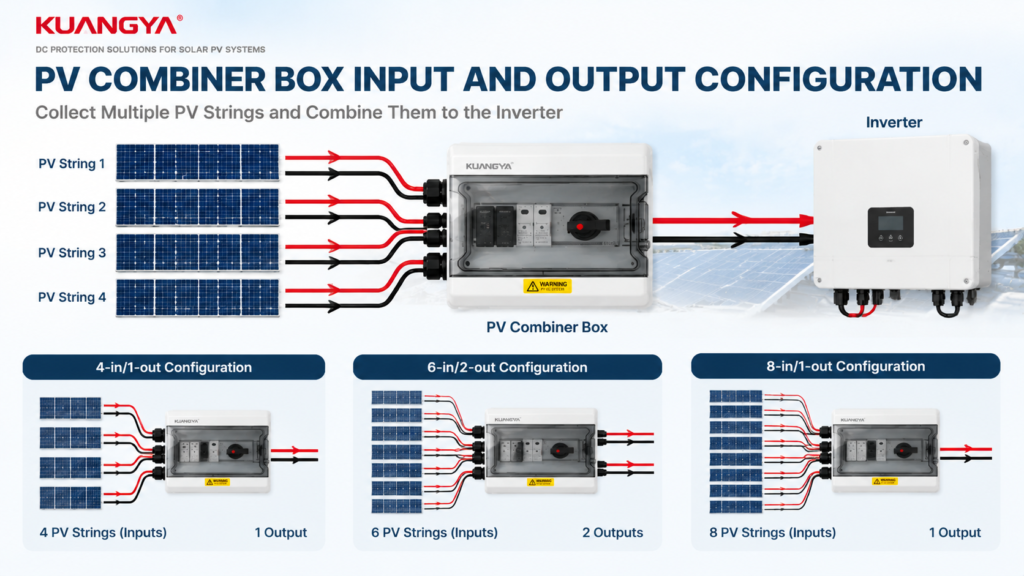
入出力数を選択する前に、以下を確認してください:
An important point is that the number of inputs does not automatically determine the number of strings that can safely be connected together.
Different MPPT groups, module configurations, and inverter input limits must be considered.
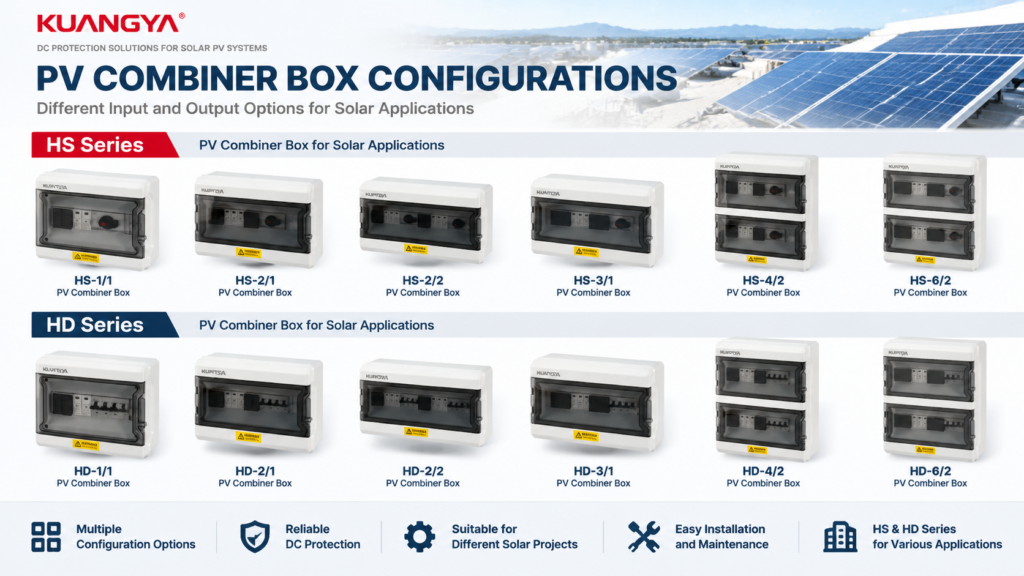
For larger installations, a customized combiner box may be required.
For example, KUANGYA has worked on a customized 16-string PV combiner box project integrating string protection, DC surge protection, and remote monitoring.
Read more about the actual configuration in our 16-String PV Combiner Box Project.
The voltage rating is one of the most important specifications when purchasing a PV combiner box.
Common PV system voltage classes include:
| DC voltage class | Typical application | Selection considerations |
|---|---|---|
| DC600V | Certain residential and smaller PV architectures | Verify actual maximum array voltage |
| DC1000V | 商業用および産業用太陽光発電システム | Check cold-temperature open-circuit voltage |
| DC1500V | Large-scale and utility PV projects | Verify every component’s voltage rating and insulation requirements |
However, choosing a combiner box based only on the nominal system voltage is not sufficient.
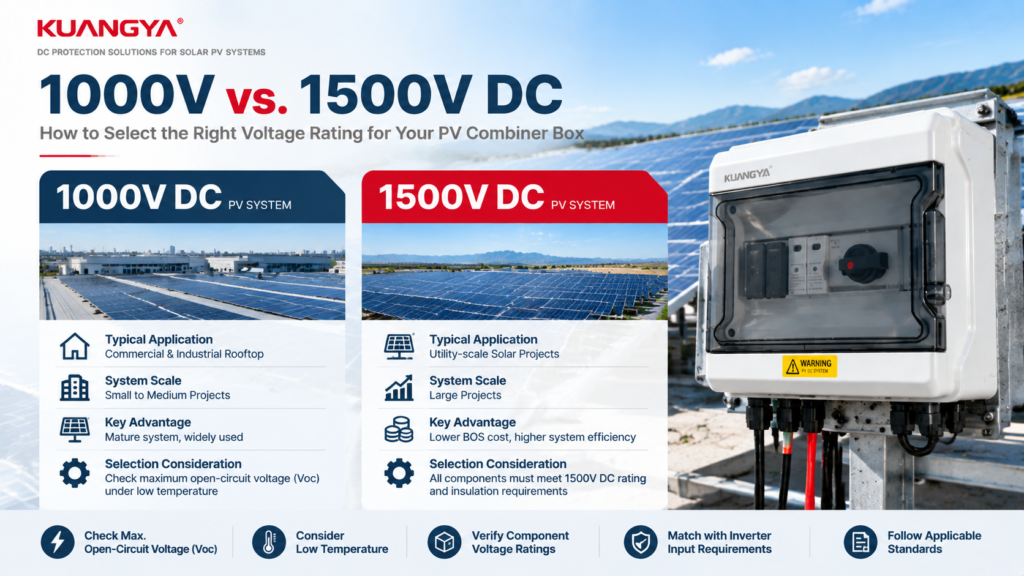
The open-circuit voltage of a solar module increases as its temperature decreases.
Therefore, the maximum PV string voltage must be calculated using the module’s electrical specifications and the project’s minimum design temperature.
The calculation should consider:
The selected combiner box and all internal components must be suitable for the resulting maximum DC voltage.
Do not verify only the enclosure’s voltage label.
The following components also need appropriate DC ratings:
A 1000V DC enclosure does not automatically mean every installed component is suitable for a 1000V DC application.
For further information, refer to the official IEC 62548-1 photovoltaic array design requirements.
Voltage is only one part of the selection process. Current capacity and overcurrent protection are equally important.
A properly specified combiner box must accommodate the operating current of the connected PV strings and the combined output circuit.
The following information should be collected from the solar module datasheet:
The project engineer must then calculate the required design current according to the applicable standards and installation conditions.
Do not select fuse ratings using a universal multiplier without checking the actual module specifications and local design requirements.
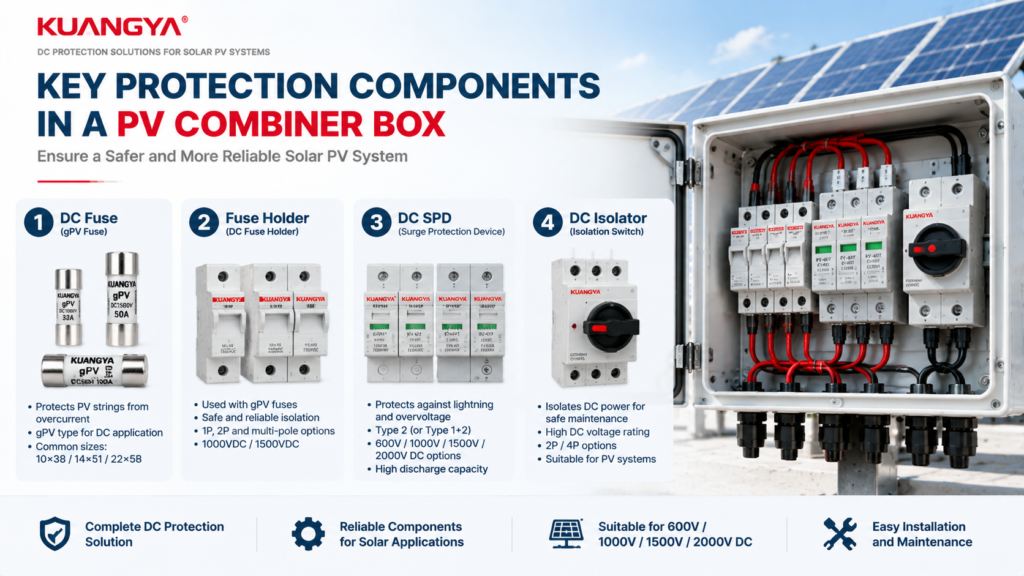
PV string protection commonly uses dedicated gPV fuse links.
When selecting a fuse, verify:
| 仕様 | 確認事項 |
|---|---|
| Fuse category | Suitable gPV photovoltaic fuse |
| 定格電圧 | Compatible with maximum PV DC voltage |
| 定格電流 | Coordinated with module and circuit requirements |
| 破断能力 | Suitable for the prospective fault current |
| Fuse holder | Compatible with the selected fuse and DC rating |
| 温度 | Consider actual operating and enclosure conditions |
The fuse link and holder must be evaluated as a compatible protection assembly.
An oversized fuse may fail to provide the intended protection, while an undersized fuse may cause unwanted operation.
For more information, see the official IEC 60269-6 photovoltaic fuse standard.
You can also explore KUANGYA’s DC Fuse and Fuse Holder product range for photovoltaic protection applications.
Surge protection is another important consideration when purchasing a solar PV combiner box.
PV systems may be exposed to transient overvoltages caused by lightning activity and switching events.
A suitable DC Surge Protective Device (SPD) helps limit transient overvoltages and protect connected equipment.
However, not every project requires the same SPD configuration.
Before confirming the SPD specification, consider:
1. SPD type
Depending on the lightning protection design and installation conditions, the project may require Type 1, Type 2, or a combined Type 1+2 SPD.
2. Maximum continuous operating voltage (Ucpv)
The SPD’s operating voltage must be compatible with the maximum PV system voltage and grounding arrangement.
3. Discharge current
Check the required nominal discharge current (In), maximum discharge current (Imax), or impulse current (Iimp), as applicable.
4. Voltage protection level (Up)
The selected SPD must provide a suitable protection level for the equipment being protected.
5. Backup protection
Confirm the manufacturer’s requirements for backup overcurrent protection and short-circuit coordination.
6. Status indication
A visual status window helps maintenance personnel identify the operating condition of the SPD.
For projects requiring remote fault indication, an SPD with a remote signaling contact may also be considered.
For additional technical information, refer to IEC 61643-31: Requirements and test methods for SPDs for photovoltaic installations.
A PV combiner box may also incorporate a DC isolator or switch-disconnector to provide a means of disconnecting the DC circuit for maintenance and servicing.
However, isolation and overcurrent protection are not the same function.
A DC isolator is designed for the specified isolation and switching duty. It should not automatically be treated as a replacement for a properly selected fuse or circuit breaker.
Before purchasing, confirm:
The selected device must be suitable for the actual DC circuit and installation conditions.
Also check whether the inverter or another downstream device already provides the required switching function. This helps avoid unnecessary duplication.
For projects with different electrical architectures, the isolator configuration should be confirmed before manufacturing.
The enclosure protects the internal electrical components from environmental exposure and mechanical damage.
Choosing the wrong enclosure can affect long-term reliability, especially in outdoor PV installations.
Common enclosure protection levels include:
| IP等級 | General protection description |
|---|---|
| IP54 | Limited dust protection and protection against water splashes |
| IP65 | Dust-tight and protected against water jets |
| IP66 | Dust-tight and protected against powerful water jets |
| IP67 | Dust-tight and protected against temporary immersion under specified test conditions |
The required rating depends on the actual installation environment and project specifications.
例えば、こうだ:
Commercial rooftop installations
Consider direct sunlight, temperature changes, rain exposure, and cable-entry sealing.
Coastal installations
Pay attention to corrosion resistance, material selection, and the effects of salt exposure.
Industrial environments
Evaluate dust, moisture, vibration, chemical exposure, and maintenance accessibility.
Ground-mounted solar farms
Consider UV exposure, enclosure durability, mounting arrangements, and long-term outdoor operation.
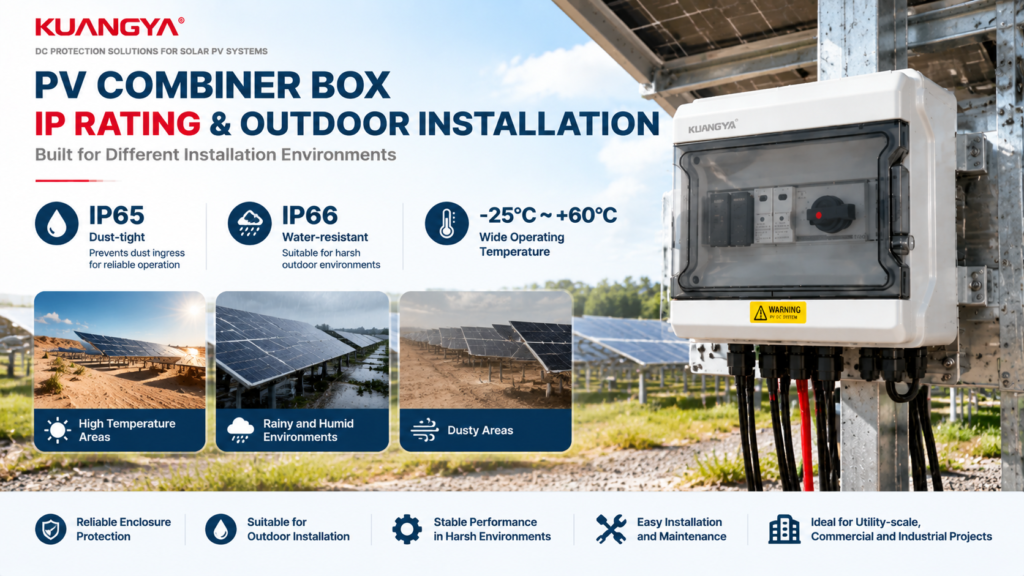
When evaluating a supplier’s enclosure, also check:
Remember that the enclosure’s effective protection depends on the complete installed assembly, including cable glands, unused openings, seals, and installation workmanship.
For larger commercial and industrial PV projects, monitoring functions can provide additional visibility into system operation.
A conventional combiner box mainly provides electrical connection and protection functions.
An intelligent PV combiner box can integrate additional monitoring and communication components.
| Monitoring function | 目的 |
|---|---|
| String current monitoring | Identify abnormal current differences between strings |
| DC voltage monitoring | Monitor DC operating conditions |
| Fuse status monitoring | Provide fault indication |
| SPDの状態監視 | Identify SPD failure conditions |
| 温度モニタリング | Monitor internal enclosure temperature |
| Remote alarm | Send fault signals to a monitoring system |
| Communication interface | Transfer operating data to an external controller |
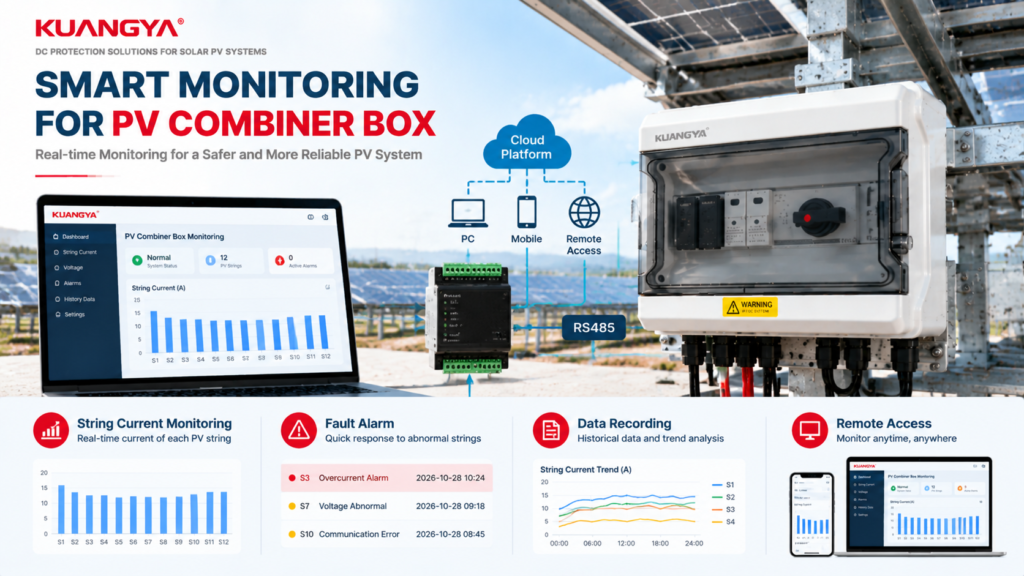
Depending on the project, communication may use RS485 and protocols such as Modbus RTU.
However, not every PV project needs all these functions.
Before purchasing, confirm:
For projects involving many PV strings, remote monitoring can help maintenance teams identify abnormal operating conditions without inspecting every string individually.
You can see how these functions can be integrated into a customized solution in our 16-String PV Combiner Box Project.
After confirming the eight factors above, the next step is to prepare a clear Request for Quotation (RFQ).
Providing complete project information helps manufacturers evaluate the required configuration and prepare a more accurate quotation.
Here is a practical checklist you can use.
| Information | Details to provide |
|---|---|
| 申し込み | Residential, commercial, industrial, or utility-scale PV |
| システム電圧 | 600V, 1000V, 1500V DC, or project-specific |
| ストリング数 | Total number of PV string inputs |
| Input/output configuration | 4-in/1-out, 8-in/1-out, 16-in/1-out, etc. |
| ストリング電流 | Module Isc, Imp, and calculated design current |
| ヒューズ保護 | Required fuse type, rating, and configuration |
| SPD | Type, Ucpv, In, Imax/Iimp, Up, and protection arrangement |
| DC isolation | Required isolator or switch-disconnector specifications |
| エンクロージャー | Material, IP rating, and installation environment |
| モニタリング | Required measurement and communication functions |
| 数量 | Estimated purchasing quantity |
| Destination market | Country and applicable project requirements |
| ドキュメンテーション | Drawings, BOM, datasheets, certificates, and test records |
Suppose you are purchasing a customized PV combiner box for a commercial solar project.
Your initial inquiry could include:
This information provides a starting point for the manufacturer to review the configuration.
However, it is not a complete engineering specification. The module datasheets, inverter input limits, current calculations, grounding arrangement, and project-specific protection requirements must also be checked before the design is approved.
Even when the basic specifications appear correct, several purchasing mistakes can create problems during installation.
Mistake 1: Selecting a model based only on voltage
A 1000V label does not guarantee that every internal component is correctly rated.
Mistake 2: Ignoring inverter MPPT configuration
Not all PV strings can be combined into one output. Check the inverter architecture first.
Mistake 3: Choosing fuses based only on current
Fuse selection requires coordination with module limits, conductor capacity, fault conditions, and the applicable design requirements.
Mistake 4: Assuming every outdoor project needs the same IP rating
Environmental conditions differ. Specify the enclosure based on the actual installation location.
Mistake 5: Requesting monitoring without defining its functions
Simply asking for an intelligent combiner box is not enough. Specify the channels, measured parameters, communication protocol, and remote alarm requirements.
Mistake 6: Confirming production before reviewing the drawings
Always review the wiring diagram, component list, terminal arrangement, and enclosure layout before mass production.
Choosing a solar PV combiner box requires careful consideration of electrical ratings, protection devices, enclosure specifications, and monitoring requirements. Before placing an order, compare the manufacturer’s technical proposal with your project’s actual requirements to ensure that the selected configuration is suitable for your solar installation.
The number of strings depends on the model and customized design. Common configurations include 2, 4, 6, 8, and 16 inputs.
The final selection must also consider inverter architecture, MPPT grouping, current capacity, and protection requirements.
No. A 1000V-rated assembly should not be used in a 1500V DC application unless the complete assembly has been specifically designed and verified for the required voltage. All internal components must have suitable ratings.
The requirement depends on the project’s surge protection design, lightning risk assessment, installation arrangement, and applicable standards.
Where an SPD is required, its type, operating voltage, protection modes, and discharge ratings must be properly specified.
A standard combiner box primarily provides string collection and electrical protection.
An intelligent combiner box can additionally integrate monitoring sensors, communication modules, remote alarms, and other monitoring functions.
Yes. Depending on the manufacturer’s capabilities, the input/output configuration, voltage class, protection devices, enclosure, monitoring functions, and labeling can be customized to meet project requirements.
Depending on the project, request:
Make sure the documentation corresponds to the actual model, component configuration, and ratings being supplied.
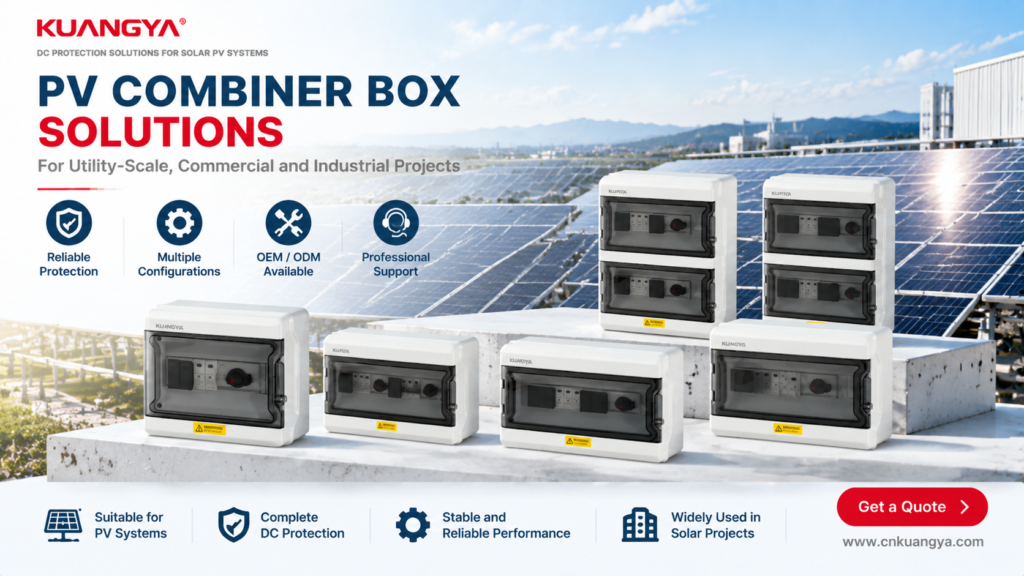
Choosing the right solar PV combiner box is not simply about finding a product with the correct number of inputs.
It requires a complete evaluation of electrical ratings, protection coordination, enclosure requirements, inverter compatibility, and project-specific monitoring functions.
で クアンニャ, we provide PV combiner box solutions for different solar applications, including commercial and industrial photovoltaic systems.
Our product and customization capabilities cover:
We can also discuss OEM/ODM requirements for distributors, panel builders, and project contractors.
Explore our PV Combiner Box product range to learn more about available configurations.
Need a quotation for your project?
Send us your system voltage, number of PV strings, input/output configuration, protection requirements, monitoring needs, and estimated quantity.
Our team can help review your requirements and discuss a suitable PV combiner box solution.
ウェブサイト https://www.cnkuangya.com/
Contact: sales@cnkuangya.com
KUANGYA – Reliable DC Protection Solutions for Solar PV Systems.

