温州市岳陽工業区 325000
勤務時間
月曜日~金曜日:午前7時~午後7時
週末午前10時~午後5時
温州市岳陽工業区 325000
勤務時間
月曜日~金曜日:午前7時~午後7時
週末午前10時~午後5時

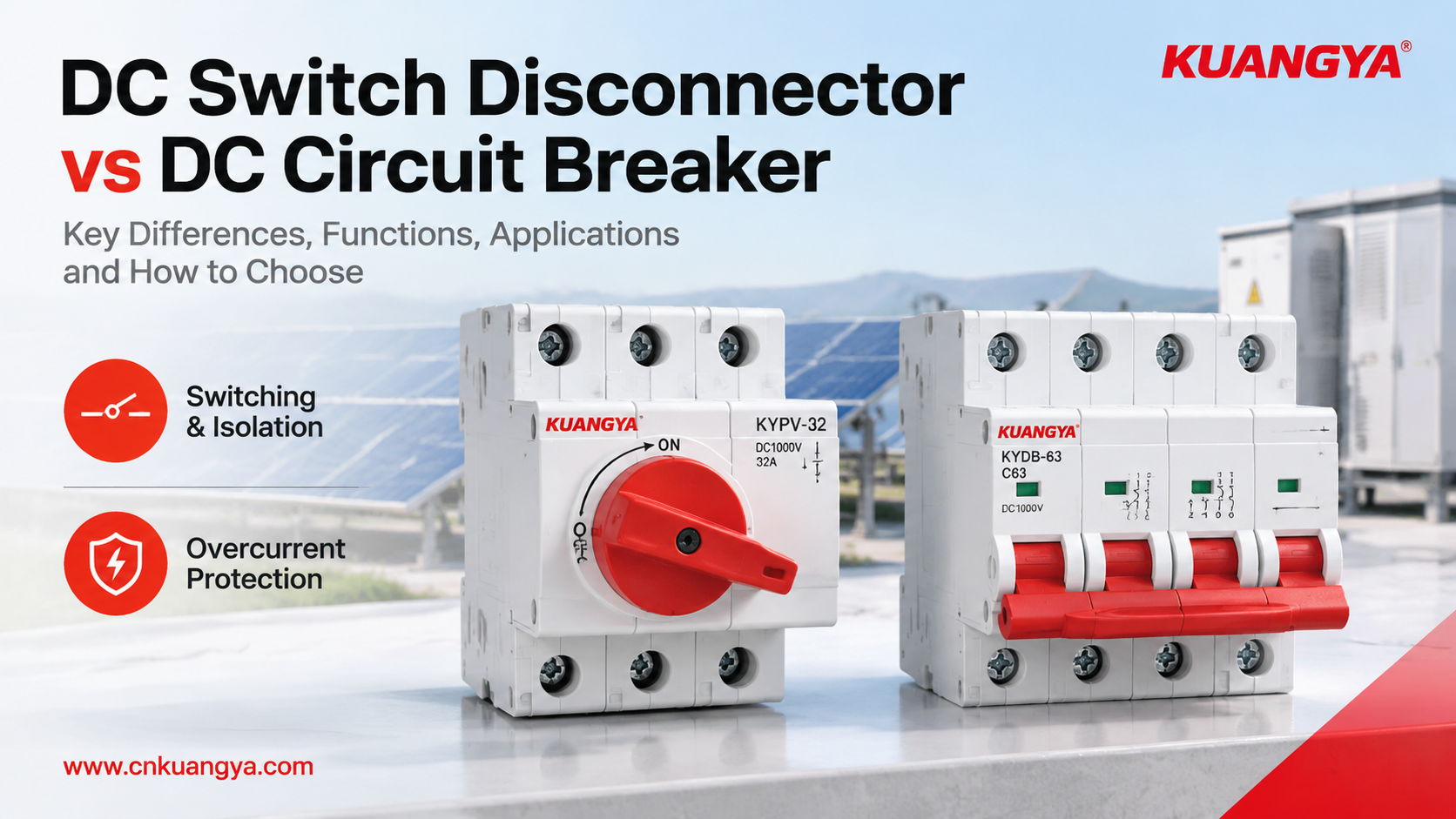
太陽光発電システムにおいて、 DCスイッチディスコネクタ対DCサーキットブレーカー の比較は、エンジニアや購入者が2つの異なる機能、すなわちスイッチングと絶縁、対自動過電流保護を理解するのに役立ちます。これらのデバイスは似たように見えるかもしれませんが、間違った方を選択すると、回路が必要な保護なしで放置されたり、メンテナンスがより困難になったりする可能性があります。.
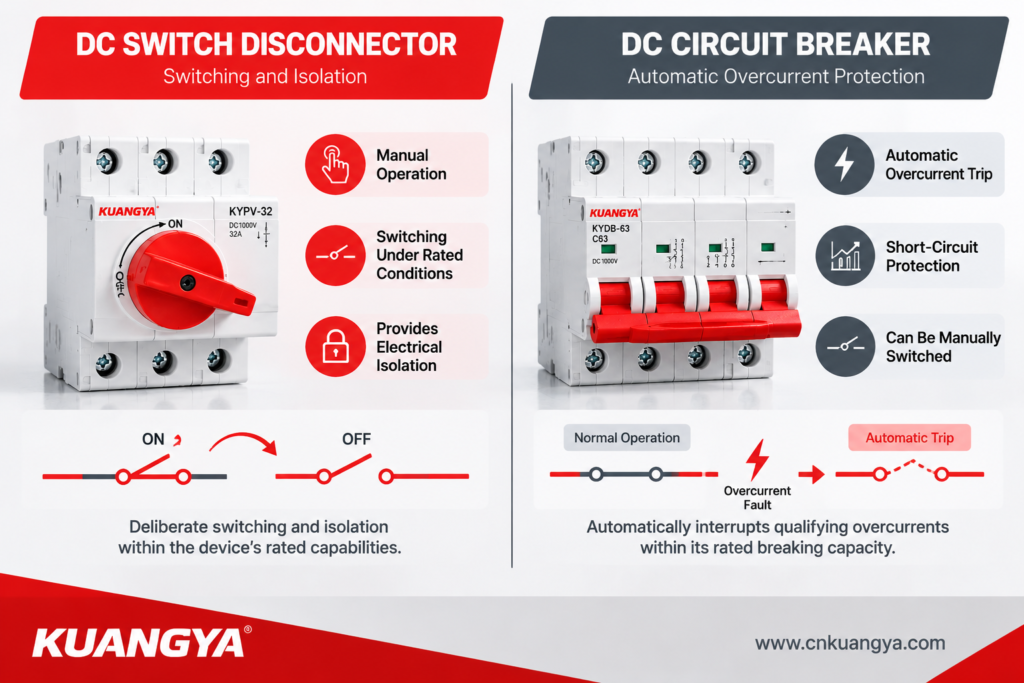
の違いは、 DCスイッチディスコネクタ対DCサーキットブレーカー の意図された機能に集約されます。スイッチディスコネクタは定格動作条件下でのスイッチングと絶縁を提供しますが、サーキットブレーカーは指定された過電流および短絡を自動的に遮断するように設計されています。.
しかし、その区別は製品名が示唆するほど単純ではない場合もあります。一部のデバイスは、スイッチング機能と絶縁機能を組み合わせており、実際の能力は定格、設計、および適用される規格によって異なります。.
このガイドでは、2つのデバイスを比較し、6つの実用的な違いを説明し、太陽光発電(PV)システム、集合箱、その他のDCアプリケーションでそれらを評価する方法を示します。.
要点: スイッチディスコネクタは自動的に短絡保護デバイスになるわけではなく、サーキットブレーカーはメンテナンスに必要なすべての絶縁機能を提供すると自動的に想定すべきではありません。.
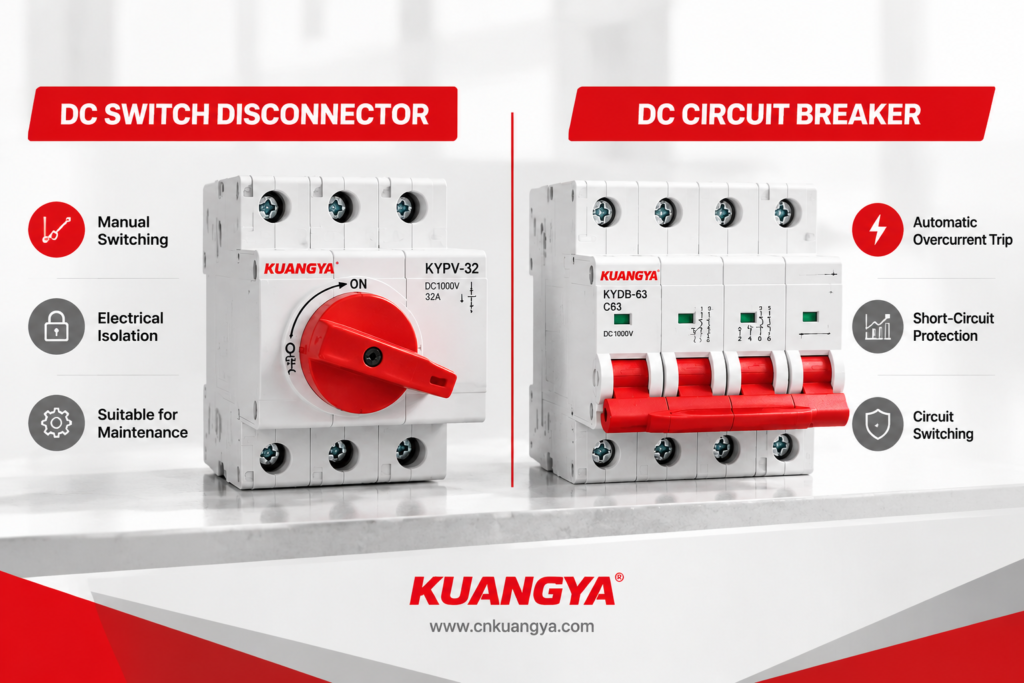
DCスイッチディスコネクタは、通常、指定された条件下で回路を接続または切断するために手動で操作されます。DCサーキットブレーカーは、保護機構が動作特性内の過電流を検出すると、回路を自動的に開くことができます。.
| 比較ポイント | DCスイッチ・ディスコネクター | DCサーキットブレーカー |
|---|---|---|
| 主要機能 | 定格に応じたスイッチングおよび電気的絶縁 | 過電流保護および回路開閉 |
| 通常負荷開閉 | はい、意図された用途に適した定格であれば | はい、定格動作条件下であれば |
| 自動過負荷トリップ | 通常は提供されません | 過負荷保護用に設計されたモデルで利用可能 |
| 短絡遮断 | 通常の単独機能ではありません | はい、定格遮断容量内であれば |
| 絶縁機能 | デバイスの宣言された絶縁能力による | その設計、マーキング、および適用される要件による |
| 通常の操作 | 手動ハンドルまたはロータリー機構 | 手動操作および自動トリップ |
| ロックアウト機能 | オフ位置での南京錠に対応している場合があります | モデルおよび付属品によります |
| 関連するIEC規格ファミリー | IEC 60947-3 | 産業用回路ブレーカーに関するIEC 60947-2 |
| 代表的なPVアプリケーション | 計画的な切断および保守のための絶縁 | 適切な分岐回路またはフィーダーの保護 |
この比較は、市場に出回っているすべてのデバイスではなく、典型的な製品機能について説明しています。常に正確なモデルのデータシートと認証を確認してください。.
評価する際 DCスイッチディスコネクタ対DCサーキットブレーカー, 、定格電圧や電流だけで製品を比較しないでください。デバイスが負荷開閉、電気的絶縁、自動トリップ、または短絡遮断のために設計されているかどうかを確認してください。これらの機能は、DC回路の実際の要件と一致する必要があります。.
重要: 絶縁のみを目的とした基本的な切断器は、負荷開閉スイッチとして扱われるべきではありません。同様に、スイッチ切断器は、その特定の定格または承認された保護アセンブリがその義務を許可しない限り、短絡を遮断することは期待されるべきではありません。.
最も重要な区別は、各デバイスが何をするために設計されているかです。.
DCスイッチ切断器は、回路を開くための意図的な手段を提供します。製品オプションとアプリケーションの詳細については、当社の DCスイッチ・ディスコネクター 太陽光発電、エネルギー貯蔵、その他のDCアプリケーション向け。デバイスが用途に適している場合、点検、保守、または機器交換の前に明確な絶縁ポイントを確立するのに役立ちます。.
DCサーキットブレーカーは、適切に設計された回路を、指定された過電流状態から保護します。トリップ特性に応じて、過負荷や短絡に応答し、定格能力内で電流を遮断することができます。.
次の例を検討してください。
太陽光発電用コンバイナボックスは、インバータに接続されたDC回路に電力を供給します。メンテナンス中、技術者は関連する回路を切り離す必要があります。異常電流が発生した場合、回路はまた、故障を遮断するために適切な保護装置を必要とします。.
これらは関連していますが、異なる要件です。設計では、定格されていない機能の実行を1つのコンポーネントに期待するのではなく、適切な絶縁装置と過電流保護を指定する必要があります。.
すべてのスイッチが、負荷のかかったDC回路を開くのに適しているわけではありません。.
DC電流には、AC電流に見られるような自然な周期的なゼロクロスがありません。DC接点が分離すると、指定された条件下で遮断するように設計されていない限り、アークが電流を伝導し続ける可能性があります。.
関連するDCスイッチングデューティに対して定格されたスイッチディスコネクタは、宣言された制限内で回路を開くことができます。非負荷絶縁を目的としたディスコネクタは、まず別の適切なデバイスによって電流を遮断する必要がある場合があります。.
デバイスを選択する前に、以下を確認してください。
ロータリーハンドル、ラベルに印刷された高電圧、または目に見えるON/OFF表示が、デバイスがいかなる種類のDC負荷も遮断できることを証明していると仮定しないでください。.
ここで、その区別が特に重要になります。.
DCサーキットブレーカーは、定格遮断容量および動作条件下で指定された故障電流を遮断するように設計されています。.
DCアプリケーション用のサーキットブレーカーを評価する際は、定格遮断容量とシステムの予測故障電流との適合性を確認してください。当社の DC MCBシリーズ を参照して、製品オプションと定格仕様をご確認ください。.
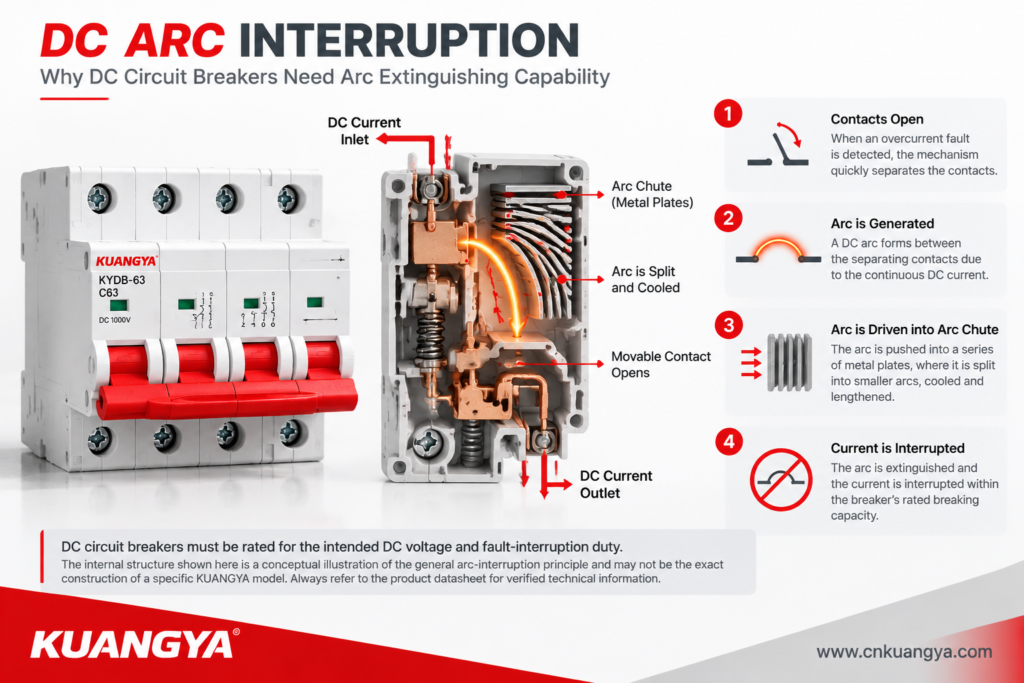
対照的に、スイッチディスコネクタは通常、独立した自動短絡保護を提供するものではありません。指定された保護装置と併用する場合、短時間耐電流能力または条件付き短絡定格が指定されている場合があります。.
これらの定格はそれぞれ異なる意味を持ちます。.
| 定格または機能 | それが示す内容 | それが自動的に意味するわけではないこと |
|---|---|---|
| 定格動作電圧 | 指定された条件下でデバイスが動作するように意図されている電圧 | その電圧でデバイスがいかなる故障も遮断できること |
| 定格電流 | 記載された条件下での許容電流 | 過負荷が自動トリップを引き起こすこと |
| 破断能力 | 定められた条件下で保護装置が遮断できる短絡電流 | その装置がすべてのDC電圧または回路構成に適していること |
| 短時間耐電流 | 装置が所定の時間耐えられる短絡電流 | それが独立して故障を解消できること |
| 条件付き短絡容量 | 指定された保護構成で使用した場合の性能 | いかなるヒューズまたはブレーカーも交換可能であること |
DCスイッチディスコネクタの場合、宣言された短絡耐量または条件付き定格と、必要な上流保護装置を確認してください。.
DCサーキットブレーカーの場合、定格DC遮断容量を確認し、設置場所での予定短絡電流に対して十分であることを確認してください。.
従来のスイッチディスコネクタは手動で操作されます。通常、過負荷を検知して自動的にトリップすることはありません。.
適切な保護機能を備えたサーキットブレーカーは、トリップ機構が適格な障害を検知した場合に回路を開くことができます。.
この違いはシステム運用に影響します。.
| 状況 | スイッチ・ディスコネクター | DCサーキットブレーカー |
|---|---|---|
| 計画メンテナンス | 適切な手動絶縁ポイントを提供します | 特定の用途に適している場合、開閉および絶縁機能を提供できます |
| 持続的な過負荷 | Does not normally trip automatically | Can trip if its protection characteristics detect the overload |
| ショート | Must not be relied upon as standalone fault protection | Can interrupt the fault within its rated capability |
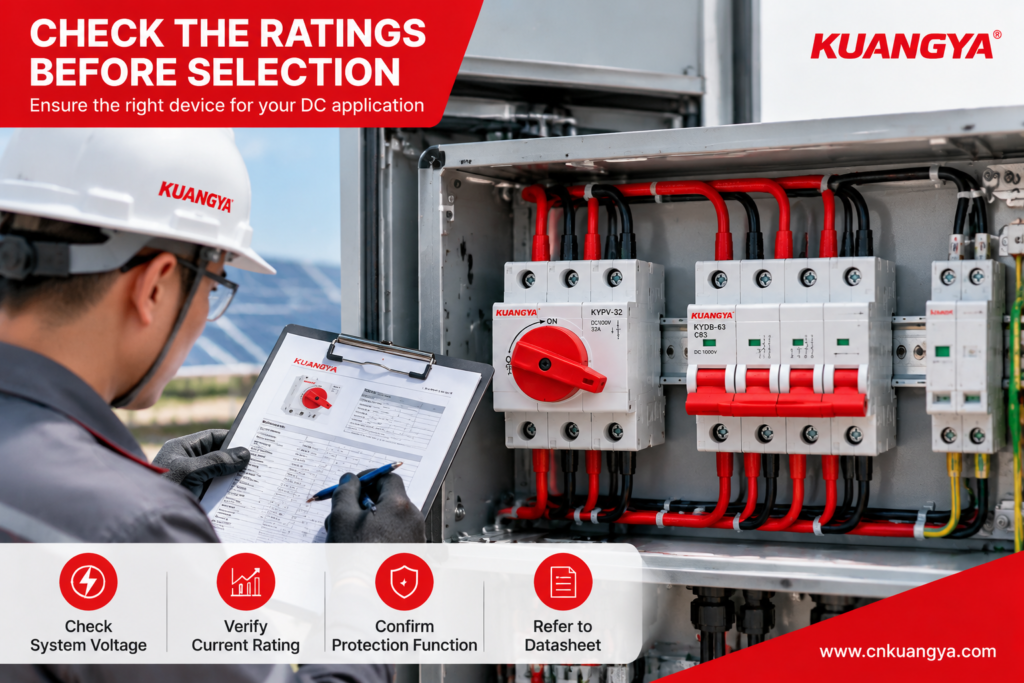
| 遠隔監視 | Requires suitable auxiliary contacts or additional equipment | May support auxiliary contacts or electronic monitoring, depending on model |
| Automatic fault response | 通常は提供されません | Available according to the protection design |
A device’s ability to be switched remotely is not the same as its ability to provide automatic fault protection. Remote actuation, status monitoring, and protective tripping should be evaluated separately.
A 2-pole device is not automatically equivalent to a 4-pole device, and a voltage rating printed on a product should not be interpreted without checking the specified wiring arrangement.
Some DC switching devices use multiple contacts in series to achieve their declared voltage or interruption capability. In such cases, the manufacturer’s wiring diagram must be followed.
For example, a device rated for a particular DC voltage with a specified series-pole connection may not retain that rating when wired differently.
When comparing a DC switch disconnector with a DC circuit breaker, verify:
Do not choose a device based on “2P,” “4P,” or “1500V DC” alone. The complete combination of voltage, current, pole arrangement, and switching duty must match the intended application.
Maintenance safety involves more than turning a handle to OFF.
A suitable isolation arrangement should help personnel identify the correct circuit, prevent unintended reconnection, and follow the applicable safe-working procedure.
A DC switch disconnector may provide a lockable OFF position, but this feature must be confirmed for the specific model. A circuit breaker may also support locking accessories, although its suitability as the required isolation device must be verified separately.
For a planned maintenance task, consider the following:
An OFF indication alone is not proof that an electrical circuit is safe to touch.
In many photovoltaic installations, the switch disconnector and circuit breaker serve complementary roles.
A typical protection arrangement may include:
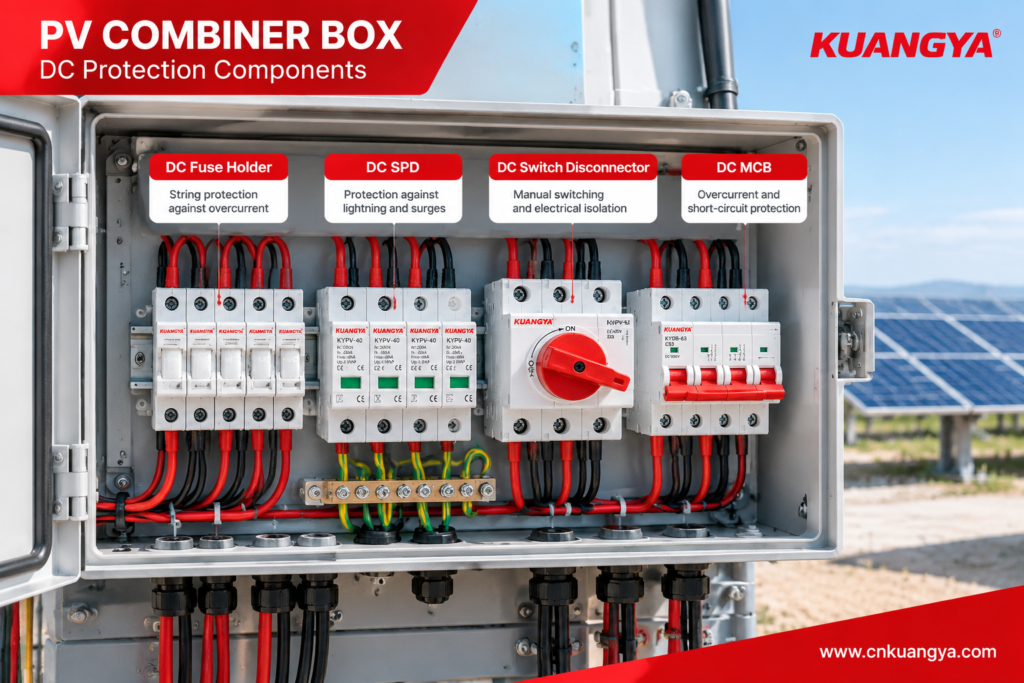
The exact arrangement depends on the system architecture, inverter requirements, prospective fault current, earthing arrangement, and applicable standards. For a closer look at how fuses, SPDs, disconnect switches, and other components work together, read our solar combiner box protection and maintenance guide. Not every installation requires all four devices in the same location.
| コンポーネント | 主な目的 | Selection Check |
|---|---|---|
| gPV fuse and fuse holder | PV string overcurrent protection | Rated voltage, current, fuse characteristic, and fault-interruption capability |
| DC SPD | 過渡過電圧保護 | PV-specific rating, protection level, and applicable SPD standard |
| 直流開閉器 | 開閉および絶縁 | Rated DC switching duty, isolation capability, and connection arrangement |
| 直流遮断器 | Overcurrent protection where required | Trip characteristics, rated breaking capacity, and system compatibility |
A combiner box with a fuse, SPD, and switch disconnector does not automatically provide every protective function that a circuit breaker would provide. Each component must be selected for its intended role.
For related technical guidance, see our Solar DC Protection Guide そして PV Combiner Box Guide.
The following cases are illustrative engineering scenarios based on common equipment-selection and system-coordination issues. They are not presented as documented KUANGYA customer incidents or laboratory test results.
状況
A panel designer selects a DC switch disconnector because its voltage and current ratings appear to match the circuit. The design does not include a suitable protective device for the relevant fault condition.
What is wrong?
The selected switch may be suitable for manual switching and isolation but may not have the capability to interrupt the prospective short-circuit current.
Corrective action
Lesson: A matching voltage and current label does not prove that a switch can clear a short circuit.
状況
A buyer chooses an AC-rated switching device because its current rating appears sufficient for a solar DC circuit.
What is wrong?
The device may not have been tested or rated to interrupt the specified DC current. Its arc-extinguishing design and contact arrangement may be unsuitable for the application.
Corrective action
Use a device with an explicit DC rating for the actual system voltage, current, and switching duty. Follow the manufacturer’s approved wiring diagram.
Lesson: AC and DC ratings are not interchangeable unless the manufacturer explicitly declares the relevant capability.
状況
A maintenance team assumes that switching a circuit breaker to OFF automatically satisfies all site isolation requirements.
What is wrong?
The breaker may not provide every required isolation, locking, or work-control feature for the particular installation. Other energy sources or backfeed paths may also remain present.
Corrective action
Check the device’s isolation suitability, locking provisions, circuit arrangement, and site procedures. Use the designated isolation method and verify the absence of voltage before work.
Lesson: Protection, isolation, and safe-work procedures are related but distinct requirements.
Use the following guide as a starting point, then confirm the choice against the applicable standard and the manufacturer’s documentation.
| Application Requirement | Appropriate Direction |
|---|---|
| Manual disconnection for planned maintenance | A suitable DC switch disconnector or isolator |
| Automatic overload protection | A suitably rated DC circuit breaker or other approved protective device |
| 短絡遮断 | A protective device with sufficient DC breaking capacity |
| Both switching and isolation | A switch disconnector rated for the required duty, or another approved arrangement |
| PV string reverse-current protection | A correctly selected gPV fuse where required by the design |
| 過渡過電圧保護 | A suitably rated DC SPD |
| Isolation and overcurrent protection | A coordinated combination of devices, unless an approved integrated solution provides the required functions |
For photovoltaic projects, the decision should be based on the system’s maximum DC voltage, current, prospective fault current, required isolation points, and applicable local requirements.
A device that is suitable for one part of a PV installation may not be suitable for another.
IEC 60947-3 covers switches, disconnectors, switch-disconnectors, and fuse-combination units within its scope. Buyers should check the applicable edition and the device’s declared ratings before selecting a product. IEC 60947-2 specifies requirements for circuit breakers within its scope, including relevant DC applications. Check the applicable edition and the manufacturer’s documentation to verify that the selected device meets the project’s requirements.
The applicable edition, product scope, and any relevant product-specific requirements should be checked for the intended application.
For more information about DC isolation principles and photovoltaic applications, see our DC switch disconnector technical guide.
Before issuing a purchase order, ask the supplier to confirm the following:
| Checkpoint | Information to Request |
|---|---|
| Product identity | Exact model and intended function |
| 定格電圧 | Rated DC voltage and any limitations |
| 現在のレーティング | Rated operational or continuous current under stated conditions |
| Switching duty | Permitted load-breaking conditions and utilization category |
| Fault performance | Breaking capacity for breakers; applicable withstand or conditional rating for disconnectors |
| Pole arrangement | Approved wiring diagram and pole configuration |
| Isolation | Declared isolation suitability and operating indication |
| Locking | Whether the OFF position can be secured, if required |
| 規格 | Applicable standard, edition, and supporting conformity documentation |
| 環境適合性 | Temperature limits, enclosure protection, terminals, and derating |
| Traceability | Model-specific datasheet, markings, and relevant test documentation |
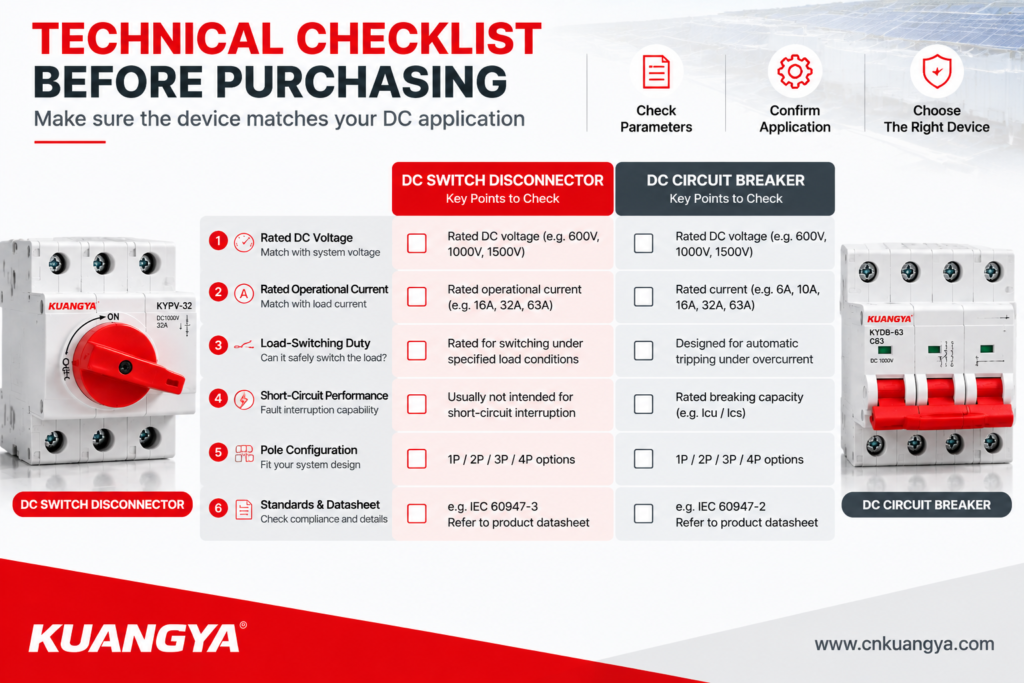
Avoid comparing suppliers solely by voltage, current, or unit price. Two products with similar front-panel markings may have different switching capabilities and short-circuit ratings.
No. A switch disconnector is intended for switching and isolation within its declared ratings. A DC circuit breaker provides automatic overcurrent protection within its rated protective capability. Their functions may overlap in some respects, but the devices are not automatically interchangeable.
Not as a general rule. A switch disconnector does not normally provide standalone automatic overload and short-circuit protection. A suitable protective device must be included where required by the system design.
Not automatically. Confirm that the breaker is suitable for the required isolation function, operating conditions, and maintenance procedures.
Each device must be rated for the actual maximum system voltage and its intended duty. A nominal 1500V system label alone is insufficient; verify the device ratings and approved connection arrangement.
IEC 60947-3 is relevant to switches, disconnectors, and switch-disconnectors. IEC 60947-2 is relevant to industrial circuit breakers. Other standards or requirements may apply depending on the product and installation.
Provide the application, maximum DC voltage, operating current, prospective fault current if known, required poles, switching duty, installation environment, quantity, and any required certifications or documentation. Include the system wiring diagram when possible.
正しい選択 DCスイッチディスコネクタ対DCサーキットブレーカー solution starts with understanding the function each device needs to perform. A switch disconnector provides switching and isolation within its rated capabilities, while a circuit breaker provides automatic overcurrent protection within its rated breaking capacity. The final choice should match the system voltage, operating current, fault conditions, and applicable standards.
For solar PV systems, the right choice depends on the maximum DC voltage, operating current, prospective fault current, required isolation functions, and applicable standards. Always verify the manufacturer’s datasheet and ensure that all protective devices work together as intended.
KUANGYA provides DC switch disconnectors and DC protection components for photovoltaic and other electrical applications. If you are selecting components for a new project, contact our team with your system specifications to discuss a suitable solution.
Explore our DCスイッチ・ディスコネクター そして DC MCB product ranges for more information.