Zona industriale di WengYang Yueqing Wenzhou 325000
Orario di lavoro
Da lunedì a venerdì: dalle 7.00 alle 19.00
Fine settimana: 10.00 - 17.00
Zona industriale di WengYang Yueqing Wenzhou 325000
Orario di lavoro
Da lunedì a venerdì: dalle 7.00 alle 19.00
Fine settimana: 10.00 - 17.00

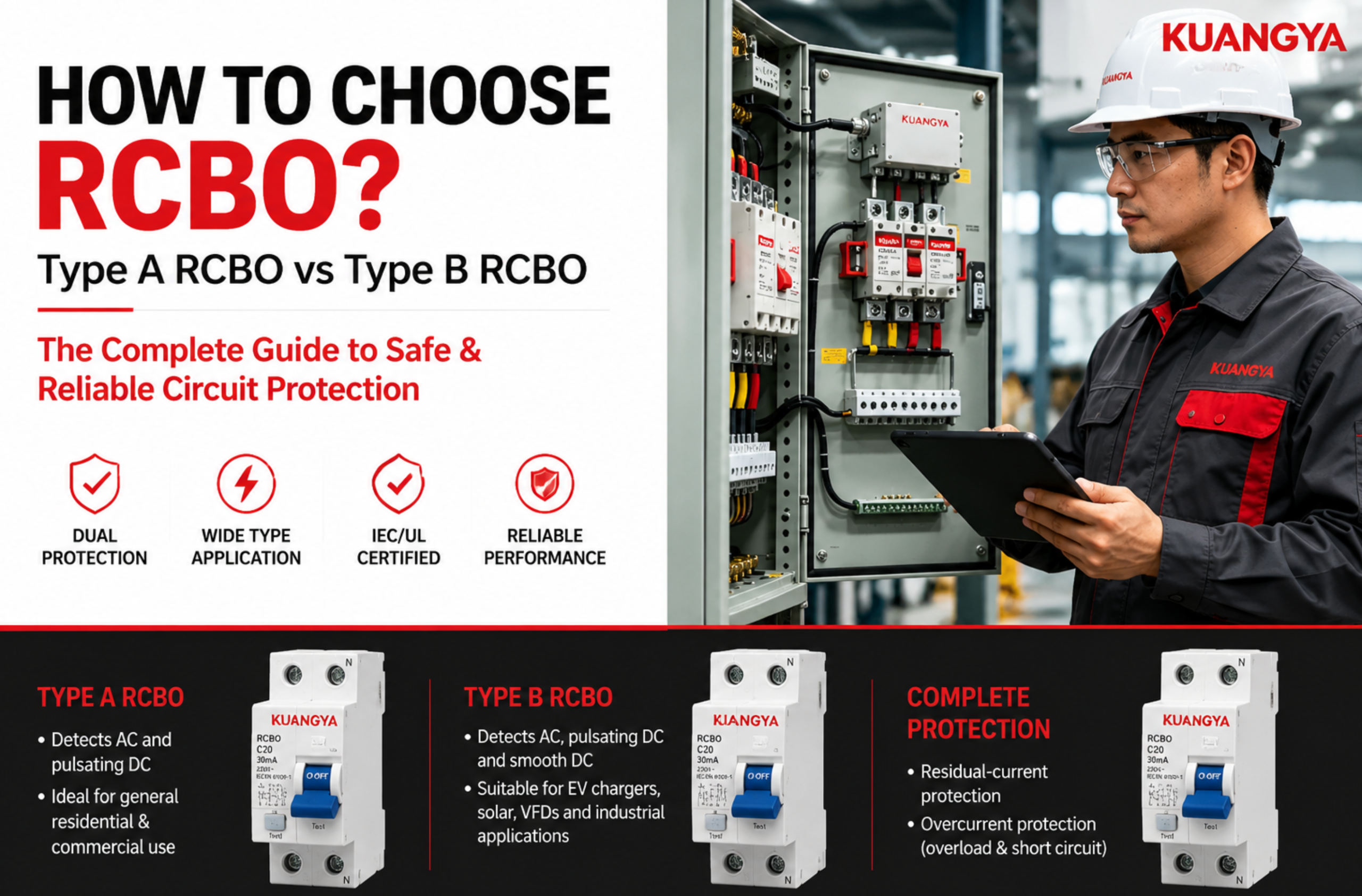
Type A vs Type B RCBO—quick answer: Type A RCBOs detect sinusoidal AC and pulsating DC residual currents. Type B RCBOs additionally cover smooth DC and mixed-frequency residual currents within the device’s specified range. Type B is not a universal upgrade: select the RCBO type according to the connected equipment, DC monitoring arrangement, manufacturer instructions, circuit design and local requirements.
This guide compares RCBO types, explains Type A or Type B selection, and covers poles, current rating, sensitivity, breaking capacity and application-specific checks for EV chargers, PV inverters and motor drives.
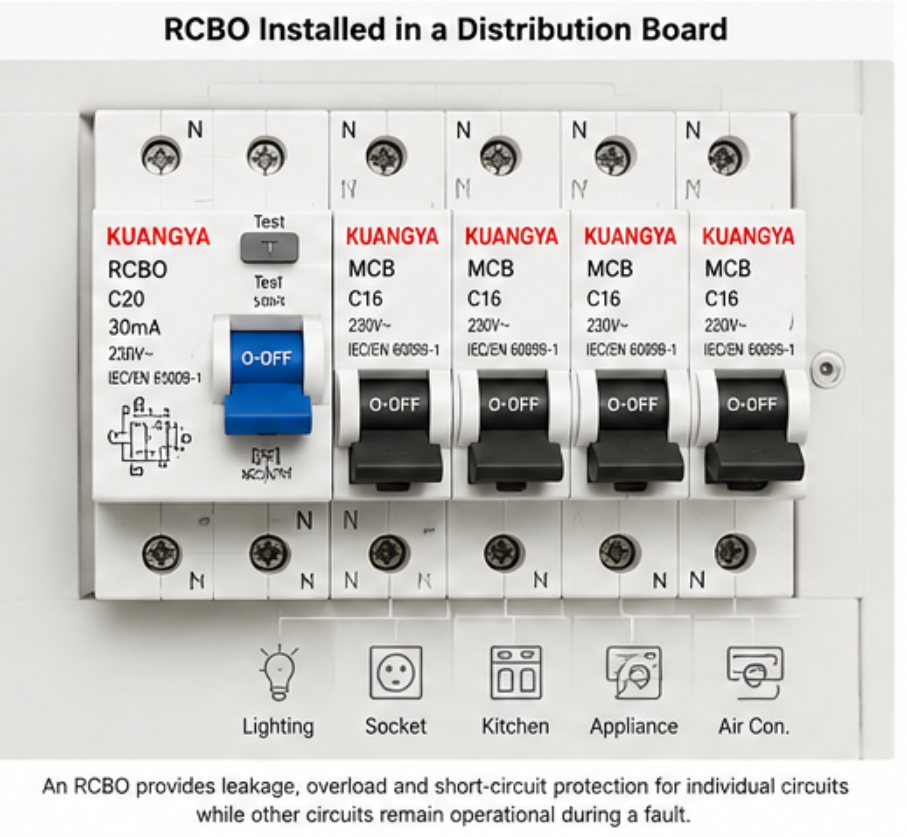
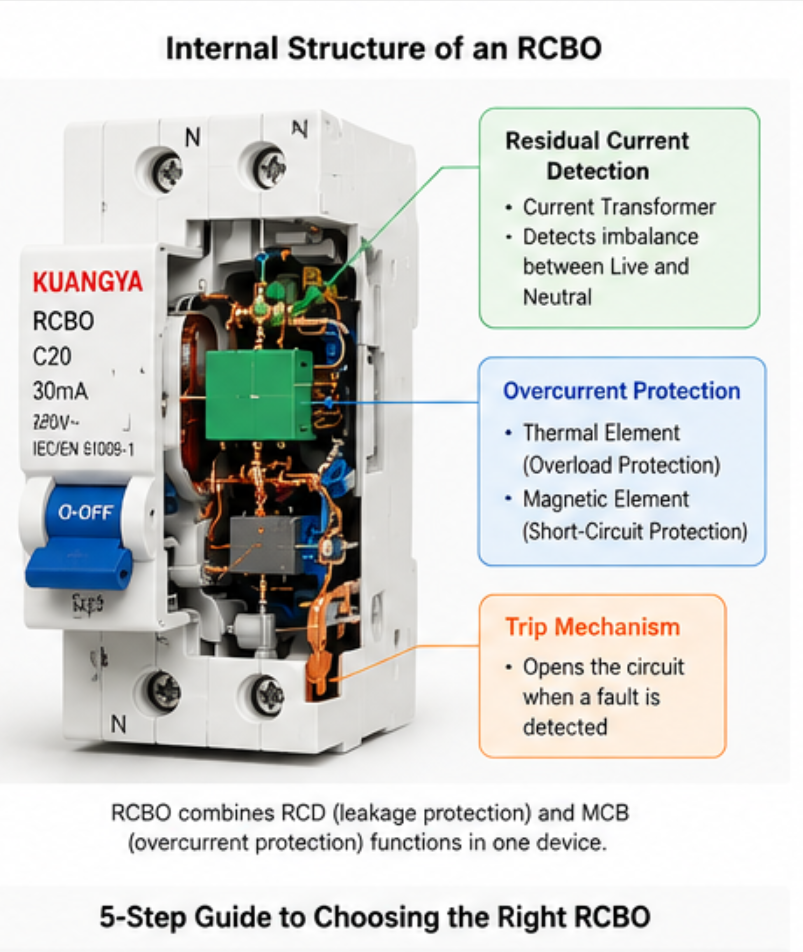
Un RCBO fornisce sia una protezione dalle correnti residue che una protezione dalle sovracorrenti in un unico dispositivo. Tuttavia, la scelta del tipo di RCBO sbagliato può ridurre l'efficacia della protezione e causare interventi indesiderati o il mancato rilevamento di alcune condizioni di guasto.
Per questo motivo è essenziale capire la differenza tra RCBO di tipo A e RCBO di tipo B quando si progetta o si aggiorna un impianto elettrico.
Molti installatori si concentrano su:
Se queste specifiche sono importanti, il tipo di corrente residua è altrettanto fondamentale.
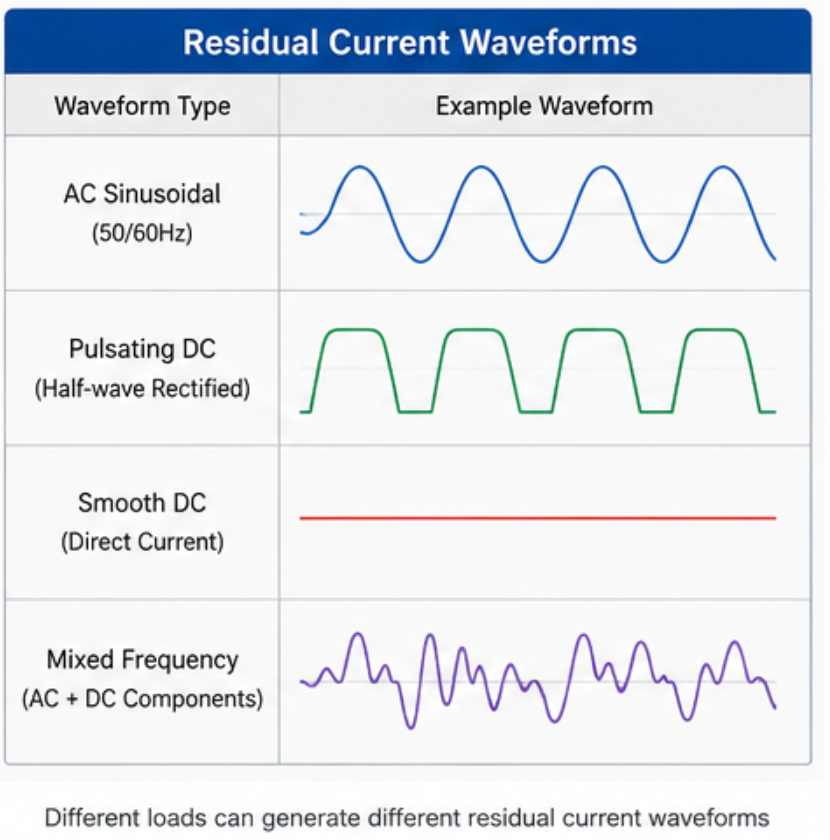
Carichi elettrici diversi possono produrre forme d'onda di corrente di dispersione diverse. Non tutti gli RCBO sono progettati per rilevarle tutte.
Se si seleziona il tipo di RCBO sbagliato, le correnti di terra pericolose potrebbero non essere rilevate correttamente.
Un RCBO di tipo A è progettato per rilevare:
Questo rende i dispositivi di tipo A adatti alla maggior parte delle moderne installazioni residenziali e commerciali in cui sono presenti apparecchiature elettroniche.
Gli RCBO di tipo A sono comunemente utilizzati per:
Poiché molti apparecchi moderni contengono componenti elettronici e raddrizzatori, gli RCBO di tipo A sono sempre più preferiti ai vecchi dispositivi di tipo AC.
| Tipo di corrente residua | Rilevato da RCBO di tipo A |
|---|---|
| AC Sinusoidale | Sì |
| Pulsante CC | Sì |
| Liscio CC | No |
| Componenti CC ad alta frequenza | Limitato |
Type A is commonly used for many residential and commercial electronic loads, but suitability still depends on the connected equipment and applicable requirements.
Un RCBO di tipo B è progettato per rilevare:
I dispositivi di tipo B offrono la più ampia capacità di rilevamento delle correnti residue tra i comuni tipi di RCBO.
Questo li rende adatti alle installazioni in cui possono essere generate correnti di guasto in corrente continua.
Gli RCBO di tipo B sono comunemente utilizzati in:
Queste applicazioni possono generare correnti residue continue che possono accecare o saturare i dispositivi di tipo A convenzionali.
| Tipo di corrente residua | Rilevato da RCBO di tipo B |
|---|---|
| AC Sinusoidale | Sì |
| Pulsante CC | Sì |
| Liscio CC | Sì |
| Frequenza mista | Sì |
| Componenti ad alta frequenza | Sì |
Grazie al suo campo di rilevamento più ampio, l'RCBO di tipo B viene spesso specificato per i sistemi elettrici avanzati.
Questo è il confronto più importante nella scelta di un RCBO.
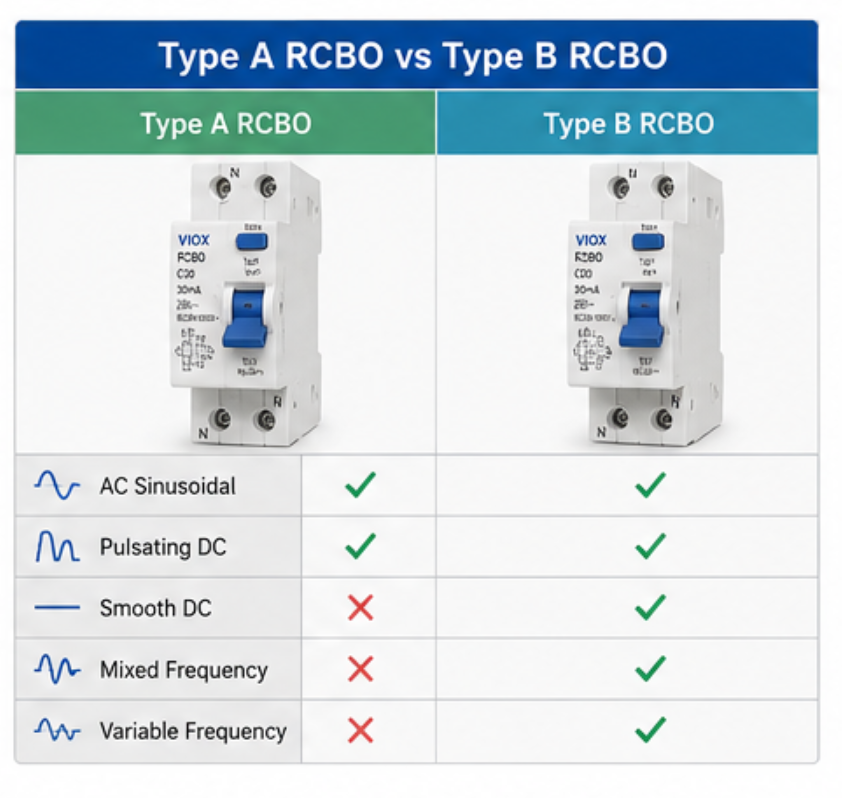
| Caratteristica | Tipo A RCBO | Tipo B RCBO |
|---|---|---|
| Rilevamento della corrente residua CA | Sì | Sì |
| Rilevamento della corrente continua pulsante | Sì | Sì |
| Rilevamento CC regolare | No | Sì |
| Mixed-Frequency Residual Currents | Verify waveform and device specification | Covered only within the device’s specified frequency range |
| Applicazioni dei caricabatterie per veicoli elettrici | Possible with verified DC protection where permitted | Use when required by the charger manual or applicable rules |
| Sistemi solari fotovoltaici | Verify inverter manual and DC monitoring | Use when required by the inverter manual or applicable rules |
| Azionamenti industriali | Limitato | Verify equipment manual and applicable rules |
| Costo | Più basso | Più alto |
The key difference is residual-current waveform coverage. Type A detects sinusoidal AC and pulsating DC residual currents, while Type B additionally detects smooth DC and mixed-frequency components within the manufacturer’s specified range.
Do not treat Type B as automatically better. For EV chargers, PV inverters and variable-speed drives, follow the equipment manual and applicable rules to determine whether Type A with verified DC detection, Type F or Type B is required.
Use the tool below to organize a preliminary RCBO specification. It highlights missing parameters and unsafe combinations, but it does not replace engineering verification or local requirements.
How to use this RCBO selector: choose the known circuit and equipment conditions. The result organizes a preliminary specification and highlights information that still requires verification.
Preliminary selection only. This tool does not approve a circuit or replace the equipment manual, product datasheet, coordination study, qualified designer, or local rules.
La scelta dell'RCBO corretto inizia con la comprensione del carico collegato.
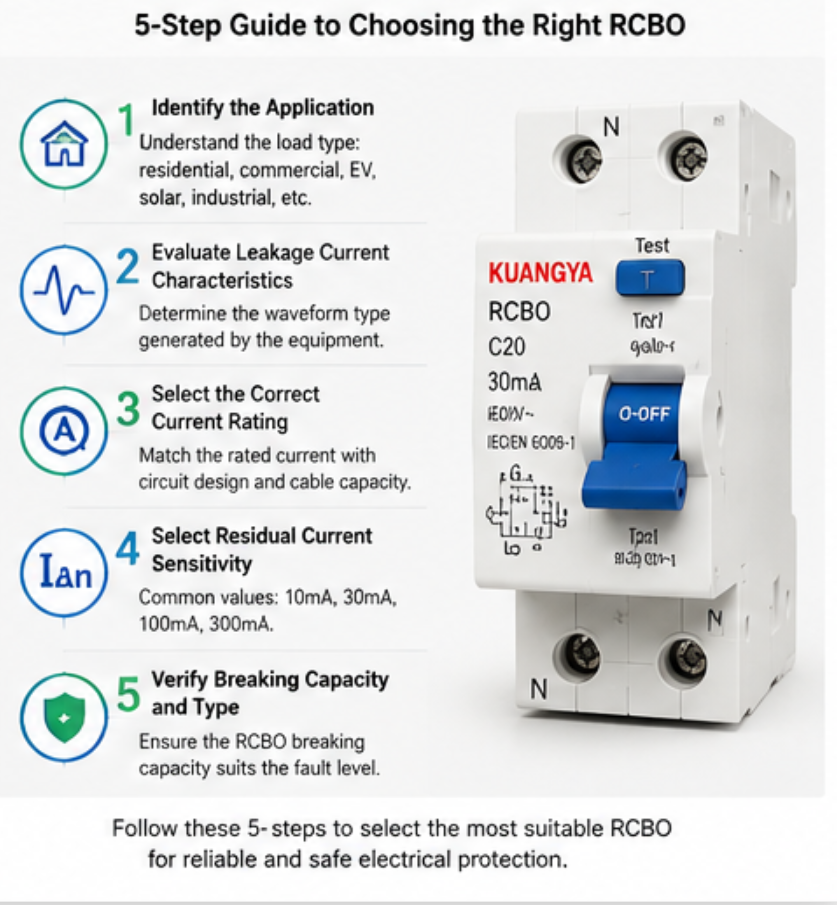
Chiedete:
Le risposte guideranno la scelta del tipo di RCBO.
Apparecchiature diverse creano forme d'onda di corrente residua diverse.
| Tipo di apparecchiatura | Tipo di RCBO consigliato |
|---|---|
| Circuiti di illuminazione | Tipo A |
| Prese di corrente | Tipo A |
| Elettrodomestici | Tipo A |
| Attrezzature per ufficio | Tipo A |
| Caricabatterie per veicoli elettrici | Follow the EVSE manual: Type A with verified DC monitoring or Type B, as required |
| Inverter solari | Follow the inverter manual and applicable rules |
| Azionamenti motore VFD | Verify leakage waveform, frequency behavior and drive manual |
| Sistemi di accumulo a batteria | Follow the converter/BESS manual and applicable rules |
La corrente nominale dovrebbe corrispondere:
Le classificazioni più comuni includono:
Le classificazioni di sensibilità più comuni includono:
| Sensibilità | Applicazione tipica |
|---|---|
| 10mA | Maggiore protezione personale |
| 30mA | Protezione del personale standard |
| 100mA | Protezione delle apparecchiature |
| 300mA | Applicazioni di protezione antincendio |
30 mA rimane la scelta più comune per i circuiti finali.
L'RCBO deve essere in grado di interrompere la corrente di guasto disponibile.
Le classificazioni tipiche includono:
Il valore richiesto dipende dal livello di guasto nel punto di installazione.
Molti errori di specifica e di acquisto derivano dall'incomprensione dei tipi di RCBO.
Gli errori più comuni includono:
Il tipo di RCBO deve sempre essere scelto in base al comportamento effettivo del carico piuttosto che al solo prezzo.
| Parametro | What to confirm | Perché è importante |
|---|---|---|
| Sistema | Single/three phase, voltage, frequency and neutral | Determines pole arrangement and operating voltage |
| Load | Electronic, motor/VFD, EVSE, PV inverter, UPS or resistive | Influences waveform type and trip curve |
| Corrente nominale | Design current, cable capacity and derating | A higher ampere rating is not automatically safer |
| RCBO type | AC, A, F or B required by the equipment manual | Determines detectable residual-current waveforms |
| Sensibilità | 10/30/100/300 mA as permitted | Must match protection objective and selectivity |
| Trip curve | B, C or D after inrush and loop checks | Controls magnetic response to overcurrent |
| Capacità di rottura | Prospective short-circuit current at installation point | Catalogue values cannot replace a fault-level calculation |
| Il mercato | Required standard edition and certificate scope | IEC reference does not prove approval in every country |
Stop condition: If breaking capacity, leakage characteristics, pole arrangement or local requirements are unknown, do not finalize the RCBO selection.
| Risultato | When to use it | Next action |
|---|---|---|
| Preliminary match | Every parameter is known and no obvious conflict exists | Compare exact datasheets and certificates; obtain engineering approval |
| Necessita di verifica | Breaking capacity, waveform, curve, poles or certification is unknown | Collect the missing data before ordering |
| Non effettuare ancora la selezione | Phase/poles conflict, EV/PV uses unverified Type AC, or the equipment manual contradicts the choice | Stop and review the circuit and equipment requirements |
System phase and voltage:
Load or equipment:
Rated current:
Poles and neutral requirement:
Residual-current type (AC/A/F/B):
Sensitivity (mA):
Trip curve (B/C/D):
Required breaking capacity (kA):
Frequency:
Target market and certification:
Quantity and purchase stage:
OEM/ODM requirement:
Required delivery date:
Also compare RCCB product families and read the RCCB vs RCBO guide. Final selection must use the exact product documentation and applicable local rules.
La scelta dell'RCBO corretto non si limita alla selezione della corrente nominale. Il tipo di corrente residua è un fattore critico che influisce direttamente sulle prestazioni della protezione.
Per la maggior parte dei circuiti residenziali e commerciali, un RCBO di tipo A fornisce una protezione efficace contro le correnti residue CA e CC pulsanti.
For EV chargers, solar installations, battery storage systems and inverter-driven equipment, follow the exact equipment manual. Some designs allow Type A with verified DC monitoring; others require Type F or Type B.
Comprendere la differenza tra RCBO di tipo A e RCBO di tipo B aiuta a garantire la conformità, a migliorare la sicurezza e a fornire una protezione affidabile ai moderni sistemi elettrici.
RCBO (Interruttore differenziale con sovracorrente) | Sicuro e affidabile Kuangya
IEC 61009-1:2024 gives general requirements and tests for RCBOs for household and similar uses within its stated scope. Always verify the applicable national adoption, installation rules, equipment manual and certificate scope of the exact product model.
Type A is common for many residential and commercial electronic circuits. EV, PV, storage and variable-frequency applications require verification against the equipment manual and local rules; do not assume one residual-current type fits every design.
L'RCBO di tipo A è in grado di rilevare correnti residue CC pulsanti, ma non può rilevare in modo affidabile correnti residue CC lisce.
L'RCBO di tipo B contiene una tecnologia di rilevamento più avanzata, in grado di rilevare una gamma più ampia di forme d'onda di corrente residua, compresi i guasti CC lisci.
Molte applicazioni di ricarica EV richiedono una protezione di tipo B o misure equivalenti di rilevamento dei guasti CC, a seconda degli standard locali e della progettazione del caricabatterie.
Do not treat Type B as a universal upgrade. The selected type must match the residual-current waveform, equipment instructions, coordination requirements and certification scope of the exact device.

