Zone industrielle WengYang Yueqing Wenzhou 325000
Heures de travail
Du lundi au vendredi : de 7h00 à 19h00
Le week-end : 10H00 - 17H00
Zone industrielle WengYang Yueqing Wenzhou 325000
Heures de travail
Du lundi au vendredi : de 7h00 à 19h00
Le week-end : 10H00 - 17H00

Do solar panels work during a power outage? A standard grid-connected solar installation usually cannot power your home when the utility supply fails. The panels may still produce DC electricity in daylight, but the inverter normally stops supplying the home’s AC circuits unless the installation has a compatible backup arrangement.
Solar-plus-battery systems can provide backup, but only when the equipment, controls and wiring support that function. Some specialist solar-only systems can also supply limited loads in daylight. The important question is what your complete system is designed to do, not simply whether there are panels or a battery on the property.
| System arrangement | Home power during an outage? | Main limitation to check |
|---|---|---|
| Standard grid-tied solar | Généralement non | The inverter normally shuts down when the grid fails |
| Solar and battery, without backup configuration | Pas nécessairement | Energy storage does not establish backup capability |
| Solar and battery with approved backup controls | Yes, for supported circuits | Available energy, output power and system configuration |
| Specialist sunlight-only backup | Limited daylight supply | Compatible equipment, available sunlight and selected loads |
| Purpose-designed off-grid system | Independent of the utility supply | Generation, storage and load limits still apply |
A grid-connected inverter must avoid unintentionally energizing a failed utility network. Anti-islanding functions detect the loss of the grid and stop that operation. The U.S. Department of Energy’s microgrid guidance explains both the hazards of uncontrolled islanding and the role of systems designed to operate independently.
An intentional backup system separates the supported premises circuits from the utility network and establishes a controlled local supply. Simply turning off the main breaker does not give an ordinary grid-following inverter the controls needed to create that supply. Never bypass anti-islanding protection to make a solar installation run during a blackout.
Also, a dark house does not prove the rooftop DC wiring is de-energized. Isolation and shutdown equipment have distinct functions; our solar rapid shutdown vs DC isolator guide explains that distinction.
No. A battery may be installed mainly to shift solar energy into the evening or reduce electricity purchased at certain times. Outage operation depends on the installed configuration. The Australian Government’s solar battery guide explicitly distinguishes systems that can provide backup from those that cannot.
Ask for written confirmation of three things: which circuits will remain energized, whether solar can recharge the battery while the grid is down, and what happens when the battery reaches its minimum state of charge. These answers can differ even between installations with similar battery capacity.
A “hybrid” label alone is not a complete specification. Check whether the quoted package includes the required backup interface, inverter functions, compatible battery and commissioning. Any optional backup output also needs the correct circuits connected to it.
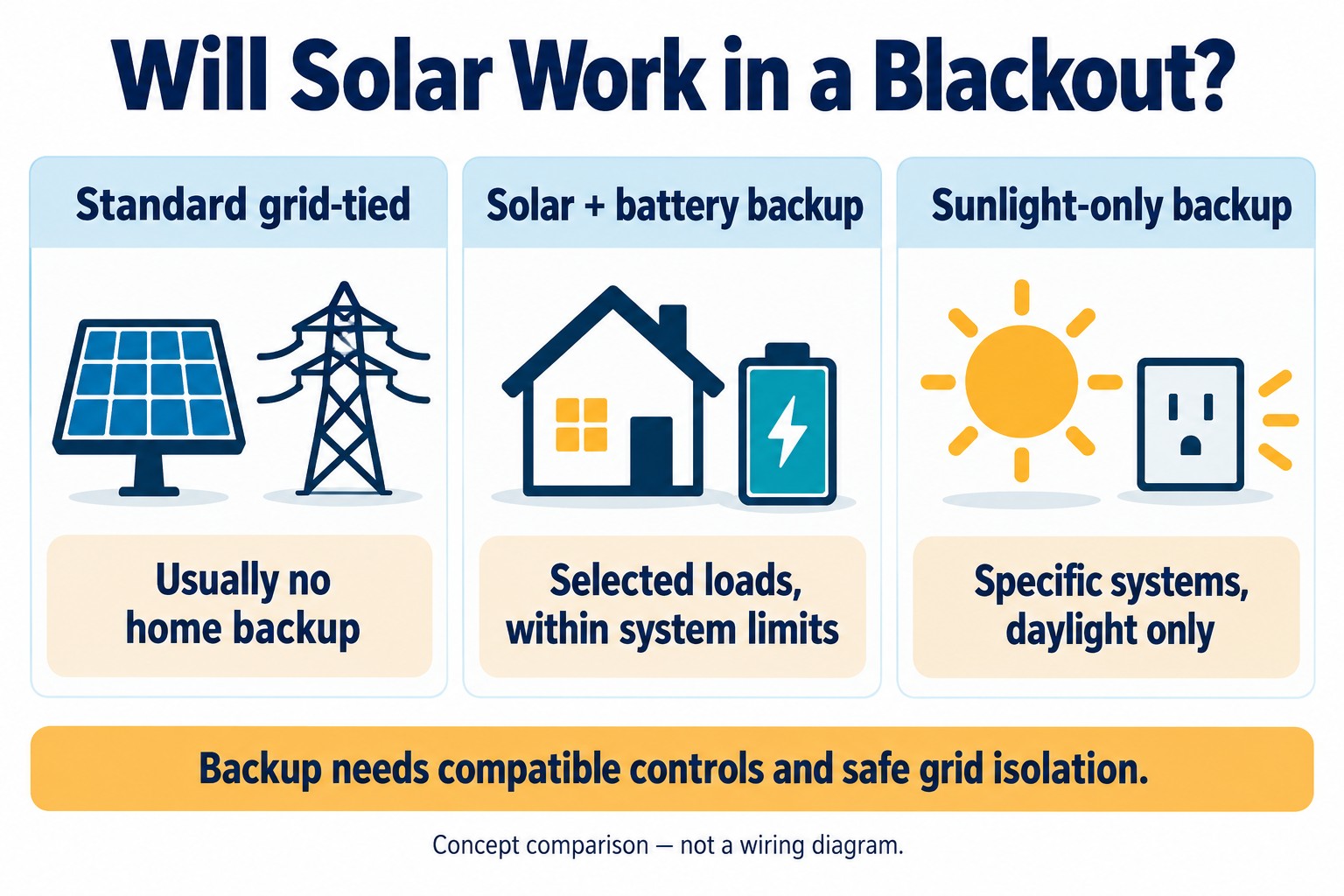
Some specifically designed systems can. For example, Enphase’s Sunlight Backup guide describes an arrangement using compatible IQ8 microinverters, system control and load control. Its guidance limits this application to essential loads rather than whole-home backup. Buying microinverters alone does not reproduce that arrangement.
Another example is Fronius Primo GEN24 PV Point, which can supply a designated single-phase output up to its specified 3kW limit when sufficient solar or optional battery power is available. Starting currents and the exact model’s instructions still matter.
These examples demonstrate that “solar never works without a battery in a blackout” is too broad. They do not establish that an existing ordinary solar system can gain this capability through a setting change. Without stored energy, available sunlight remains the constraint; after sunset, sunlight-only backup cannot supply the load.
Essential-load backup supports an agreed group of circuits, such as lighting, refrigeration and communications. Whole-home backup includes a wider set of circuits, but the connected appliances must still stay within the system’s power capability.
Tesla’s backup planning guidance describes partial and whole-home arrangements and explains why equipment quantity and household demand affect the result. “Whole home” should not be read as permission to run every high-power appliance simultaneously.
Make a room-by-room circuit list before requesting a quotation. Identify the refrigerator, router and lights separately from electric heating, cooking, air conditioning and EV charging. For a three-phase property, ask which phases and loads the proposed backup arrangement actually supports.
Keep two quantities separate: kW describes power demand at a moment in time; kWh describes energy over time. A battery can have enough stored energy for hours of light loads yet be unable to start or sustain a large appliance.
As a first planning estimate:
Runtime in hours ≈ energy available to the loads in kWh ÷ average load in kW.
For an illustrative system with 8kWh actually available at the AC loads after reserve and conversion losses, an average 0.5kW load gives about 16 hours. An average 2kW load gives about 4 hours. These are arithmetic examples, not performance claims for a specific battery.
Real results depend on the initial charge, cycling appliances, temperature, system consumption and solar recharge. Separately verify continuous output and motor-start capability. Tesla’s Powerwall 3 design guidance illustrates why adding energy-storage capacity can extend duration without necessarily increasing the system’s output-power capability.
Backup power and electrical protection solve different problems. A transfer arrangement selects or separates sources as designed; it does not turn a conventional inverter into a backup inverter. Selection must account for source compatibility, ratings and the approved system architecture. See our automatic vs manual transfer switch comparison for the operating distinction.
Breakers and fuses address overcurrent protection within their specified ratings. Battery circuits need particular attention to DC voltage and available fault current, as explained in our DC circuit breaker guide for ESS.
An SPD addresses transient overvoltage; it does not store energy or keep appliances running through a blackout. Our SPD and overvoltage guide explains its protection limits. These devices remain parts of a coordinated design, not substitutes for backup controls.
Have a qualified installer confirm grid separation, earthing, neutral arrangements and protective-device coordination for the local installation. Request a labelled circuit schedule and operating instructions instead of relying on a generic internet wiring diagram.
No. More panel capacity does not add grid-forming controls or the required backup interface. Establish backup compatibility before deciding whether more generation is useful.
No. Neither device is an energy source. Their protection or isolation functions remain separate from the equipment that supplies and controls backup electricity.
Some backup systems support this; others do not. Confirm it for the complete solar-and-storage configuration, including its restart behavior after a low-battery shutdown.
Planning protection for a solar backup project? Prepare the inverter and battery models, maximum DC voltage, backup output ratings, source-transfer arrangement and circuit list before selecting components. These details make the protection specification useful for the installation you actually intend to build.

