Zone industrielle WengYang Yueqing Wenzhou 325000
Heures de travail
Du lundi au vendredi : de 7h00 à 19h00
Le week-end : 10H00 - 17H00
Zone industrielle WengYang Yueqing Wenzhou 325000
Heures de travail
Du lundi au vendredi : de 7h00 à 19h00
Le week-end : 10H00 - 17H00

Planifiez la protection contre les surtensions PoE pour les réseaux de caméras extérieures. Comparez les parafoudres pour l'alimentation et l'Ethernet, vérifiez la compatibilité des données et de l'alimentation, examinez le placement et la liaison équipotentielle, et utilisez une matrice de dépannage pratique.
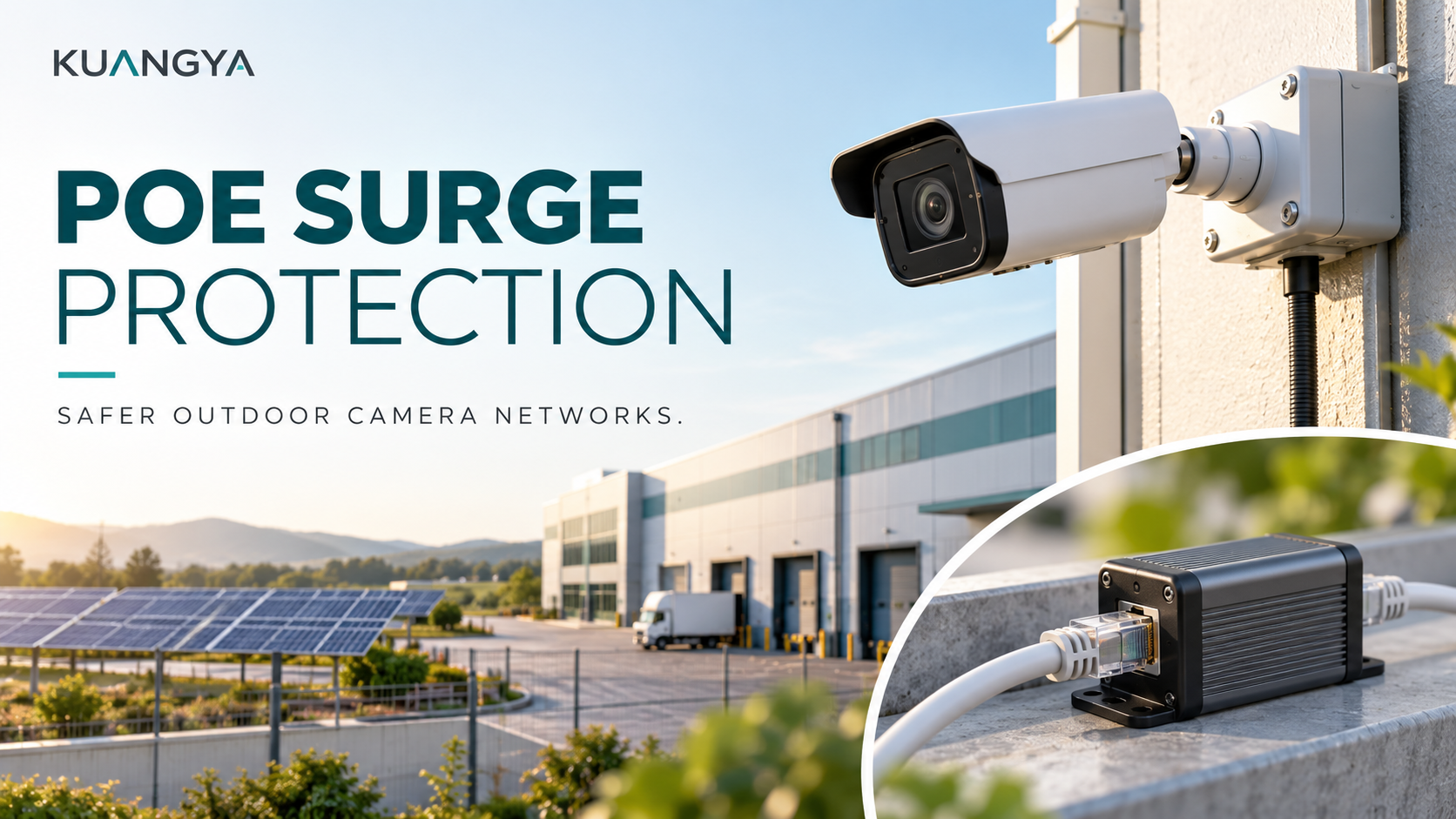
Protection contre les surtensions PoE répond à un risque qu'un parafoudre de tableau électrique seul ne peut couvrir : les surtensions transitoires arrivant par le câble Ethernet en cuivre connecté à une caméra extérieure. Un réseau peut avoir une alimentation CA protégée tout en laissant ses ports de caméra exposés via un chemin de données extérieur.
La bonne solution n'est pas simplement un boîtier RJ45 avec la valeur de surtension la plus élevée. Il doit laisser passer les données Ethernet et l'alimentation PoE requises, être adapté à l'environnement et être installé dans le cadre d'une conception coordonnée de liaison équipotentielle et de protection. Ce guide suit un projet pratique de caméra extérieure, de l'examen du cheminement des câbles à l'approvisionnement et à la maintenance.
Il est destiné aux intégrateurs système, aux tableautiers électriques et aux acheteurs de projets. L'installation, la mise à la terre et les tests doivent être effectués par du personnel qualifié en utilisant les instructions spécifiques de l'équipement et les exigences locales applicables. Aucun parafoudre ne garantit la survie à chaque événement de foudre.
La technologie Power over Ethernet combine la communication réseau et l'alimentation électrique sur une liaison cuivre compatible. La caméra peut ne pas disposer d'un câble d'alimentation secteur séparé, mais cela ne rend pas sa connexion entrante non pertinente pour la protection contre les surtensions. L'équipement d'alimentation, le cheminement des câbles et la caméra forment un système unique qui nécessite une analyse coordonnée.
Un point de départ utile consiste à dessiner chaque connexion conductrice entrant dans l'équipement. Incluez l'alimentation CA vers le commutateur ou l'injecteur, le câble Ethernet extérieur et toute connexion supplémentaire d'alarme, audio ou de contrôle. La protection d'une connexion ne doit pas être confondue avec la protection de toutes les connexions.
La protection contre les surtensions PoE complète donc, plutôt qu'elle ne remplace, la protection du côté de la distribution électrique. Un parafoudre (SPD) d'alimentation et un parafoudre Ethernet desservent des interfaces différentes. Aucun ne doit être substitué à l'autre simplement parce qu'ils sont tous deux décrits comme des dispositifs de protection contre les surtensions.
Imaginez un entrepôt avec un commutateur PoE intérieur, un câble traversant un mur extérieur et une caméra montée à une entrée de véhicule. Le commutateur est alimenté par un tableau de distribution qui contient déjà un parafoudre. Le propriétaire demande si la caméra est désormais correctement protégée.
La première réponse doit être une étude du cheminement, et non une recommandation de produit. Où passe le câble en cuivre ? Est-il exposé à l'extérieur, acheminé entre des structures ou installé à proximité d'autres services ? Où pénètre-t-il dans le bâtiment ? Quelles installations de liaison équipotentielle et quels emplacements de montage appropriés existent réellement ?
Ces réponses établissent la portée de la conception de la protection contre les surtensions PoE. Elles révèlent également si l'installateur protège uniquement le dispositif extérieur, uniquement l'équipement réseau intérieur ou les deux. Un nom de produit sur un devis ne peut pas répondre à ces questions de localisation.
Axis traite d'un agencement avec une protection adjacente à une caméra extérieure distante et une protection supplémentaire à l'entrée du bâtiment pour l'équipement intérieur. Ses directives insistent également sur le chemin de mise à la terre et de blindage dans ses systèmes de caméras. Voir le document officiel Livre blanc d'Axis sur les surtensions électriques. Appliquez les instructions relatives à l'équipement plutôt que de considérer un exemple comme un schéma d'installation universel.
| Question | Parafoudre pour tableau électrique | Parafoudre Ethernet compatible PoE |
|---|---|---|
| Quelle interface est prise en considération ? | Le circuit d'alimentation électrique couvert par ses caractéristiques nominales et son raccordement | L'interface réseau cuivre compatible |
| Qu'est-ce qui doit rester compatible ? | Tension d'alimentation, schéma de liaison à la terre, coordination des protections et installation | Débit de données, charge PoE, disposition des paires, interface de signal et installation |
| Qu'est-ce qui n'est pas couvert automatiquement ? | Un cheminement Ethernet extérieur séparé | L'alimentation CA alimentant un commutateur ou un injecteur |
| Comment doit-il être sélectionné ? | À partir de la conception du système électrique et de la documentation technique précise du produit | À partir des exigences réseau et d'alimentation de la liaison complète |
La distinction est importante lorsqu'un appareil extérieur partage un bâtiment avec une installation solaire. Un parafoudre CC sélectionné pour un champ photovoltaïque n'est pas un protecteur Ethernet. Ses exigences en matière de tension et d'interface sont différentes. N'adaptez pas un parafoudre de puissance sur un circuit RJ45 en utilisant des connexions improvisées.
For the broader standards context, see our guide to IEC 61643 and surge protective devices. This article focuses specifically on PoE surge protection and the network-link decisions that a general power-panel specification can miss.
Matching plugs are only the beginning. Two devices may both have RJ45 sockets while supporting different network speeds, power arrangements or environments. Before approving a protector, compare its complete data sheet with the switch, injector and powered-device requirements.
The PoE surge protection review should identify the applicable PoE standard or proprietary powering scheme. Confirm the supported power level and pair arrangement for the exact device. Do not assume that a generic statement such as PoE compatible covers every higher-power camera or access point.
A fixed camera and a camera with motors, infrared illumination or heaters can have different power demands. Base the review on the manufacturer’s declared maximum operating requirements, including enabled accessories, rather than a convenient reading taken under one daytime condition.
Also distinguish available power at the source from the power required at the device. Cable and connection losses belong in the system budget. A surge protector does not create additional PoE capacity, and installing one does not correct an undersized source or unsuitable cable.
| Specification to record | Pourquoi c'est important | Evidence to request |
|---|---|---|
| Ethernet data rate | The protector must support the intended network link | Documented supported speed for the exact model |
| PoE compatibility | The power arrangement must match the source and powered device | Supported standards, modes, power and current limits |
| Protected conductors and modes | A connector shape does not describe the protection circuit | Manufacturer interface and protection specifications |
| Surge performance | Values only make sense with their test conditions | Waveform, protection mode and relevant test information |
| Environnement | An indoor unit may need a suitable enclosure | Temperature, moisture and installation requirements |
| Bonding and shielding | The installed protection path must follow the design | Grounding terminal and cable-shield instructions |
A large surge-current value does not demonstrate adequate network performance. Conversely, successful gigabit negotiation does not establish surge performance. PoE surge protection has to satisfy both the communication requirement and the protective requirement.
Compare like-for-like data. A surge-current number without its waveform and protection mode is incomplete. A headline maximum should not be treated as a universal measure of service life or proof that one device is suitable for every site.
As an example of the information a detailed data sheet can provide, TRENDnet lists network speed, PoE support, environmental ratings and protection modes separately for its TI-OS300. Its stated capabilities apply to that model, not all Ethernet SPDs. See the official TI-OS300 product specifications.
For procurement, place these fields in separate columns. That makes it easier to reject an otherwise attractive quotation that omits one essential capability. It also prevents a supplier from answering a network-speed question with a surge-current number.
The location should follow the exposure and the equipment being protected. Identify building entries, exposed route sections, remote equipment and the available bonding arrangement. Then apply the manufacturer’s installation requirements within the project’s overall protection design.
A cabinet may be a convenient location, but convenience alone is not enough. Consider whether unprotected and protected cable sections are routed sensibly and whether the unit can be inspected without disturbing unrelated circuits. The design should identify the device ports and any directional labels.
PoE surge protection at a remote camera also needs an environmental plan. If the unit is not rated for direct exposure, specify an appropriate enclosure. Include connectors, glands, cable entry and access for service; the protector housing is only one part of the installed assembly.
Do not turn this into a universal distance rule. Two installations with similar cable lengths may have different routes, grounding arrangements and equipment. A project-specific layout is more reliable than copying a photograph and estimating where to mount the box.
Follow the exact protector and equipment instructions for bonding and cable shielding. Do not leave a required ground connection unused simply because the camera image appears normal. Normal operation and surge performance are different questions.
Likewise, a cable marked shielded is not the complete answer. The installer must review the connectors, couplings and equipment interfaces specified in the design. A purchasing list that only names a cable category may omit important installation details.
PoE surge protection should be integrated with the site’s bonding system by qualified personnel. Do not improvise an isolated ground rod or attach the protector to a convenient metal object without evaluating the electrical design. The objective is not merely to find somewhere to fasten a green wire.
Document the intended bonding point and connection requirements on the installation drawing. If that point cannot be reached as designed, resolve the change before commissioning. Our article on SPDs and grounding explains why a ground connection must be considered as part of the protection arrangement.
For a link between separate buildings, compare copper with a properly designed fiber connection early in the project. An all-dielectric optical link does not provide the same conductive data path as copper Ethernet. However, the remote equipment still needs power, and metallic cable elements or other connected services require their own assessment.
Fiber is therefore a design alternative, not a claim that the entire remote installation is now immune to surges. Evaluate the local power supply, network equipment, environmental requirements and maintenance capability alongside the data connection.
PoE surge protection remains relevant wherever exposed copper PoE segments remain. A fiber uplink to a remote switch does not automatically protect the copper connections from that switch to cameras. Mark those segments individually on the network drawing.
This comparison can be made before purchasing hardware. Ask the designer to show which conductive paths disappear, which remain and how the remote devices receive power. That gives the buyer a clearer basis for comparing total installed cost and service requirements.
Return to the hypothetical warehouse camera. The project team initially specifies an Ethernet surge protector only because a previous site used one. No one has recorded the camera’s maximum power requirement or the expected network speed.
The revised review starts with the actual equipment references. The integrator records the switch port capability, camera power requirement, cable route and intended operating features. The electrical designer reviews exposure and bonding, while the buyer requests matching product documentation.
The PoE surge protection specification then identifies the required interface, operating environment and installation locations. It does not name an arbitrary surge rating as the whole requirement. Any uncertainty about compatibility remains an open issue until the manufacturer or designer resolves it.
Before handover, the installer verifies normal network and camera operation under the planned operating modes using an approved test procedure. The team records the installed protector model and mounting location so maintenance staff can find it later. No one creates an artificial surge or deliberately faults the circuit to prove that protection works.
This is a planning example, not a universal wiring diagram. Its value is the sequence of decisions: understand the link, define the interfaces, resolve installation requirements, and retain a record of what was approved.
If a problem appears after adding PoE surge protection, do not immediately assume that the SPD has failed or remove it permanently. Compare the symptom with the approved equipment requirements and use a safe, controlled troubleshooting procedure.
| Observed symptom | Checks to include | Do not conclude automatically |
|---|---|---|
| No Ethernet link | Port identification, cable termination, connector seating and supported data rate | That every surge protector blocks network traffic |
| Camera starts but restarts later | Power budget, cable losses and enabled camera features | That the surge-current rating is too small |
| Link negotiates below the intended speed | Cabling quality and documented capability of every inline component | That a matching RJ45 connector guarantees the intended speed |
| Problems occur after wet weather | Enclosure condition, glands, connectors and signs of moisture | That all storm-related failures are electrical surges |
| Several ports fail after an event | All possible incoming paths and the wider installation | That replacing one protector resolves the root cause |
A continuity check or a normal video stream is not certification of PoE surge protection performance. Keep functional testing separate from any specialist protective-device assessment. Follow the manufacturer procedure and replace damaged components only with approved equivalents.
A good request for quotation describes the system rather than asking only for an Ethernet SPD price. Include the powered-device and source references, required data rate, powering scheme, maximum demand, cable route and environmental conditions.
Ask the supplier to identify the exact offered model and provide its data sheet and installation instructions. Request explicit confirmation of the relevant PoE compatibility and any restrictions on mounting, grounding, cable types or port orientation. General marketing language is not a substitute for those documents.
For KUANGYA project inquiries, distinguish the power-panel SPD requirement from the data-line requirement. Ask for confirmation of product availability and application suitability; this educational guide does not claim that every illustrated device is a KUANGYA product or that one model suits every network.
Keep an asset register showing the protector location, ordering reference, commissioning date and linked equipment. Record significant events and maintenance findings. This is more useful than relying on a sticker that simply says lightning protection installed.
Inspection should follow manufacturer guidance and site procedures. Include physical condition, environmental sealing, readable identification and required connections. Do not open equipment or disturb bonding while it is energized merely to perform a quick check.
If PoE surge protection is replaced, review equivalence before fitting a different model. A replacement must satisfy the data and power requirements as well as the protection and environmental requirements. Reuse of the same connector type is not enough.
Also update the record when cameras, switches or injectors change. An upgrade to a higher-power device or faster link can invalidate an earlier compatibility assumption even though the outdoor cable route remains unchanged.
No automatic conclusion follows from having a UPS. Its presence does not establish protection for a separate outdoor copper data route. Review the UPS specifications, power-side design and network-side exposure as separate parts of the system.
No. Select a device explicitly compatible with the intended powering arrangement and equipment. Confirm its documented limits instead of assuming that Ethernet support means support for every PoE application.
A correctly selected device should support its stated data rate when installed within the specified system conditions. Poor cabling, incompatible equipment or an unsuitable inline device can affect operation. Verify the complete channel, not just the advertised protector speed.
That depends on the exposure, equipment and approved design. Consider the remote device and the building entry rather than applying a universal yes or no. Follow the equipment manufacturer’s layout guidance and the site’s bonding requirements.
No. An SPD has defined limits and forms only part of a wider protection approach. Do not use it to justify unsafe exposure or to replace an appropriate lightning-protection assessment.
Not when the manufacturer requires that connection. A functioning network does not prove that the protective path is correctly installed. Have qualified personnel resolve grounding and bonding requirements before relying on the installation.
Effective PoE surge protection begins with a route and interface review. Match the protector to the network speed and power requirements, identify the equipment and cable entries being protected, and document the environmental and bonding requirements.
The result should be a coordinated design rather than an isolated accessory. Keep power-panel protection, Ethernet protection and normal network testing distinct, then bring them together in one verified installation and maintenance record.

