WengYang Industriegebiet Yueqing Wenzhou 325000
Arbeitszeiten
Montag bis Freitag: 7AM - 7PM
Am Wochenende: 10AM - 5PM
WengYang Industriegebiet Yueqing Wenzhou 325000
Arbeitszeiten
Montag bis Freitag: 7AM - 7PM
Am Wochenende: 10AM - 5PM

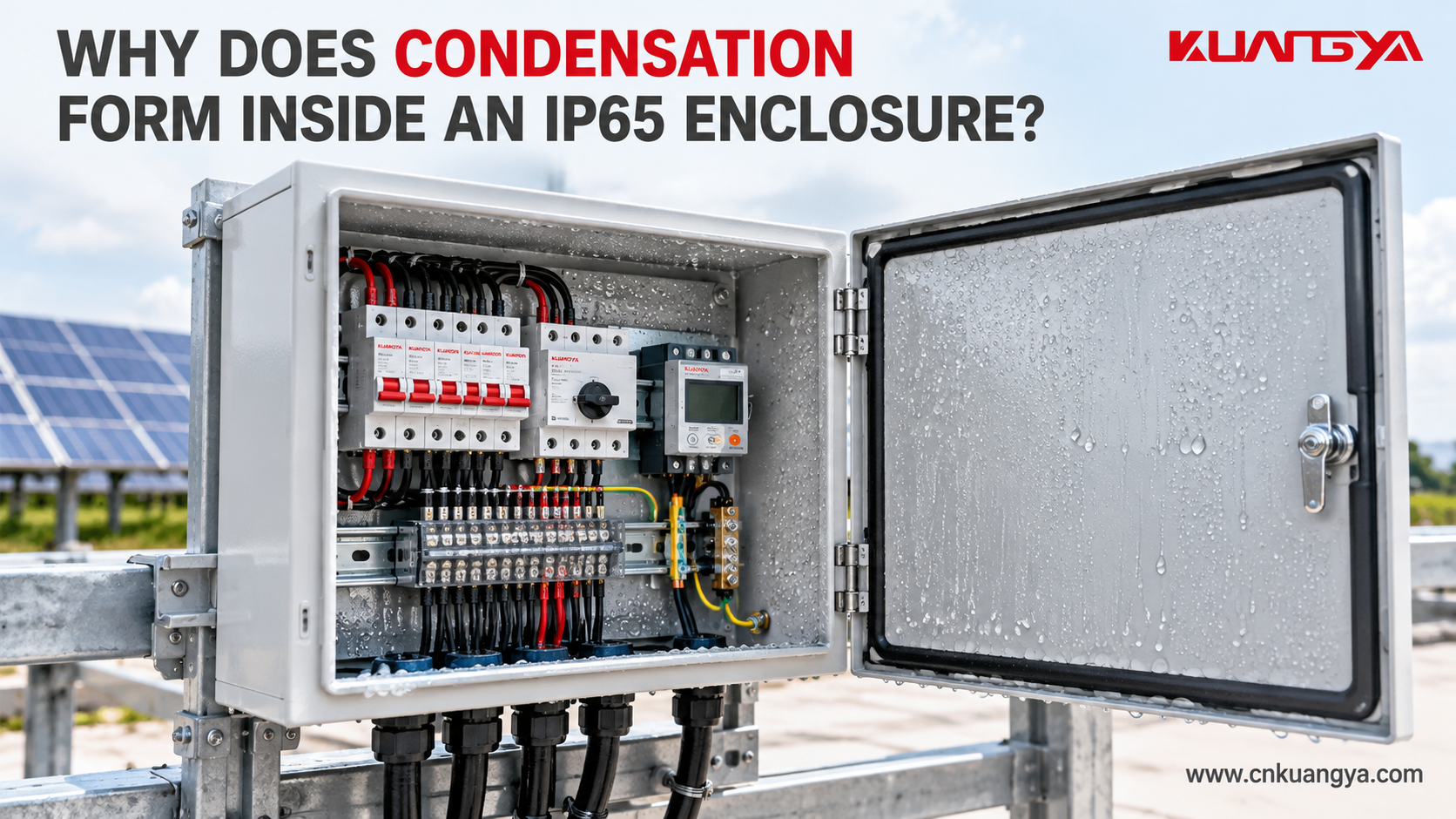
Ein Schaltschrank ist nach IP65 klassifiziert. Seine Tür ist fest verschlossen, die Kabelverschraubungen scheinen ordnungsgemäß installiert zu sein, und es gibt keine sichtbaren Anzeichen von Regenwassereintritt.
Dennoch entdeckt das Wartungspersonal bei einer routinemäßigen Inspektion Wassertropfen an der Innenseite der Schaltschranktür.
In ernsteren Situationen kann Feuchtigkeit in der Nähe von Klemmblöcken, Metallmontageplatten oder elektronischen Bauteilen auftreten.
Wie kann sich Kondensation im Inneren eines IP65-Schaltschranks bilden, wenn der Schaltschrank so konzipiert ist, dass er Staub und Wassereintritt widersteht?
Die Antwort liegt im Unterschied zwischen Wassereintrittsschutz und interner Feuchtigkeitskontrolle.
Kondensation in einem IP65-Gehäuse kann auftreten, wenn feuchte Luft im Inneren des Schranks auf eine Oberfläche unterhalb ihres Taupunkts trifft, auch wenn kein externes Wasser eingedrungen ist.
Diese Unterscheidung ist besonders wichtig für elektrische Außenschränke, PV-Kombinationskästen, industrielle Schalttafeln und elektrische Geräte, die in tropischen Klimazonen installiert sind.
In diesem Leitfaden erklären wir, warum Kondensation auftritt, wie man Kondensation von Wassereintritt unterscheidet, welche Probleme Feuchtigkeit verursachen kann und welche Präventionsmethoden für verschiedene Anwendungen funktionieren.
Ja. Kondensation kann sich in einem IP65-Elektroschrank bilden, ohne dass eine sichtbare Undichtigkeit der externen Wasserdichtigkeit vorliegt.
Die IP-Schutzart und das Risiko von Kondensation beschreiben zwei verschiedene Aspekte der Gehäuseleistung.
Nach Angaben von IEC 60529: Schutzarten durch Gehäuse, IP-Codes klassifizieren den Schutz gegen Berührung, Fremdkörper und Wassereintritt unter definierten Prüfbedingungen.
Für ein IP65-Gehäuse:
Keine der Ziffern stellt eine Garantie dafür dar, dass die Luft im Gehäuse trocken bleibt.
| Vergleich | IP65-Schutz | Kondensationsverhinderung |
|---|---|---|
| Primäres Ziel | Begrenzen Sie das Eindringen von Staub und Wasser von außen | Begrenzen Sie die Feuchtigkeitsansammlung im Inneren |
| Hauptbedenken | Umwelteinflüsse | Luftfeuchtigkeit und Temperatur |
| Zugehörige Norm | IEC 60529 | Anwendungsbezogene thermische und feuchtigkeitsbezogene Auslegung |
| Verhindert die Bildung von internem Taupunkt? | Nein | Kann das Risiko verringern |
| Hauptlösungen | Dichtungen, Gehäusedesign, geeignete Kabelverschraubungen | Heizung, Feuchtigkeitsmanagement, Druckentlastungsventile |
| Typisches Problem | Eindringen von Regenwasser oder Staub in den Schrank | Bildung von Wassertropfen auf inneren Oberflächen |
Deshalb löst die Aufwertung eines Gehäuses von IP65 auf IP66 nicht automatisch die interne Kondensation.
Die höhere Schutzart bietet möglicherweise zusätzlichen Schutz gegen eine andere Form der externen Wassereinwirkung, adressiert jedoch nicht direkt den physikalischen Prozess, der zur Kondensation von Wasserdampf führt.
Für weitere Informationen zum Schutzgrad von Gehäusen siehe unseren separaten Leitfaden: IP65 vs. IP66 vs. IP67 für Solar-Kombinationskästen.
Kondensation tritt auf, wenn feuchtigkeitshaltige Luft eine Oberfläche berührt, deren Temperatur am oder unter dem Taupunkt der Luft liegt.
Der Taupunkt ist die Temperatur, bei der die Luft mit Wasserdampf gesättigt ist, vorausgesetzt, ihr Feuchtigkeitsgehalt bleibt unverändert.
Wenn eine Oberfläche unter diesen Punkt abkühlt, kann Wasserdampf in flüssige Tröpfchen umgewandelt werden.
Der Prozess ist unkompliziert:
Warme, feuchte Luft → Abkühlung der Oberfläche → Taupunkt erreicht → Wasserkondensation
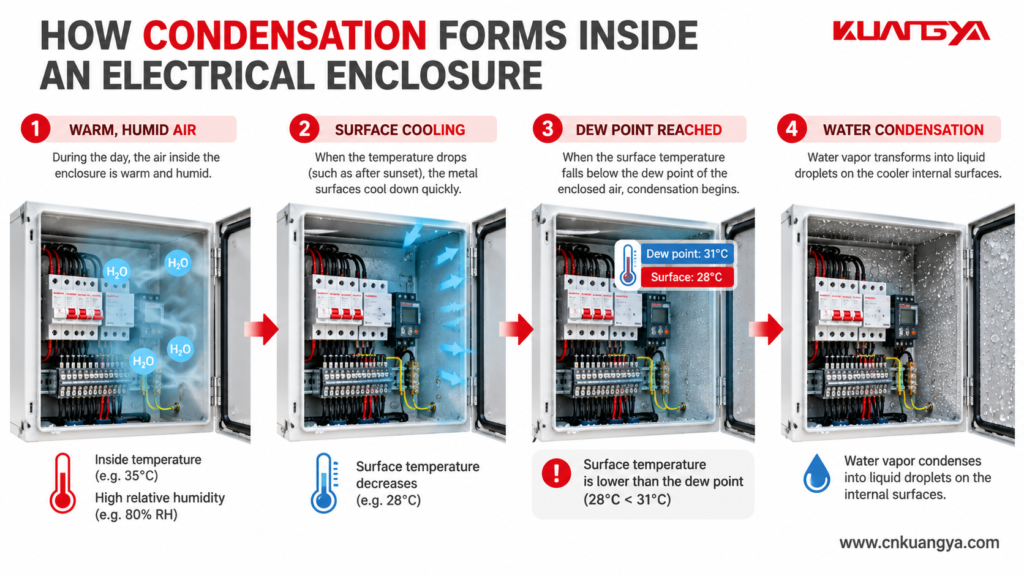
Beispielsweise kann ein elektrischer Außenschrank am Nachmittag relativ warm sein.
Nach Sonnenuntergang können die Metallgehäusewände schnell abkühlen.
Wenn die Innenflächen kälter als der Taupunkt der eingeschlossenen Luft werden, kann sich Feuchtigkeit auf diesen Oberflächen ansammeln.
Dieser Kondensationsmechanismus basiert auf der Beziehung zwischen Lufttemperatur, relativer Luftfeuchtigkeit und Taupunkt. Wenn eine Gehäuseoberfläche unter den Taupunkt abkühlt, kann sich Feuchtigkeit bilden, auch ohne äußeres Eindringen von Wasser.
Betrachten Sie ein elektrisches Gehäuse mit den folgenden hypothetischen Bedingungen.
| Parameter | Beispielwert |
|---|---|
| Innere Lufttemperatur | 35°C |
| Innere relative Luftfeuchtigkeit | 80% |
| Ungefährer Taupunkt | 31°C |
| Innere Gehäusewandtemperatur nach Kühlung | 28°C |
| Kondensationsrisiko | Hoch |
Bei 35°C und 80% relativer Luftfeuchtigkeit beträgt der ungefähre Taupunkt 31°C.
Wenn die Wandtemperatur auf 28°C fällt, während die eingeschlossene Luft ungefähr den gleichen Feuchtigkeitsgehalt beibehält, kann es zu Kondensation kommen.
Das Gehäuse muss dafür keine sichtbare Undichtigkeit entwickeln.
Das Beispiel ist eine psychrometrische Berechnung, kein gemeldeter Feldausfall. Die tatsächliche interne Luftfeuchtigkeit und der Taupunkt ändern sich, wenn das Gehäuse Wärme und Feuchtigkeit mit seiner Umgebung austauscht.
Obwohl die Taupunktbildung der zugrunde liegende physikalische Prozess ist, machen mehrere Installations- und Umweltfaktoren die Kondensation wahrscheinlicher.
Elektrische Außengehäuse erfahren kontinuierliche Temperaturänderungen.
Während der Tageslichtstunden erwärmt die Sonneneinstrahlung die Gehäuseoberfläche. Interne elektrische Komponenten können ebenfalls Wärme abgeben.
Nachts verliert der Schrank Wärme an die Umgebung.
Wenn die Innenluft feucht bleibt, während die Gehäuseoberflächen abkühlen, kann sich Kondenswasser bilden.
Dieses Muster ist besonders relevant für Aufdach-Installationen und bodenmontierte Photovoltaikanlagen.
Feuchtigkeit ist ein Hauptfaktor für das Kondensationsrisiko.
Je höher der Feuchtigkeitsgehalt der Innenluft ist, desto näher liegt wahrscheinlich ihr Taupunkt an der tatsächlichen Lufttemperatur.
Ein in einer feuchten Umgebung installiertes elektrisches Gehäuse kann ab dem Zeitpunkt, an dem seine Tür geschlossen wird, feuchte Luft enthalten.
Selbst wenn die Dichtungen des Gehäuses korrekt installiert sind, kann diese eingeschlossene Feuchtigkeit kondensieren, wenn das Gehäuse abkühlt.
Nicht die gesamte Feuchtigkeit dringt nach der Inbetriebnahme ein.
Wasserdampf kann während der anfänglichen Montage, der Feldverdrahtung, der Inspektion oder der Wartung im Inneren eingeschlossen werden.
Mögliche Umstände sind:
Ein korrekt abgedichtetes Gehäuse kann innere Feuchtigkeit zurückhalten, wenn kein geeigneter Mechanismus zu deren Entfernung vorhanden ist.
Wenn sich die Luft in einem Gehäuse erwärmt, dehnt sie sich aus. Wenn die Luft abkühlt, zieht sie sich zusammen.
Diese Änderungen erzeugen Druckunterschiede zwischen dem Inneren und dem Äußeren des Gehäuses.
Wenn wiederholt Druckunterschiede auftreten, können Gehäusedichtungen und Kabeleinführungen zusätzlichen mechanischen Belastungen ausgesetzt sein.
Mit der Zeit können Schwachstellen an diesen Schnittstellen zum Eindringen von Feuchtigkeit beitragen.
Eine speziell entwickelte Druckausgleichsentlüftung kann helfen, diese Druckunterschiede zu reduzieren.
Nach Angaben von Technische Richtlinien von GORE für Schutzlüfter, kann der Druckausgleich die Dichtungsbelastung reduzieren und die Kondensationsbildung minimieren.
Ein Lüftungsschlitz garantiert jedoch nicht, dass das Innere des Gehäuses immer trocken bleibt.
Cable glands are potential moisture-entry points if they are incorrectly selected or installed.
Common problems include:
In these cases, the problem may be actual liquid-water ingress rather than condensation alone.
A cable gland carrying its own IP rating does not automatically make the completed enclosure assembly IP65.
The installed configuration must maintain the required protection.
Installation position affects both solar heating and direct exposure to rain.
A cabinet installed in strong sunlight may experience higher daytime temperatures.
The same enclosure may subsequently cool during the evening.
Cable routing can also influence moisture movement.
For example, poorly positioned cable entries may allow water to collect around sealing interfaces or travel toward an entry point.
Suitable mounting positions, cable routing, and enclosure orientation should be included in the design.
Some enclosure designs focus heavily on preventing external water from entering but provide little consideration for internal humidity.
Potential weaknesses include:
The appropriate solution depends on the cabinet’s size, environmental conditions, electrical contents, and installation requirements.
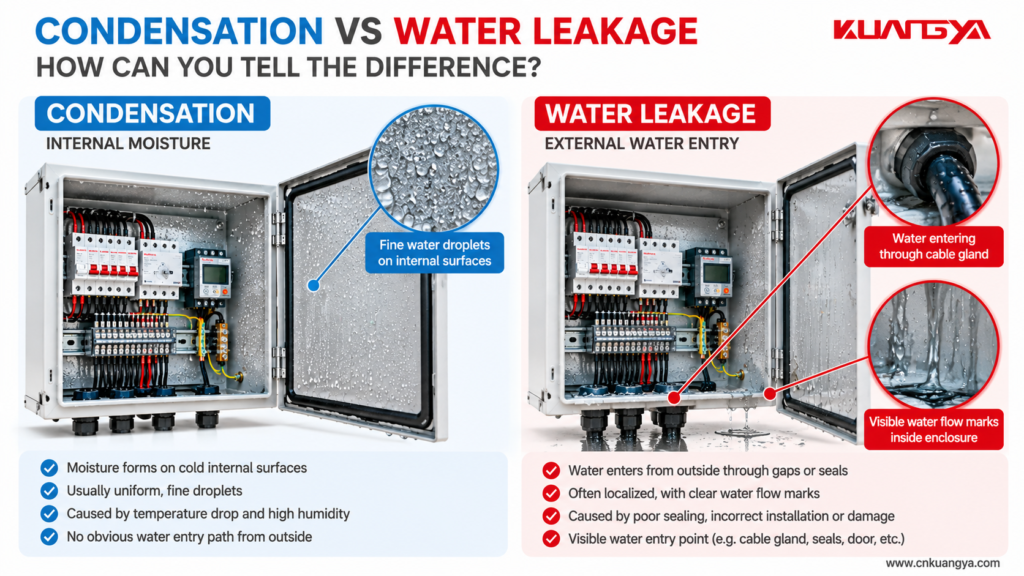
Finding water inside an enclosure does not automatically mean that its sealing system has failed.
Equally, it would be unsafe to assume that every moisture problem is harmless condensation.
The first troubleshooting task is to distinguish between condensation, external water ingress, and other possible moisture sources.
| Beobachtung | Possible Condensation | Possible Water Ingress |
|---|---|---|
| Fine droplets on cool internal surfaces | Common indication | Also possible |
| Moisture appears after nighttime cooling | Consistent with condensation | Not conclusive |
| Water concentrated below a cable entry | Less characteristic | Check cable gland or entry |
| Water appears immediately after heavy rain | Possible, depending on cooling | Leakage should be investigated |
| Visible water track from a door gasket | Less likely to be pure condensation | Strong leakage indication |
| Repeated moisture without rainfall | Possible | Also possible from trapped water or cable pathways |
| Corrosion concentrated near a penetration | Possible | Inspect for a local leak |
These observations are diagnostic clues, not definitive tests.
Step 1: Make the equipment safe.
Only qualified personnel should inspect electrical cabinets. Follow the applicable isolation, lockout/tagout, and verification procedures.
For photovoltaic installations, remember that DC circuits may remain energized whenever the solar array is illuminated, even if some switches are open.
Step 2: Inspect the enclosure exterior.
Look for damage to the housing, door seals, hinges, latches, cable glands, and unused openings.
Step 3: Inspect moisture distribution.
Check whether droplets are distributed across cool surfaces or concentrated around a specific penetration.
Step 4: Review environmental conditions.
Record ambient temperature, internal temperature, relative humidity, recent rainfall, and relevant operating conditions.
Step 5: Check the dew point.
Compare the calculated internal-air dew point with the measured temperature of the surfaces where moisture appears.
Step 6: Identify the source before modifying the enclosure.
Do not drill drainage or ventilation holes into an IP65 enclosure without a properly engineered solution. Unapproved modifications can compromise ingress protection.
Small water droplets may appear insignificant, but repeated moisture exposure can create serious reliability problems.
The consequences depend on the electrical system, contamination levels, component materials, and duration of exposure.
| Affected Component | Potential Moisture-Related Problem | Possible Consequence |
|---|---|---|
| Reihenklemmen | Corrosion or contamination | Increased contact resistance |
| Metal mounting plate | Surface corrosion | Reduced service life |
| Electronic PCB | Leakage paths and corrosion | Malfunction or communication failure |
| Fuse holder connections | Contact degradation | Lokale Erwärmung |
| DC SPD terminals | Corrosion or insulation deterioration | Reduced reliability |
| Monitoring module | Moisture-related electronic faults | Lost or unreliable monitoring |
| Door gasket | Aging or physical deterioration | Increased water-ingress risk |
| Cable gland interface | Seal deterioration | External moisture penetration |
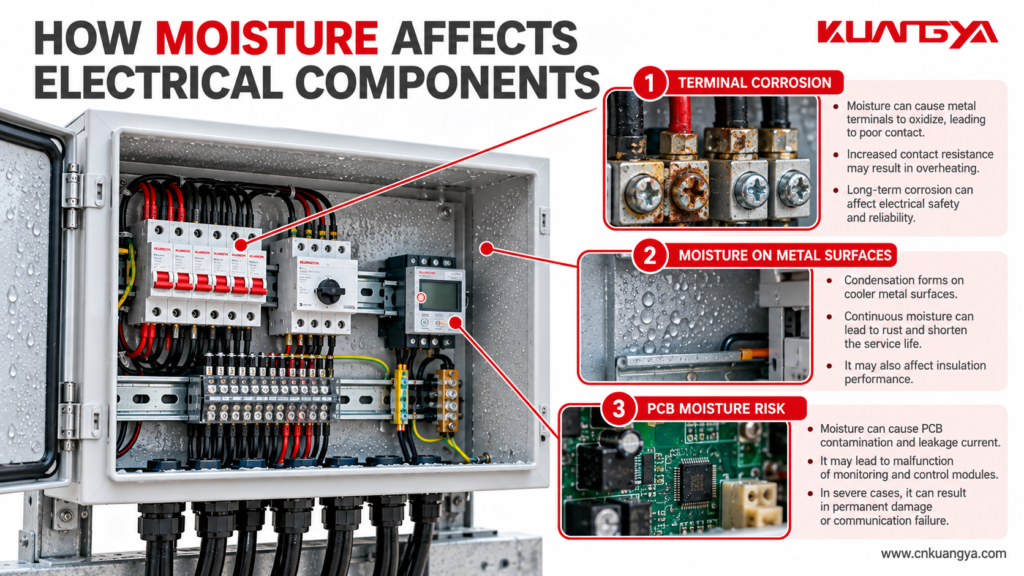
Moisture can accelerate corrosion on susceptible metal surfaces.
Where corrosion affects current-carrying connections, contact resistance may increase.
Higher resistance can produce additional heat during operation.
This does not mean every corroded connection will overheat, but it is a failure mechanism that requires attention.
Moisture and conductive contamination can reduce surface insulation resistance.
Under unfavorable conditions, leakage currents or tracking can develop.
This is particularly important in high-voltage DC installations where appropriate insulation coordination and separation distances are essential.
Modern electrical enclosures may contain sensors, communication interfaces, power supplies, and monitoring modules.
These components can be more sensitive to sustained moisture than simple mechanical structures.
In photovoltaic systems, electronic failures may interrupt data collection or remote monitoring.
For an example of a more complex PV enclosure architecture, see KUANGYA’s 16-String PV Combiner Box with Monitoring and Remote Control.
No single method is suitable for every electrical enclosure.
The correct approach should address the actual moisture source, operating temperature, environmental conditions, and enclosure requirements.
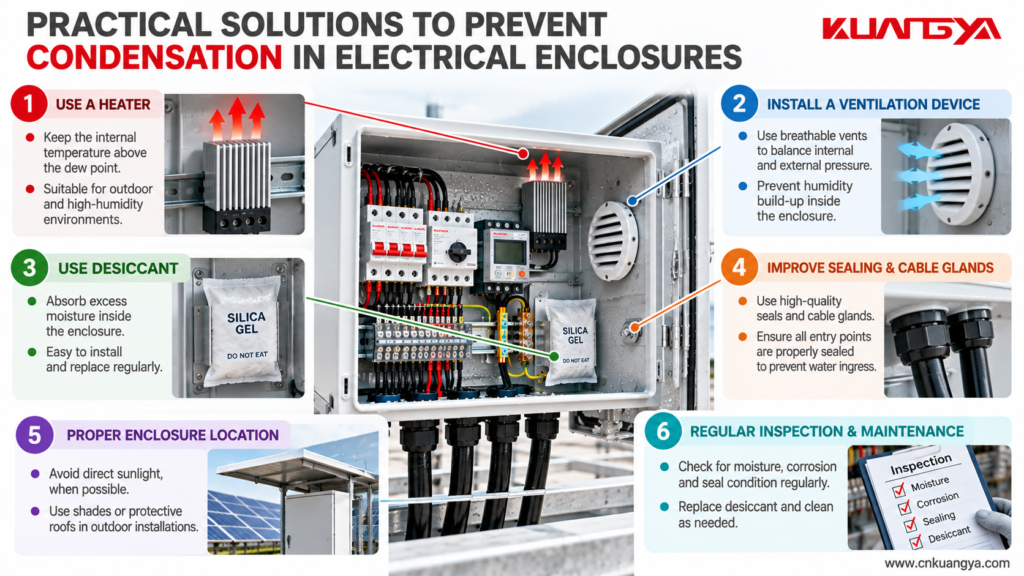
A pressure-equalization vent allows controlled gas exchange between the enclosure interior and external environment.
Certain protective membrane vents can limit entry of liquid water and particles while permitting air and water vapor movement.
Potential benefits include:
For photovoltaic applications, GORE Protective Vents for Solar Energy Systems explains how membrane vents can support pressure equalization and moisture management.
Wichtig: Water vapor can pass in both directions. A vent is not a dehumidifier, and it does not guarantee a dry interior.
The entire enclosure-and-vent configuration must also be suitable for the required ingress protection.
An anti-condensation heater maintains selected internal surfaces at temperatures that reduce the likelihood of reaching the dew point.
Heaters may be controlled by thermostats, hygrostats, or combined temperature-and-humidity controllers.
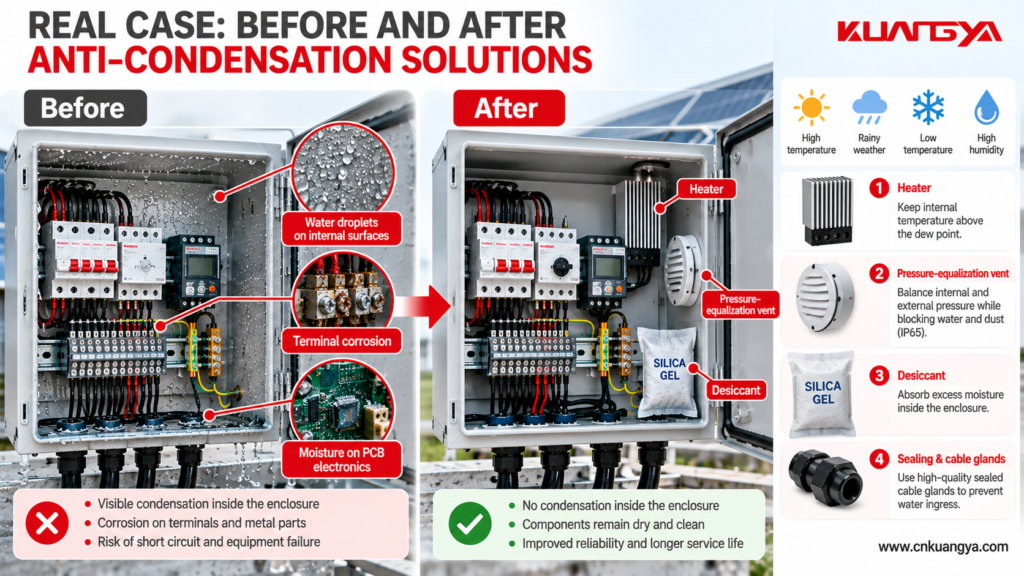
For example, a heater can be activated when the enclosure reaches conditions associated with condensation risk.
Schneider Electric provides dedicated enclosure heating solutions in its ClimaSys CR range.
However, a heater must be correctly sized and controlled.
It also requires a suitable power supply and must not cause internal components to exceed their permitted operating temperatures.
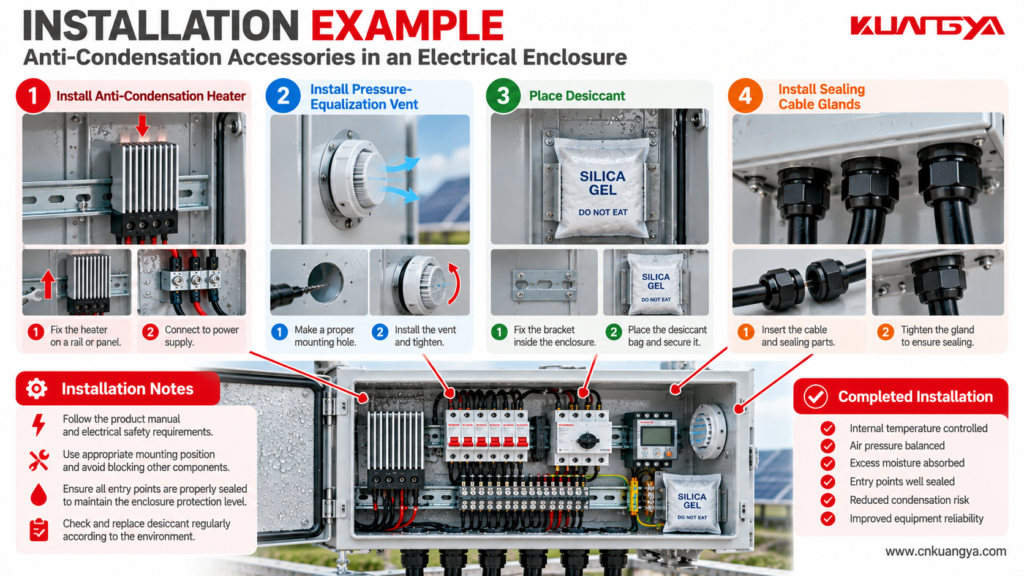
All cable entries should use glands suitable for the cable diameter, enclosure material, and environmental exposure.
Check that:
This primarily addresses external water entry, which can otherwise be confused with condensation.
Direct sunlight can increase cabinet surface temperature.
Where practical, enclosure orientation, location, and suitable shading arrangements can reduce extreme thermal exposure.
However, shading should not obstruct required airflow, compromise maintenance access, or violate product installation requirements.
For enclosures containing significant electrical heat sources, thermal calculations are important.
For critical installations, temperature and relative-humidity sensors can provide useful information.
Continuous or periodic monitoring may help identify conditions in which the internal dew point approaches the temperature of the enclosure walls.
Alarm settings should be based on the actual equipment and environment rather than a universal humidity threshold.
This is particularly useful for remote electrical cabinets that cannot be inspected frequently.
In some applications, approved enclosure drainage devices may help manage liquid water accumulation.
However, drainage is not a universal solution.
A simple open hole can compromise dust and water protection.
Where drainage is needed, use components compatible with the enclosure design and verify the ingress-protection requirements of the completed assembly.
Even a correctly designed enclosure benefits from periodic inspection.
Maintenance should include checking the condition of seals, glands, protective vents, internal moisture indicators, and vulnerable electrical connections.
Any evidence of corrosion, standing water, degraded insulation, or abnormal heating should be investigated.
For photovoltaic installations, additional maintenance information is available in the KUANGYA Solar Combiner Box Protection and Maintenance Guide.
The following table summarizes the advantages and limitations of common solutions.
| Methode | Hauptzweck | Vorteile | Beschränkungen |
|---|---|---|---|
| Pressure-equalization vent | Reduce pressure differences and trapped moisture | Passive operation; no electrical power | Does not actively dry the air |
| Anti-condensation heater | Reduce dew-point formation on surfaces | Suitable for controlled thermal management | Requires power and correct sizing |
| Hygrostat or humidity controller | Control based on humidity conditions | Automatic operation | Requires compatible equipment |
| Improved cable sealing | Prevent external water entry | Essential for enclosure integrity | Does not remove trapped humidity |
| Suitable shading | Reduce solar heating effects | Passive thermal benefit | Site and design dependent |
| Humidity monitoring | Detect unfavorable internal conditions | Supports preventive maintenance | Monitoring alone does not remove moisture |
| Engineered drainage | Remove accumulated liquid water | Useful in selected designs | Must preserve required enclosure protection |
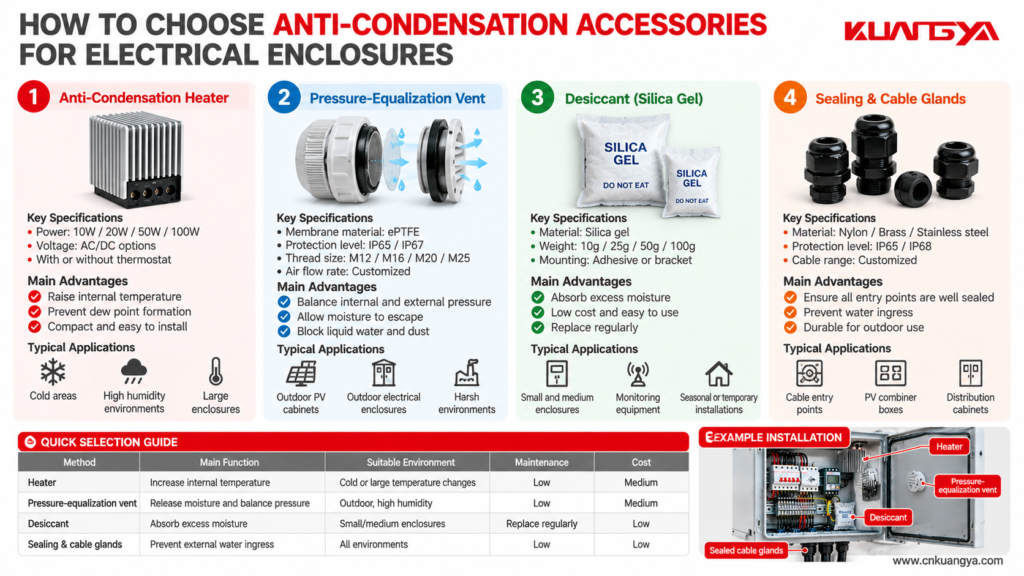
For a relatively small outdoor cabinet with moderate thermal cycling, a suitable pressure-equalization strategy may be worth evaluating.
For an enclosure exposed to low temperatures or persistent condensation risk, a controlled anti-condensation heater may be appropriate.
For complex enclosures containing electronic monitoring equipment, a combined approach involving environmental monitoring, sealing, and moisture control may be preferable.
The best solution is not necessarily the most expensive accessory. It is the solution that addresses the actual failure mechanism without creating a new electrical or environmental risk.
The following examples are illustrative engineering scenarios, not documented KUANGYA customer incidents. They demonstrate how environmental conditions can change the appropriate design response.
Anwendung: Outdoor photovoltaic system in Southeast Asia.
Operating environment: High relative humidity, frequent rainfall, and daily temperature variations.
Observed condition: Fine moisture droplets appear on the inside of the enclosure after cooler nighttime conditions.
Possible explanation:
Humid air inside the enclosure cools below its dew point.
The source of the moisture could be trapped air, vapor exchange, or another route that requires investigation.
Recommended engineering evaluation:
In this example, simply specifying a higher IP rating would not necessarily eliminate condensation.
Anwendung: Industrial control cabinet containing monitoring electronics.
Operating environment: Warm daytime conditions followed by substantial nighttime cooling.
Observed condition: Repeated moisture formation on internal metal surfaces.
Possible explanation:
Temperature cycling causes internal surfaces to fall below the dew point.
Recommended engineering evaluation:
A controlled anti-condensation heater may be considered, subject to power availability, internal temperature limits, and enclosure design.
A humidity sensor can also help determine whether the selected approach improves conditions.
Anwendung: Outdoor electrical control enclosure near a marine environment.
Observed condition: Moisture and corrosion around internal metal connections.
Possible explanations:
Recommended engineering evaluation:
Inspect the enclosure carefully for ingress paths, evaluate material and corrosion resistance, and choose sealing and moisture-management components suitable for the coastal environment.
In a coastal installation, corrosion protection should be considered separately from IP rating.
A solar PV combiner box is more than an outdoor enclosure.
It may contain DC fuse holders, surge protective devices, isolators, busbars, and electronic monitoring equipment.
These components have different thermal, electrical, and environmental requirements.
A moisture-control strategy must therefore be considered alongside the electrical design.
| Design Area | What Should Be Checked? |
|---|---|
| Gehege | Appropriate IP rating for actual exposure |
| Cable entries | Correctly installed and sealed |
| Internal temperature | Ambient heat, solar gain, electrical heat dissipation |
| Internal humidity | Dew-point risk and monitoring requirements |
| DC fuse holders | Contact integrity and operating temperature |
| DC SPD | Manufacturer’s environmental and installation requirements |
| Überwachungsgeräte | Humidity and temperature operating limits |
| Vent or heater | Compatibility with enclosure and electrical design |
| Wartung | Accessibility and inspection intervals |
For example, a multi-string PV combiner box containing monitoring equipment may have a different thermal profile from a basic enclosure containing only fuse holders and a disconnect device.
Additional components can increase internal heat generation and introduce more environmental requirements.
For larger applications, see KUANGYA’s 16-String PV Combiner Box with Monitoring and Remote Control.
For a broader discussion of DC protection components, see Solar PV Electrical Protection: Complete Guide.
Ja.
A sealed enclosure can contain water vapor from the moment it is assembled or closed.
When the temperature changes, that moisture can condense on colder internal surfaces.
Sealing does not remove moisture already present.
Moreover, many practical electrical enclosures are not hermetically sealed.
Their long-term performance depends on the integrity of seals, cable entries, materials, and installation workmanship.
This is one reason why moisture management should be considered during enclosure design rather than treated only as a maintenance issue.
Before replacing an enclosure, use a systematic inspection process.
| Prüfpunkt | Was ist zu prüfen? | Possible Next Action |
|---|---|---|
| Door gasket | Damage, distortion, contamination | Replace or restore sealing as specified |
| Kabelverschraubungen | Correct size, tightness, condition | Korrekte Installation |
| Unused entries | Missing plugs or seals | Install approved sealing accessories |
| Internal water patterns | Droplets, streaks, pooling | Investigate condensation or leakage |
| Temperatur | Internal and external conditions | Evaluate thermal management |
| Luftfeuchtigkeit | Internal RH and calculated dew point | Evaluate moisture-control strategy |
| Pressure-equalization vent | Condition, location, suitability | Inspect or select suitable component |
| Electrical connections | Corrosion, discoloration | Qualified electrical inspection |
| Electronic modules | Moisture damage or abnormal operation | Follow manufacturer guidance |
| Maintenance records | Recurring seasonal or weather-related patterns | Revise inspection plan |
Document inspection results before changing the enclosure.
If moisture has affected energized components, the equipment should be evaluated by qualified personnel before it is returned to service.
For OEM buyers, distributors, EPC contractors, and electrical equipment purchasers, condensation prevention should be discussed before confirming the final enclosure specification.
| Frage | Warum es wichtig ist |
|---|---|
| Where will the enclosure be installed? | Determines environmental exposure |
| What is the required IP rating? | Defines relevant ingress-protection requirements |
| What is the ambient temperature range? | Supports thermal design |
| What humidity conditions are expected? | Helps evaluate dew-point risk |
| Will the enclosure be exposed to direct sunlight? | Influences temperature cycling |
| Are electronic monitoring components included? | Adds environmental requirements |
| Are additional cable entries required? | May affect completed enclosure protection |
| Is pressure equalization needed? | Can help with seal stress and moisture management |
| Is a heater or humidity controller required? | May reduce condensation risk |
| What tests and documentation are available? | Supports purchasing verification |
Buyers should request specifications for the complete assembly rather than relying solely on the nominal IP rating of an empty enclosure.
IP65 indicates dust-tight protection and resistance to water jets under defined test conditions.
It does not mean that an enclosure is suitable for all water exposures, prolonged immersion, or every installation environment.
It also does not guarantee that condensation will never form inside.
Possible causes include internal condensation, damaged gaskets, unsuitable cable glands, unsealed openings, or water entering along a cable.
Inspect the enclosure before determining the cause.
Not automatically.
IP66 and IP67 describe particular external ingress-protection tests.
Condensation depends primarily on the relationship between internal moisture, dew point, and surface temperature.
Nein.
A suitable membrane vent can help equalize pressure and reduce trapped moisture, but it cannot guarantee zero condensation under every environmental condition.
Vent performance also depends on correct selection, positioning, and installation.
Nein.
Heaters require appropriate power, space, control, and thermal design.
They must be suitable for the enclosure contents and application environment.
Desiccants such as silica gel can absorb a limited amount of moisture in suitable applications.
However, they have finite capacity and require replacement or regeneration.
They are not a universal substitute for proper sealing, pressure management, or engineered humidity control.
Ja.
Outdoor PV equipment may experience strong solar heating, cooler nighttime conditions, humidity, and weather exposure.
Condensation can affect internal electrical connections and electronic components.
The design should consider moisture risk alongside electrical protection.
Not without an engineered and approved design.
An uncontrolled opening may compromise ingress protection and introduce additional contamination or water-entry risks.
Use compatible drainage components where the application requires them.
Condensation inside an IP65 electrical enclosure is not necessarily evidence of defective waterproofing.
An enclosure may successfully resist external water jets while still containing enough internal water vapor to form droplets during temperature changes.
The key is to understand the actual moisture mechanism.
For reliable long-term operation:
IP protection controls external exposure. Condensation prevention requires attention to the environment inside the enclosure.
Both are important for dependable outdoor electrical installations.
KUANGYA supplies electrical protection components and photovoltaic combiner box solutions for industrial and solar energy applications.
Our product scope includes DC surge protective devices, DC fuse holders, DC circuit breakers, and PV combiner box configurations.
For a project involving an outdoor solar combiner box, buyers can discuss environmental exposure, string count, system voltage, internal electrical components, monitoring requirements, and enclosure specifications before confirming the configuration.
If your project requires a customized photovoltaic combiner box, contact KUANGYA with your electrical and environmental requirements.
Website: www.cnkuangya.com
E-Mail: Please use the contact information published on the official KUANGYA website.
Discuss your PV combiner box requirements with KUANGYA before finalizing your outdoor enclosure design.
Technical note: This article provides general engineering guidance. Final enclosure selection, thermal design, installation, inspection, and maintenance must comply with applicable electrical requirements and the instructions for the specific products used. Illustrative scenarios are not presented as documented field incidents.

