WengYang Industrial Zone Yueqing Wenzhou 325000
Work Hours
Monday to Friday: 7AM - 7PM
Weekend: 10AM - 5PM
WengYang Industrial Zone Yueqing Wenzhou 325000
Work Hours
Monday to Friday: 7AM - 7PM
Weekend: 10AM - 5PM

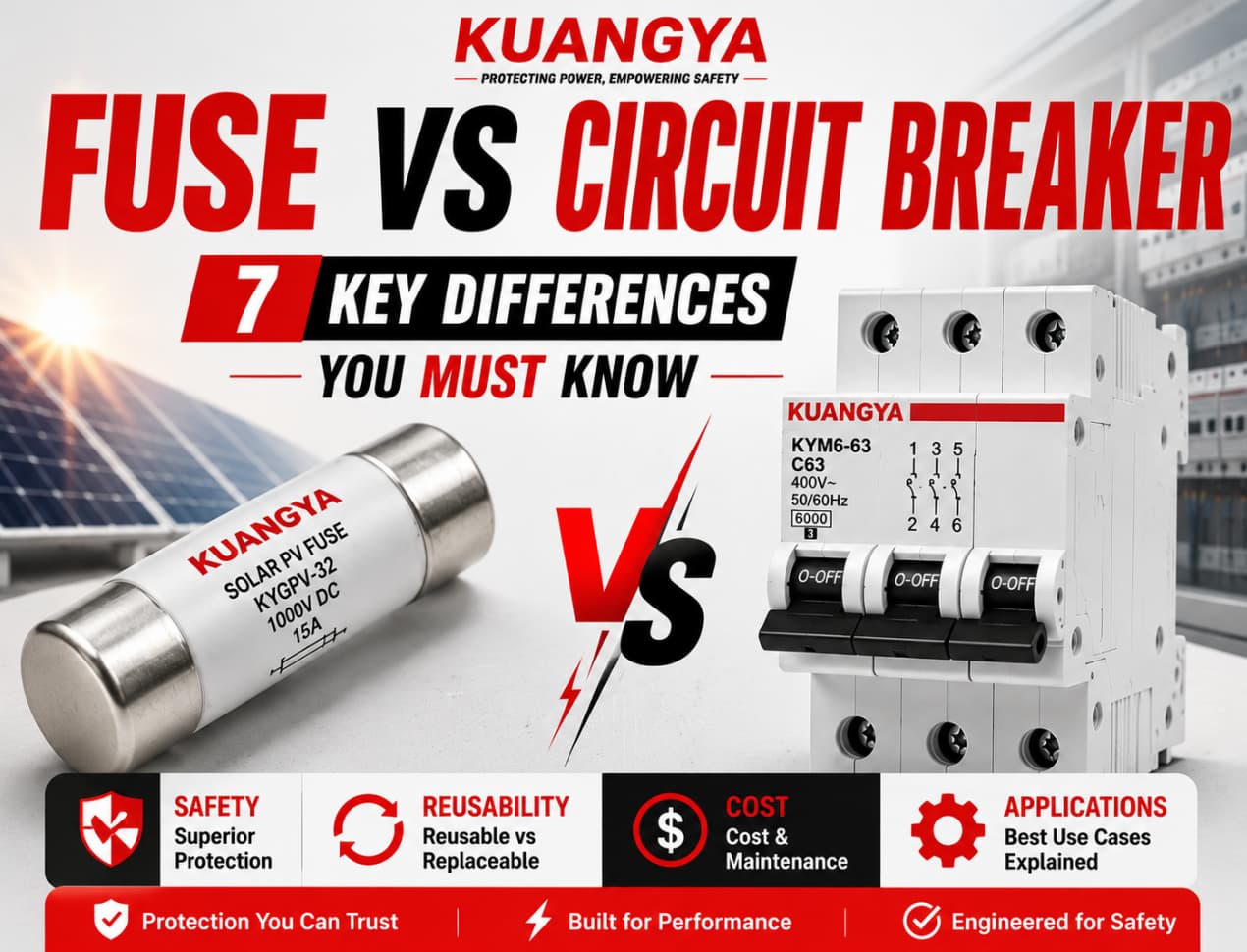
When it comes to electrical safety, two devices are commonly used to protect circuits from overloads and short circuits: fuses and circuit breakers.
Many people often wonder about the fuse vs circuit breaker debate. Which one is safer? Which lasts longer? Which should be used in homes, factories, or solar systems?
Understanding the difference between fuse and circuit breaker can help homeowners, electricians, and facility managers make smarter decisions and improve electrical safety.
In this guide, we’ll explain how each device works, compare their advantages and disadvantages, and help you determine which protection method is best for your application.
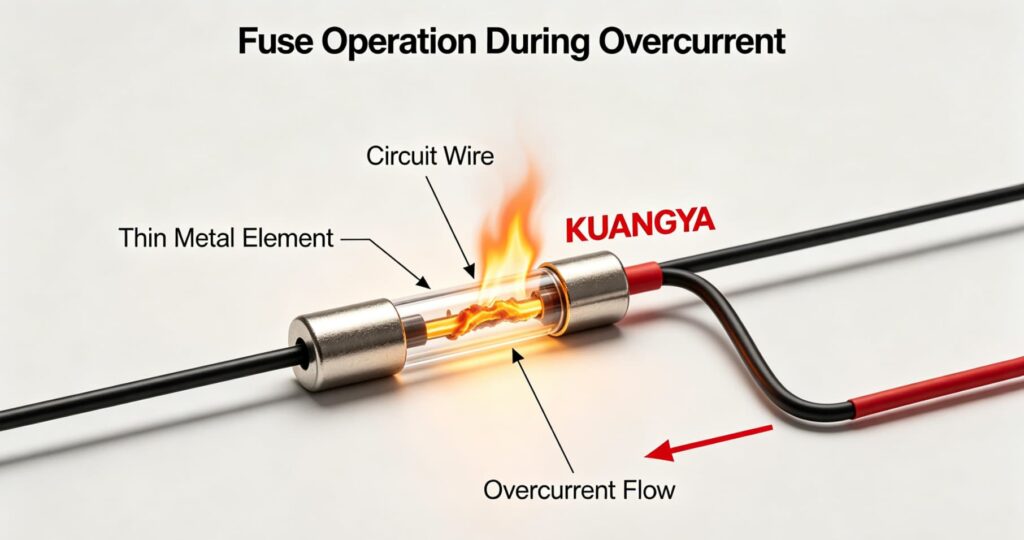
A fuse is one of the oldest electrical protection devices.For photovoltaic applications, understanding the correct selection of DC fuse protection is equally important.
It contains a thin metal element designed to melt when excessive current flows through the circuit.
When the current exceeds the fuse rating:
This prevents wires, appliances, and equipment from overheating or catching fire.Fuse performance and testing requirements are defined by internationally recognized IEC standards for low-voltage protection devices.
Imagine a water pipe carrying water.
If too much pressure builds up, a weak section intentionally breaks to protect the rest of the system.
A fuse works in the same way.
| Component | Function |
|---|---|
| Fuse Element | Melts during overload |
| Fuse Body | Holds the element |
| End Caps | Connect to the circuit |
| Filler Material | Helps extinguish arcs |
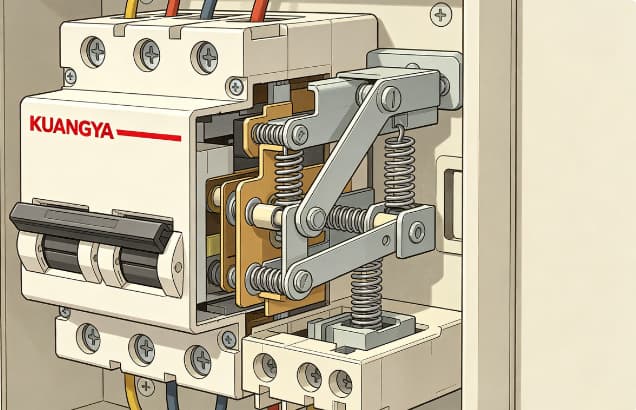
A circuit breaker is an automatic electrical switch designed to interrupt excessive current flow.Different circuit breaker types are used in residential, industrial, and renewable energy systems.
Unlike a fuse, a circuit breaker does not need replacement after operation.
Instead, it trips and can be reset.
When an overload occurs:
This reusability is one reason circuit breakers have become popular in modern installations.Many modern breakers are manufactured according to UL safety standards for circuit protection.
| Component | Function |
|---|---|
| Contacts | Carry current |
| Trip Unit | Detects faults |
| Arc Chute | Extinguishes arc |
| Operating Handle | Manual control |
| Housing | Provides insulation |
Although both devices protect electrical systems, they use different methods.
A fuse works through thermal melting.
Excessive current generates heat.
The fuse element melts and permanently disconnects the circuit.
A circuit breaker uses mechanical switching.
The trip mechanism detects abnormal current and opens the contacts automatically.
After troubleshooting, the breaker can be reset.
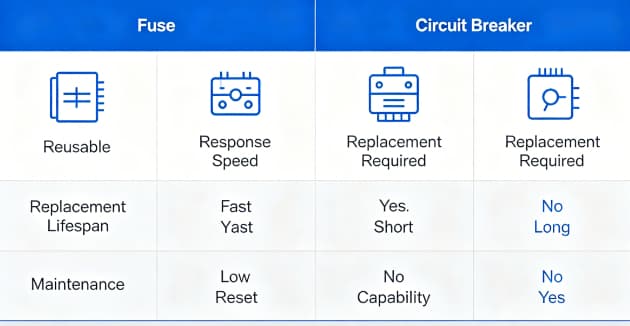
| Feature | Fuse | Circuit Breaker |
|---|---|---|
| Reusable | No | Yes |
| Response Speed | Very Fast | Fast |
| Replacement Required | Yes | No |
| Initial Cost | Lower | Higher |
| Maintenance | More Frequent | Less Frequent |
| Reset Capability | No | Yes |
| Lifespan | Shorter | Longer |
| Convenience | Lower | Higher |
| Fault Indication | Limited | Better |
| Automation Support | Limited | Excellent |
Understanding the difference between fuse and circuit breaker becomes easier when comparing specific characteristics.
The first major difference lies in how they interrupt current.
Uses a sacrificial metal element.
The element melts permanently during a fault.
Uses mechanical contacts and trip mechanisms.
The device opens and can later be reset.
| Device | Operating Method |
|---|---|
| Fuse | Melting element |
| Circuit Breaker | Mechanical trip |
One advantage in the fuse vs circuit breaker comparison is speed.
Fuses often react faster to severe short circuits.
This rapid action can limit equipment damage.
Circuit breakers are slightly slower because mechanical components must operate.
For pure speed:
✅ Fuse
This is perhaps the most obvious difference.
Once a fuse blows, it cannot be used again.
A new fuse must be installed.
Circuit breakers simply need resetting.
If a homeowner experiences a temporary overload:
✅ Circuit Breaker
Fuses require stock management and periodic replacement.
Circuit breakers generally require less maintenance.
For large facilities, reducing downtime is critical.
This makes circuit breakers more attractive.
| Maintenance Factor | Fuse | Circuit Breaker |
|---|---|---|
| Replacement Parts | Needed | Rarely Needed |
| Downtime | Higher | Lower |
| Maintenance Cost | Medium | Lower Long-Term |
Initial purchase cost is another important factor.
Relative protection device cost
Typical comparison of upfront investment.01234FuseCircuit Breaker
While actual prices vary, circuit breakers generally cost more initially.
Both devices provide excellent protection when properly selected.
However, circuit breakers offer additional safety features.Understanding common breaker failures can further improve system reliability.
Examples include:
Traditional fuses mainly provide overcurrent protection.
✅ Circuit Breaker
A fuse may operate only once.
A circuit breaker can trip thousands of times over its service life.
For applications with frequent switching, circuit breakers provide greater durability.
| Characteristic | Fuse | Circuit Breaker |
|---|---|---|
| Service Life | Limited | Long |
| Number of Operations | Single Use | Multiple Use |
| Long-Term Value | Moderate | High |
Despite the popularity of breakers, fuses still offer many benefits.
Circuit breakers dominate modern electrical installations for several reasons.Selecting the correct MCB specification is essential for ensuring long-term protection performance.
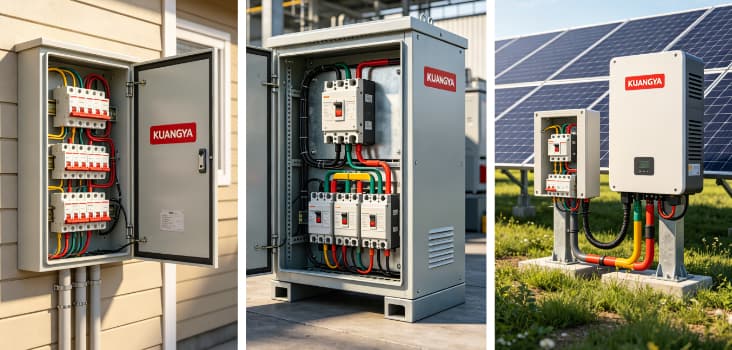
For residential electrical panels, circuit breakers are usually preferred.
Reasons include:
Most modern homes worldwide now use breaker panels instead of fuse boxes.Residential electrical systems should follow NFPA electrical safety recommendations whenever applicable.
Industrial environments often use both technologies.
The best solution often combines both devices.
Solar installations use both protection methods.Surge protection for solar systems is also essential to protect inverters and photovoltaic equipment from lightning-induced damage.
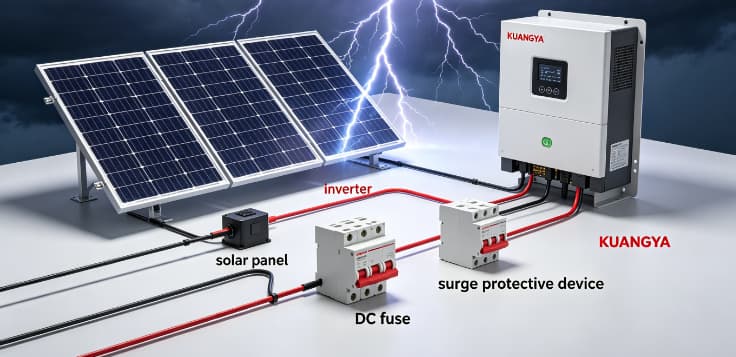
Modern photovoltaic systems frequently incorporate both devices to achieve comprehensive protection.
Not necessarily.
Certain applications require the extremely fast protection provided by fuses.
Fuses remain essential in many industries.
They continue to protect sensitive electronics and renewable energy systems.
Like all electrical devices, breakers require proper selection, installation, and maintenance.
Consider the following factors:
Both are safe when correctly selected and installed. Fuses typically react faster, while circuit breakers provide additional operational safety features.
A circuit breaker generally lasts longer because it can be reset and reused many times.
Circuit breakers offer convenience, reusability, and improved safety features compared with traditional fuse systems.
In many applications, yes. However, some specialized systems still require fuse protection due to their fast response characteristics.
Fuses usually cost less initially, while circuit breakers may offer lower long-term operating costs.
The debate over fuse vs circuit breaker does not have a universal winner.
The right choice depends on the application, safety requirements, maintenance expectations, and budget.
If you need fast and economical protection, a fuse may be ideal.
If you value convenience, reusability, and advanced safety features, a circuit breaker is often the better solution.
Understanding the difference between fuse and circuit breaker allows homeowners, engineers, and business owners to make informed decisions that improve electrical safety and system reliability.
In many modern electrical systems, the most effective approach is not choosing one over the other—but using both together to provide comprehensive protection.

We are a professional manufacturer of electrical products for solar and industrial applications, including MCB, SPD, RCD, and related accessories. With rich export experience, we provide reliable solutions and OEM/ODM services for global clients.

