Промышленная зона Вэньян Юэцин Вэньчжоу 325000
Рабочие часы
Понедельник - пятница: 7AM - 7PM
Выходные: 10AM - 5PM
Промышленная зона Вэньян Юэцин Вэньчжоу 325000
Рабочие часы
Понедельник - пятница: 7AM - 7PM
Выходные: 10AM - 5PM

Compare 1P+N and 2P RCBOs: neutral switching, protected poles, ratings and a practical buyer checklist. Learn why the exact datasheet matters.
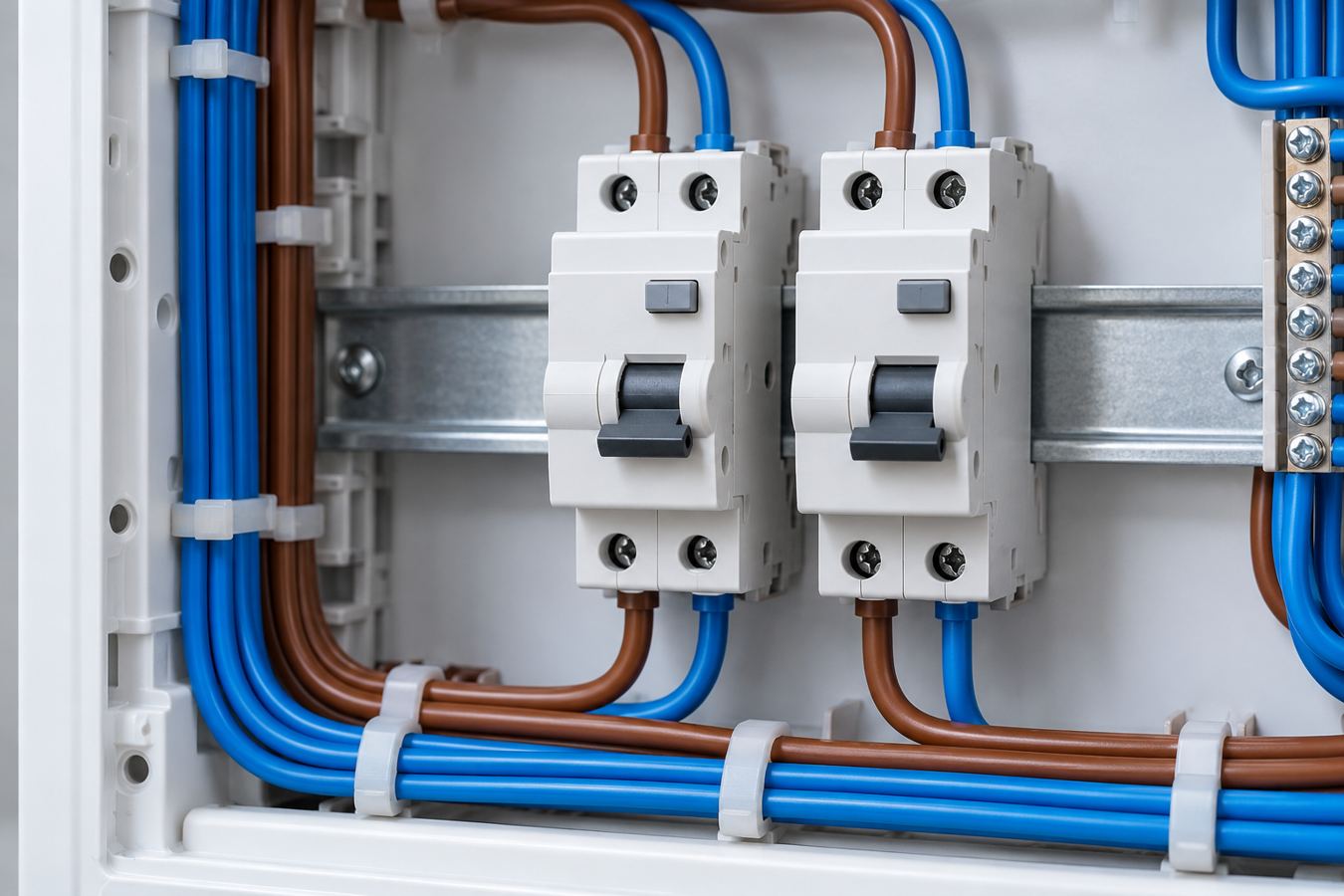
1P+N vs 2P RCBO: both labels appear on residual-current circuit breakers with overcurrent protection, but they do not, by themselves, tell you whether the neutral is switched or whether both poles have overcurrent protection. The exact circuit diagram and datasheet decide those details. This guide explains what to check before specifying an RCBO for a single-phase distribution board.
A 1P+N RCBO has one phase pole and a neutral path. Its phase conductor receives overcurrent protection; the neutral can be switched or unswitched depending on the model. ABB, for example, lists both neutral-switched and neutral-unswitched variants within its 1P+N DSE201 family. A 2P RCBO has two poles, but its protection and switching functions still need to be confirmed from the particular manufacturer’s schematic. Schneider Electric lists a 2P iC60H2 variant with two protected poles. These product examples demonstrate why a pole-count label alone is insufficient for procurement.
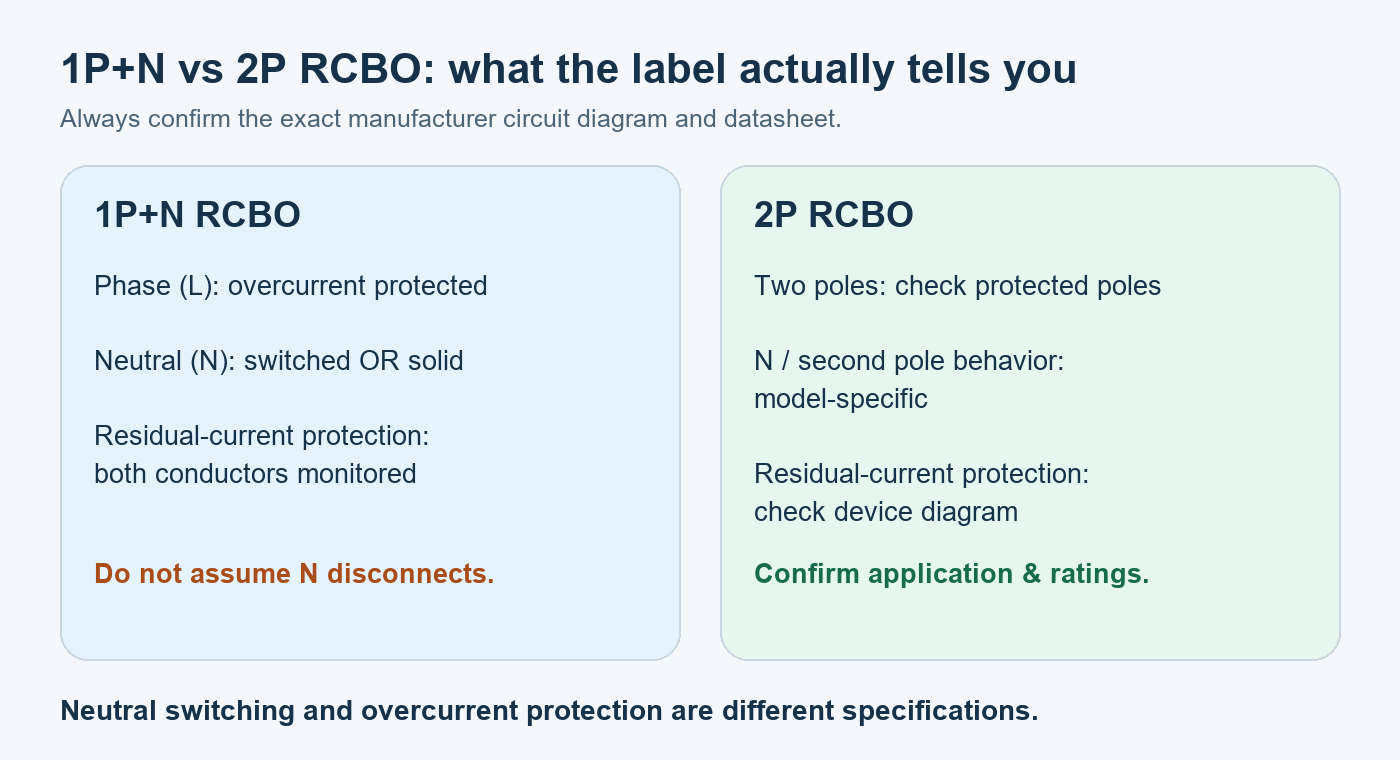
“Neutral switched” means that the device opens the neutral path as part of its switching action. It does не mean the neutral has its own overcurrent trip element. This distinction affects isolation requirements, panel schedules, test procedures and the suitability of a device for a particular earthing arrangement. Some 1P+N units switch the neutral; others leave it solid. Therefore, never infer isolation performance from “1P+N” printed on a sales page.
The RCBO’s residual-current function compares current in the conductors passing through its sensing arrangement. A mismatch can cause a trip. Overcurrent protection is a separate function, with its own rated current and breaking-capacity specifications. For the wider context, see our RCBO wiring diagram guide.
| Вопрос | 1P+N RCBO | 2P RCBO |
|---|---|---|
| How many poles/paths? | One phase pole plus neutral path | Two poles |
| Which poles have overcurrent protection? | Phase pole; verify the exact device | Check datasheet; some models protect both poles |
| Does neutral disconnect? | May be switched or unswitched | Verify wiring diagram and pole designation |
| Can the label alone confirm isolation? | Нет | Нет |
| Other ratings to verify | Voltage, current, residual-current sensitivity/type, short-circuit capacity, certification and dimensions | |
Published model specifications show why the pole label is only a starting point. The VKL003/VKL003N product page lists 1P+N versions rated 5–40 A, with VKL003 at AC 240 V and VKL003N at AC 120 V. The VRL22 product page lists a 2P version rated 6–63 A at AC 240 V. Residual-current type and sensitivity options depend on the selected variant.
These family-level specifications do not establish whether neutral is switched or whether both poles have overcurrent protection. Before specifying a unit, request the exact variant’s terminal diagram, datasheet and applicable approval documents, then match them to the circuit and local requirements.
No. Their pole designations differ, and the internal switching and overcurrent functions vary by model. Compare datasheets rather than treating the labels as interchangeable.
No. ABB’s DSE201 1P+N range includes both switched-neutral and solid-neutral variants. Check the exact model code and wiring diagram.
The required residual-current sensitivity depends on circuit use, applicable code and design. Specify it with a qualified engineer or electrician; do not assume one value fits every application.
Tell us your supply voltage, rated current, required residual-current type/sensitivity, breaking capacity, certification market and whether switched neutral is required. Contact KUANGYA for a matching RCBO specification and datasheet. If you are diagnosing an existing device, see our RCBO troubleshooting guide.
Technical references: IEC 61009-1:2024; ABB DSE201 eRCBO range; Schneider Electric iC60H2 2P RCBO.

