Промышленная зона Вэньян Юэцин Вэньчжоу 325000
Рабочие часы
Понедельник - пятница: 7AM - 7PM
Выходные: 10AM - 5PM
Промышленная зона Вэньян Юэцин Вэньчжоу 325000
Рабочие часы
Понедельник - пятница: 7AM - 7PM
Выходные: 10AM - 5PM

УЗИП против стабилизатора напряжения: узнайте разницу между защитой от импульсных перенапряжений и стабилизацией напряжения, а также на что обратить внимание перед выбором оборудования.
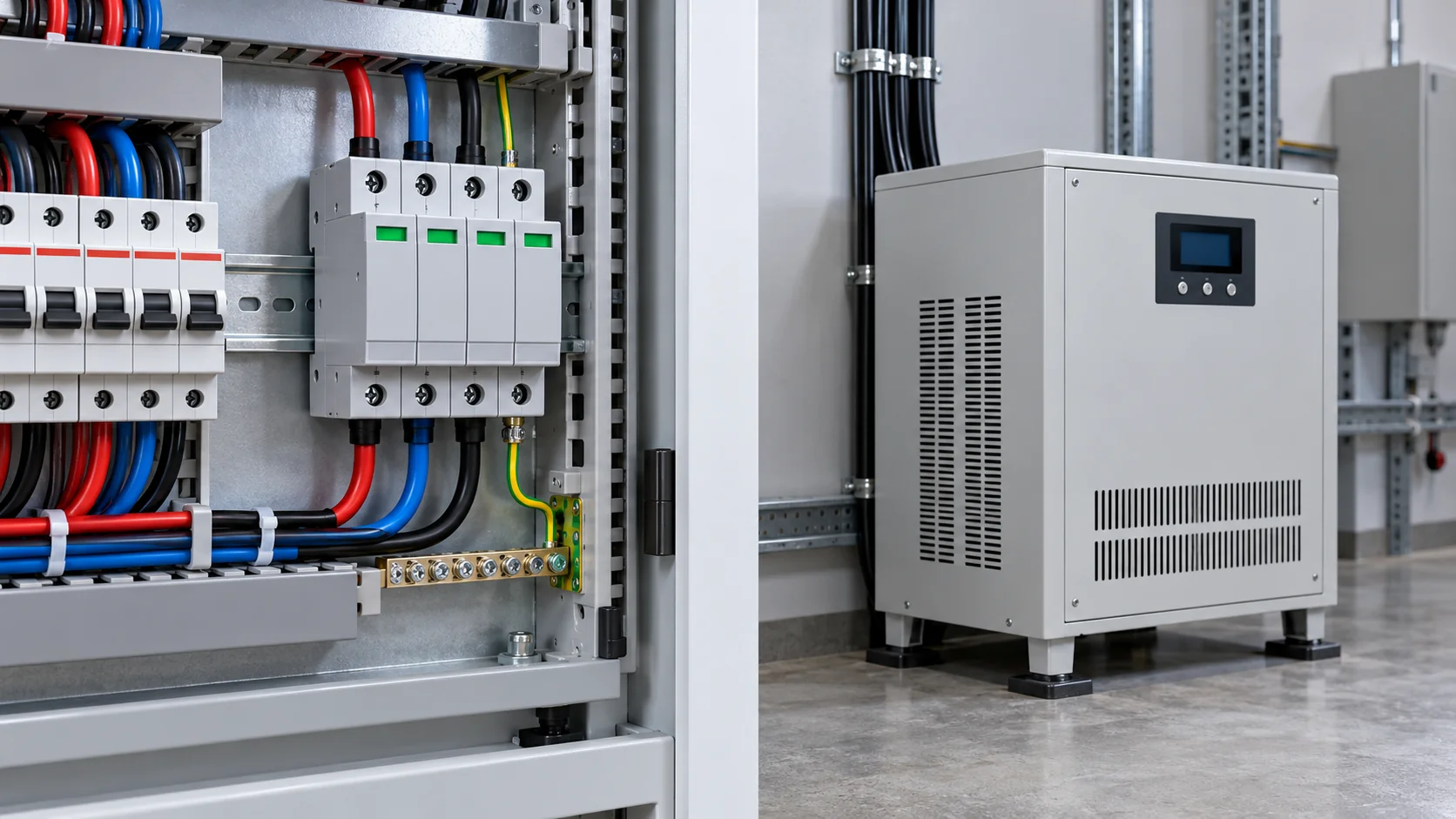
SPD vs voltage stabilizer: these devices address different electrical problems. A surge protective device (SPD) limits short transient overvoltage under its rated conditions. A voltage stabilizer, often called an automatic voltage regulator (AVR), adjusts a supply that varies within its specified operating range. One does not automatically replace the other.
For a factory panel, commercial building or equipment room, the first step is to identify whether the complaint is a brief spike, a sustained high or low supply voltage, or a power interruption. The correct protective arrangement depends on that diagnosis.
| Вопрос | Surge protective device | Voltage stabilizer / AVR |
|---|---|---|
| Main job | Limit specified transient overvoltage | Regulate input variation within its rated range |
| Typical time scale | Fast impulse or switching transient | Longer supply variation within the regulator’s response capability |
| Backup power | Нет | No, unless part of a separate backup system |
| Can it replace an SPD? | It is the SPD | Not unless the exact product includes a separately specified surge-protection function |
| Can it fix a loose neutral? | Нет | No; diagnose and repair the wiring fault |
An SPD is selected and tested to limit transient overvoltage from events such as lightning-induced impulses or switching operations. It does not continuously hold a fluctuating supply at a fixed output voltage. Eaton’s surge-protection guidance distinguishes fast surges from longer-duration swells and temporary overvoltage. Schneider Electric likewise describes SPDs as protection against high peak voltage impulses.
For a closer look at this boundary, read our surge versus temporary-overvoltage guide. A fault that lasts seconds or minutes needs a different investigation from a microsecond-scale transient.
A stabilizer regulates its output when the incoming voltage varies within the model’s specified input range, load rating and response limits. Designs differ: relay, servo and electronic regulators do not have identical accuracy or response. A stabilizer is therefore selected using the load’s power demand, permissible voltage range, operating environment and the manufacturer’s data.
Do not infer that a stabilizer can absorb a high-energy surge simply because it maintains a nominal output during ordinary voltage variation. If its datasheet claims surge protection, check the separate rating, test standard and installation instructions for that function.
Consider a workshop where the supply voltage drifts enough to interrupt equipment operation and the distribution system is also exposed to switching transients. A properly selected stabilizer may address the defined voltage variation, while a coordinated SPD arrangement addresses transient surges. The installation order and coordination are project-specific; follow both manufacturers’ instructions rather than assuming a universal wiring sequence.
If the concern is loss of power, neither device supplies runtime. A correctly sized UPS or another backup system serves that separate purpose. Our Сравнение ИБП и сетевых фильтров объясняет различие.
For AC distribution-board surge protection, review the Диапазон УЗИП KUANGYA AC. Select a specific model only after checking its current datasheet against the installation; a kA headline alone is not enough.
Do not assume it will. Check whether the exact stabilizer includes a separately rated surge-protection function and whether the complete installation provides the required SPD and bonding arrangement.
No. An SPD is not a continuous voltage regulator. Investigate the supply and load, then determine whether a stabilizer, network repair or another measure is appropriate.
An SPD is not a repair for a loose or open neutral. This can create dangerous abnormal voltage and requires qualified diagnosis and correction.
Send your nominal voltage, phase arrangement, earthing system, panel location, equipment load and a description of the voltage event to КУАНЬЯ. We can propose an AC SPD candidate and provide its datasheet for review by your electrician or engineer.

