Промышленная зона Вэньян Юэцин Вэньчжоу 325000
Рабочие часы
Понедельник - пятница: 7AM - 7PM
Выходные: 10AM - 5PM
Промышленная зона Вэньян Юэцин Вэньчжоу 325000
Рабочие часы
Понедельник - пятница: 7AM - 7PM
Выходные: 10AM - 5PM

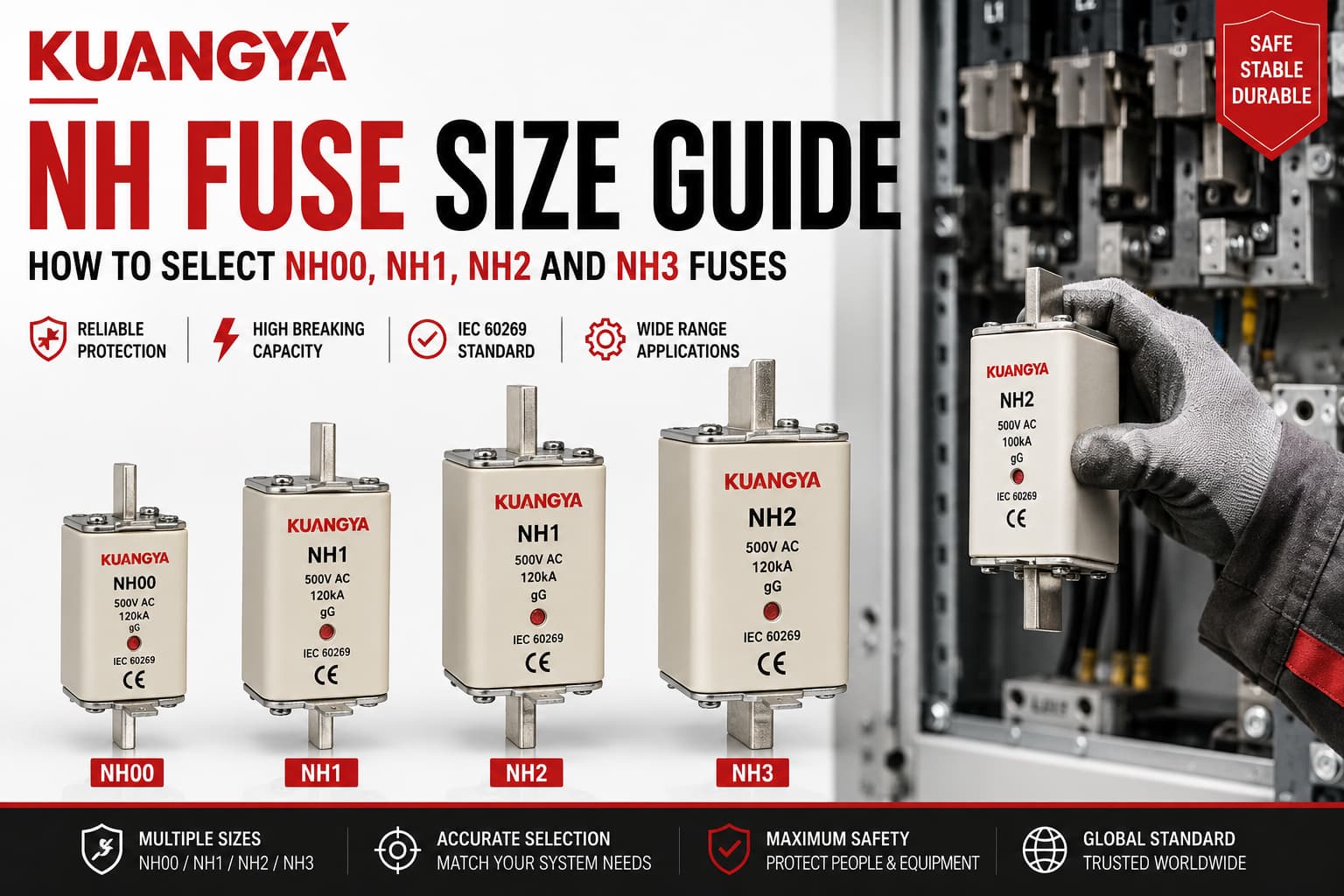
Electrical safety is a fundamental requirement for any power distribution system, whether residential, commercial, or industrial. Among the most reliable protective devices in medium- and high-current systems are NH fuses, known for their high breaking capacity and fast response to overcurrent conditions. Installing the wrong fuse, however, can result in system outages, damaged equipment, and even fire hazards.
The NH fuse family includes four standard sizes: NH00, NH1, NH2, and NH3, each corresponding to specific current ranges, physical dimensions, and applications. Understanding the differences between these sizes is essential for electricians, engineers, and anyone responsible for electrical safety.
This guide will provide a comprehensive overview of NH fuses, including step-by-step guidance on how to select the correct size, a comparison table, and detailed explanations for each NH fuse type. By following this guide, you can ensure safe, efficient, and reliable electrical protection for your systems.
An NH fuse, also called a high-capacity cartridge fuse, is designed to interrupt overcurrent conditions in electrical circuits quickly and safely. Unlike standard fuses, NH fuses can handle industrial-level currents and high prospective short-circuit currents without damaging equipment or the surrounding installation.
Key features of NH fuses:
Типичные области применения включают:
All NH fuses referenced in this guide are КУАНЬЯ branded products to ensure consistent quality and safety.
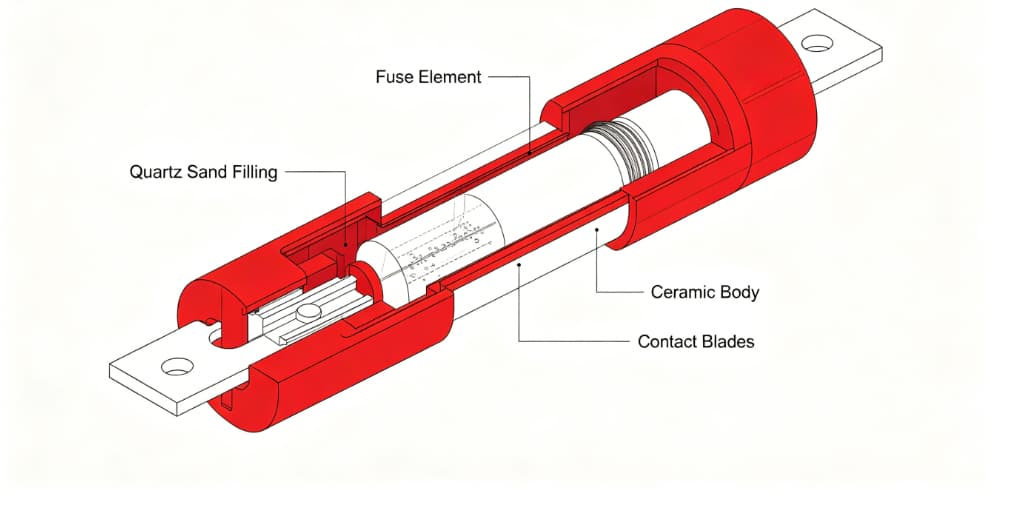
Understanding the internal structure of an NH fuse helps users select the correct type.
Components of an NH Fuse:
Example marking on a KUANGYA NH fuse:
NH1 100A 500V AC I1=80kA IEC 60269-2These markings ensure the fuse is used in the correct application and complies with international safety standards.
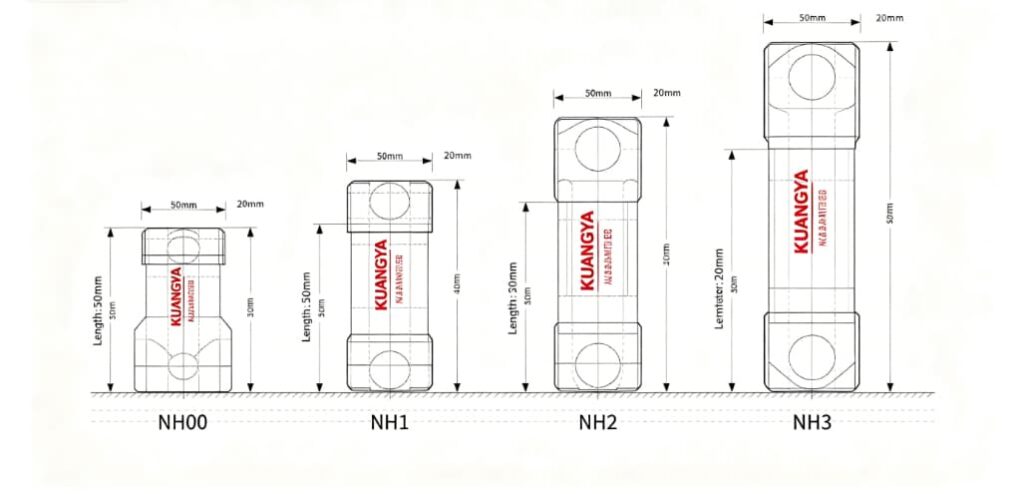
NH fuses are categorized by physical size, rated current, and breaking capacity.
| NH Size | Номинальный ток (A) | Разрывная способность (кА) | Approx. Body Dimensions (mm) |
|---|---|---|---|
| NH00 | 16 – 63 | 50 – 100 | 10 × 38 |
| NH1 | 63 – 100 | 80 – 100 | 14 × 50 |
| NH2 | 100 – 160 | 100 – 120 | 18 × 70 |
| NH3 | 160 – 250 | 120 – 150 | 22 × 85 |
Совет: Always select a fuse whose breaking capacity exceeds the maximum prospective short-circuit current in your system.
Example Scenario:
A small office lighting circuit with 50A full load would typically use a KUANGYA NH00 fuse rated 63A.
Example Scenario:
A commercial building panel supplying 90A to motors and lighting would require a KUANGYA NH1 fuse rated 100A.
Example Scenario:
A solar PV inverter with 120A output would be protected by a KUANGYA NH2 fuse rated 125A.
Example Scenario:
A large industrial motor drawing 200A would require a KUANGYA NH3 fuse rated 200A.
| Характеристика | NH00 | NH1 | NH2 | NH3 |
|---|---|---|---|---|
| Номинальный ток (A) | 16 – 63 | 63 – 100 | 100 – 160 | 160 – 250 |
| Rated Voltage (AC) | 500V | 500V | 500V | 500V |
| Разрывная способность (кА) | 50 – 100 | 80 – 100 | 100 – 120 | 120 – 150 |
| Body Length (mm) | 38 | 50 | 70 | 85 |
| Дуговая камера | Quartz Sand | Quartz Sand | Quartz Sand | Quartz Sand |
| Типовое применение | Small circuits | Medium load | Промышленность | Сверхмощный |
Using this table helps engineers, electricians, and facility managers quickly identify the correct NH fuse for their system.
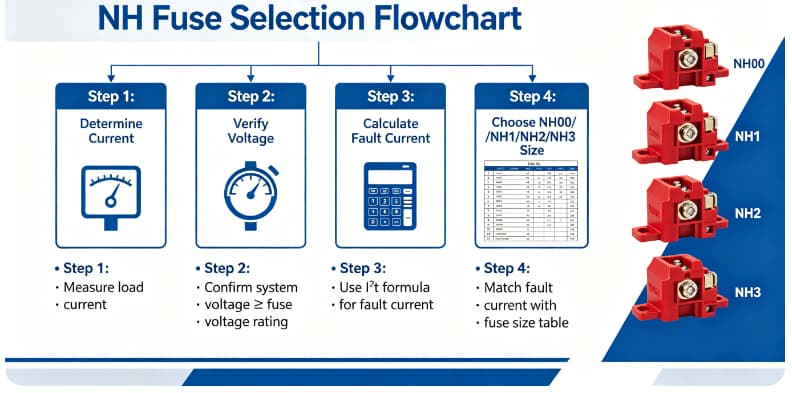
Selecting the right NH fuse involves more than simply matching the fuse current rating to the circuit current. A properly selected fuse must provide reliable protection while allowing normal operation without nuisance tripping.
Engineers typically consider four key factors:
Let’s examine each factor in detail.
The first step is identifying the actual operating current of the circuit.
Например:
| Оборудование | Рабочий ток |
|---|---|
| Lighting Panel | 40A |
| Distribution Board | 80A |
| Солнечный инвертор | 125A |
| Промышленный двигатель | 180A |
A common rule is:
Fuse Rating = Continuous Load × 1.25Пример:
100A × 1.25 = 125ATherefore, a 125A fuse would normally be selected.
This additional margin prevents unnecessary fuse operation during temporary load fluctuations.
The fuse voltage rating must always be equal to or greater than the system voltage.
| Напряжение системы | Рекомендуемое напряжение предохранителя |
|---|---|
| 230 В ПЕРЕМЕННОГО ТОКА | 500V AC |
| 400 В ПЕРЕМЕННОГО ТОКА | 500V AC |
| 480V AC | 690V AC |
| 690V AC | 690V AC |
Using an undervoltage-rated fuse can prevent proper arc interruption.
Breaking capacity refers to the maximum fault current the fuse can safely interrupt.
Например:
| Prospective Fault Current | Required Breaking Capacity |
|---|---|
| 50 кА | ≥50kA |
| 80 кА | ≥80kA |
| 100 кА | ≥100kA |
Always select a fuse with a breaking capacity higher than the available fault current.
Different applications require different protection characteristics.
| Приложение | Typical NH Fuse Size |
|---|---|
| Residential Distribution | NH00 |
| Commercial Building | NH1 |
| Солнечная фотоэлектрическая система | NH2 |
| Промышленный двигатель | NH2 |
| Heavy Machinery | NH3 |
| Main Distribution Panel | NH3 |
Project Information:
Recommended Selection:
| Параметр | Значение |
|---|---|
| Размер предохранителя | NH1 |
| Текущий рейтинг | 80A |
| Номинальное напряжение | 500V AC |
| Разрывная способность | 80 кА |
Результат:
A KUANGYA NH1 80A fuse would be suitable.
Project Information:
Recommended Selection:
| Параметр | Значение |
|---|---|
| Размер предохранителя | NH2 |
| Текущий рейтинг | 125A |
| Номинальное напряжение | 500V AC |
| Разрывная способность | 100 кА |
Результат:
A KUANGYA NH2 125A fuse provides reliable protection.
Project Information:
Recommended Selection:
| Параметр | Значение |
|---|---|
| Размер предохранителя | NH3 |
| Текущий рейтинг | 200A |
| Номинальное напряжение | 500V AC |
| Разрывная способность | 120 кА |
Результат:
A KUANGYA NH3 fuse is recommended.
Many fuse failures are caused by incorrect selection rather than product defects.
Many users only consider amperage.
However, voltage and breaking capacity are equally important.
Some users install larger fuses to avoid nuisance tripping.
This practice is dangerous.
An oversized fuse may fail to protect the circuit during overload conditions.
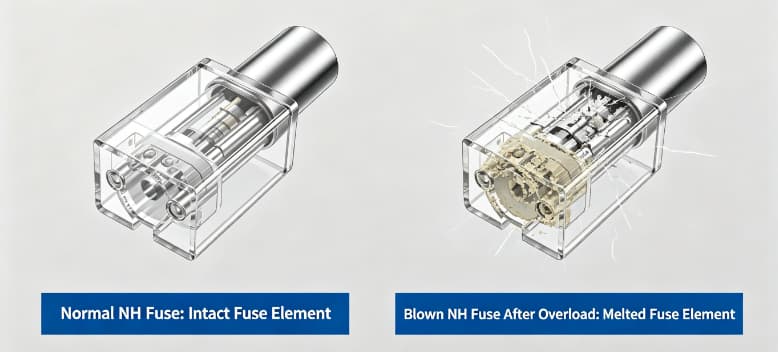
A fuse may have the correct current rating but insufficient breaking capacity.
This can result in catastrophic failure.
NH00, NH1, NH2, and NH3 are not interchangeable.
Always use the correct fuse holder and fuse size.
Electrical systems do not operate in laboratory conditions.
Factors such as:
can influence fuse performance.
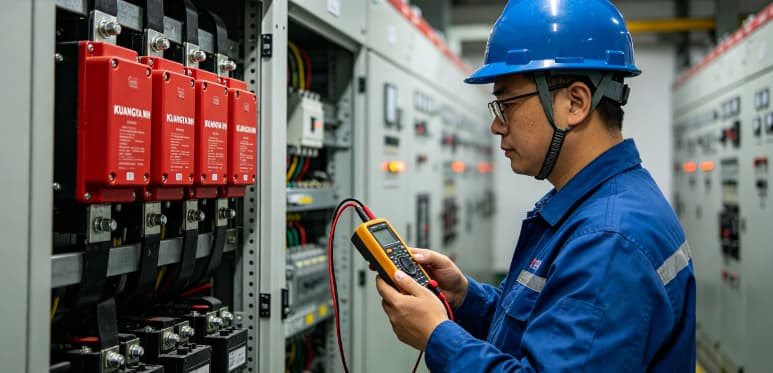
NH fuses are widely used in:
Their high breaking capacity makes them ideal for fault protection.
Large motors often generate significant inrush currents.
NH fuses provide protection against:
The renewable energy industry continues to grow rapidly.
NH fuses are commonly installed in:
Solar projects require reliable protection to maximize uptime.
Battery energy storage systems are becoming increasingly popular.
Защита необходима для:
NH fuses are commonly used in these applications.
Electric vehicle charging stations require dependable circuit protection.
NH fuses help protect:
Even though fuses are passive devices, regular inspections are recommended.
Проверьте наличие:
Use infrared cameras to identify:
Replace damaged fuses immediately.
Never reuse a blown fuse.
Store spare fuses in:
This helps maintain long-term reliability.
The primary differences are:
Larger NH fuse sizes generally support higher current levels.
Not normally.
Fuse holders are designed for specific NH sizes.
Mechanical and electrical compatibility must be verified.
Under normal operating conditions, an NH fuse can last many years.
A fuse only requires replacement after operating due to a fault.
Quartz sand helps extinguish the electrical arc created when the fuse element melts.
This significantly improves safety.
Да.
NH fuses are widely used in AC distribution sections of solar power systems.
The most commonly referenced standard is:
This standard defines performance requirements and testing methods.
Да.
NH fuses are commonly used alongside motor starters and contactors to provide short-circuit protection.
To achieve maximum reliability:
✔ Verify current rating
✔ Verify voltage rating
✔ Verify breaking capacity
✔ Follow IEC standards
✔ Consider future expansion
✔ Use compatible fuse holders
✔ Perform routine inspections
✔ Use high-quality products
Choosing the correct NH fuse is one of the most important steps in ensuring electrical safety and system reliability.
Whether you are working with residential distribution panels, commercial buildings, solar power systems, energy storage installations, or industrial machinery, understanding the differences between NH00, NH1, NH2, and NH3 is essential.
A properly selected fuse helps:
Remember that fuse selection should never be based solely on current rating. Voltage rating, breaking capacity, environmental conditions, and application requirements must also be considered.
By following the guidance in this NH Fuse Size Guide, electricians, engineers, facility managers, and system designers can make informed decisions and improve the overall reliability of their electrical systems.
If you would like to expand your knowledge of electrical protection devices, you may also find these guides helpful:
For more circuit protection solutions, visit:

