Промышленная зона Вэньян Юэцин Вэньчжоу 325000
Рабочие часы
Понедельник - пятница: 7AM - 7PM
Выходные: 10AM - 5PM
Промышленная зона Вэньян Юэцин Вэньчжоу 325000
Рабочие часы
Понедельник - пятница: 7AM - 7PM
Выходные: 10AM - 5PM

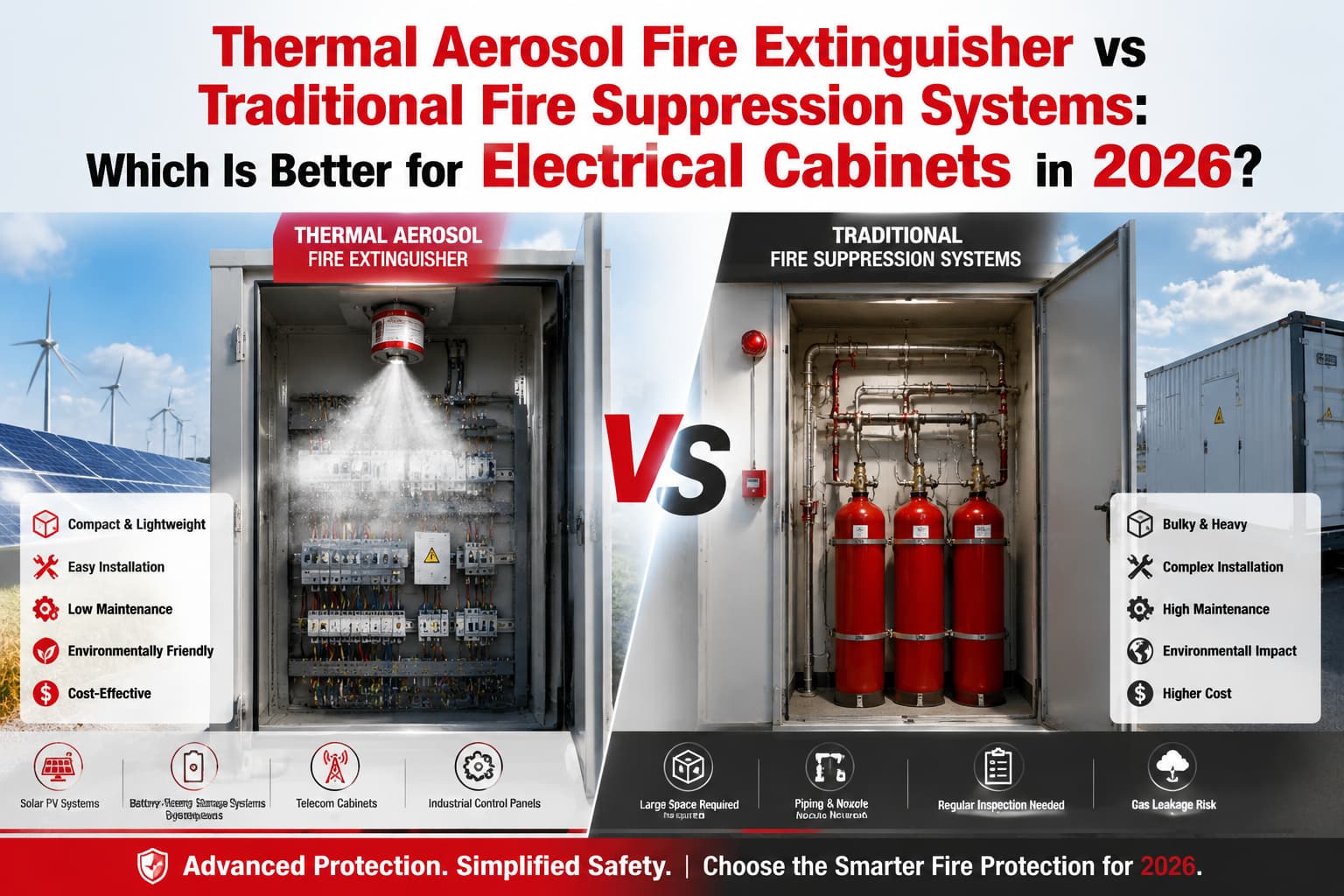
Thermal Aerosol Fire Extinguisher vs Traditional Fire Suppression Systems is a key comparison for modern electrical cabinet fire protection systems.
When protecting electrical cabinets, solar PV combiner boxes, battery energy storage systems (BESS), and industrial control panels, choosing the right fire suppression technology can significantly reduce downtime, equipment loss, and safety risks.
Traditional fire suppression systems such as CO₂, FM-200, Novec 1230, and water-based systems have been widely used for decades. However, thermal aerosol fire extinguishers are increasingly becoming the preferred solution for enclosed electrical spaces due to their compact size, lower installation cost, fast activation, and minimal maintenance requirements.
This guide compares thermal aerosol fire extinguishers and traditional suppression systems across installation complexity, effectiveness, maintenance, environmental impact, lifecycle cost, and real-world applications.
Electrical cabinets are the operational heart of modern industrial systems.
Они часто встречаются в:
Unfortunately, these cabinets also present a significant fire risk.
To better understand how electrical protection systems work together with fire safety components such as circuit breakers and surge protection devices, see our circuit protection and surge protection solutions.
| Причина | Описание |
|---|---|
| Loose Connections | Generate excessive heat due to resistance |
| Дуговые разрывы | Electrical arcs can exceed 3,000°C |
| Перегруженные цепи | Excessive current creates thermal stress |
| Отказ компонента | Aging breakers, relays, and contactors |
| Battery Thermal Runaway | Especially in lithium-ion storage systems |
| Скопление пыли | Increases ignition probability |
According to industrial fire investigation reports, many cabinet fires begin as small localized electrical faults. Detecting and suppressing these fires within the first few minutes is critical.
Once flames spread beyond the cabinet enclosure, repair costs can escalate dramatically.
A thermal aerosol fire extinguisher is an automatic fire suppression device designed to detect and extinguish fires at an early stage.
Instead of releasing water, gas, or foam, the device generates a suspension of ultra-fine solid particles and gases.
These particles interrupt the chemical chain reactions responsible for combustion.
Traditional fire suppression systems generally fall into four categories:
| Тип системы | Suppression Method |
|---|---|
| Водяной спринклер | Cooling effect |
| Система на основе CO₂ | Oxygen displacement |
| FM-200 System | Heat absorption |
| Novec 1230 System | Heat absorption and chemical interruption |
These systems are effective but often require:
As infrastructure becomes more distributed, facility owners increasingly seek simpler alternatives.
One of the largest differences between aerosol and traditional systems is installation.
| Характеристика | Thermal Aerosol | Traditional Systems |
|---|---|---|
| Piping Required | Нет | Да |
| Pressure Cylinders | Нет | Да |
| Control Room Needed | Нет | Часто |
| Retrofit Friendly | Превосходно | Умеренный |
| Время монтажа | Hours | Days or Weeks |
For panel builders and EPC contractors, aerosol systems significantly reduce engineering workload.
A typical electrical cabinet may require only one or two aerosol generators mounted inside the enclosure.
By contrast, gas suppression systems usually involve extensive system design and commissioning.
Fire suppression effectiveness depends heavily on response time.
| Параметр | Thermal Aerosol | Traditional Systems |
|---|---|---|
| Detection-to-Discharge Time | Секунды | От секунд до минут |
| Point-Source Protection | Превосходно | Умеренный |
| Enclosed Space Protection | Превосходно | Хорошо |
| Early-Stage Fire Control | Превосходно | Хорошо |
Because aerosol generators are installed directly inside cabinets, suppression begins very close to the ignition source.
This localized protection often prevents fire escalation.
Space is increasingly valuable in modern industrial facilities.
Aerosol generators are compact and lightweight.
Пример:
| Система | Approximate Space Requirement |
|---|---|
| Aerosol Device | Installed inside cabinet |
| CO₂ Cylinder | Separate cylinder room often required |
| FM-200 Cylinder Bank | Dedicated storage area |
| Water Tank System | Large external infrastructure |
For small switchgear rooms or PV installations, aerosol systems offer substantial design flexibility.
Maintenance costs are often overlooked during system selection.
Typically requires:
Typically require:
| Фактор | Aerosol | Traditional |
|---|---|---|
| Routine Maintenance | Низкий | Высокий |
| Annual Inspection Complexity | Простой | Complex |
| System Downtime | Минимум | Выше |
This translates into significant lifecycle savings.
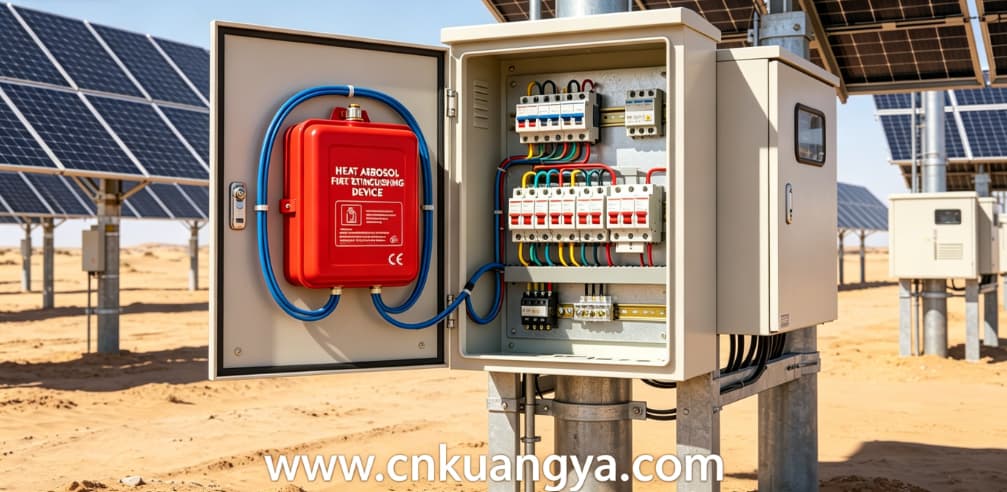
A utility-scale solar farm experienced recurring overheating events inside DC combiner boxes.
Traditional suppression options presented several issues:
The operator installed thermal aerosol extinguishing devices directly inside each combiner box.
| Метрика | Результат |
|---|---|
| Время монтажа | Reduced by 70% |
| Maintenance Visits | Reduced significantly |
| Fire Incidents | No escalation events reported |
| Доступность системы | Improved |
For distributed solar infrastructure, localized aerosol protection proved more practical than centralized suppression systems.
A manufacturing facility suffered repeated production interruptions due to electrical cabinet failures.
The company evaluated:
| Критерии | FM-200 | CO₂ | Aerosol |
|---|---|---|---|
| Стоимость | Высокий | Умеренный | Низкий |
| Installation Difficulty | Высокий | Высокий | Низкий |
| Техническое обслуживание | Высокий | Умеренный | Низкий |
| Cabinet-Level Protection | Хорошо | Хорошо | Превосходно |
The facility ultimately selected aerosol generators for over 120 control cabinets.
Reported benefits included:
EPC companies face increasing pressure to deliver projects:
Aerosol suppression aligns well with these objectives.
Ключевые преимущества включают:
✓ No pipework
✓ No cylinder storage room
✓ Minimal engineering requirements
✓ Faster commissioning
✓ Easy integration into electrical cabinets
✓ Lower project cost
Thermal Aerosol Fire Extinguisher vs Traditional Fire Suppression Systems is widely evaluated for solar, energy storage, telecom, and industrial projects.
For solar, energy storage, telecom, and industrial projects, these advantages can substantially improve project economics.
However, beyond installation and operational simplicity, decision-makers must also evaluate deeper factors such as long-term lifecycle cost, environmental compliance, system reliability, and application-specific performance differences.
Environmental compliance is becoming a key requirement in modern industrial fire protection projects, especially in Europe, the Middle East, and Asia-Pacific regions.
| Фактор | Thermal Aerosol | CO₂ Systems | FM-200 / Novec 1230 | Water Systems |
|---|---|---|---|---|
| Ozone Depletion Potential | 0 | 0 | 0 | 0 |
| Global Warming Impact | Очень низкий | Средний | Низкий | Нет |
| Toxic Residue | Минимум | Нет | Нет | Нет |
| Water Damage Risk | Нет | Нет | Нет | Высокий |
| Maintenance Complexity | Низкий | Средний | Высокий | Средний |
International standards for fire safety systems are defined by organizations such as NFPA (Национальная ассоциация противопожарной защиты) which provides guidelines for clean agent fire suppression systems.
Unlike traditional gas-based systems that rely on pressurized cylinders and piping networks, aerosol systems are solid-state devices with minimal environmental leakage risk and no refilling requirements.
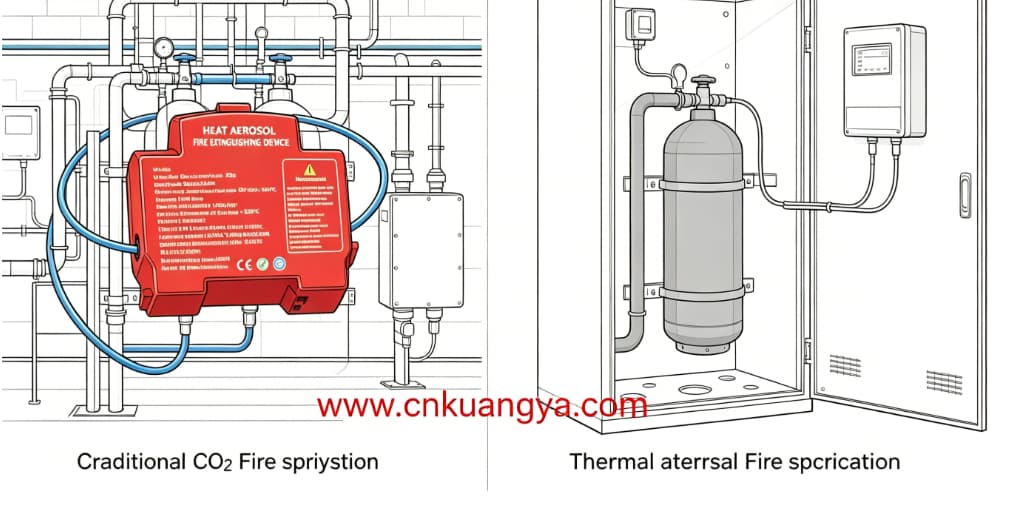
Total cost of ownership is often more important than initial purchase cost, especially for EPC contractors and industrial operators managing large-scale deployments.
| Cost Component | Thermal Aerosol | Traditional Gas Systems |
|---|---|---|
| Initial Equipment Cost | Low–Medium | Высокий |
| Стоимость установки | Очень низкий | Высокий |
| Infrastructure Requirement | Нет | Piping + Cylinders |
| Annual Maintenance | Минимум | Высокий |
| Gas Refill Requirement | Not Required | Требуется |
| System Downtime | Очень низкий | Medium–High |
Industrial fire protection system evaluation and compliance frameworks are widely referenced from ISO international standards organization.
The comparison between Thermal Aerosol Fire Extinguisher vs Traditional Fire Suppression Systems clearly shows differences in installation cost, maintenance requirements, and long-term performance.
Key insight: In real EPC and industrial projects, aerosol systems can reduce total lifecycle cost by approximately 30%–60% compared to traditional fire suppression systems.
Solar installations require compact, distributed, and low-maintenance fire protection solutions.
Key requirements:
Thermal aerosol systems are particularly suitable because they can be installed directly inside combiner boxes without external piping or centralized infrastructure.
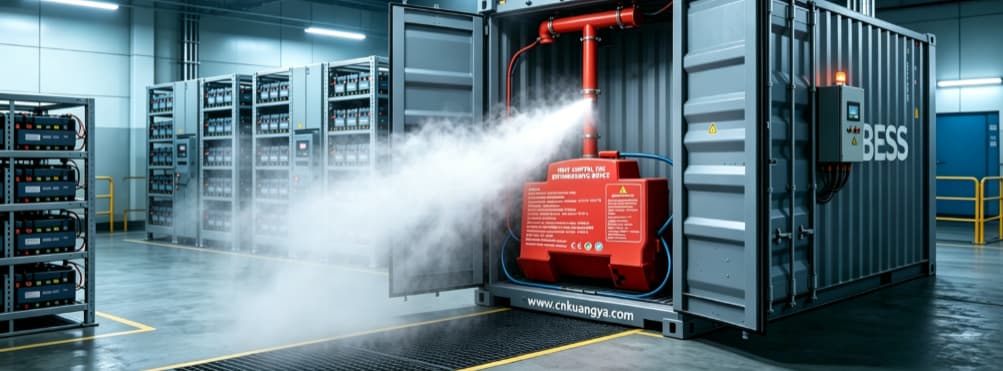
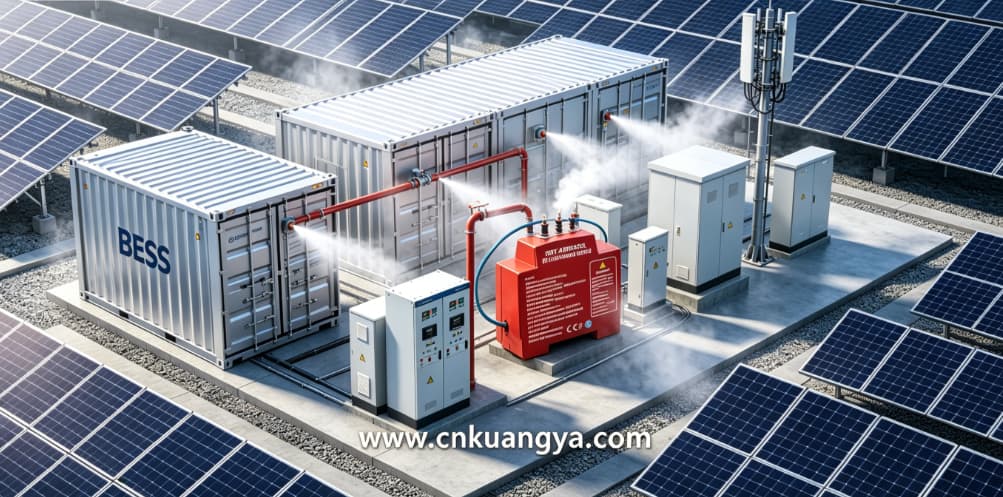
BESS applications introduce higher fire risks due to lithium-ion thermal runaway, which can escalate rapidly in enclosed spaces.
| Тип системы | Early-Stage Fire Suppression Effectiveness |
|---|---|
| Thermal Aerosol | High (localized suppression) |
| CO₂ | Средний |
| Тонкораспыленная вода | Medium–Low (equipment damage risk) |
| FM-200 / Novec | High but slower system-wide response |
Aerosol systems are increasingly used as a first-response layer at cabinet or rack level to prevent fire escalation before it spreads.
For energy storage systems, coordinated protection design combining SPD and fuses is critical. You can explore energy storage protection solutions (SPD & fuse coordination) for more technical details.
Telecom infrastructure requires maximum uptime and minimal maintenance disruption.
Critical requirements:
Aerosol systems eliminate the need for cylinder storage rooms and piping networks, making them ideal for distributed telecom networks.
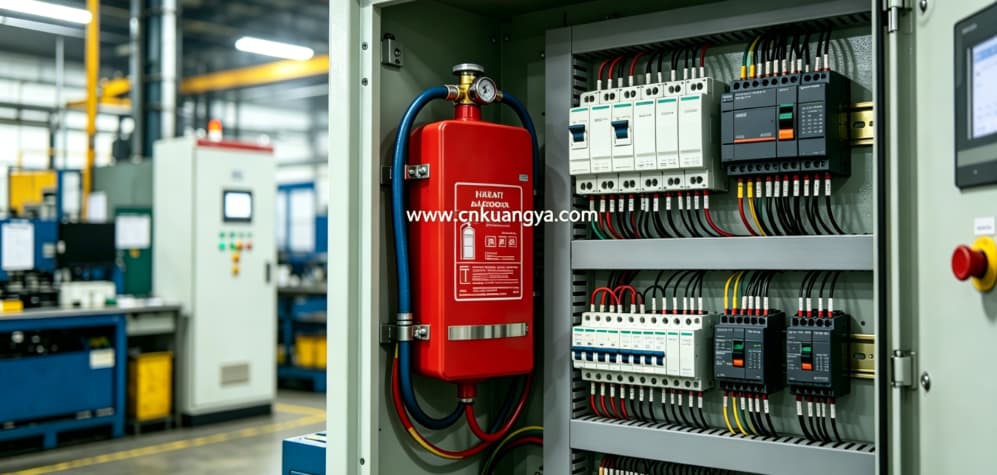
Most electrical fires originate inside control cabinets rather than in open spaces.
This makes localized suppression extremely important.
Aerosol systems offer direct suppression at the ignition source, significantly reducing fire escalation risk and equipment damage.
A mid-sized data center in Europe experienced repeated electrical faults in UPS distribution cabinets.
Thermal aerosol fire extinguishing units were installed directly inside high-risk electrical cabinets.
| Метрика | Результат |
|---|---|
| Fire escalation incidents | Significantly reduced |
| Время отклика | Seconds-level suppression |
| Повреждение оборудования | Minimized |
| Время простоя системы | Reduced |
This case demonstrates the importance of shifting from room-level protection to cabinet-level suppression in modern electrical infrastructure.
| Failure Point | Thermal Aerosol | Traditional Systems |
|---|---|---|
| Pipe leakage | Нет | Possible |
| Cylinder pressure loss | Нет | Да |
| Valve failure | Нет | Possible |
| Control system dependency | Низкий | Высокий |
| Detector network failure | Minimal impact | System-wide risk |
A key advantage of aerosol systems is that they are self-contained units, significantly reducing infrastructure complexity and mechanical failure points.
| Критерии | Aerosol | CO₂ | FM-200 / Novec | Вода |
|---|---|---|---|---|
| Installation Simplicity | ★★★★★ | ★★ | ★★ | ★ |
| Стоимость обслуживания | ★★★★★ | ★★★ | ★★ | ★★ |
| Fire Response Speed | ★★★★ | ★★★ | ★★★★ | ★★ |
| Cabinet Suitability | ★★★★★ | ★★★ | ★★★ | ★ |
This evaluation of Thermal Aerosol Fire Extinguisher vs Traditional Fire Suppression Systems helps EPC contractors make more cost-effective decisions.
For EPC contractors and system integrators, KUANGYA provides complete electrical protection solutions including surge protection, DC fuses, and fire suppression systems. Visit KUANGYA electrical protection solutions для получения дополнительной информации.
The comparison between thermal aerosol fire extinguishers and traditional fire suppression systems is no longer simply a matter of old versus new technology.
It reflects a fundamental shift in fire protection philosophy:
For modern solar, energy storage, telecom, and industrial automation projects, aerosol technology offers a more efficient, scalable, and cost-effective fire protection solution.
For EPC contractors, panel builders, and industrial system integrators, selecting the right fire protection strategy directly impacts cost, reliability, and project performance.
Learn more about KUANGYA aerosol fire suppression solutions:
https://cnkuangya.com/cabinet-automatic-fire-extinguishing-devices/

