WengYang Industrial Zone Yueqing Wenzhou 325000
Horas de trabalho
De segunda a sexta-feira: das 7h às 19h
Fim de semana: 10:00 - 17:00
WengYang Industrial Zone Yueqing Wenzhou 325000
Horas de trabalho
De segunda a sexta-feira: das 7h às 19h
Fim de semana: 10:00 - 17:00

Quando a eletricidade foi inventada? Ela não foi inventada: os povos antigos observaram a eletricidade estática, Volta construiu uma bateria em 1800 e Faraday descobriu a indução em 1831.
Início – Fabricante de Disjuntores CC | Fornecedor de Dispositivos de Proteção Solar – Kuangya
Em que ano a eletricidade foi inventada?
A eletricidade não foi inventada em um único ano: ela ocorre naturalmente. As pessoas observaram a eletricidade estática por volta de 600 a.C.; Alessandro Volta apresentou uma bateria que fornecia corrente constante em 1800; e Michael Faraday demonstrou a indução eletromagnética em 1831. Estes são marcos na compreensão e no uso da eletricidade, não a data em que a eletricidade em si começou. American Physical Society - Smithsonian - O trabalho de Faraday de 1831
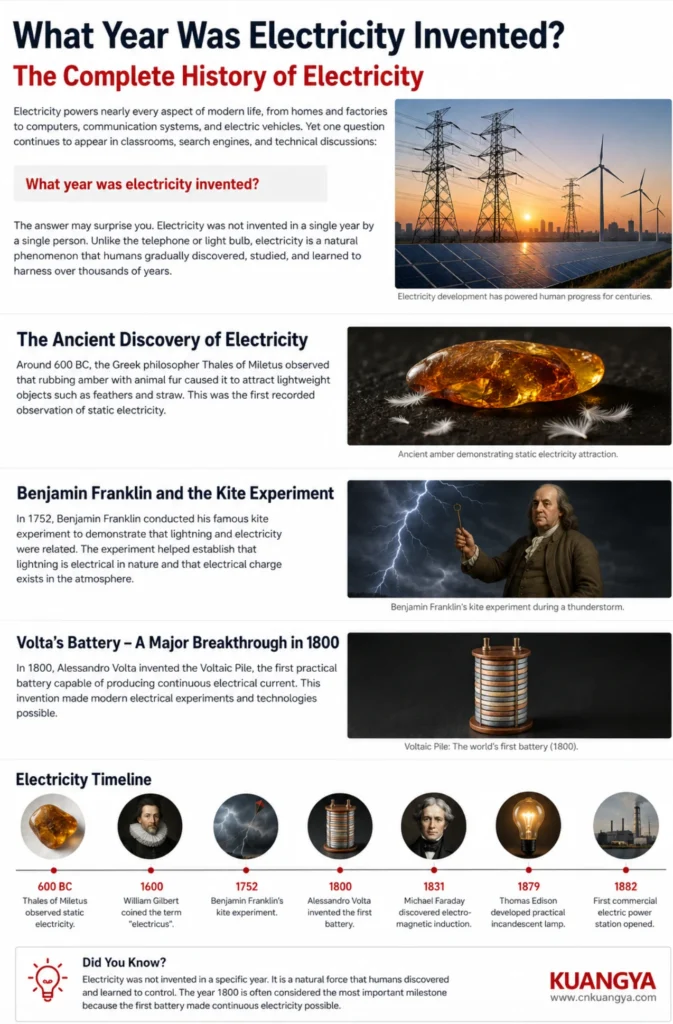
Uma ilustração que mostra a evolução da eletricidade desde as descobertas antigas até aos sistemas de energia modernos
Este artigo explora a história completa da eletricidade, incluindo quando foi descoberta, quem contribuiu para o seu desenvolvimento e os marcos fundamentais que transformaram a eletricidade na base da civilização moderna.
A eletricidade não foi inventada num ano específico porque existe naturalmente no ambiente.
No entanto, vários marcos importantes moldaram a nossa compreensão da eletricidade:
| Ano | Evento |
|---|---|
| Por volta de 600 a.C. | Os antigos gregos observaram a eletricidade estática |
| 1600 | William Gilbert introduziu o termo “electricus” |
| 1752 | A famosa experiência da pipa de Benjamin Franklin |
| 1800 | Alessandro Volta inventou a bateria elétrica |
| 1831 | Michael Faraday descobriu a indução eletromagnética |
| 1879 | Thomas Edison desenvolveu uma lâmpada incandescente prática |
| 1882 | A primeira central elétrica comercial foi inaugurada |
Se alguém perguntar “Em que ano a eletricidade foi inventada?”, a resposta correta é que não existe um ano único. 1800 marca a bateria de Volta, um passo importante em direção à corrente elétrica contínua — não a invenção da própria eletricidade.
Esta distinção é importante.
A eletricidade em si foi descoberta, não inventada.
Os seres humanos não criaram a eletricidade. Em vez disso, os cientistas descobriram gradualmente como as forças elétricas funcionam e desenvolveram tecnologias para gerar, armazenar, transmitir e utilizar a energia elétrica.
Exemplos de eletricidade que ocorre naturalmente incluem:
A invenção ocorreu quando os seres humanos aprenderam a controlar esses fenômenos elétricos.
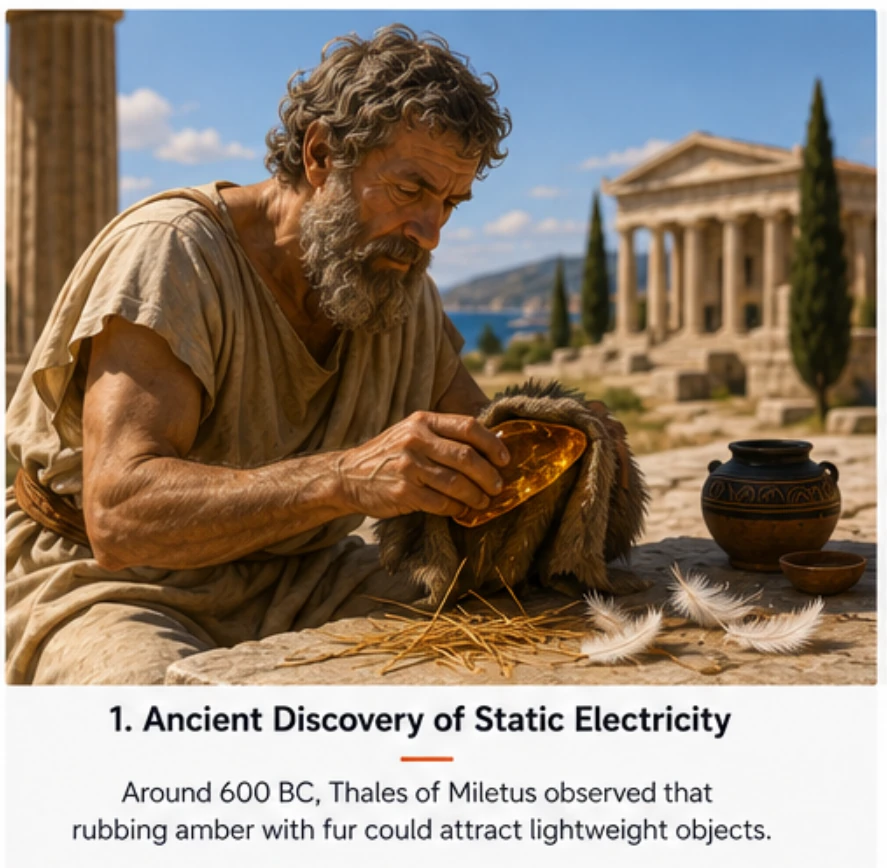
Muito antes de a ciência moderna existir, as pessoas notavam efeitos elétricos estranhos.
Âmbar antigo demonstrando atração por eletricidade estática
Por volta de 600 a.C., o filósofo grego Tales de Mileto observou que esfregar âmbar com pele de animal fazia com que ele atraísse objetos leves, como penas e palha.
Esta foi a primeira observação registrada de eletricidade estática.
Embora os gregos não compreendessem os elétrons ou a carga elétrica, eles documentaram o fenômeno que eventualmente levaria à ciência elétrica.
The modern word “electricity” comes from the Greek word:
Elektron = Amber
In 1600, English scientist William Gilbert published his groundbreaking work De Magnete.
He used the Latin term:
Electricus
meaning “like amber.”
This was the first scientific use of a term related to electricity.
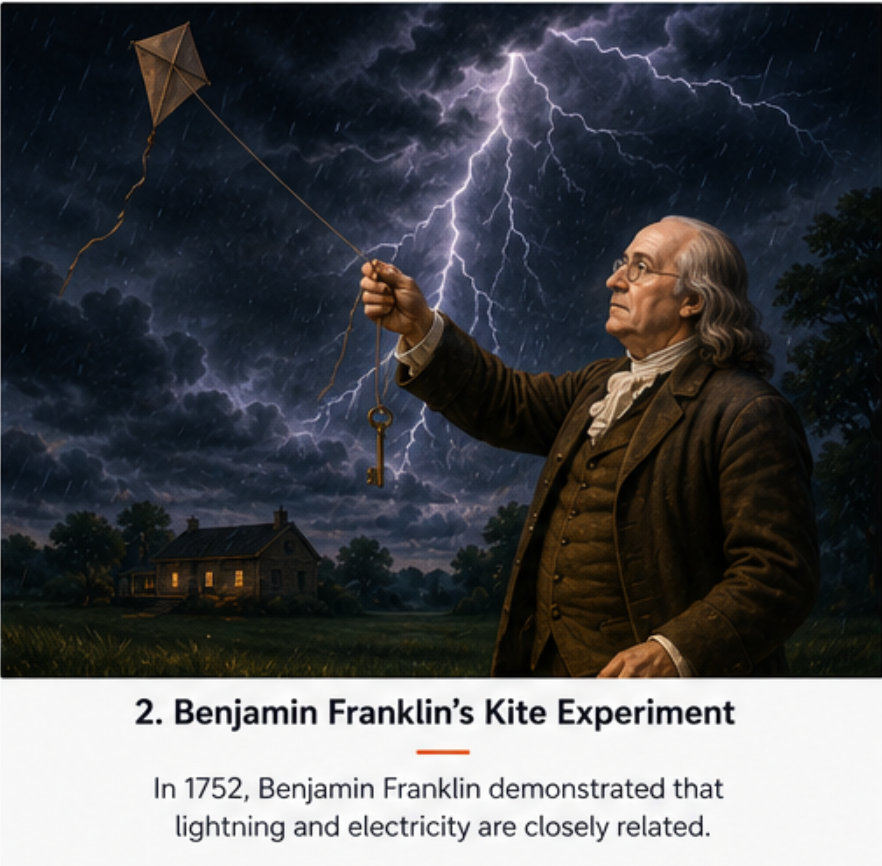
One of the most famous events in electrical history occurred in 1752.
Illustration of Benjamin Franklin’s kite experiment during a thunderstorm
Benjamin Franklin conducted his famous kite experiment to demonstrate that lightning and electricity were related.
The experiment helped establish:
Franklin’s work later contributed to the invention of the lightning rod, one of the earliest practical electrical safety devices.
1800 was a major milestone in the practical use of electricity.
That year, Italian physicist Alessandro Volta invented the:
The first practical battery capable of producing continuous electrical current.
Before Volta’s pile, researchers had studied static electricity and other electrical effects, but lacked a practical source of sustained current for repeatable experiments.
The Voltaic Pile allowed scientists to:
For this reason, 1800 is an important date in the history of electrical technology, while electricity itself has no invention date.
“Em que ano a eletricidade foi inventada?”
The next major breakthrough occurred in 1831.
British scientist Michael Faraday discovered:
V=-N\frac{d\Phi}{dt}
Faraday demonstrated that moving a magnet through a coil of wire could generate electricity.
This discovery became the foundation of:
Virtually every electrical grid in the world still relies on Faraday’s principle today.
The late nineteenth century transformed electricity from a scientific curiosity into a practical utility.
Thomas Edison developed:
In 1882, Edison opened the first commercial power station in New York City.
Nikola Tesla revolutionized electricity through:
Tesla’s AC system eventually became the global standard for electrical transmission because it allowed power to travel long distances efficiently.
| Ano | Scientist | Contribution |
|---|---|---|
| 600 a.C. | Tales de Mileto | First observation of static electricity |
| 1600 | William Gilbert | Coined electricus |
| 1752 | Benjamin Franklin | Demonstrated electrical nature of lightning |
| 1800 | Alessandro Volta | Invented first battery |
| 1820 | Hans Christian Ørsted | Linked electricity and magnetism |
| 1831 | Michael Faraday | Discovered electromagnetic induction |
| 1879 | Thomas Edison | Practical incandescent lamp |
| 1882 | Edison | First commercial power station |
| 1888 | Nikola Tesla | AC power system development |
Electricity did not immediately become available after its discovery.
Household electrification spread gradually.
| Period | Development |
|---|---|
| 1880s | Electric lighting introduced in cities |
| 1900s | Early urban electrification |
| 1920s | Increasing residential adoption |
| 1950s | Electricity became common in most developed countries |
| Today | Electricity powers nearly every modern industry |
The growth of electrical infrastructure required:
Electricity became one of humanity’s most important technological achievements because it enabled:
Modern electrical infrastructure supports virtually every sector of the global economy.
Não.
Thomas Edison did not invent electricity.
He developed practical electrical products and distribution systems.
Não.
Franklin studied electricity and proved lightning was electrical in nature.
Não.
Tesla improved electrical generation and transmission technologies but did not invent electricity itself.
No single person invented electricity.
Many scientists contributed to our understanding and use of electricity over centuries.
Portanto, what year was electricity invented?
The most accurate answer is that electricity was never invented because it is a natural force that already existed in nature.
However, if referring to the first practical method of producing continuous electrical current, 1800 is often considered the key year when Alessandro Volta invented the Voltaic Pile, the world’s first battery.
The development of electricity was a collective achievement involving scientists such as Thales, William Gilbert, Benjamin Franklin, Alessandro Volta, Michael Faraday, Thomas Edison, and Nikola Tesla. Their discoveries transformed electricity from a mysterious natural phenomenon into the foundation of modern civilization.
Electricity was not invented. It is a natural phenomenon. However, 1800 is often cited because Alessandro Volta created the first practical battery.
No single person invented electricity. Many scientists contributed to its discovery and development over centuries.
The earliest recorded observation of electricity dates to around 600 BC when the Greeks observed static electricity using amber.
No. Franklin helped explain electrical phenomena but did not invent electricity.
No. Edison developed practical electrical systems and lighting technologies.
Volta invented the first practical battery in 1800, enabling continuous electrical current and advancing electrical science.
For the protective devices used in modern electrical distribution, explore KUANGYA’s miniature circuit breaker range.

