温州市岳陽工業区 325000
勤務時間
月曜日~金曜日:午前7時~午後7時
週末午前10時~午後5時
温州市岳陽工業区 325000
勤務時間
月曜日~金曜日:午前7時~午後7時
週末午前10時~午後5時

Home – DC Circuit Breaker Manufacturer | Solar Protection Device Supplier – Kuangya
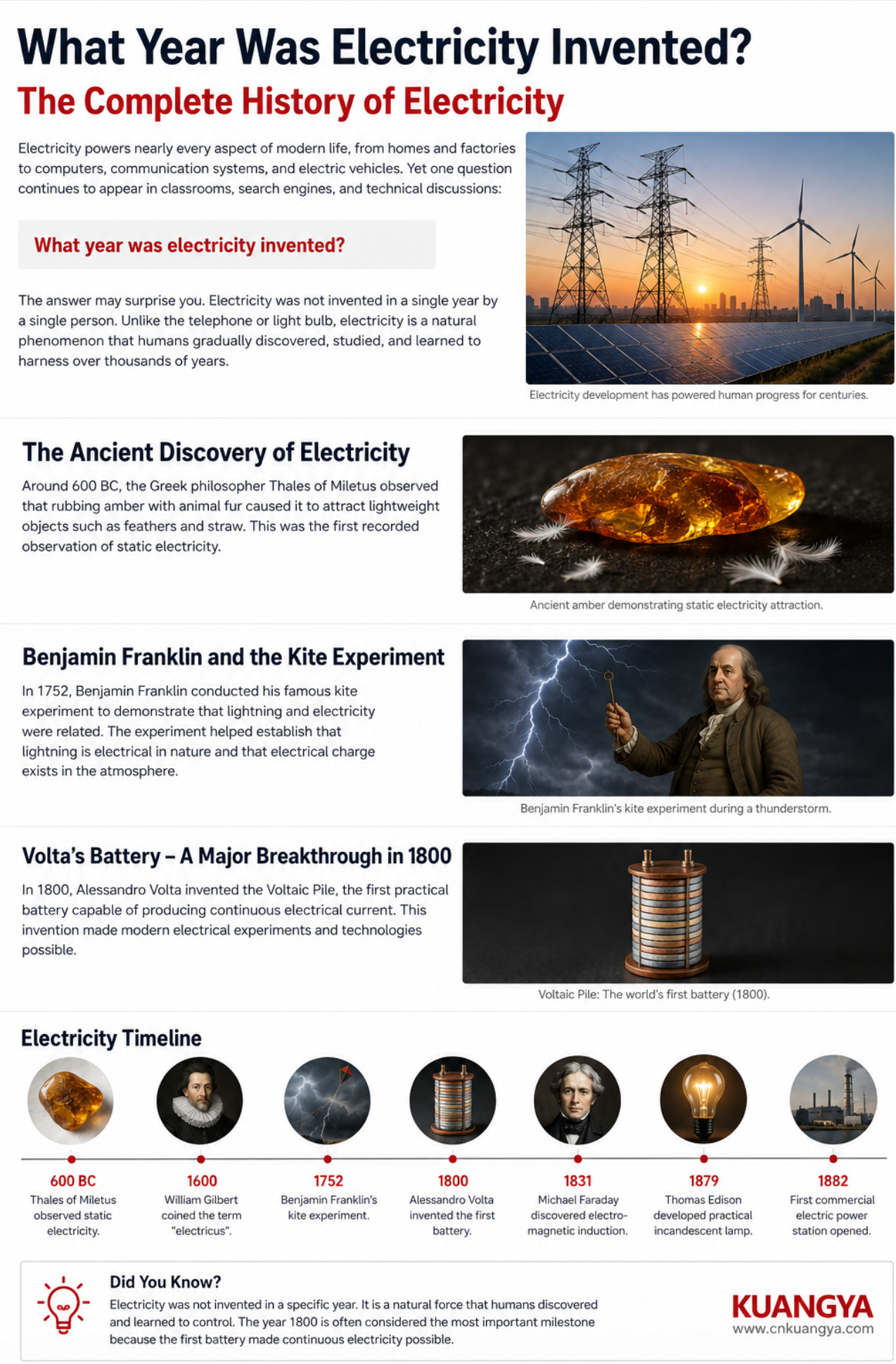
What year was electricity invented?
The answer may surprise you. Electricity was not invented in a single year by a single person. Unlike the telephone or light bulb, electricity is a natural phenomenon that humans gradually discovered, studied, and learned to harness over thousands of years.
An illustration showing the evolution of electricity from ancient discoveries to modern power systems
This article explores the complete history of electricity, including when electricity was discovered, who contributed to its development, and the key milestones that transformed electricity into the foundation of modern civilization.
Electricity was not invented in a specific year because it exists naturally in the environment.
However, several important milestones shaped our understanding of electricity:
| 年 | 事象 |
|---|---|
| Around 600 BC | Ancient Greeks observed static electricity |
| 1600 | William Gilbert introduced the term “electricus” |
| 1752 | Benjamin Franklin’s famous kite experiment |
| 1800 | Alessandro Volta invented the electric battery |
| 1831 | Michael Faraday discovered electromagnetic induction |
| 1879 | Thomas Edison developed a practical incandescent lamp |
| 1882 | First commercial electric power station opened |
If someone asks, “What year was electricity invented?”, the most commonly accepted historical milestone is 1800, when Volta created the first practical battery that produced a continuous electric current.
この区別は重要です。.
Electricity itself was discovered, not invented.
Humans did not create electricity. Instead, scientists gradually uncovered how electrical forces work and developed technologies to generate, store, transmit, and utilize electrical energy.
Examples of naturally occurring electricity include:
The invention occurred when humans learned how to control these electrical phenomena.
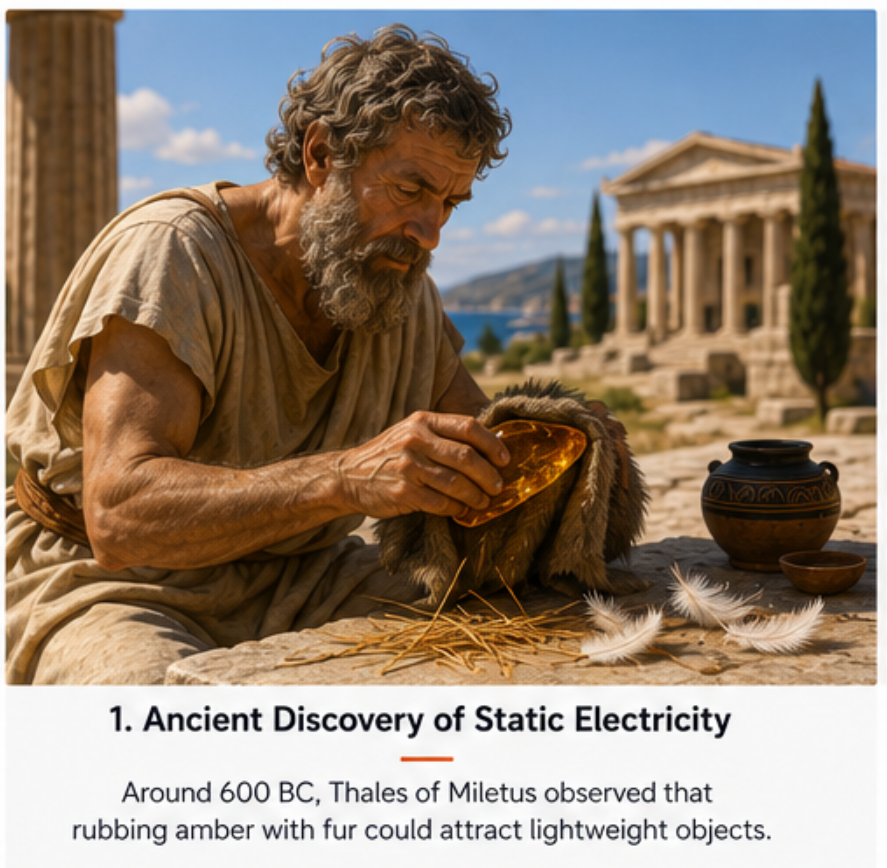
Long before modern science existed, people noticed strange electrical effects.
Ancient amber demonstrating static electricity attraction
Around 600 BC, the Greek philosopher Thales of Miletus observed that rubbing amber with animal fur caused it to attract lightweight objects such as feathers and straw.
This was the first recorded observation of static electricity.
Although the Greeks did not understand electrons or electric charge, they documented the phenomenon that would eventually lead to electrical science.
The modern word “electricity” comes from the Greek word:
Elektron = Amber
In 1600, English scientist William Gilbert published his groundbreaking work De Magnete.
He used the Latin term:
Electricus
meaning “like amber.”
This was the first scientific use of a term related to electricity.
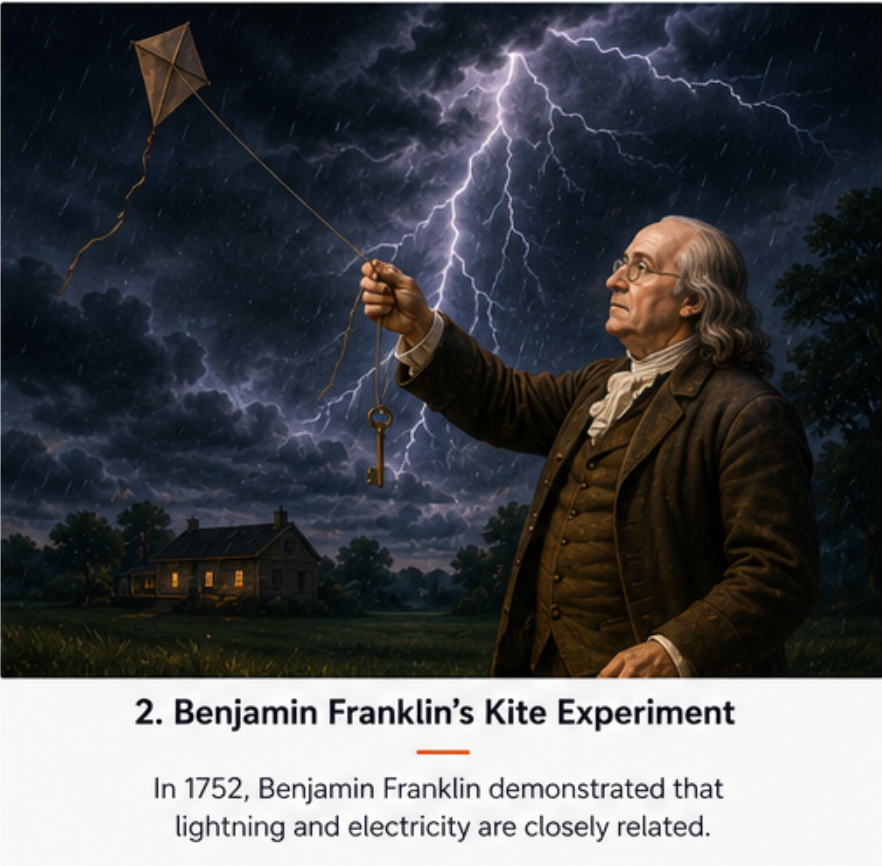
One of the most famous events in electrical history occurred in 1752.
Illustration of Benjamin Franklin’s kite experiment during a thunderstorm
Benjamin Franklin conducted his famous kite experiment to demonstrate that lightning and electricity were related.
The experiment helped establish:
Franklin’s work later contributed to the invention of the lightning rod, one of the earliest practical electrical safety devices.
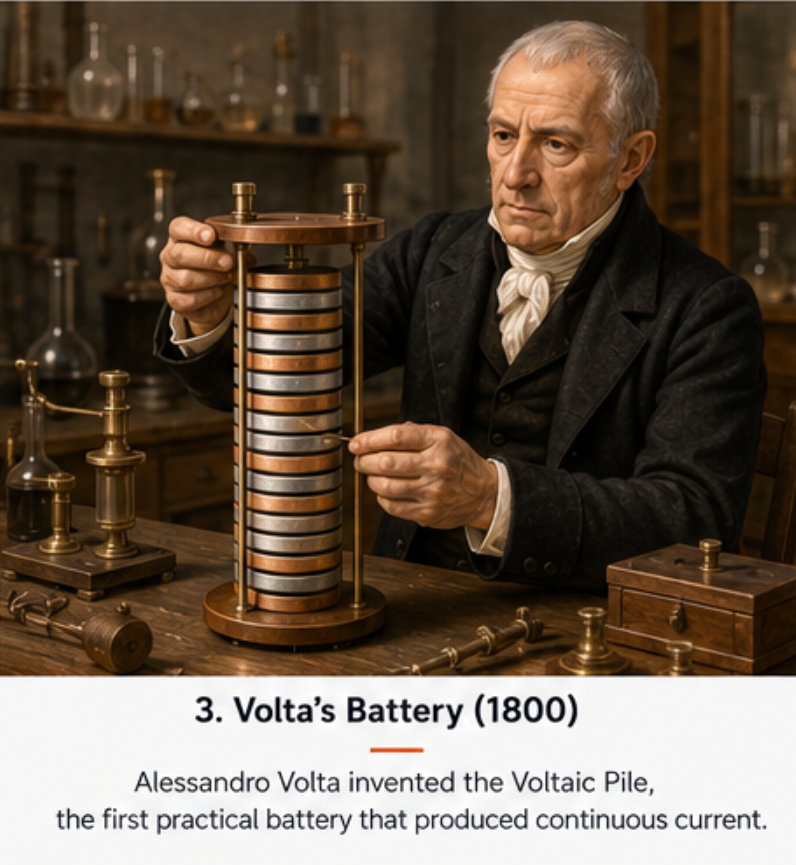
Many historians consider 1800 the most important year in the history of electricity.
That year, Italian physicist Alessandro Volta invented the:
The first practical battery capable of producing continuous electrical current.
Cross-sectional diagram of Volta’s original battery design
Before Volta’s invention, electricity could only be generated briefly through static charge.
The Voltaic Pile allowed scientists to:
For this reason, 1800 is often cited as the closest answer to the question:
“What year was electricity invented?”
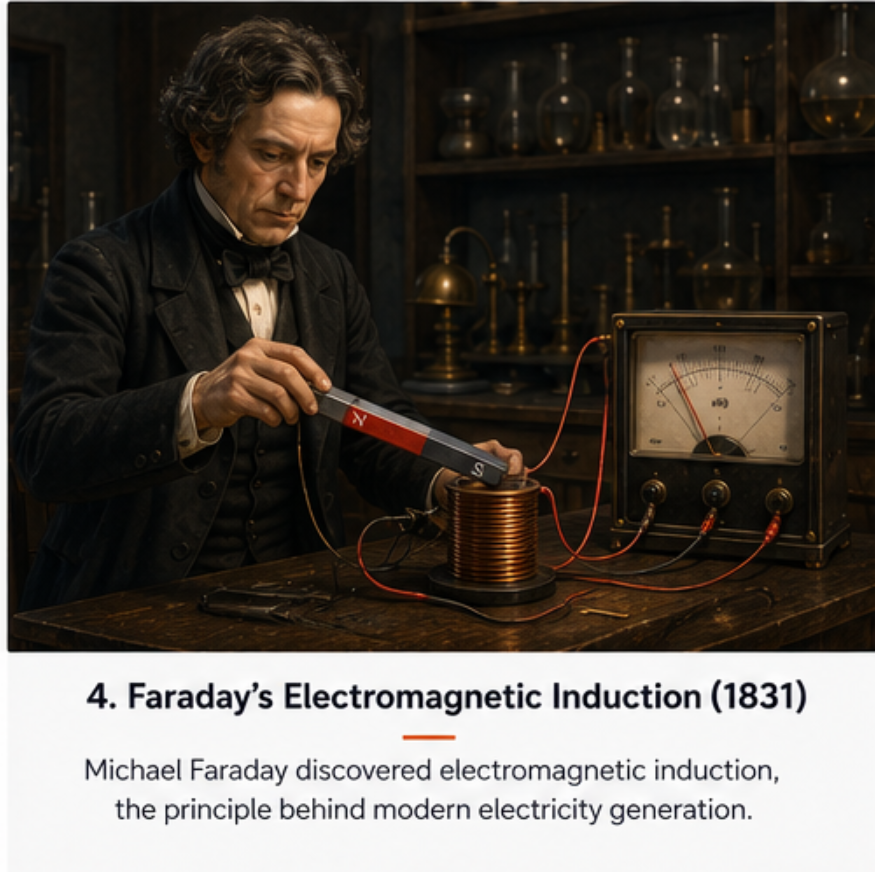
The next major breakthrough occurred in 1831.
British scientist Michael Faraday discovered:
V=-N\frac{d\Phi}{dt}
Faraday demonstrated that moving a magnet through a coil of wire could generate electricity.
This discovery became the foundation of:
Virtually every electrical grid in the world still relies on Faraday’s principle today.
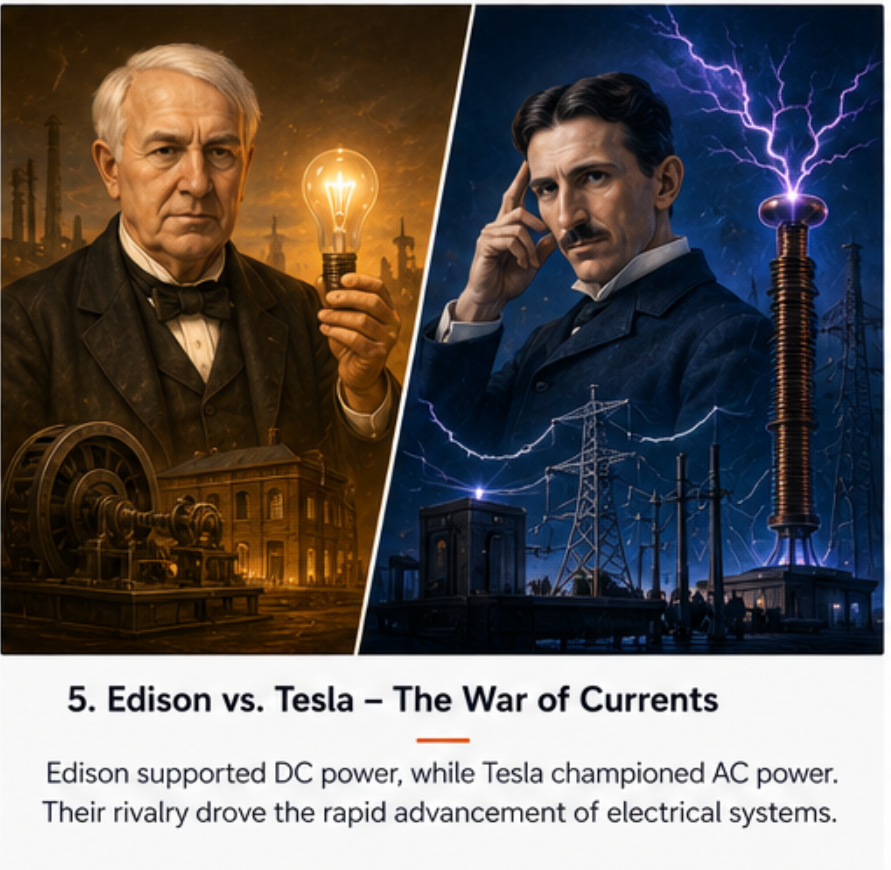
The late nineteenth century transformed electricity from a scientific curiosity into a practical utility.
Thomas Edison developed:
In 1882, Edison opened the first commercial power station in New York City.
Nikola Tesla revolutionized electricity through:
Tesla’s AC system eventually became the global standard for electrical transmission because it allowed power to travel long distances efficiently.
| 年 | Scientist | Contribution |
|---|---|---|
| 600 BC | Thales of Miletus | First observation of static electricity |
| 1600 | William Gilbert | Coined electricus |
| 1752 | Benjamin Franklin | Demonstrated electrical nature of lightning |
| 1800 | Alessandro Volta | Invented first battery |
| 1820 | Hans Christian Ørsted | Linked electricity and magnetism |
| 1831 | Michael Faraday | Discovered electromagnetic induction |
| 1879 | Thomas Edison | Practical incandescent lamp |
| 1882 | Edison | First commercial power station |
| 1888 | Nikola Tesla | AC power system development |
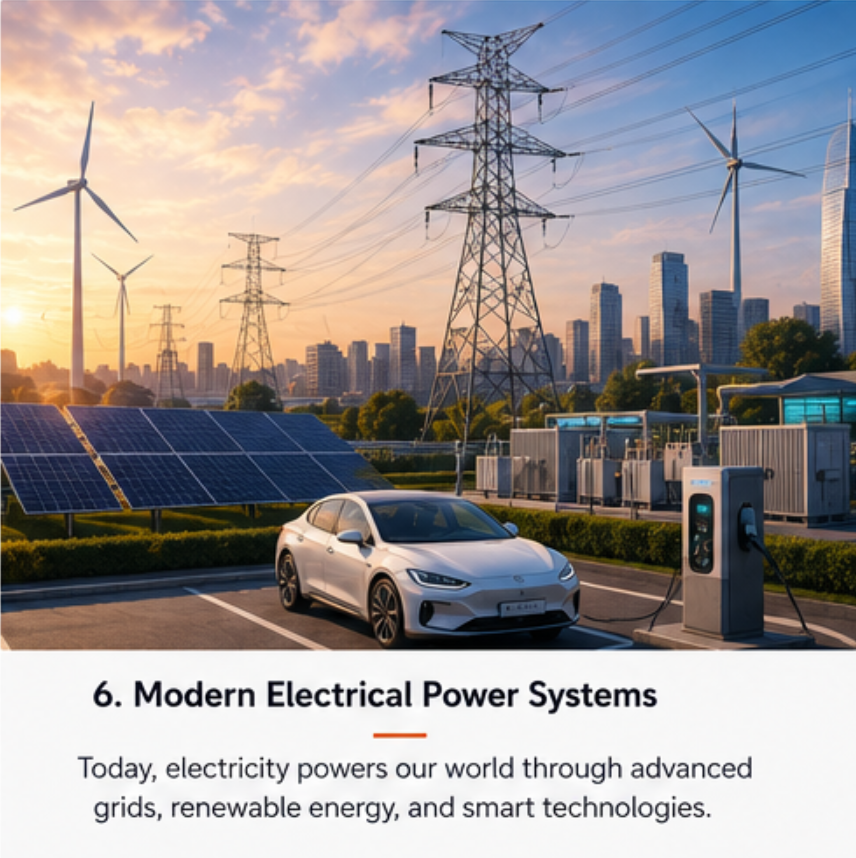
Electricity did not immediately become available after its discovery.
Household electrification spread gradually.
| Period | Development |
|---|---|
| 1880s | Electric lighting introduced in cities |
| 1900s | Early urban electrification |
| 1920s | Increasing residential adoption |
| 1950s | Electricity became common in most developed countries |
| Today | Electricity powers nearly every modern industry |
The growth of electrical infrastructure required:
Electricity became one of humanity’s most important technological achievements because it enabled:
Modern electrical infrastructure supports virtually every sector of the global economy.
そうだ。.
Thomas Edison did not invent electricity.
He developed practical electrical products and distribution systems.
そうだ。.
Franklin studied electricity and proved lightning was electrical in nature.
そうだ。.
Tesla improved electrical generation and transmission technologies but did not invent electricity itself.
No single person invented electricity.
Many scientists contributed to our understanding and use of electricity over centuries.
だから, what year was electricity invented?
The most accurate answer is that electricity was never invented because it is a natural force that already existed in nature.
However, if referring to the first practical method of producing continuous electrical current, 1800 is often considered the key year when Alessandro Volta invented the Voltaic Pile, the world’s first battery.
The development of electricity was a collective achievement involving scientists such as Thales, William Gilbert, Benjamin Franklin, Alessandro Volta, Michael Faraday, Thomas Edison, and Nikola Tesla. Their discoveries transformed electricity from a mysterious natural phenomenon into the foundation of modern civilization.
Electricity was not invented. It is a natural phenomenon. However, 1800 is often cited because Alessandro Volta created the first practical battery.
No single person invented electricity. Many scientists contributed to its discovery and development over centuries.
The earliest recorded observation of electricity dates to around 600 BC when the Greeks observed static electricity using amber.
No. Franklin helped explain electrical phenomena but did not invent electricity.
No. Edison developed practical electrical systems and lighting technologies.
Volta invented the first practical battery in 1800, enabling continuous electrical current and advancing electrical science.

