WengYang Industrial Zone Yueqing Wenzhou 325000
Horas de trabalho
De segunda a sexta-feira: das 7h às 19h
Fim de semana: 10:00 - 17:00
WengYang Industrial Zone Yueqing Wenzhou 325000
Horas de trabalho
De segunda a sexta-feira: das 7h às 19h
Fim de semana: 10:00 - 17:00

Introdução
RCBO (disjuntor de corrente residual com sobrecorrente) - Kuangya seguro e confiável
Os disjuntores de corrente residual (RCCBs) estão entre os dispositivos de segurança mais importantes usados em instalações elétricas modernas. Seu principal objetivo é proteger pessoas e propriedades contra choques elétricos, falhas de fuga à terra e riscos de incêndio causados por falhas de isolamento.
No entanto, nem todos os RCCBs são projetados para detectar o mesmo tipo de corrente de fuga. À medida que os sistemas elétricos se tornam cada vez mais dependentes de eletrônica de potência, inversores de frequência variável (VFDs), carregadores de veículos elétricos, inversores solares e equipamentos de automação industrial, a escolha do tipo correto de RCCB se torna fundamental.
Entre as opções mais comumente discutidas estão Tipo A RCCB e Tipo B RCCB. Embora ambos ofereçam proteção contra corrente residual, seus recursos de detecção diferem significativamente.
A escolha do tipo errado pode resultar em:
Neste guia, explicaremos as diferenças entre os RCCBs Tipo A e Tipo B, seus princípios operacionais, aplicações, vantagens, limitações e critérios de seleção.
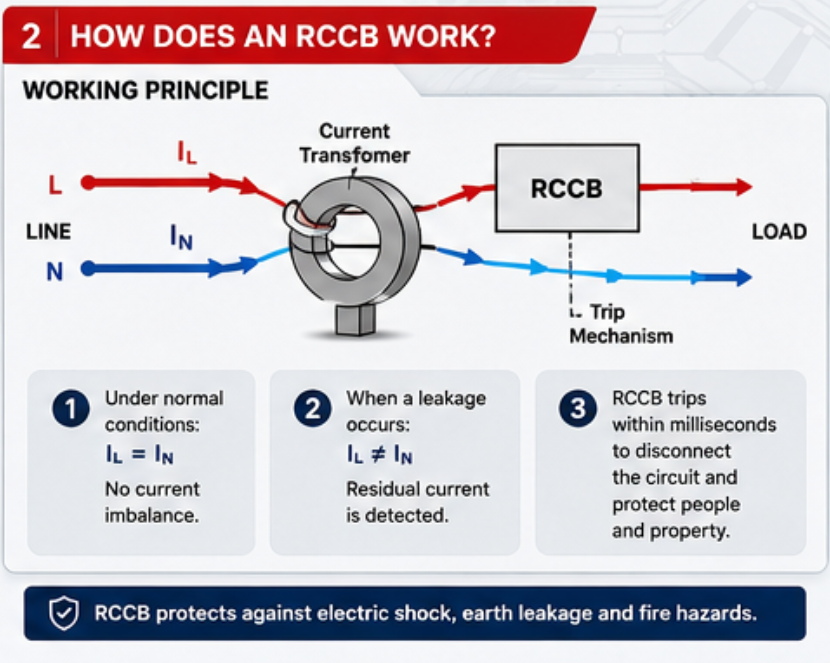
Um RCCB (Residual Current Circuit Breaker, disjuntor de corrente residual) monitora continuamente a corrente que flui pelos condutores vivos e neutros.
Em condições normais:
Entrada atual = Saída atual
Quando ocorrer uma falha de isolamento ou choque elétrico:
Entrada de corrente ≠ Saída de corrente
O RCCB detecta esse desequilíbrio e desconecta o circuito em milissegundos.
Diferentemente dos MCBs, os RCCBs não oferecem proteção contra sobrecarga ou curto-circuito. Portanto, geralmente são instalados junto com um MCB ou integrados em um RCBO.
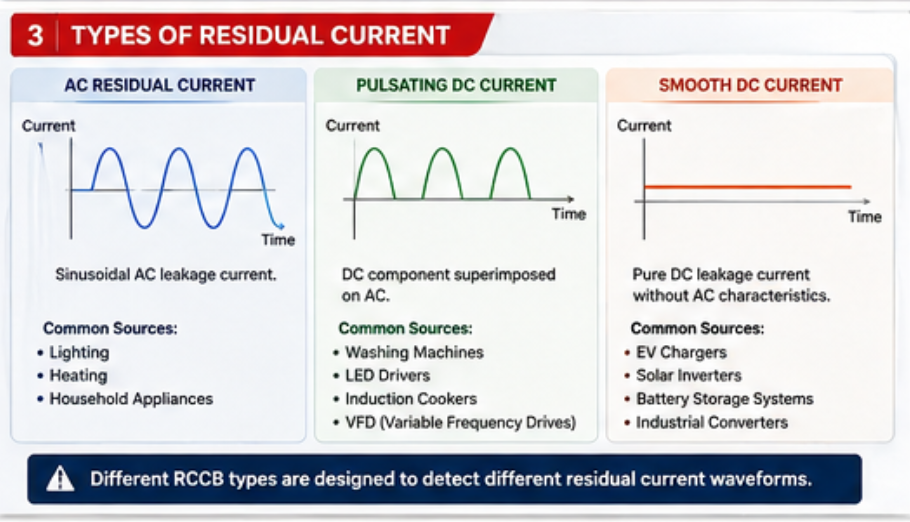
Antes de comparar os RCCBs Tipo A e Tipo B, é importante entender as diferentes formas de corrente residual.
Os equipamentos elétricos modernos podem gerar:
Fuga de corrente alternada senoidal tradicional.
Fontes comuns:
Corrente de fuga que contém um componente CC sobreposto ao CA.
Fontes comuns:
Corrente de fuga CC pura sem características CA.
Fontes comuns:
Diferentes tipos de RCCBs são projetados para detectar diferentes combinações dessas correntes.
RCBO (disjuntor de corrente residual com sobrecorrente) - Kuangya seguro e confiável
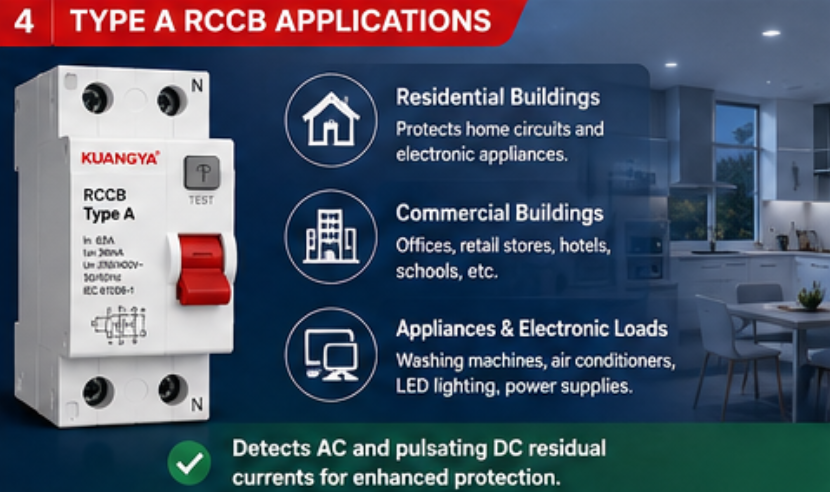
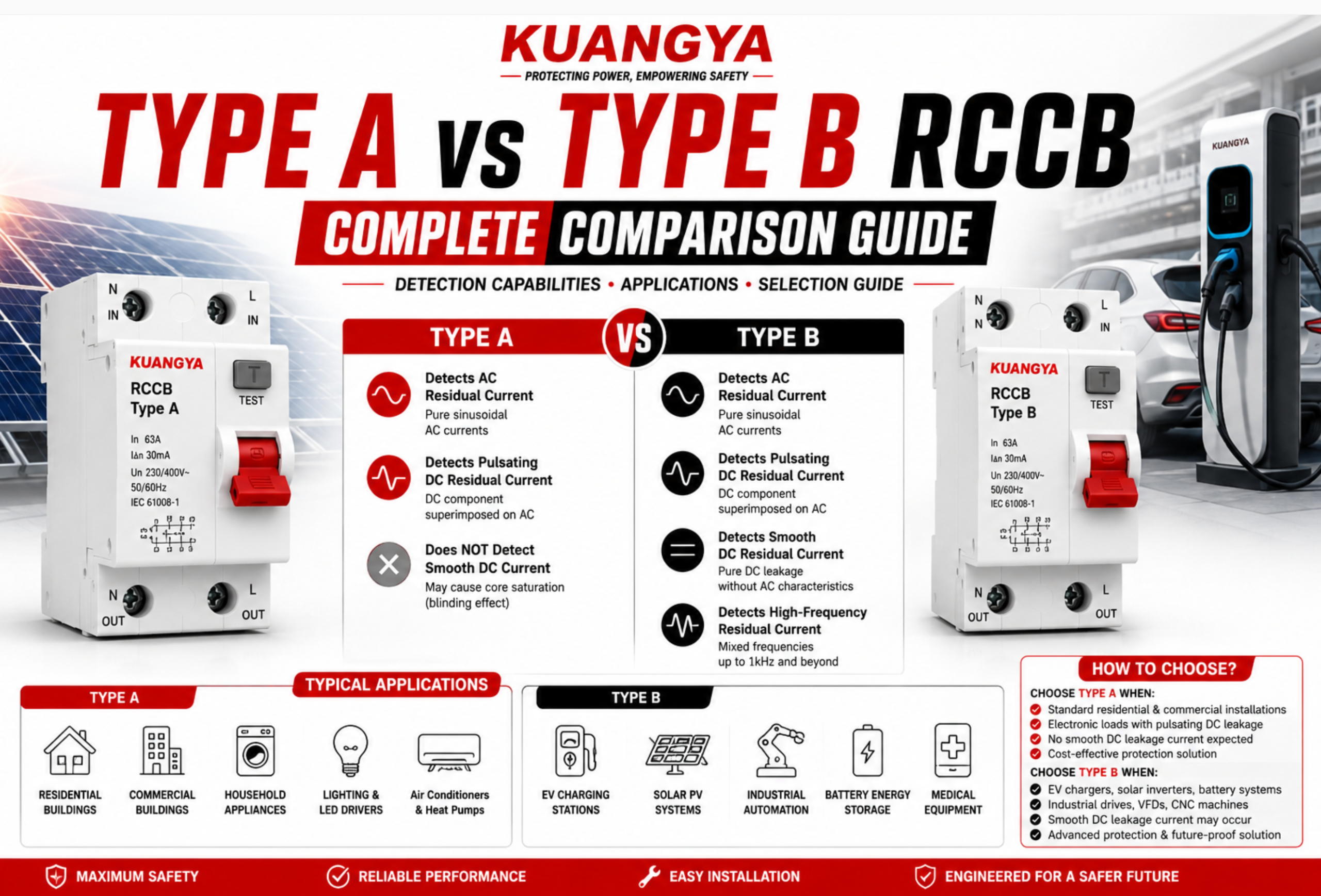
Um RCCB Tipo A pode detectar:
Correntes residuais CA senoidais
Correntes residuais CC pulsantes
Ele oferece proteção aprimorada em comparação com o antigo RCCB tipo AC.
O RCCB tipo A responde a:
Os RCCBs tipo A são amplamente utilizados em:
Detecta correntes de fuga CA e CC pulsantes.
Custo mais baixo em comparação com os RCCBs do tipo B.
Adequado para a maioria das aplicações residenciais e comerciais.
Fácil substituição e manutenção.
Os RCCBs do tipo A não podem detectar de forma confiável:
Nessas aplicações, são necessários RCCBs do tipo B.
RCBO (disjuntor de corrente residual com sobrecorrente) - Kuangya seguro e confiável
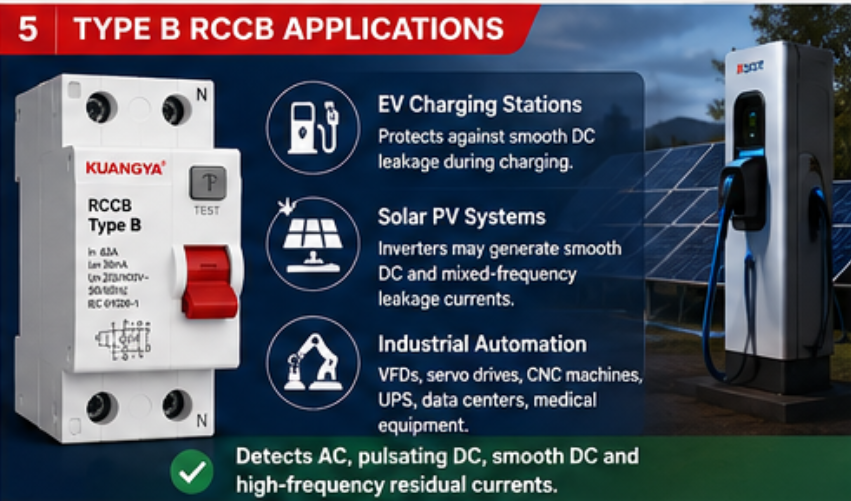
Os RCCBs do tipo B são a categoria mais avançada de RCCBs.
Eles podem detectar:
Correntes residuais CA
Correntes residuais CC pulsantes
Correntes residuais CC suaves
Correntes de fuga de frequência mista
Correntes residuais de alta frequência
Os RCCBs tipo B oferecem proteção contra:
Os RCCBs tipo B são comumente instalados em:
Oferece o mais alto nível de detecção de corrente residual.
Compatível com eletrônicos de potência modernos.
Reduz as falhas de vazamento não detectadas.
Exigido por muitos padrões de carregamento de EV e energia renovável.
Os RCCBs do tipo B são significativamente mais caros.
Pode exigir espaço adicional no painel.
Geralmente requer considerações de design especializadas.
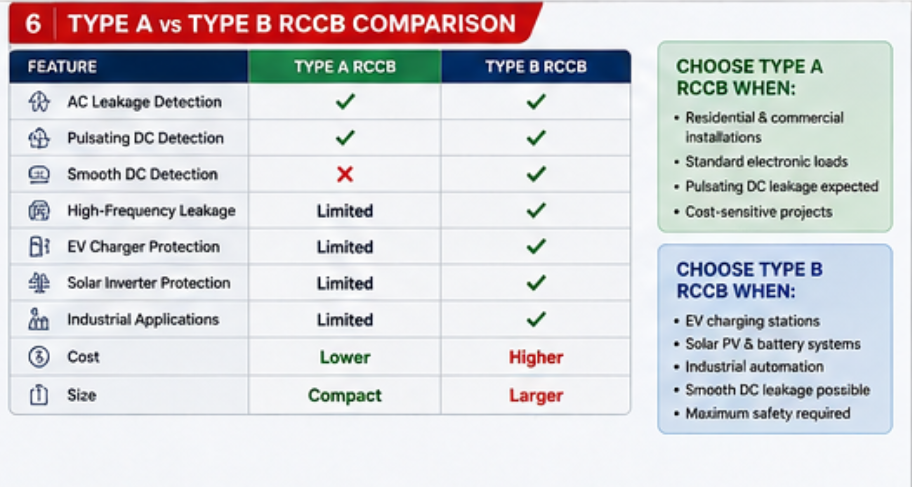
| Recurso | Tipo A RCCB | Tipo B RCCB |
|---|---|---|
| Detecção de vazamento de CA | ✔ | ✔ |
| Detecção de CC pulsante | ✔ | ✔ |
| Detecção suave de CC | ✘ | ✔ |
| Vazamento de alta frequência | Limitada | ✔ |
| Proteção do carregador de EV | Limitada | ✔ |
| Proteção do inversor solar | Limitada | ✔ |
| Acionadores de frequência variável | Limitada | ✔ |
| Uso residencial | ✔ | ✔ |
| Uso industrial | Limitada | ✔ |
| Custo | Inferior | Mais alto |
Os equipamentos eletrônicos modernos geralmente usam retificadores, inversores e fontes de alimentação comutadas.
Esses dispositivos podem gerar correntes de fuga CC suaves.
Um grande problema ocorre quando uma corrente CC suave atinge um RCCB padrão.
O componente CC pode saturar o núcleo magnético do transformador de detecção.
Como resultado:
Esse fenômeno é frequentemente chamado de:
RCCB cego
Os RCCBs do tipo B são projetados especificamente para evitar esse problema.
A maioria das residências modernas contém aparelhos que geram correntes CC pulsantes.
Os exemplos incluem:
Os RCCBs tipo A são geralmente recomendados para instalações residenciais.
Adequado para:
Qualquer aplicação em que possa ocorrer fuga de CC pulsante, mas em que seja improvável uma fuga de CC suave.
Os carregadores de veículos elétricos usam a tecnologia de conversão CA/CC.
Pode ocorrer um vazamento suave de CC durante o carregamento.
Muitos padrões internacionais exigem proteção Tipo B ou monitoramento de CC equivalente.
Os inversores solares geram componentes CC e CA simultaneamente.
As correntes de fuga podem conter:
Os RCCBs tipo B oferecem proteção abrangente.
Os equipamentos industriais geralmente incluem:
Esses dispositivos frequentemente geram correntes de fuga de CC.
Equipamentos médicos críticos exigem detecção confiável de falhas.
Os RCCBs tipo B oferecem maior segurança.
Vários padrões definem os requisitos de desempenho do RCCB.
Especifica os requisitos para RCCBs sem proteção integral contra sobrecorrente.
Define dispositivos avançados de corrente residual, incluindo:
Fornece orientação de instalação para sistemas elétricos de baixa tensão.
Muitos regulamentos de carregamento de EV fazem referência:
Isso geralmente requer RCCBs Tipo B ou monitoramento de falha CC equivalente.
Aplicações residenciais
Edifícios comerciais
Aparelhos eletrônicos padrão
Projetos sensíveis ao custo
Não é esperado nenhum vazamento suave de CC
Estações de carregamento de veículos elétricos
Instalações solares fotovoltaicas
Sistemas de armazenamento de bateria
Automação industrial
Unidades de frequência variável
Equipamentos médicos
Pode ocorrer um vazamento suave de CC
Muitos instaladores ainda usam RCCBs do tipo AC desatualizados.
Isso pode deixar as cargas eletrônicas insuficientemente protegidas.
Os sistemas de carregamento de EV podem gerar correntes de fuga de CC suaves.
Um RCCB Tipo A sozinho pode se tornar ineficaz.
Os fabricantes de equipamentos geralmente especificam o tipo de RCCB necessário.
O não cumprimento das recomendações pode anular as garantias.
Os RCCBs devem ser coordenados com:
A seletividade adequada aumenta a confiabilidade do sistema.
Os sistemas elétricos continuam a evoluir.
As principais tendências incluem:
Milhões de carregadores de veículos elétricos estão sendo instalados em todo o mundo.
A demanda por RCCBs do tipo B continua a aumentar.
As instalações solares residenciais e comerciais exigem proteção avançada.
Os sistemas de automação predial dependem cada vez mais da eletrônica de potência.
As tecnologias de bateria apresentam riscos adicionais de vazamento de CC.
Como resultado, os RCCBs tipo B estão se tornando mais comuns na infraestrutura elétrica moderna.
Não necessariamente.
O tipo B oferece uma proteção mais ampla, mas só é necessário quando podem ocorrer correntes de fuga CC suaves.
Para instalações residenciais padrão, o Tipo A geralmente é suficiente.
Não.
Se for possível um vazamento suave de CC, o Tipo A não poderá fornecer a proteção necessária.
Em muitas instalações, sim.
As regulamentações locais e as especificações do carregador devem ser sempre verificadas.
Os RCCBs tipo B exigem tecnologia de detecção avançada capaz de detectar várias formas de onda e frequências de corrente residual.
Sim, tecnicamente.
No entanto, o custo adicional geralmente é desnecessário para circuitos residenciais comuns.
Compreender as diferenças entre os RCCBs Tipo A e Tipo B é essencial para projetar sistemas elétricos seguros e em conformidade.
Os RCCBs tipo A são ideais para a maioria das aplicações residenciais e comerciais, fornecendo proteção contra correntes de fuga CA e CC pulsantes. Eles oferecem um excelente equilíbrio entre segurança e custo.
Os RCCBs tipo B oferecem o mais alto nível de proteção ao detectar CA, CC pulsante, CC suave e correntes residuais de alta frequência. Eles são indispensáveis para estações de carregamento de veículos elétricos, sistemas de energia solar, automação industrial e outras instalações elétricas avançadas.
À medida que a energia renovável, os veículos elétricos e a eletrônica de potência se tornam cada vez mais comuns, a seleção do tipo correto de RCCB é mais importante do que nunca. Investir no dispositivo de proteção correto garante a segurança elétrica, a conformidade regulatória, a confiabilidade do equipamento e o desempenho do sistema a longo prazo.

