WengYang Industriegebiet Yueqing Wenzhou 325000
Arbeitszeiten
Montag bis Freitag: 7AM - 7PM
Am Wochenende: 10AM - 5PM
WengYang Industriegebiet Yueqing Wenzhou 325000
Arbeitszeiten
Montag bis Freitag: 7AM - 7PM
Am Wochenende: 10AM - 5PM

Einführung
RCBO (Fehlerstromschutzschalter mit Überstrom) | Sicher & Zuverlässig Kuangya
Fehlerstromschutzschalter (RCCBs) gehören zu den wichtigsten Sicherheitseinrichtungen in modernen elektrischen Anlagen. Ihr Hauptzweck ist der Schutz von Menschen und Gütern vor Stromschlägen, Erdschlussfehlern und Brandgefahren aufgrund von Isolationsfehlern.
Allerdings sind nicht alle Fehlerstromschutzschalter dafür ausgelegt, dieselbe Art von Leckstrom zu erkennen. Da elektrische Systeme zunehmend von Leistungselektronik, frequenzvariablen Antrieben (VFDs), EV-Ladegeräten, Solarwechselrichtern und industriellen Automatisierungsgeräten abhängig sind, wird die Wahl des richtigen RCCB-Typs entscheidend.
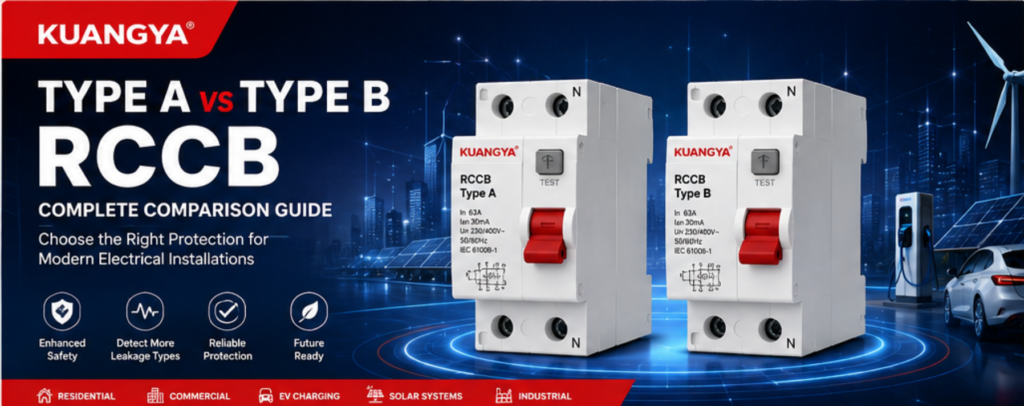
Zu den am häufigsten diskutierten Optionen gehören Typ A RCCB und Typ B RCCB. Beide bieten zwar einen Fehlerstromschutz, ihre Erkennungsmöglichkeiten unterscheiden sich jedoch erheblich.
Die Wahl des falschen Typs kann dazu führen:
In diesem Leitfaden werden die Unterschiede zwischen RCCBs des Typs A und des Typs B, ihre Funktionsprinzipien, Anwendungen, Vorteile, Einschränkungen und Auswahlkriterien erläutert.
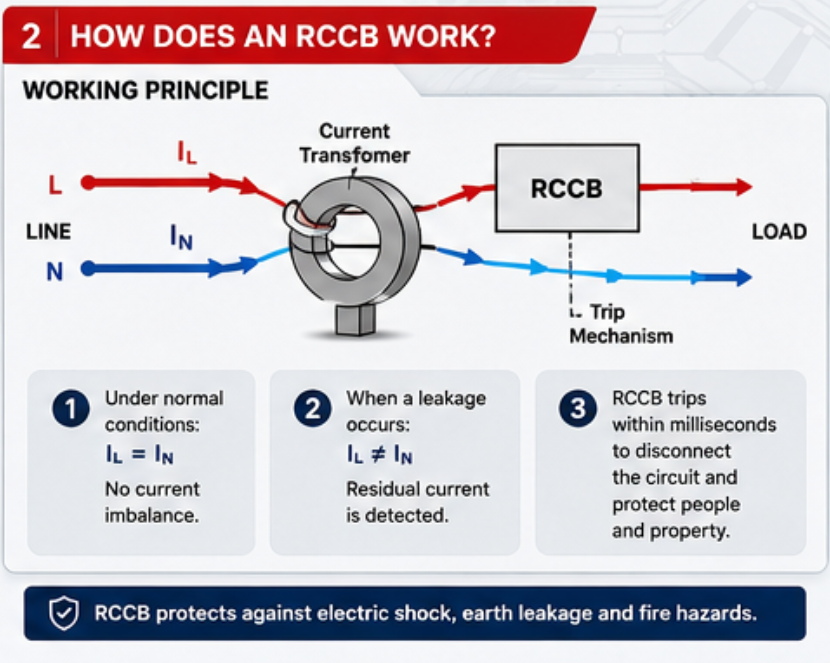
Ein Fehlerstromschutzschalter (RCCB) überwacht kontinuierlich den Strom, der durch stromführende und neutrale Leiter fließt.
Unter normalen Bedingungen:
Stromeingang = Stromausgang
Wenn ein Isolationsfehler oder ein elektrischer Schlag auftritt:
Stromeingang ≠ Stromausgang
Der Fehlerstromschutzschalter erkennt dieses Ungleichgewicht und schaltet den Stromkreis innerhalb von Millisekunden ab.
Im Gegensatz zu MCBs bieten RCCBs keinen Überlast- oder Kurzschlussschutz. Daher werden sie normalerweise zusammen mit einem MCB installiert oder in einen RCBO integriert.
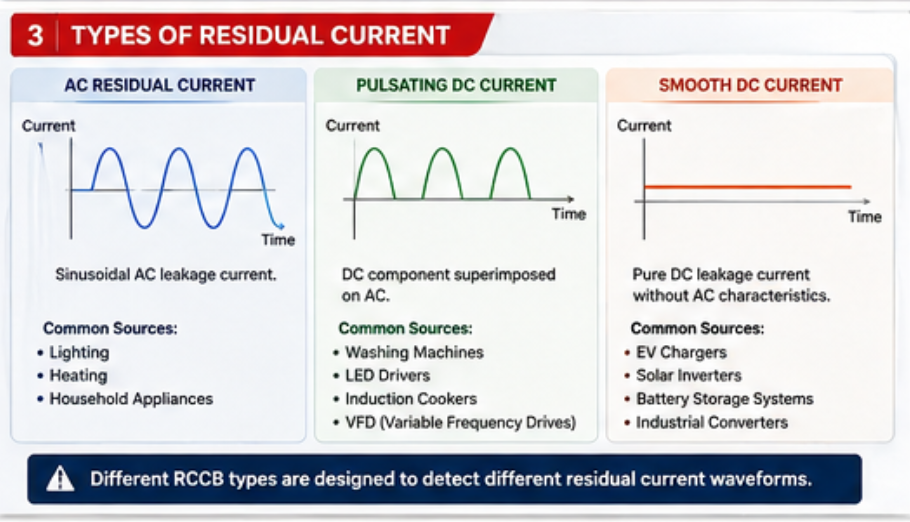
Bevor man RCCBs des Typs A und B vergleicht, ist es wichtig, die verschiedenen Formen des Fehlerstroms zu verstehen.
Moderne Elektrogeräte können Strom erzeugen:
Herkömmliche sinusförmige Wechselstromableitung.
Gemeinsame Quellen:
Ableitstrom, der eine Gleichstromkomponente enthält, die dem Wechselstrom überlagert ist.
Gemeinsame Quellen:
Reiner DC-Ableitstrom ohne AC-Eigenschaften.
Gemeinsame Quellen:
Verschiedene RCCB-Typen sind so konzipiert, dass sie unterschiedliche Kombinationen dieser Ströme erkennen.
RCBO (Fehlerstromschutzschalter mit Überstrom) | Sicher & Zuverlässig Kuangya
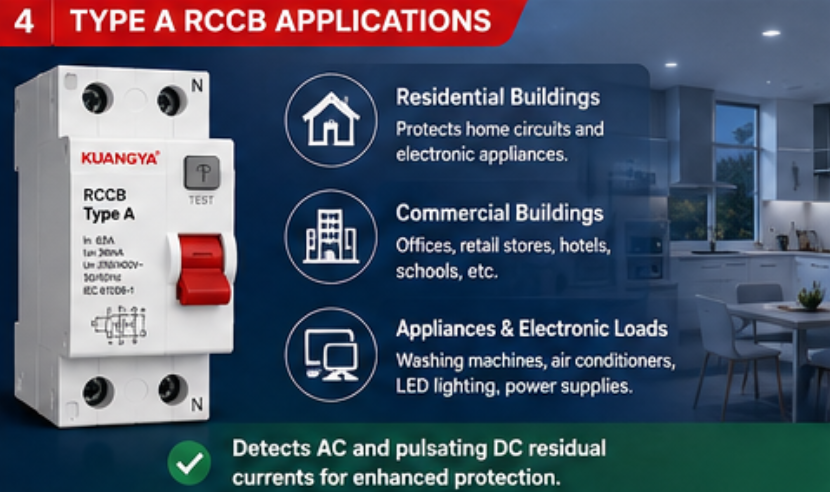
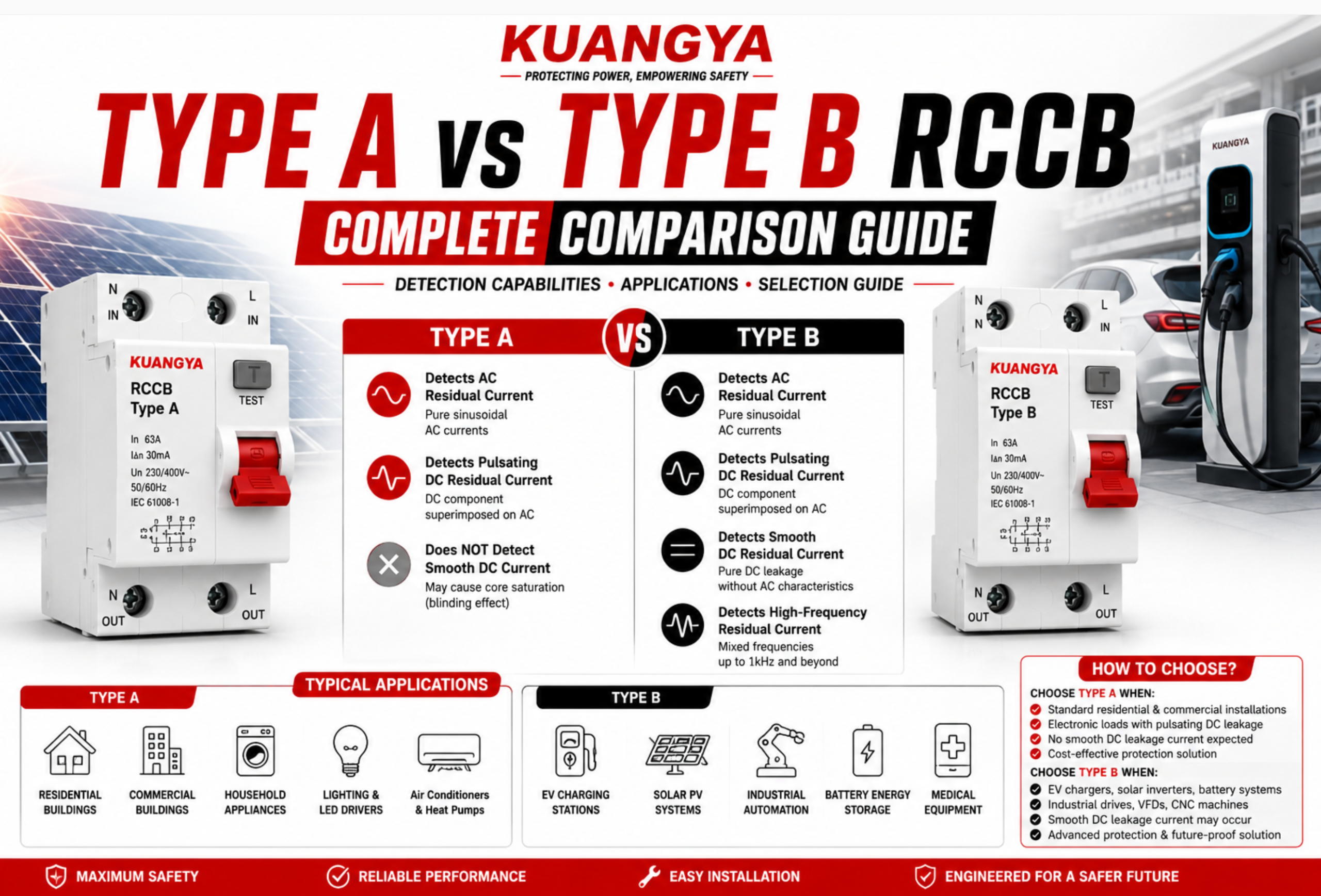
Ein RCCB Typ A kann erkennen:
✔ Sinusförmige AC-Fehlerströme
✔ Pulsierende Gleichfehlerströme
Er bietet einen besseren Schutz als der ältere RCCB vom Typ AC.
Typ A RCCB antwortet auf:
RCCBs vom Typ A sind weit verbreitet in:
Erfasst sowohl AC- als auch pulsierende DC-Leckströme.
Geringere Kosten im Vergleich zu Typ B RCCBs.
Geeignet für die meisten privaten und gewerblichen Anwendungen.
Einfacher Austausch und Wartung.
RCCBs vom Typ A können nicht zuverlässig erkennen:
Für solche Anwendungen sind RCCBs vom Typ B erforderlich.
RCBO (Fehlerstromschutzschalter mit Überstrom) | Sicher & Zuverlässig Kuangya
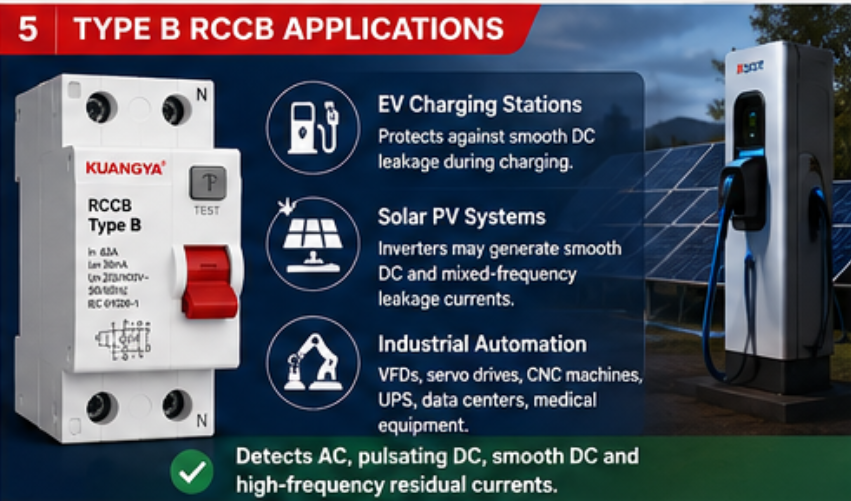
RCCBs vom Typ B sind die fortschrittlichste Kategorie von RCCBs.
Sie können erkennen:
✔ AC-Fehlerströme
✔ Pulsierende Gleichfehlerströme
✔ Glatte DC-Fehlerströme
✔ Mischfrequente Ableitströme
✔ Hochfrequente Fehlerströme
RCCBs vom Typ B bieten Schutz gegen:
RCCBs des Typs B werden in der Regel installiert:
Bietet die höchste Stufe der Fehlerstromerkennung.
Kompatibel mit moderner Leistungselektronik.
Verringert unentdeckte Leckage-Fehler.
Erforderlich für viele Normen zum Laden von Elektrofahrzeugen und für erneuerbare Energien.
RCCBs vom Typ B sind wesentlich teurer.
Kann zusätzlichen Platz auf der Platte erfordern.
Erfordert oft spezielle Designüberlegungen.
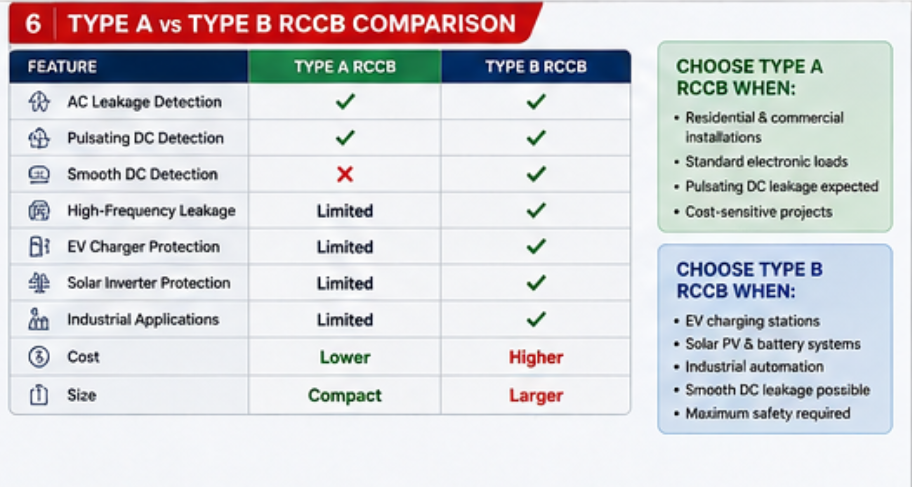
| Merkmal | Typ A RCCB | Typ B RCCB |
|---|---|---|
| AC Leckage-Erkennung | ✔ | ✔ |
| Erkennung von pulsierendem DC | ✔ | ✔ |
| Glatte DC-Erkennung | ✘ | ✔ |
| Hochfrequenz-Leckage | Begrenzt | ✔ |
| Schutz von EV-Ladegeräten | Begrenzt | ✔ |
| Schutz von Solarwechselrichtern | Begrenzt | ✔ |
| Antriebe mit variabler Frequenz | Begrenzt | ✔ |
| Verwendung für Wohnzwecke | ✔ | ✔ |
| Industrielle Nutzung | Begrenzt | ✔ |
| Kosten | Unter | Höher |
Moderne elektronische Geräte verwenden häufig Gleichrichter, Wechselrichter und Schaltnetzteile.
Diese Geräte können glatte Gleichstrom-Ableitströme erzeugen.
Ein großes Problem tritt auf, wenn ein glatter Gleichstrom einen Standard-FCCB erreicht.
Die Gleichstromkomponente kann den Magnetkern des Messwandlers sättigen.
Das Ergebnis ist:
Dieses Phänomen wird häufig genannt:
RCCB-Verblindung
RCCBs des Typs B sind speziell dafür ausgelegt, dieses Problem zu verhindern.
Die meisten modernen Haushalte enthalten Geräte, die pulsierende Gleichströme erzeugen.
Beispiele hierfür sind:
RCCBs des Typs A werden im Allgemeinen für Installationen in Wohngebäuden empfohlen.
Geeignet für:
Jede Anwendung, bei der pulsierende Gleichstromleckagen auftreten können, ein gleichmäßiges Gleichstromleck jedoch unwahrscheinlich ist.
Ladegeräte für Elektrofahrzeuge verwenden eine AC/DC-Umwandlungstechnologie.
Während des Ladevorgangs kann es zu Gleichstromverlusten kommen.
Viele internationale Normen verlangen einen Schutz vom Typ B oder eine gleichwertige Gleichstromüberwachung.
Solarwechselrichter erzeugen gleichzeitig Gleich- und Wechselstromkomponenten.
Leckströme können enthalten sein:
RCCBs vom Typ B bieten umfassenden Schutz.
Zu den industriellen Ausrüstungen gehören häufig:
Diese Geräte erzeugen häufig DC-Leckströme.
Kritische medizinische Geräte erfordern eine zuverlässige Fehlererkennung.
RCCBs vom Typ B bieten mehr Sicherheit.
Mehrere Normen definieren die Leistungsanforderungen an RCCB.
Spezifiziert Anforderungen für RCCBs ohne integrierten Überstromschutz.
Definiert fortschrittliche Fehlerstrom-Schutzeinrichtungen einschließlich:
Bietet eine Installationsanleitung für elektrische Niederspannungsanlagen.
Viele Vorschriften zum Laden von Elektrofahrzeugen verweisen darauf:
Diese erfordern häufig RCCBs vom Typ B oder eine gleichwertige DC-Fehlerüberwachung.
✔ Anwendungen im Wohnbereich
✔ Gewerbliche Gebäude
✔ Elektronische Standardgeräte
✔ Kostensensible Projekte
✔ Keine glatten DC-Leckagen zu erwarten
✔ EV-Ladestationen
✔ PV-Solaranlagen
✔ Batteriespeichersysteme
✔ Industrielle Automatisierung
✔ Antriebe mit variabler Frequenz
✔ Medizinische Ausrüstung
✔ Leichte DC-Leckagen können auftreten
Viele Installateure verwenden immer noch veraltete RCCBs vom Typ AC.
Dadurch können elektronische Lasten unzureichend geschützt sein.
EV-Ladesysteme können glatte DC-Leckströme erzeugen.
Ein RCCB vom Typ A allein kann unwirksam werden.
Die Gerätehersteller geben oft den erforderlichen RCCB-Typ an.
Die Nichteinhaltung der Empfehlungen kann zum Erlöschen der Garantien führen.
RCCBs sollten mit koordiniert werden:
Eine angemessene Selektivität verbessert die Zuverlässigkeit des Systems.
Die elektrischen Systeme entwickeln sich ständig weiter.
Zu den wichtigsten Trends gehören:
Weltweit werden Millionen von Ladestationen für Elektrofahrzeuge installiert.
Die Nachfrage nach RCCBs vom Typ B steigt weiter an.
Solaranlagen für Privathaushalte und Unternehmen erfordern einen fortschrittlichen Schutz.
Gebäudeautomationssysteme basieren zunehmend auf Leistungselektronik.
Batterietechnologien bergen zusätzliche Risiken durch Gleichstromverluste.
Infolgedessen werden RCCBs des Typs B in der modernen elektrischen Infrastruktur immer häufiger eingesetzt.
Nicht unbedingt.
Typ B bietet einen umfassenderen Schutz, ist aber nur erforderlich, wenn glatte Gleichstrom-Ableitströme auftreten können.
Für Standardinstallationen in Wohngebäuden ist der Typ A in der Regel ausreichend.
Nein.
Wenn ein gleichmäßiger Gleichstromabfall möglich ist, kann Typ A nicht den erforderlichen Schutz bieten.
In vielen Installationen, ja.
Örtliche Vorschriften und Spezifikationen des Ladegeräts sollten immer überprüft werden.
RCCBs vom Typ B erfordern eine fortschrittliche Sensortechnologie, die in der Lage ist, mehrere Fehlerstromwellenformen und -frequenzen zu erkennen.
Ja, technisch gesehen.
Bei normalen Haushaltsstromkreisen sind die zusätzlichen Kosten jedoch oft unnötig.
Das Verständnis der Unterschiede zwischen RCCBs des Typs A und des Typs B ist für den Entwurf sicherer und konformer elektrischer Systeme unerlässlich.
Fehlerstromschutzschalter des Typs A eignen sich ideal für die meisten Anwendungen im Wohn- und Gewerbebereich und bieten Schutz gegen Wechsel- und pulsierende Gleichstromableitströme. Sie bieten ein hervorragendes Gleichgewicht zwischen Sicherheit und Kosten.
Fehlerstromschutzschalter des Typs B bieten das höchste Schutzniveau, indem sie Wechselstrom, pulsierenden Gleichstrom, glatten Gleichstrom und hochfrequente Fehlerströme erkennen. Sie sind unverzichtbar für EV-Ladestationen, Solaranlagen, Industrieautomation und andere fortschrittliche elektrische Anlagen.
Mit der zunehmenden Verbreitung von erneuerbaren Energien, Elektrofahrzeugen und Leistungselektronik ist die Auswahl des richtigen FI-Schutzschalters wichtiger denn je. Die Investition in das richtige Schutzgerät gewährleistet die elektrische Sicherheit, die Einhaltung von Vorschriften, die Zuverlässigkeit der Geräte und die langfristige Systemleistung.

