À medida que a adoção de veículos elétricos se acelera globalmente, os instaladores enfrentam uma decisão crítica que afeta diretamente a lucratividade do projeto e a conformidade com a segurança: escolher entre o Tipo A+ (Tipo A com RDC-DD) e o Tipo B RCCB para instalações de carregamento de veículos elétricos. Essa escolha pode significar a diferença entre uma economia de custos de $300-400 ou uma solução com engenharia excessiva que consome suas margens. A confusão decorre da evolução das normas IEC 61851-1 e das variações regionais dos códigos elétricos. Muitos instaladores optam por RCCBs tipo B caros sem entender quando uma solução tipo A+ mais econômica está em perfeita conformidade. Este guia o equipará com o conhecimento técnico e a estrutura de seleção para citar o dispositivo de proteção correto para cada trabalho, maximizando sua vantagem competitiva e mantendo a conformidade total com a segurança.
Entendendo a tecnologia RCD e RCCB para aplicações de EV
O que torna o carregamento de veículos elétricos diferente?
Os Dispositivos de Corrente Residual (RCDs) e os Disjuntores de Corrente Residual (RCCBs) funcionam como a linha de frente de defesa contra choques elétricos e riscos de incêndio, detectando correntes de fuga. No entanto, o carregamento de veículos elétricos apresenta um desafio único que a proteção residencial padrão não consegue enfrentar: Corrente de fuga CC suave. Quando um veículo elétrico é carregado, seu carregador integrado converte a energia da rede CA em corrente CC para o armazenamento da bateria. Sob determinadas condições de falha - especialmente na eletrônica de potência do veículo ou no cabo de carregamento - esse processo de conversão pode fazer com que a corrente CC suave vaze de volta para o circuito CA. Essa contaminação por corrente contínua apresenta dois riscos críticos:
RCD Blinding: Mesmo pequenas quantidades de corrente CC (acima de 6mA) podem saturar o núcleo magnético de um RCD Tipo A padrão, tornando-o incapaz de detectar correntes de fuga CA perigosas. O dispositivo permanece fechado enquanto pensa que tudo está normal, deixando os usuários expostos a riscos de choque elétrico.
Risco de incêndio: Correntes de fuga não detectadas podem causar aquecimento localizado na fiação, quebra do isolamento e possíveis pontos de ignição de incêndio. Os RCDs tipo A tradicionais, comumente encontrados em instalações residenciais, podem detectar correntes CA senoidais e correntes CC pulsantes, mas falham quando confrontados com fugas CC suaves - o tipo exato gerado pela eletrônica de potência do carregador de EV.
RCCB tipo A: a linha de base padrão
Os RCCBs tipo A representam o nível de proteção de base encontrado na maioria das instalações residenciais e comerciais leves modernas. Esses dispositivos podem detectar de forma confiável:
Correntes residuais senoidais de CA: Vazamento padrão de 50/60 Hz devido a isolamento danificado, entrada de umidade ou falhas de aterramento
Correntes residuais CC pulsantes: Correntes retificadas de meia onda com um componente CC sobreposto à CA A proteção do tipo A funciona perfeitamente para aparelhos convencionais, circuitos de iluminação e ferramentas elétricas básicas. Entretanto, seu calcanhar de Aquiles é a corrente CC suave. Quando exposta a um vazamento de CC superior a aproximadamente 6 mA, a bobina de detecção magnética começa a saturar, perdendo progressivamente a sensibilidade a falhas de CA. Acima desse limite, o dispositivo pode não disparar mesmo em um cenário de choque com risco de morte. Principais especificações:
Corrente operacional residual nominal: tipicamente 30 mA para proteção contra choques
Capacidade de detecção: Somente CA + CC pulsante
Resposta de frequência: 50-60Hz otimizada
Posição de custo: Linha de base (opção de menor custo)
Os RCCBs do tipo B representam o padrão ouro em proteção contra corrente residual, capazes de detectar todos os tipos de corrente de falta que o tipo A controla, além disso:
Correntes residuais CC suaves: Fuga de CC pura de conversores eletrônicos de potência
Correntes residuais de CA de alta frequência: Até 1kHz, relevante para acionamentos de frequência variável e eletrônica de potência avançada O dispositivo Tipo B consegue isso por meio de um circuito de detecção sofisticado que monitora os componentes CA e CC de forma independente, evitando a saturação magnética independentemente dos níveis de contaminação CC. Isso o torna imune ao efeito de “cegueira” que compromete os dispositivos Tipo A em aplicações de carregamento de EV. Principais especificações:
Corrente operacional residual nominal: 30mA (padrão para aplicações EV)
Capacidade de detecção: CA + CC pulsante + CC suave + CA de alta frequência
Resposta de frequência: 50Hz a 1kHz
Posição de custo: Premium (normalmente $300-400 a mais do que o Tipo A) Quando o Tipo B é obrigatório:
Carregadores de EV mais antigos (pré-2020) sem detecção de falha de CC integrada
Orçamento de EVSE (equipamento de abastecimento de veículos elétricos) com falta de RDC-DD
Estações comerciais de carregamento rápido acima de 7kW
Instalações em que as especificações do carregador exigem explicitamente o Tipo B
Aplicações com eletrônica de potência trifásica
Tipo A+ (Tipo A com RDC-DD): A solução com custo otimizado
A configuração Tipo A+ representa a abordagem moderna e econômica para a proteção de carregamento de EV. Ela combina:
Tipo A RCCB: Detecção de CA padrão e CC pulsante no quadro de distribuição
RDC-DD (Dispositivo de detecção de corrente contínua residual): Um dispositivo de monitoramento integrado ao carregador de EV que mede continuamente a corrente de fuga de CC O RDC-DD atua como um guardião especializado, monitorando o vazamento suave de CC no próprio carregador. Quando a corrente CC excede 6 mA - o limite em que os RCDs Tipo A começam a perder a eficácia - o RDC-DD desconecta imediatamente o circuito de carga. Isso evita que a contaminação de CC chegue ao RCCB Tipo A a montante, mantendo sua sensibilidade total a falhas de CA. Como funciona a RDC-DD:\ O dispositivo usa um sensor de efeito Hall ou tecnologia similar sensível à CC para medir a corrente diferencial entre os condutores energizados e o terra de proteção. Diferentemente dos RCCBs que dependem do equilíbrio do fluxo magnético, o RDC-DD emprega um sensor eletrônico que não é afetado pela saturação de CC. Quando o limite é excedido, ele aciona um contator ou relé dentro do carregador para isolar o circuito, normalmente dentro de 100 a 300 milissegundos. Principais especificações:
Tipo A RCCB: Padrão 30mA, CA + detecção de CC pulsante
RDC-DD: Limite de detecção de CC de 6 mA (conforme IEC 62955)
Proteção combinada: Equivalente ao Tipo B para falhas específicas de EV
Posição de custo: Média (preço do Tipo A + recurso de carregador integrado) Padrões de conformidade:\ A combinação Tipo A + RDC-DD atende aos requisitos da IEC 61851-1 (atualizada em 2017) para carregamento de EVs no Modo 3, que especifica: “RCD Tipo A, combinado com equipamento apropriado para desconectar a alimentação em caso de correntes de falha de CC superiores a 6 mA.” A maioria das estações de carregamento de Nível 2 modernas fabricadas após 2020 inclui RDC-DD integrado em conformidade com a norma IEC 62955, tornando o Tipo A+ a especificação preferida para instalações residenciais e comerciais leves em mercados como Reino Unido, países nórdicos e China.
Tipo A+ vs. Tipo B: comparação abrangente
Comparação de desempenho técnico
Aspecto de proteção
Tipo A + RDC-DD (Tipo A+)
Tipo B RCCB
Detecção de corrente residual de CA
Proteção total (30mA)
Proteção total (30mA)
Detecção de CC pulsante
Proteção total
Proteção total
Detecção suave de CC
Via RDC-DD (limite de 6 mA)
Via tecnologia de núcleo RCCB
CA de alta frequência (>60 Hz)
Limitado (depende do carregador)
Até 1kHz
Local da detecção
Distribuído (RCCB na placa + RDC-DD no carregador)
Centralizado (no quadro de distribuição)
Tempo de resposta
100-300ms (RDC-DD) + <30ms (RCCB)
<30ms (dispositivo único)
Imunidade ao DC Blinding
O RDC-DD impede que a CC chegue ao RCCB
Imunidade inerente
Proteção contra danos ao cabo
O RCCB protege o cabo de alimentação
O RCCB protege o cabo de alimentação
Dependência do carregador
Requer RDC-DD no carregador
Independente dos recursos do carregador
Análise de custo-benefício
Fator
Tipo A + RDC-DD (Tipo A+)
Tipo B RCCB
Custo RCCB/RCBO
$50-80 (Tipo A)
$350-480 (Tipo B)
Mão de obra de instalação
Padrão (igual ao Tipo A)
Padrão (igual ao Tipo A)
Requisito do carregador
Deve ter a norma IEC 62955 RDC-DD
Compatível com qualquer carregador
Diferença de custo total
Linha de base
+$300-400
Preparado para o futuro
Vinculado à tecnologia do carregador
Compatibilidade universal
Manutenção
O carregador RDC-DD deve permanecer funcional
Dispositivo único para manutenção
Vantagem competitiva
Preço de cotação mais baixo
Posicionamento premium
Vantagens e desvantagens
Tipo A+ (Tipo A com RDC-DD) Vantagens:
Eficiência de custo: Economiza $300-400 por instalação em comparação com o Tipo B, permitindo cotações mais competitivas e mantendo as margens totais
Conformidade regulatória: Atende plenamente aos requisitos da IEC 61851-1 para carregamento no Modo 3 quando o RDC-DD é certificado pela IEC 62955
Ideal para carregadores modernos: Aproveita os recursos de segurança integrados dos equipamentos de carregamento de EV contemporâneos
Economia de espaço: Os RCBOs tipo A são mais compactos, valiosos em quadros de distribuição lotados
Alinhamento de mercado: Solução preferida nos mercados britânico, nórdico e chinês, onde a maioria dos carregadores inclui RDC-DD Desvantagens do tipo A+:
Dependência do carregador: A proteção depende do fato de o RDC-DD permanecer funcional; a falha ou substituição do carregador exige verificação
Verificação necessária: O instalador deve confirmar a presença do RDC-DD e a conformidade com a IEC 62955 na documentação do carregador
Proteção limitada de alta frequência: Pode não detectar falhas de CA de alta frequência acima de 400 Hz (raramente um problema no carregamento de VEs residenciais)
Educação do cliente: Pode ser necessário explicar por que a proteção “mais barata” é igualmente segura Vantagens do RCCB tipo B:
Compatibilidade universal: Funciona com qualquer carregador EV, independentemente dos recursos de proteção incorporados
Proteção de ponto único: Toda a detecção de falhas em um único dispositivo, simplificando a solução de problemas
Preparado para o futuro: Sem dependência da evolução ou substituição da tecnologia do carregador
Detecção abrangente: Lida com todos os tipos de falhas, incluindo CA de alta frequência de eletrônica de potência avançada
Cenários obrigatórios: Necessário para instalações comerciais, carregadores rápidos >7kW e equipamentos mais antigos Desvantagens do tipo B:
Custo do prêmio: $300-400 O custo mais alto do material reduz a competitividade ou a margem de lucro
Maior área de cobertura: Os RCBOs tipo B ocupam mais espaço nos quadros de distribuição
Possível excesso de engenharia: Oferece recursos que vão além do que os carregadores residenciais modernos exigem
Incompatibilidade de mercado: Pode ser desnecessário em regiões onde o Tipo A+ é a prática padrão
Etapa 1: Identificar as especificações do carregador
Antes de cotar qualquer instalação de carregamento de VE, obtenha e verifique a documentação técnica do carregador: Informações críticas a serem extraídas:
Requisitos de proteção especificados pelo fabricante (verifique a seção “Proteção elétrica” ou “Requisitos de RCD” do manual de instalação)
Presença de RDC-DD integrado (procure por “compatível com IEC 62955” ou “detecção de 6mA DC” nas especificações)
Potência nominal do carregador (7kW, 11kW, 22kW, etc.)
Configuração monofásica ou trifásica
Data de fabricação ou geração do modelo (pré-2020 vs. pós-2020) Onde encontrar essas informações:
Seção “Dispositivos de proteção” da folha de dados do produto
Manual de instalação “Requisitos de instalação elétrica”
Declaração de Conformidade (DoC) ou Declaração de Conformidade do Fornecedor (SDoC)
Especificações técnicas do site do fabricante
Etapa 2: Aplicar a matriz de decisão
Use esta lógica de fluxograma para determinar o tipo de proteção correto: COMECE AQUI: Pergunta 1: O carregador exige explicitamente o Tipo B em seu manual de instalação?
SIM → Especifique o tipo B RCCB (nenhuma análise adicional é necessária)
NÃO ou NÃO CLARO → Continuar na pergunta 2 Pergunta 2: O carregador inclui RDC-DD em conformidade com a norma IEC 62955?
SIM (confirmado na documentação) → Continue na pergunta 3
NO ou CANNOT VERIFY → Especifique o tipo B RCCB Pergunta 3: Qual é o tipo de instalação?
Residencial/Comercial leve, ≤7kW, monofásico → Especifique o tipo A + verifique o RDC-DD (Solução do tipo A+)
Comercial, >7kW, ou trifásico → Especifique o tipo B RCCB Pergunta 4: Qual é a idade/geração do carregador?
Carregador moderno pós-2020 → O tipo A+ é ideal
EVSE pré-2020 ou orçamentário → Especifique o tipo B RCCB
Etapa 3: Verificação de conformidade regional
Mercados diferentes têm preferências e requisitos diferentes: Tipo A+ Mercados preferenciais:
Reino Unido (com verificação RDC-DD)
Países nórdicos (Suécia, Noruega, Dinamarca)
China
Austrália (com conformidade com AS/NZS 3000) Mercados comuns do tipo B:
Alemanha (abordagem conservadora)
França (instalações comerciais)
Áustria (padrão OVE E8601)
Itália (instalações trifásicas)
Estados Unidos (requisitos NEC para >3,7kW)
Etapa 4: Documente sua seleção
Para cada orçamento de instalação, inclua: Tipo A+ Especificação:
“40A Tipo A RCBO (ou 2 polos Tipo A RCCB + MCB)”
“Modelo do carregador de EV: [especificar] com IEC 62955 RDC-DD”
“Está em conformidade com os requisitos do Modo 3 da IEC 61851-1” Tipo B Especificação:
“40A Tipo B RCBO (ou 2 polos Tipo B RCCB + MCB)”
“Proteção universal para todos os tipos de carregadores de EV”
“Está em conformidade com as normas IEC 61851-1 e IEC 62423”
Montagem em trilho DIN: 2 módulos de largura Para soluções do tipo B:
CNK-RCBO-B40: 40A Tipo B RCBO, 30mA, capacidade de interrupção de 10kA
Ideal para: Instalações comerciais, carregadores mais antigos, compatibilidade universal
Preço: Nível premium
Montagem em trilho DIN: 4 módulos de largura
CNK-RCCB-B63RCCB tipo B 63A, 30mA (requer MCB separado)
Ideal para: Instalações de alta potência (11kW-22kW), aplicações trifásicas
Preço: Nível premium
Montagem em trilho DIN: 4 módulos de largura Acessórios de instalação:
CNK-MCB-C40: 40A Tipo C MCB (para uso com RCCB autônomo)
CNK-SPD-275: Dispositivo de proteção contra surtos (recomendado para todas as instalações de EV)
CNK-ISO-63: Chave isoladora para acesso de manutenção
Cenários de aplicativos com guias visuais
Cenário 1: Instalação residencial monofásica (7kW) - Solução tipo A
Configuração típica:
Alimentação da rede → Quadro de distribuição principal → RCBO tipo A (40A) → Circuito dedicado para VEs → Carregador moderno para VEs (com RDC-DD) → Veículo
Contexto da instalação:
Casa unifamiliar
Instalação de garagem ou entrada de garagem
Carregador EV moderno (Tesla Wall Connector Gen 3, Wallbox Pulsar Plus, Zappi V2, etc.)
Potência de carregamento de 7kW (32A a 230V)
Carregador fabricado após 2020 com IEC 62955 RDC-DD Configuração de proteção:
Rio acima: 40A Tipo A RCBO no quadro de distribuição principal
Carregador: O RDC-DD integrado monitora o vazamento de CC
Cabo: Cobre de 6 mm² ou 10 mm² (dependendo do comprimento do percurso)
Adicional: Dispositivo de proteção contra surtos (DPS) recomendado Representação visual:
┌─────────────────────────────────────────────────────────────┐
│ QUADRO DE DISTRIBUIÇÃO PRINCIPAL │
│ ┌────────────┐ │
│ │ Tipo A │ 40A, 30mA │
│ │ RCBO │ AC + Detecção de CC pulsante │
│ │ CNK-RCBO-A40│ │
│ └─────┬──────┘ │
└────────┼─────────────────────────────────────────────────────┘
         │
         Passagem de cabo de 6-10 mm²
         │
         ▼
┌─────────────────────────────────────────────────────────────┐
│ CARREGADOR DE VEÍCULOS MODERNO (Pós-2020) │
│ ┌──────────────────────────────────────────────────────┐ │
│ │ RDC-DD integrado (IEC 62955) │ │
│ │ - Monitora continuamente o vazamento de CC │ │ │
│ │ - Desarma no limite de 6 mA DC │ │ │
│ │ - Impede que a CC atinja o RCBO tipo A │ │ │
│ └──────────────────────────────────────────────────────┘ │
│ │
│ [Cabo de carregamento] ──────────► Veículo │
└─────────────────────────────────────────────────────────────┘
CAMADAS DE PROTEÇÃO:
✓ Tipo A RCBO: Falhas de CA, CC pulsante, danos ao cabo
RDC-DD: vazamento suave de CC dos componentes eletrônicos do veículo
Combinado: Equivalente à proteção Tipo B
Detalhamento de custos:
Tipo A RCBO: $60-80
Mão de obra de instalação: $150-200
Cabo e acessórios: $100-150
Custo total da proteção: $310-430 Quando usar esse cenário:
O proprietário quer uma solução econômica
A documentação do carregador confirma a norma IEC 62955 RDC-DD
Aplicação residencial com equipamentos modernos
É necessária uma cotação competitiva
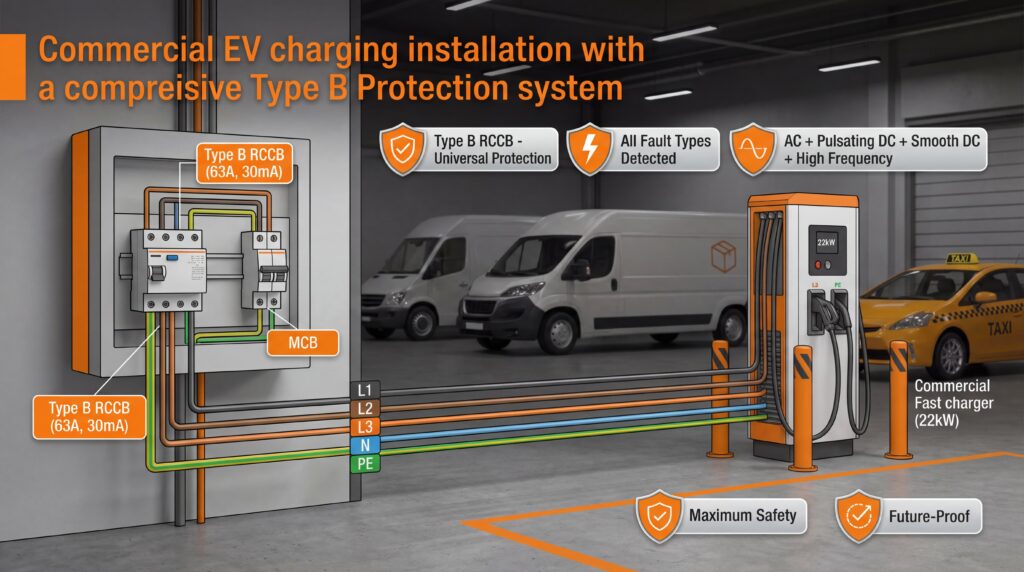
Cenário 2: Instalação comercial trifásica (22kW) - Solução tipo B
Configuração típica:
Alimentação da rede → Quadro de distribuição comercial → RCCB tipo B (63A) + MCB (63A) → Circuito dedicado para VEs → Carregador rápido comercial → Veículo
Contexto da instalação:
Estacionamento comercial, estação de recarga no local de trabalho ou estação de recarga pública
Fonte de alimentação trifásica (400 V)
Capacidade de carregamento rápido de 22 kW
Uso de vários veículos por dia
Pode incluir carregadores mais antigos ou econômicos sem garantia de RDC-DD Configuração de proteção:
Rio acimaRCCB 63A Tipo B + MCB 63A Tipo C no quadro de distribuição
Carregador: Pode ou não ter RDC-DD (o tipo B oferece proteção independente)
Cabo: 10 mm² ou 16 mm² de cobre trifásico + neutro + terra
Adicional: Dispositivo de proteção contra surtos (DPS) obrigatório, chave de isolamento para manutenção Representação visual:
┌─────────────────────────────────────────────────────────────┐
│ QUADRO DE DISTRIBUIÇÃO COMERCIAL │
│ ┌────────────┐ ┌────────────┐ │
│ │ Tipo B │ │ Tipo C │ 63A │
│ │ RCCB │ │ MCB │ Trifásico │
│ │ CNK-RCCB-B63│ │ CNK-MCB-C63│ │
│ │ 30mA │ │ │ │ │
│ └─────┬──────┘ └─────┬──────┘ │
└────────┼───────────────┼─────────────────────────────────────┘
         │ │
         L1, L2, L3, N, PE (10-16mm²)
         │
         ▼
┌─────────────────────────────────────────────────────────────┐
│ CARREGADOR RÁPIDO COMERCIAL (22kW) │
│ ┌──────────────────────────────────────────────────────┐ │
│ │ Tipo B RCCB Fornece:                               │ │
│ │ ✓ Detecção de corrente residual CA │ │ │
│ │ ✓ Detecção de CC pulsante │ │
│ │ ✓ Detecção de CC suave (independente do carregador) │ │
│ │ ✓ Detecção de CA de alta frequência (até 1kHz) │ │
│ └──────────────────────────────────────────────────────┘ │
│ │
│ [Cabo de carregamento] ──────────► Veículo comercial │
│ (frota, táxi, público) │
└─────────────────────────────────────────────────────────────┘
CAMADAS DE PROTEÇÃO:
✓ RCCB tipo B: Todos os tipos de falha, incluindo CC suave
MCB: proteção contra sobrecarga e curto-circuito
Independente: Não depende dos recursos do carregador
Universal: Compatível com qualquer tipo de carregador
Detalhamento de custos:
Tipo B RCCB: $350-450
MCB tipo C: $40-60
Mão de obra de instalação: $250-350
Cabo e acessórios: $200-300
Chave de isolamento: $80-120
Custo total da proteção: $920-1.280 Quando usar esse cenário:
Aplicativo de cobrança comercial ou público
Instalação trifásica de alta potência (>7kW)
Vários carregadores ou modelos de carregadores futuros desconhecidos
Máxima segurança e conformidade necessárias
O orçamento permite a proteção premium
Perguntas frequentes (FAQs)
Perguntas frequentes 1: Posso usar um RCBO tipo A se o cliente substituir posteriormente o carregador de EV por um modelo diferente?
Resposta: Essa é uma consideração fundamental que muitos instaladores não levam em conta. Se você instalar um RCBO Tipo A com base no carregador original com RDC-DD e o cliente substituí-lo posteriormente por um carregador que não tenha esse recurso, a instalação não atenderá mais aos requisitos de segurança da IEC 61851-1. Recomendações de melhores práticas:
Documentar a dependência: Em seu certificado de instalação e na documentação de entrega, declare claramente: “A proteção do tipo A está em conformidade somente quando usada com o modelo de carregador de EV [especificar] ou equivalente com IEC 62955 RDC-DD. Os carregadores de reposição devem manter essa especificação.”
Educar o cliente: Explique que o RCBO tipo A faz parte de um sistema de proteção que inclui o RDC-DD do carregador. Se eles atualizarem ou substituírem o carregador, deverão verificar se a nova unidade tem detecção de falha CC equivalente.
Considere a possibilidade de se preparar para o futuro: Para clientes que expressam incerteza sobre a escolha do carregador de longo prazo, recomende o RCBO tipo B, apesar do custo mais alto. Enquadre essa recomendação como uma “proteção ao investimento” que elimina preocupações com compatibilidade futura.
Oferecer caminho de upgrade: Cite as duas opções - Tipo A+ para a configuração atual e Tipo B para proteção à prova de futuro - permitindo que o cliente decida com base em seu uso e orçamento previstos. Cenário do mundo real: Um proprietário instala um Tesla Wall Connector Gen 3 (que tem RDC-DD) com proteção Tipo A. Três anos depois, ele vende a casa. O novo proprietário quer instalar uma marca diferente de carregador que não tem RDC-DD. O eletricista deve verificar se o novo carregador tem RDC-DD ou atualizar o RCBO para o Tipo B - um custo inesperado que gera insatisfação do cliente. Proteção do instalador: Alguns instaladores incluem uma cláusula em seu contrato: “A proteção elétrica foi projetada para o modelo de carregador de EV especificado. A substituição ou modificação do carregador pode exigir a atualização do dispositivo de proteção a um custo adicional.” Isso gerencia as expectativas e protege contra a responsabilidade.
Perguntas frequentes 2: O que devo fazer se a documentação do carregador não indicar claramente se ele tem RDC-DD?
Resposta: Uma documentação ambígua ou incompleta é frustrantemente comum, especialmente em carregadores econômicos ou de marcas internacionais. Nunca presuma que um carregador tenha RDC-DD se isso não estiver explicitamente declarado - os riscos de segurança e de responsabilidade legal são muito altos. Processo de verificação passo a passo: Etapa 1: Verifique várias fontes de documentação
Folha de dados do produto (procure por “IEC 62955”, “RDC-DD”, “6mA DC detection” ou “DC fault current monitoring”)
Manual de instalação (seção de requisitos de proteção elétrica)
Declaração de Conformidade do Fornecedor (SDoC) ou Declaração CE
Especificações técnicas do site do fabricante Etapa 2: Entre em contato com o fabricante ou fornecedor\ Se a documentação não estiver clara, envie um e-mail ou ligue para a equipe de suporte técnico com esta pergunta específica: “O [número do modelo] inclui um dispositivo integrado de detecção de corrente contínua residual (RDC-DD) em conformidade com a norma IEC 62955? Você pode fornecer uma confirmação por escrito?” Solicite uma resposta por escrito (e-mail é suficiente) que possa ser guardada com os registros da instalação. Isso o protegerá se houver uma auditoria de conformidade ou investigação de incidente. Etapa 3: Verifique os indicadores físicos\ Alguns carregadores têm um botão de teste rotulado como “Teste de CC” ou “Teste de RDC-DD” separado do botão principal de teste de RCD. Essa presença física sugere a integração RDC-DD, embora não seja uma prova definitiva da conformidade com a IEC 62955. Etapa 4: Padrão para o tipo B se não houver certeza\ Quando não for possível obter uma confirmação clara em um prazo razoável (48 a 72 horas), a abordagem segura e em conformidade é especificar o RCCB Tipo B. Documente sua decisão: “Tipo B especificado devido à incapacidade de verificar a conformidade com RDC-DD no modelo de carregador [X].” Gerenciamento de custos: Se o cliente recusar o custo do Tipo B, explique: “Só podemos usar a proteção Tipo A, mais econômica, quando o fabricante do carregador confirmar que ele tem o recurso de detecção de CC necessário. Sem essa confirmação, os regulamentos exigem o Tipo B para sua segurança.” Sinais de alerta que sugerem a ausência de RDC-DD:
Carregador fabricado antes de 2018
Preço extremamente baixo (<$300 para unidade de 7kW)
Não há menção à IEC 62955 em nenhuma parte da documentação
Marca genérica ou de marca branca com especificações técnicas mínimas
O site do fabricante não contém informações técnicas detalhadas Abordagem alternativa: Alguns instaladores mantêm uma “lista de carregadores verificados” de modelos que confirmaram ter RDC-DD, simplificando futuras cotações. Os modelos verificados mais populares incluem Tesla Wall Connector Gen 3, Wallbox Pulsar Plus/Max, Zappi V2, Easee One e Ohme Home Pro.
Conclusão: Fazendo a escolha certa para obter lucro e segurança
A decisão entre a proteção RCCB Tipo A+ e Tipo B não é meramente técnica - é uma escolha comercial estratégica que afeta sua competitividade, lucratividade e reputação profissional. Ao compreender os recursos distintos de cada tipo de proteção e aplicar a estrutura de seleção sistemática da cnkuangya.com, você pode cotar com segurança a solução ideal para cada instalação de carregamento de EV. Principais conclusões para os instaladores:
O tipo A+ é sua vantagem competitiva para instalações residenciais com carregadores modernos - economizando $300-400 por trabalho e mantendo total conformidade e segurança.
O tipo B é seu escudo de responsabilidade para aplicações comerciais, instalações de alta potência e cenários em que as especificações do carregador são incertas.
Sempre verifique a RDC-DD antes de especificar a documentação do Tipo A é sua proteção contra futuros problemas de responsabilidade e conformidade.
Eduque seus clientes no sistema de proteção como um todo, não apenas em componentes individuais, criando confiança e justificando suas recomendações.
Os padrões regionais são importantes-Alinhe suas especificações com as práticas do mercado local e as expectativas regulatórias. O mercado de carregamento de veículos elétricos só crescerá nos próximos anos, e os instaladores que dominarem essas nuances técnicas capturarão mais projetos, manterão margens mais saudáveis e construirão reputações como profissionais experientes. Independentemente de você escolher o Tipo A+ para otimizar os custos ou o Tipo B para obter compatibilidade universal, o fator crítico é tomar uma decisão informada e documentada com base nos requisitos específicos da instalação.
Para obter mais orientações técnicas, especificações de produtos e suporte à instalação, acesse cnkuangya.com ou entre em contato com nossa equipe técnica para obter consultoria específica para o projeto.
Sobre a CNKuangya: Fabricante líder de dispositivos de proteção elétrica para infraestrutura de carregamento de veículos elétricos, oferecendo soluções abrangentes de RCCB/RCBO Tipo A e Tipo B com total conformidade com a IEC e suporte técnico para instaladores em todo o mundo.
elaine
Chefe de Marketing da Kuangya, com foco na promoção global de soluções de proteção elétrica e distribuição de energia.● Áreas principais: Construção de marca nos mercados de energia fotovoltaica, armazenamento de energia e energia industrial.Produtos profissionais: Fusíveis, dispositivos de proteção contra surtos (SPD), disjuntores miniatura (MCB) e chaves de transferência.Proposta de valor: Servir o mercado global de energia renovável com "Segurança, Confiabilidade e Inovação" como nossos pilares. Seja bem-vindo para se conectar e colaborar para avançarmos juntos no progresso da tecnologia de distribuição inteligente de energia.