温州市岳陽工業区 325000
勤務時間
月曜日~金曜日:午前7時~午後7時
週末午前10時~午後5時
温州市岳陽工業区 325000
勤務時間
月曜日~金曜日:午前7時~午後7時
週末午前10時~午後5時


The RCD itself is only one part of an EV charger protection budget. A low device price can become an expensive installation after adding the MCB, enclosure space, contactor, DC residual-current detection, labour, testing and future replacement work. The correct comparison is the total installed cost of the protection system.
クイックアンサー: Type A or Type F with a compliant 6 mA RDC-DD is often the lower-cost option when the charger already includes the RDC-DD and its manufacturer permits that arrangement. Type B usually has a higher device cost but can reduce dependence on the charger’s internal DC-detection system. The cheapest compliant option depends on the exact EVSE, local rules and distribution-board design.
| Cost item | Type A/F + 6 mA RDC-DD | Type B RCD |
|---|---|---|
| Residual-current device | Usually lower device cost | Usually higher device cost |
| 6 mA DC detection | Must be integrated into or correctly combined with the EVSE | Handled by the Type B RCD characteristics |
| 過電流保護 | MCB/fuse or suitable RCBO still required | MCB/fuse or suitable Type B RCBO still required |
| Switching device | May depend on the RDC-DD design and EVSE contactor | Normally independent of the EVSE’s RDC-DD |
| Board space | Often compact when using a suitable RCBO | May require more modules depending on product |
| Verification | Confirm IEC 62955 RDC-DD and charger compatibility | Confirm Type B characteristics and charger instructions |
| Future charger replacement | New EVSE must retain the required DC-detection arrangement | Usually less dependent on EVSE DC-detection features |
Do not compare a Type A RCCB price with a Type B RCBO price. An RCCB does not include overload and short-circuit protection, while an RCBO does. Normalize the function, poles, current rating, sensitivity, certification and commercial terms before comparing quotations.
Total protection cost = RCD or RCBO + overcurrent protection + DC detection + switching hardware + enclosure space + installation labour + testing + documentation + expected maintenance.
| Budget input | Information required |
|---|---|
| Charger | Model, charging mode, power, phases and installation manual |
| 直流保護 | Built-in RDC-DD, standard, trip method and self-monitoring |
| さいせつぞく | Type, poles, In and IΔn |
| 過電流保護 | MCB/fuse/RCBO curve, rating and breaking capacity |
| インストール | Cable route, board capacity, enclosure and labour rate |
| コンプライアンス | Local wiring rules, inspection, test records and certificates |
| コマーシャル | VAT, freight, distributor margin, warranty and replacement lead time |
The following bands show how to structure a quotation; they are not universal market prices. Labour, brand, country, tax, charger design and ratings can change the result substantially. Replace each allowance with a current supplier or contractor quotation.
| シナリオ | Protection arrangement | Cost position | Main reason |
|---|---|---|---|
| Home wallbox with verified IEC 62955 RDC-DD | Type A or Type F RCD/RCBO as permitted | Lower to medium | The charger already supplies the 6 mA DC-detection function |
| Home wallbox without verified RDC-DD | Type B RCD plus overcurrent protection, or Type B RCBO | より高い | Smooth-DC-sensitive protection is provided externally |
| Three-phase 11–22 kW AC charger with RDC-DD | Approved Type A/F arrangement may be possible | ミディアム | Four-pole equipment and board work increase cost |
| Three-phase charger without suitable DC detection | Type B solution | より高い | Four-pole Type B device and coordination requirements |
| Multiple charging points | Individual feeder protection plus coordinated upstream design | Project-specific | Leakage, selectivity, load management and downtime dominate cost |
| Existing crowded distribution board | Compact compliant solution or board upgrade | Potentially high | Enclosure modification and labour can exceed the RCD price difference |
An RDC-DD conforming to IEC 62955 detects the DC residual-current condition associated with Mode 3 charging and initiates disconnection through the appropriate switching arrangement. When that function is already included in the EVSE, the external protective device can often be Type A or Type F if the manufacturer and local rules permit it.
The saving is real only when the RDC-DD is documented and the complete arrangement is compliant. “6 mA DC detection” in marketing text is not enough; check the installation manual, declared standard and disconnection method.
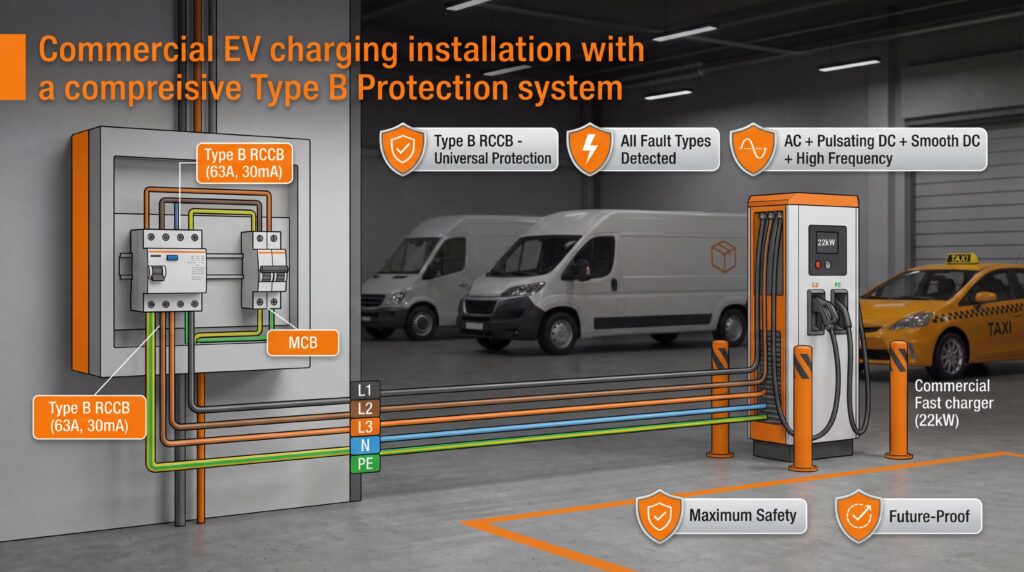
A タイプB RCCB responds to the residual-current waveforms specified for Type B, including smooth DC. It can be the more economical whole-life choice when the charger lacks a compliant RDC-DD, the documentation is unclear, the manufacturer requires Type B, or future charger replacement flexibility has a high value.
Type B is not automatically required because a charger is three-phase, commercial or rated above 7 kW. Determine the requirement from the EVSE design, possible residual-current waveform, manufacturer instructions and local rules.
A quote that omits the MCB, enclosure work, cable, glands, isolator, testing and documentation will look competitive but can lose money during installation.
If the EVSE documentation does not confirm compliant DC detection, the low-cost Type A design may need to be changed after the quote has been accepted.
A Type A RCBO and a Type B RCCB are not functionally identical. Add the separate overcurrent device and installation space to the RCCB side before comparing totals.
Online prices may exclude VAT, freight, accessories or the required certification. Use dated model-specific quotations and state how long the price is valid.
A Type A design that depends on the original charger’s RDC-DD must be reviewed if that EVSE is replaced. Include this dependency in handover documents and maintenance instructions.
| Arrangement | Hardware cost | Installation cost | Best use |
|---|---|---|---|
| Type A RCCB + MCB + EVSE RDC-DD | Usually low to medium | More wiring and modules than one RCBO | EVSE has documented RDC-DD and grouped arrangement is suitable |
| Type A RCBO + EVSE RDC-DD | Usually medium | Often compact and simple per circuit | Dedicated final circuit with documented RDC-DD |
| Type B RCCB + MCB | Usually high | Separate devices and coordination required | Type B required and separate overcurrent protection preferred |
| タイプB RCBO | Usually highest unit price | Can simplify individual-circuit protection | Compact integrated solution where available and specified |
See the separate Type B versus Type A + RDC-DD technical guide for waveform and standards detail. This article focuses on budgeting and procurement.
| ステップ | 質問 | Commercial impact |
|---|---|---|
| 1 | What does the EVSE installation manual require? | Prevents redesign and unpriced hardware |
| 2 | Is a 6 mA RDC-DD declared to IEC 62955? | Determines whether a Type A/F option may be available |
| 3 | RCCB or RCBO, and what separate MCB is needed? | Normalizes hardware and labour cost |
| 4 | Is there enough distribution-board space? | Identifies enclosure or board upgrade cost |
| 5 | What inspection and documentation are required? | Adds commissioning time and test records |
| 6 | Could the customer replace the charger later? | Supports a future-compatibility option in the quote |
| 7 | What do local rules require? | Avoids non-compliant low bids |
There is no universal price. Poles, current, sensitivity, brand, certification, market, tax and quantity all matter. Request a current model-specific quotation and compare the complete installed system.
It is often cheaper when the charger already contains a compliant RDC-DD. If an external detector, contactor, extra wiring or board work is needed, the cost advantage can shrink or disappear.
Possibly, if the EVSE manufacturer and local rules permit it and the DC detection is suitable. Verify the IEC 62955 documentation and the complete protection arrangement.
No automatic rule follows from power or phase count alone. Check the charger’s residual-current protection, manufacturer instructions and applicable regulations.
Reassess the protection design. A Type A/F arrangement can depend on the original EVSE’s RDC-DD, so the replacement charger must provide an equivalent approved function or the RCD arrangement may need upgrading.
An RCCB needs separate overcurrent protection. An RCBO integrates residual-current, overload and short-circuit protection. Compare device cost, board space, wiring and fault localisation.
Use verified charger features, avoid duplicated functions, size devices correctly, standardise models, order efficiently and compare landed costs. Never downgrade the required RCD type or sensitivity to meet a price target.
List the exact EVSE model, RCD/RCBO type and ratings, dependency on an RDC-DD, included labour and tests, exclusions, price validity and the condition that charger replacement requires review.
The most profitable compliant quote is not automatically the one with the cheapest RCD. It is the quote that includes every required component, documents the EVSE dependency and avoids redesign. For current RCCB そして アールシーボ options or a project quotation, これらの詳細を持ってKUANGYAに連絡し with the charger model, ratings, quantity and destination.

