웽양 공업구 웨칭 원저우 325000
근무 시간
월요일~금요일: 오전 7시~오후 7시
주말: 주말: 오전 10시 - 오후 5시
웽양 공업구 웨칭 원저우 325000
근무 시간
월요일~금요일: 오전 7시~오후 7시
주말: 주말: 오전 10시 - 오후 5시

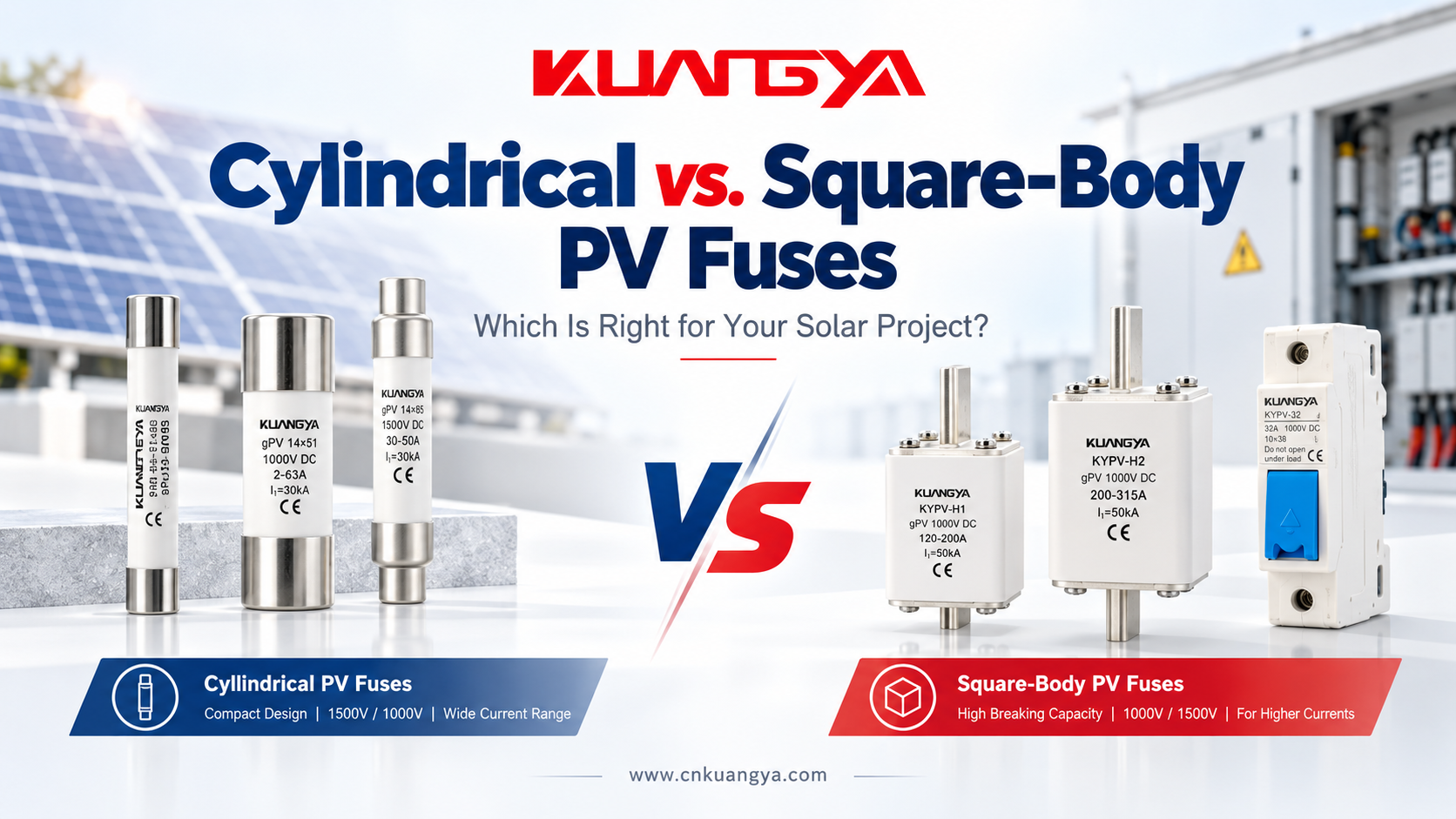
원통형 대 사각형 PV 퓨즈는 태양광 시스템의 DC 보호를 선택할 때 중요한 비교 대상입니다. 두 유형 모두 태양광 애플리케이션용으로 설계될 수 있지만 물리적 구조, 장착 배열 및 일반적인 용도에서 차이가 있습니다. 올바른 퓨즈를 선택하려면 정격 전압, 전류, DC 차단 용량 및 퓨즈 홀더와의 호환성을 확인해야 합니다.
태양광 DC 보호에 사용되는 두 가지 일반적인 형식은 다음과 같습니다. 원통형 PV 퓨즈 및 사각형 gPV 퓨즈. 원통형 설계는 일반적으로 컴팩트한 스트링 보호 회로에 사용되는 반면, 사각형 설계는 결합기 박스 출력, 중앙 인버터 입력 및 DC 버스 보호와 같은 고전류 애플리케이션에 자주 선택됩니다.
그러나 어느 형식도 자동으로 더 좋지는 않습니다. 올바른 선택은 전기적 요구 사항, 사용 가능한 설치 공간, 장비 설계 및 적용 가능한 표준에 따라 달라집니다.
이 가이드에서는 두 가지 형식을 비교하고 구매자가 주문하기 전에 확인해야 할 사항을 설명합니다.
원통형 및 사각형 본체 PV 퓨즈 모두 태양광 DC 회로용으로 설계될 수 있습니다. 주요 차이점은 물리적 구조와 전기 시스템에 연결되는 방식입니다.
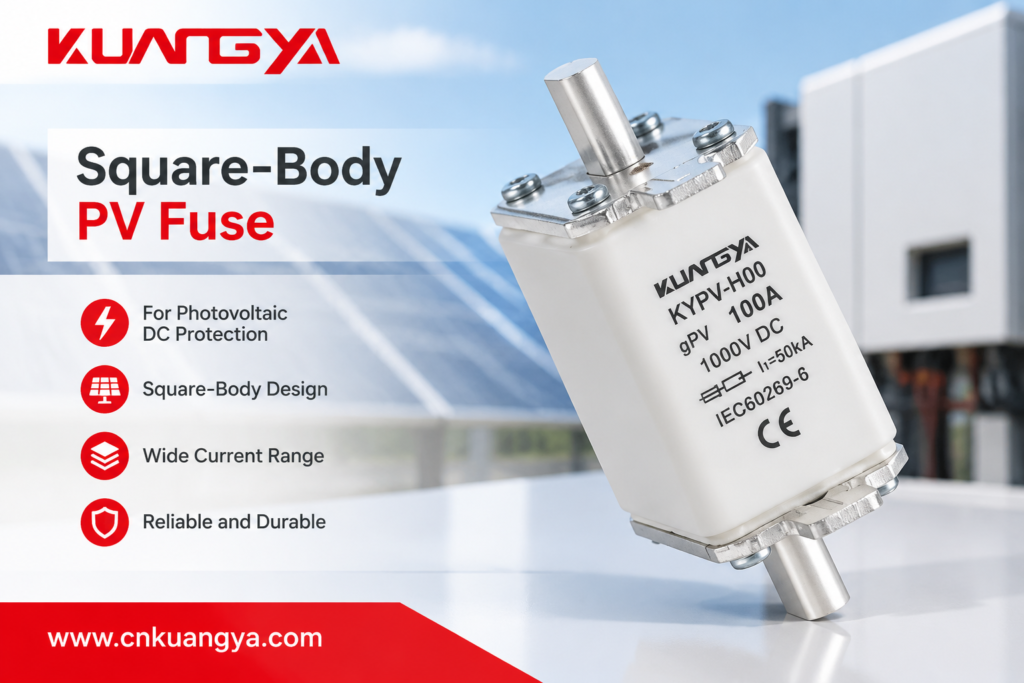
원통형 PV 퓨즈는 양 끝에 금속 접점이 있는 튜브 모양의 본체를 가지고 있습니다. 일반적인 규격으로는 10×38mm, 14×51mm, 10×85mm, 14×85mm가 있습니다.
PV 스트링 보호 및 컴팩트 퓨즈 링크가 적합한 기타 회로에 자주 사용됩니다. 모델에 따라 호환되는 DIN 레일 퓨즈 홀더 또는 기타 지정된 장착 배열에 설치할 수 있습니다.
일반적인 애플리케이션은 다음과 같습니다:
정확한 전압 정격, 전류 범위 및 차단 용량은 선택한 퓨즈 모델에 따라 달라집니다.
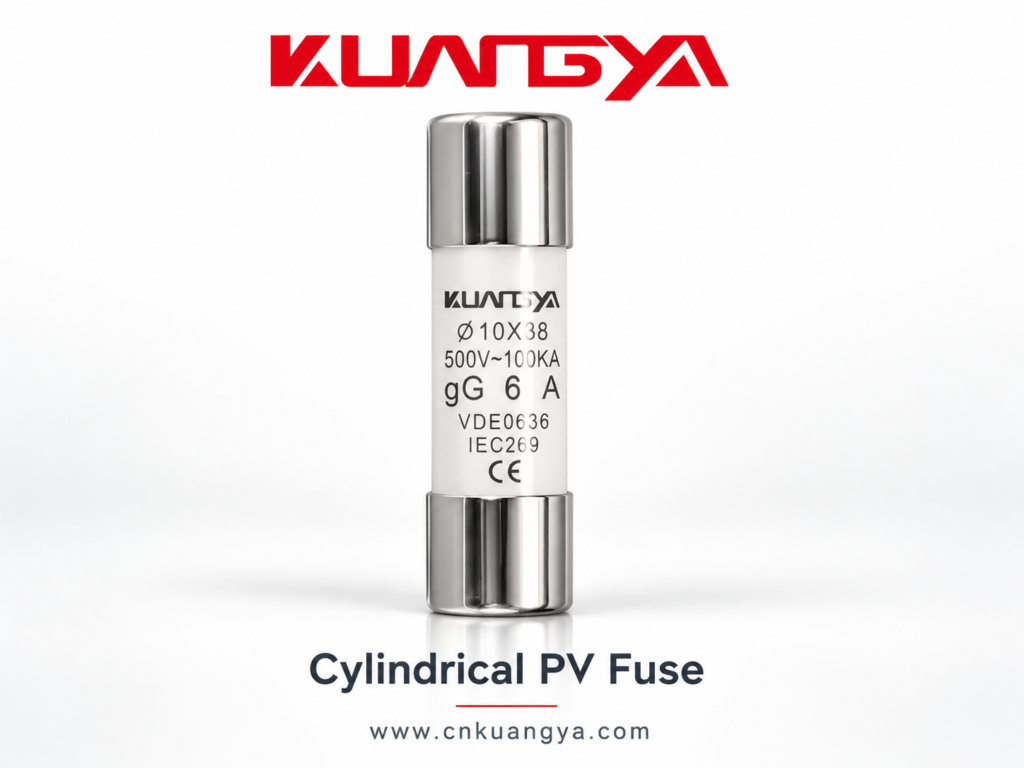
사각형 본체 PV 퓨즈는 일반적으로 블레이드 접점이 있는 NH 스타일 설계를 사용합니다. 일반적인 프레임 지정에는 H0, H1, H2 및 H3이 포함되며, 특정 고전류 애플리케이션의 경우 XL 변형도 있습니다.
이 퓨즈는 일반적으로 더 높은 전류 정격과 호환되는 고전류 퓨즈 베이스가 필요한 회로에 사용됩니다.
일반적인 애플리케이션은 다음과 같습니다:
사각형 본체 구조라고 해서 퓨즈의 전압 등급이나 차단 용량이 자동으로 높아지는 것은 아닙니다. 이러한 값은 특정 모델의 데이터시트를 통해 확인해야 합니다.
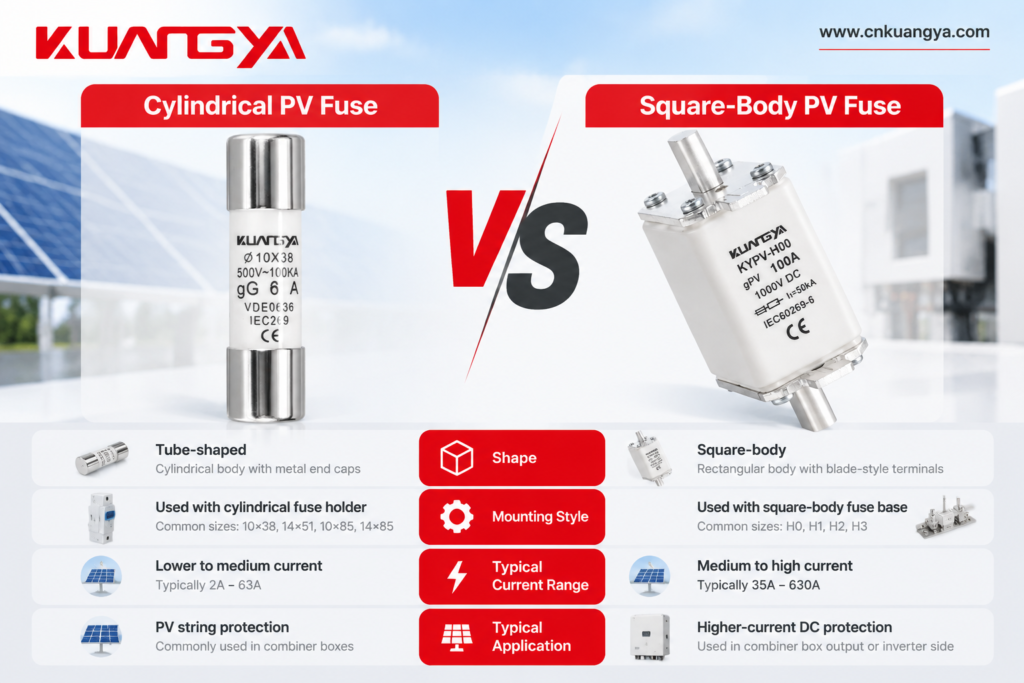
다음 표는 구매자가 고려해야 할 주요 요인을 요약한 것입니다.
| 비교 요소 | 원통형 gPV 퓨즈 | 사각형 본체 gPV 퓨즈 |
|---|---|---|
| 물리적 설계 | 끝 접점이 있는 튜브형 본체 | 블레이드 접점이 있는 직사각형 본체 |
| 일반적인 형식 | 10×38, 14×51, 10×85, 14×85 mm | H0–H3 및 선택된 XL 프레임 |
| 일반적인 전류 응용 분야 | 종종 저전류 스트링 회로에 사용됩니다. | 종종 고전류 피더 및 버스 연결에 사용됩니다. |
| 설치 | 호환 가능한 원통형 퓨즈 홀더 또는 지정된 장착 시스템 | 호환 가능한 NH형 퓨즈 베이스 또는 지정된 장착 시스템 |
| 공간 고려 사항 | 소형 모듈식 레이아웃에 적합한 경우가 많음 | 퓨즈 본체, 베이스, 단자 및 유지보수 접근을 위한 공간 필요 |
| 교체 | 정확한 원통형 크기 및 전기적 정격 일치 | 프레임, 접점 구성, 치수 및 전기적 정격 일치 |
| 일반적인 시스템 위치 | PV 스트링 및 선택된 분기 회로 | 고전류 결합기 출력, 인버터 입력 및 DC 분배 |
| 선정 우선순위 | 스트링 전류, 전압, 홀더 호환성 및 레이아웃 | 회로 전류, 고장 레벨, 프레임 호환성 및 열적 조건 |
중요: 이는 일반적인 적용 패턴이며 보편적인 규칙은 아닙니다. 일부 원통형 모델은 까다로운 애플리케이션을 지원하며, 사각 바디 퓨즈는 다양한 전기적 정격으로 제공됩니다. 항상 제품 데이터시트와 시스템 설계를 확인하십시오.
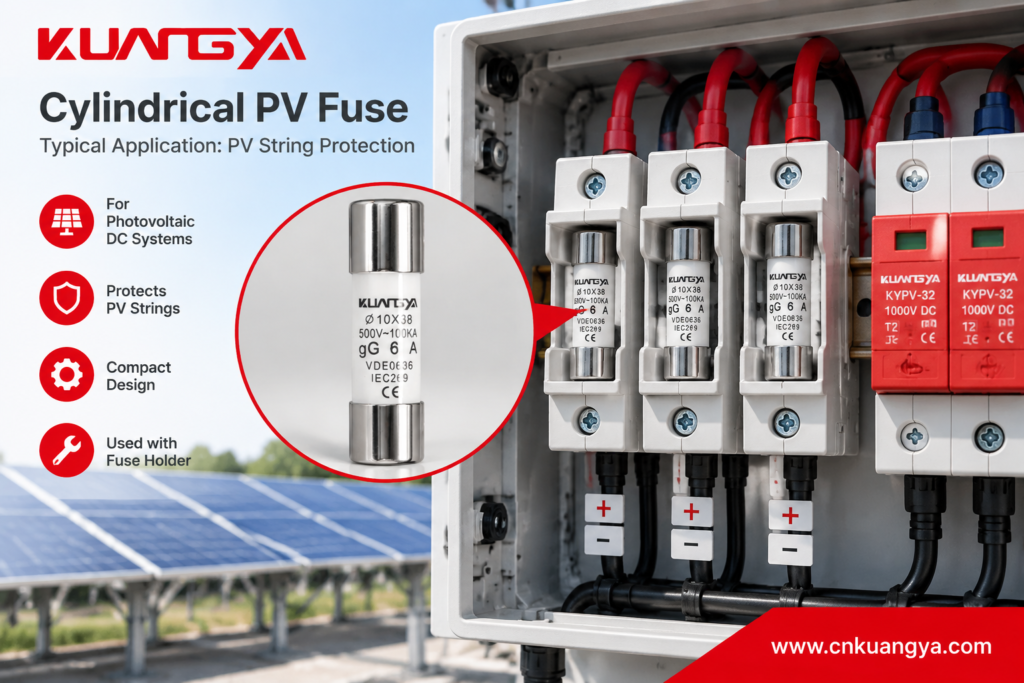
회로 설계상 소형 모듈식 퓨즈 배치가 필요한 경우 원통형 gPV 퓨즈를 고려할 가치가 있습니다.
원통형 퓨즈 홀더는 모듈식 DIN 레일 레이아웃에 맞출 수 있습니다. 이는 분배 상자에서 여러 개의 개별 스트링 보호 회로의 배열을 단순화할 수 있습니다.
그러나 전체 설치 공간에는 홀더, 배선, 단자 간격, 열 방출 및 교체를 위한 접근 공간이 포함되어야 합니다.
원통형 gPV 퓨즈는 시스템 설계에서 개별 분기 보호가 필요한 PV 스트링 회로에 일반적으로 사용됩니다.
선택된 퓨즈는 스트링의 계산된 전류, PV 모듈 제조업체의 최대 직렬 퓨즈 정격, 케이블 허용 전류 및 예상 고장 전류와 조정되어야 합니다.
물리적 크기만으로 퓨즈를 선택하지 마십시오.
개별 회로에 별도의 퓨즈 홀더를 사용하는 설계의 경우, 전체 장착 배열을 변경하지 않고 호환되는 원통형 퓨즈 링크를 교체할 수 있습니다.
교체품 주문 전에 정확한 치수, 정격 전압, 정격 전류, DC 차단 용량 및 퓨즈 홀더 호환성을 확인하십시오.
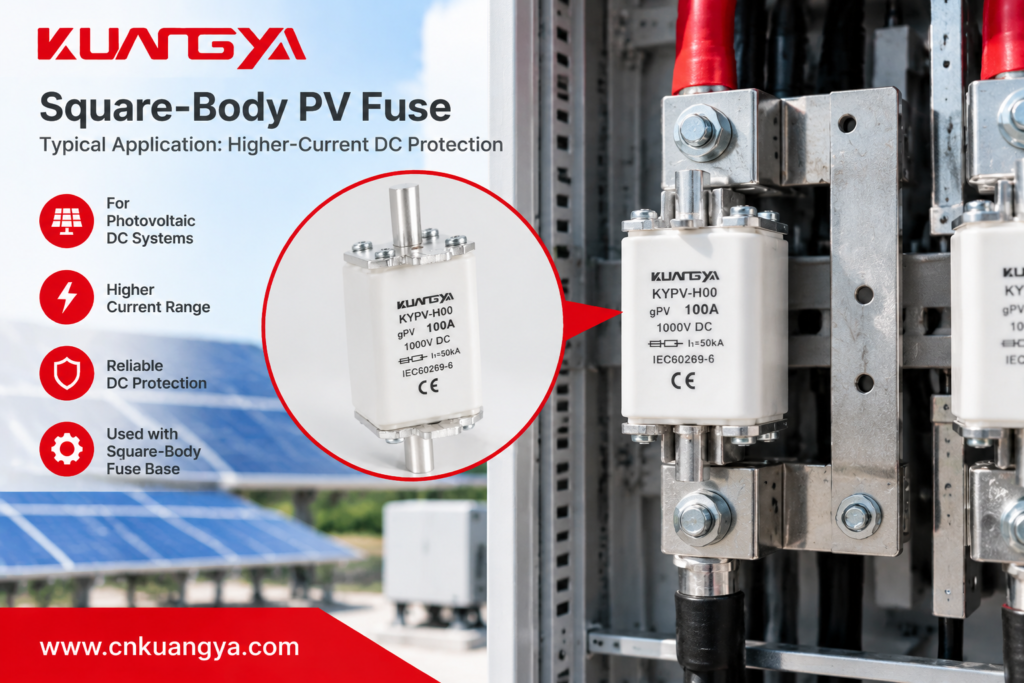
사각형 본체 gPV 퓨즈는 블레이드 접점 설계와 호환되는 퓨즈 베이스가 장비 레이아웃에 적합한 고전류 회로에 종종 고려됩니다.
사각형 본체 모델은 일반적으로 선택된 콤비너 박스 출력 회로, 중앙 인버터 DC 입력 및 주요 DC 분배 연결에 사용됩니다.
프레임 크기만으로는 허용 전류를 결정할 수 없습니다. 퓨즈의 실제 전류 정격, 전압 정격, 차단 용량 및 작동 조건은 모두 회로에 적합해야 합니다.
일부 사각형 퓨즈 베이스는 더 큰 전기 어셈블리 및 버스바 배열과 통합되도록 설계되었습니다.
구매자는 교체품을 선택하기 전에 장착 치수, 단자 배열, 도체 또는 버스바 연결 요구 사항, 조임 토크 및 유지 보수 간격을 확인해야 합니다.
사각형 gPV 퓨즈는 유틸리티 규모의 PV 시스템 및 에너지 저장 시스템의 특정 고전류 회로에 적합할 수 있습니다.
그러나 PV 및 배터리 회로는 서로 다른 고장 전류 특성을 가질 수 있습니다. PV 어레이에 적합한 퓨즈가 배터리 회로에 자동으로 적합한 것은 아닙니다. 실제 시스템 설계에 대해 퓨즈의 의도된 적용 및 정격을 확인하십시오.
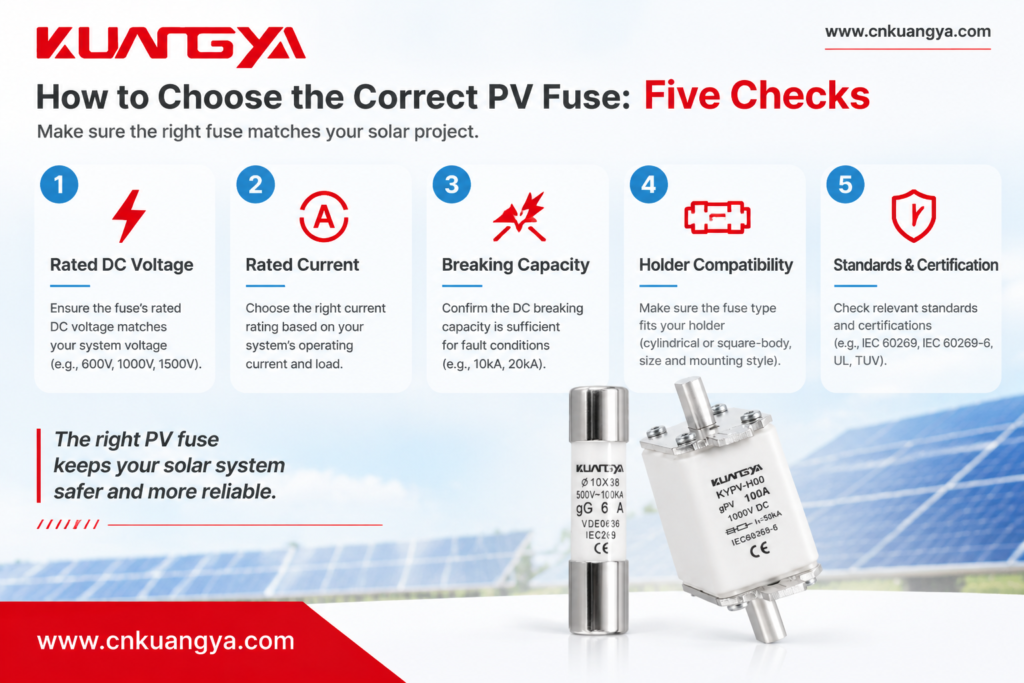
물리적 형식은 퓨즈 선택의 일부일 뿐입니다. 주문하기 전에 다음 다섯 가지 항목을 확인하십시오.
퓨즈의 정격 DC 전압은 회로에서 발생할 수 있는 최대 전압에 적합해야 합니다.
PV 어레이의 경우, 이 계산은 모듈의 개방 회로 전압과 예상되는 최소 작동 온도를 고려해야 합니다. 공칭 시스템 전압만으로는 충분하지 않습니다.
KUANGYA는 1000V DC 및 1500V DC 모델을 포함한 다양한 전압 등급의 PV 퓨즈 제품을 제공합니다. 가용성 및 사양은 제품마다 다릅니다.
퓨즈 전류 등급은 다음을 포함한 회로 설계에 따라 선택해야 합니다.
더 높은 전류 정격이 자동으로 더 안전한 것은 아닙니다. 과대 평가는 회로 보호의 효과를 감소시킬 수 있으며, 과소 평가는 원치 않는 퓨즈 작동을 유발할 수 있습니다.
차단 용량은 특정 조건에서 퓨즈가 차단하도록 정격된 최대 고장 전류를 나타냅니다.
선택된 퓨즈는 설치 지점에서의 예상 고장 전류에 대해 적절한 DC 차단 용량을 가져야 합니다.
적용 전압 및 시험 조건을 확인하지 않고 차단 용량 수치를 비교하지 마십시오.
A fuse link and its holder must be mechanically and electrically compatible.
For cylindrical models, verify the exact fuse dimensions and compatible holder. For square-body models, confirm the frame size, contact geometry, mounting arrangement, and compatible fuse base.
Also check terminal torque, conductor size, clearances, and installation instructions.
Never assume that two fuses are interchangeable simply because their rated current and voltage are the same.
For photovoltaic fuse links, IEC 60269-6 specifies supplementary requirements for fuses protecting PV strings and PV arrays in DC circuits up to 1500 V.
The IEC standard can be reviewed here:
IEC 60269-6 — Low-voltage fuses for photovoltaic applications
Buyers should request the relevant datasheet and applicable test or certification documents for the exact model being purchased. Confirm that the documentation covers the required product and rating rather than relying on a general statement about the manufacturer’s product range.
Two fuses with the same current rating may have different dimensions, DC breaking capacities, voltage ratings, and time-current characteristics.
Better approach: Compare the complete datasheets before approving a substitute.
A cylindrical fuse cannot be installed in an NH-style fuse base, and square-body fuse links require a compatible mounting arrangement.
Better approach: Confirm the existing holder model, fuse dimensions, and contact design before ordering replacement parts.
The gPV designation identifies a photovoltaic fuse category, but it does not mean every model has identical electrical ratings or interruption performance.
Better approach: Check the specific model’s voltage, current, breaking capacity, time-current characteristics, and applicable standards.
A fuse with a higher current rating may not provide the protection required by the cables, modules, or other connected equipment.
Better approach: Have the replacement reviewed against the circuit design and applicable requirements.
Enclosure temperature, adjacent components, terminal connections, and mounting conditions can affect the performance of a fuse assembly.
Better approach: Follow the manufacturer’s derating guidance, installation instructions, and terminal torque specifications.
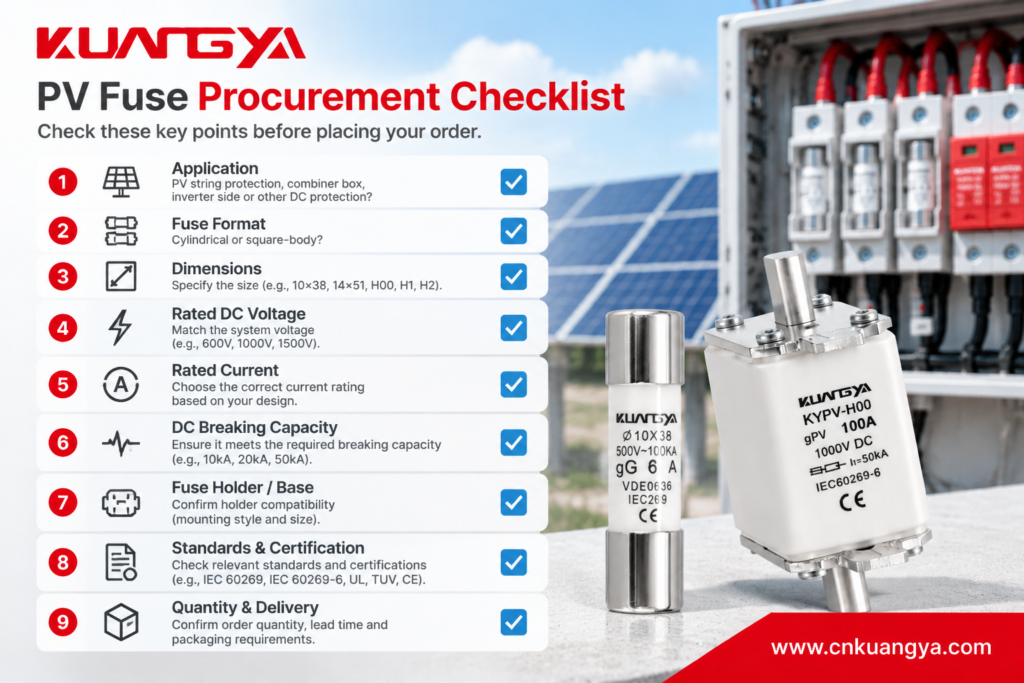
Before requesting a quotation, prepare the following information.
| 항목 | Information to Confirm |
|---|---|
| 애플리케이션 | PV string, combiner output, inverter input, or DC bus |
| Fuse format | Cylindrical or square-body |
| 치수 | Exact size or frame designation |
| 정격 전압 | Required DC voltage |
| 정격 전류 | Required current based on engineering calculations |
| 차단 용량 | Required DC fault-current interruption capability |
| Fuse holder | Existing model or required compatible base |
| 표준 | Applicable standard and required documentation |
| 수량 | Required quantity and expected order schedule |
| Custom requirements | Labeling, packaging, or other confirmed specifications |
Providing these details helps suppliers identify a suitable model and reduces the risk of ordering an incompatible replacement.
KUANGYA supplies photovoltaic DC fuse links and compatible fuse holders for different solar protection applications.
The product range includes cylindrical gPV formats such as 10×38 mm and 14×51 mm, as well as selected high-voltage cylindrical formats. Square-body options include H0–H3 and selected XL series.
The suitable model depends on the required voltage, current, breaking capacity, physical dimensions, and installation arrangement.
Explore the product range:
For OEM requirements or project-specific selections, provide the circuit ratings, existing fuse or holder model, and intended application so the specifications can be reviewed before ordering.
Neither format is universally better. Cylindrical designs are commonly used in compact string-protection circuits, while square-body designs are often selected for higher-current circuits. The correct format depends on the system requirements and compatible mounting arrangement.
Not as a direct physical replacement. The two formats use different mounting and contact arrangements. Any change requires a compatible fuse base and an engineering review of the electrical ratings and equipment design.
No. Square-body models are commonly available for higher-current applications, but ratings vary by model. Check the manufacturer’s datasheet rather than assuming performance from the body shape alone.
Only if its rated DC voltage and other specifications are suitable for the application. A fuse rated for 1000 V DC should not be assumed suitable for a 1500 V DC circuit.
IEC 60269-6 specifies supplementary requirements for fuse links used to protect photovoltaic strings and arrays. Other standards or certifications may be required depending on the destination market and project specifications.
Provide the application, rated DC voltage, required current, breaking-capacity requirement, fuse dimensions or frame size, compatible holder, quantity, and any required standards or documentation.
Choosing between cylindrical and square-body PV fuses is not simply a matter of selecting the smaller or larger design. Both formats serve useful roles in photovoltaic DC protection, but they differ in physical construction, installation requirements, and typical applications.
For a reliable selection, verify the electrical ratings, breaking capacity, holder compatibility, thermal conditions, and applicable standards before ordering.
Need help selecting a PV fuse for your project? Contact KUANGYA with your system requirements and existing fuse or holder model to discuss a suitable product configuration.

