WengYang Industrial Zone Yueqing Wenzhou 325000
Work Hours
Monday to Friday: 7AM - 7PM
Weekend: 10AM - 5PM
WengYang Industrial Zone Yueqing Wenzhou 325000
Work Hours
Monday to Friday: 7AM - 7PM
Weekend: 10AM - 5PM

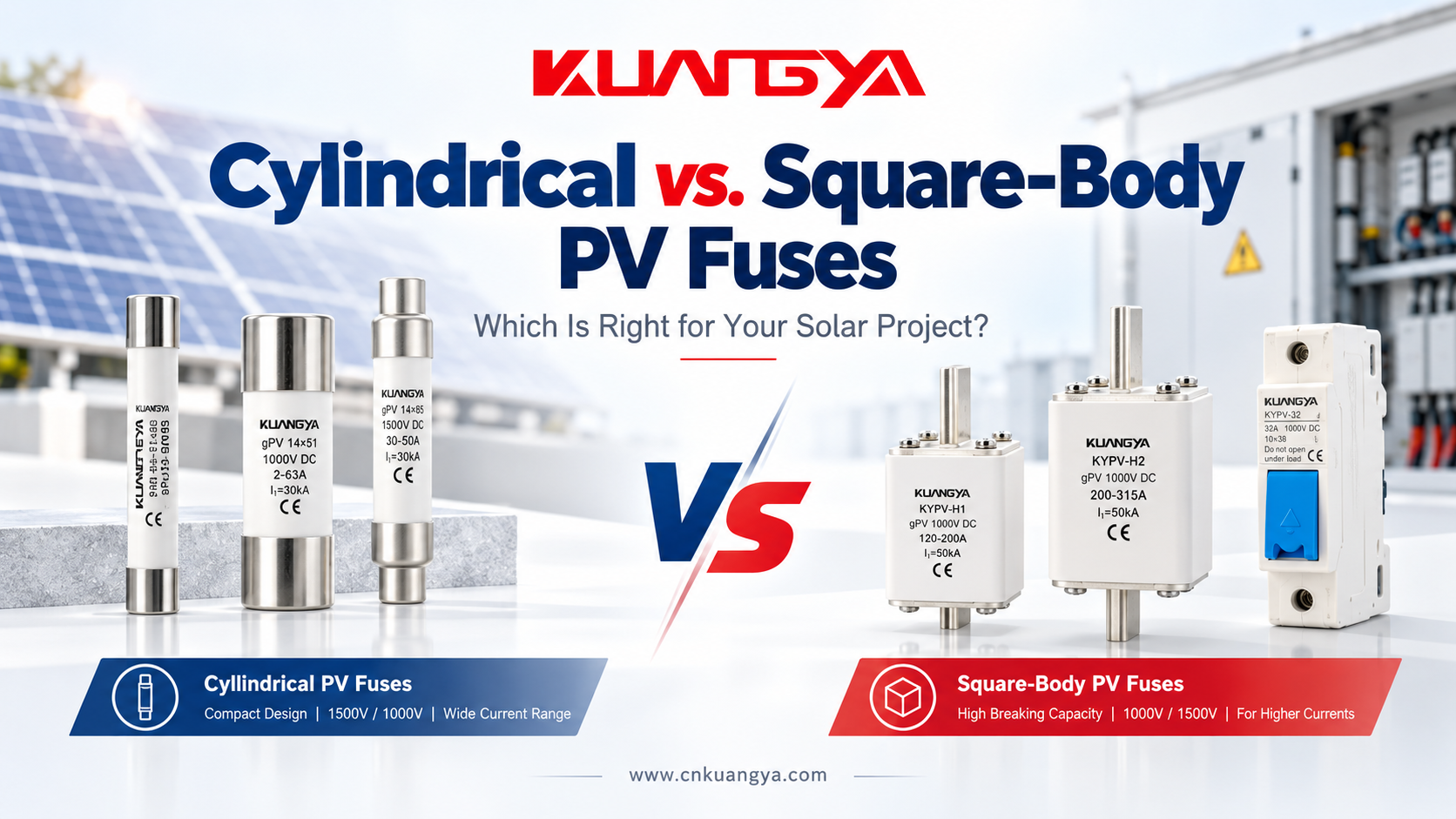
Cylindrical vs square-body PV fuses is an important comparison when selecting DC protection for a photovoltaic system. Although both types can be designed for solar applications, they differ in physical construction, mounting arrangements, and typical uses. Choosing the right fuse requires checking the rated voltage, current, DC breaking capacity, and compatibility with the fuse holder.
Two common formats used in solar DC protection are cylindrical gPV fuses and square-body gPV fuses. Cylindrical designs are commonly used in compact string-protection circuits, while square-body designs are often selected for higher-current applications, such as combiner box outputs, central inverter inputs, and DC bus protection.
However, neither format is automatically better. The correct choice depends on the electrical requirements, available installation space, equipment design, and applicable standards.
This guide compares the two formats and explains what buyers should check before ordering.
Both cylindrical and square-body PV fuses can be designed for photovoltaic DC circuits. The main difference is their physical construction and the way they connect to the electrical system.
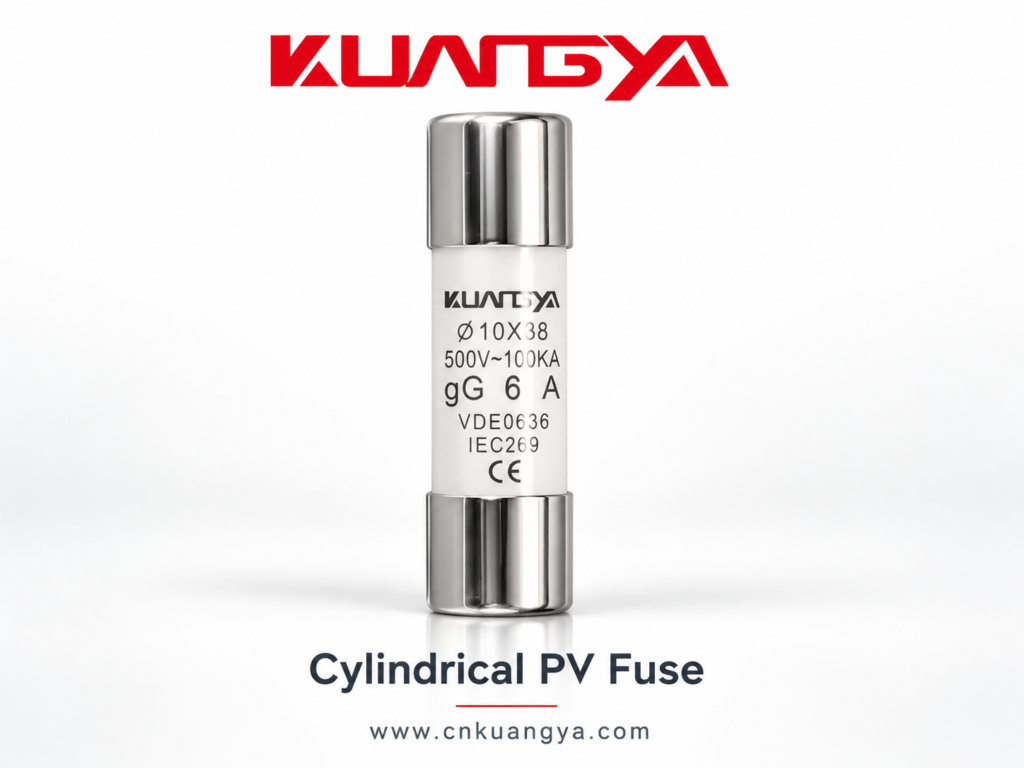
Cylindrical PV fuses have a tube-shaped body with metal contacts at both ends. Common formats include 10×38 mm, 14×51 mm, 10×85 mm, and 14×85 mm.
They are frequently used for PV string protection and other circuits where a compact fuse link is appropriate. Depending on the model, they can be installed in compatible DIN-rail fuse holders or other specified mounting arrangements.
Typical applications include:
The exact voltage rating, current range, and breaking capacity depend on the selected fuse model.
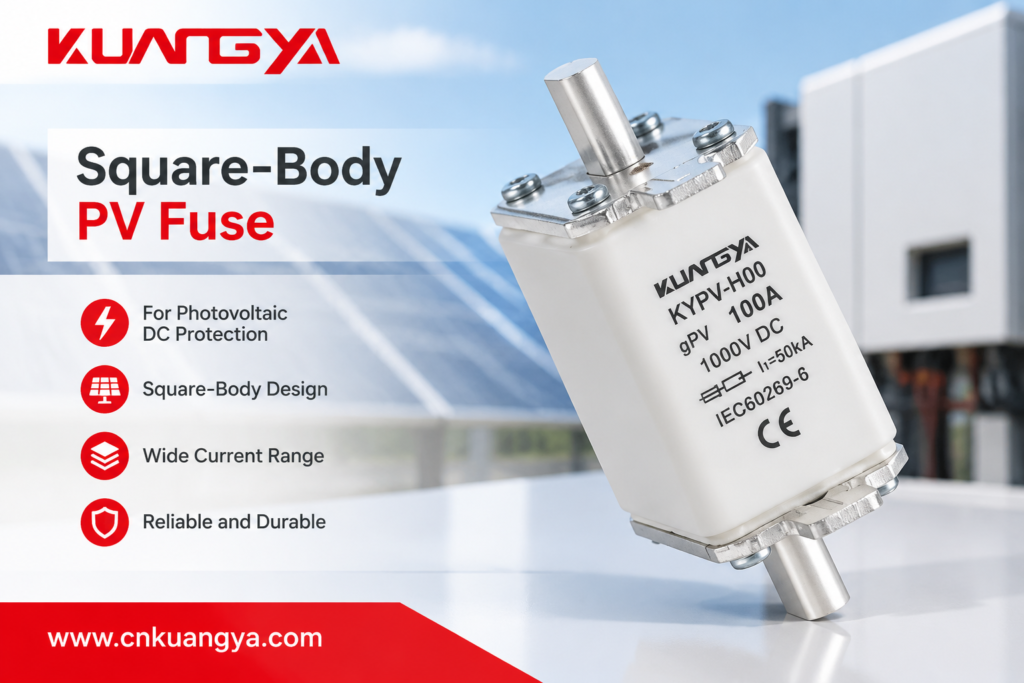
Square-body PV fuses typically use an NH-style design with blade contacts. Common frame designations include H0, H1, H2, and H3, along with XL variants for certain higher-current applications.
These fuses are commonly used in circuits requiring larger current ratings and compatible high-current fuse bases.
Typical applications include:
Square-body construction does not automatically mean a fuse has a higher voltage rating or breaking capacity. These values must be verified against the specific model’s datasheet.
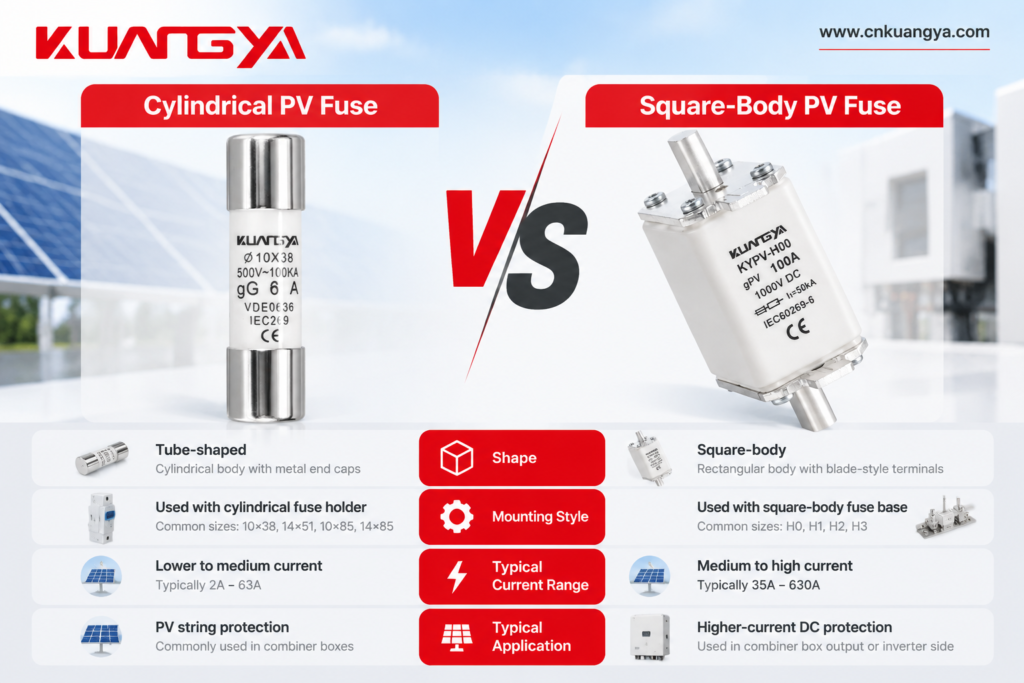
The following table summarizes the main factors buyers should consider.
| Comparison Factor | Cylindrical gPV Fuse | Square-Body gPV Fuse |
|---|---|---|
| Physical design | Tube-shaped body with end contacts | Rectangular body with blade contacts |
| Common formats | 10×38, 14×51, 10×85, 14×85 mm | H0–H3 and selected XL frames |
| Typical current applications | Often used in lower-current string circuits | Often used in higher-current feeders and bus connections |
| Installation | Compatible cylindrical fuse holder or specified mounting system | Compatible NH-style fuse base or specified mounting system |
| Space considerations | Often suitable for compact, modular layouts | Requires space for the fuse body, base, terminals, and maintenance access |
| Replacement | Match the exact cylindrical size and electrical ratings | Match the frame, contact arrangement, dimensions, and electrical ratings |
| Typical system position | PV strings and selected branch circuits | Higher-current combiner outputs, inverter inputs, and DC distribution |
| Selection priority | String current, voltage, holder compatibility, and layout | Circuit current, fault level, frame compatibility, and thermal conditions |
Important: These are typical application patterns, not universal rules. Some cylindrical models support demanding applications, and square-body fuses are available in different electrical ratings. Always check the product datasheet and system design.
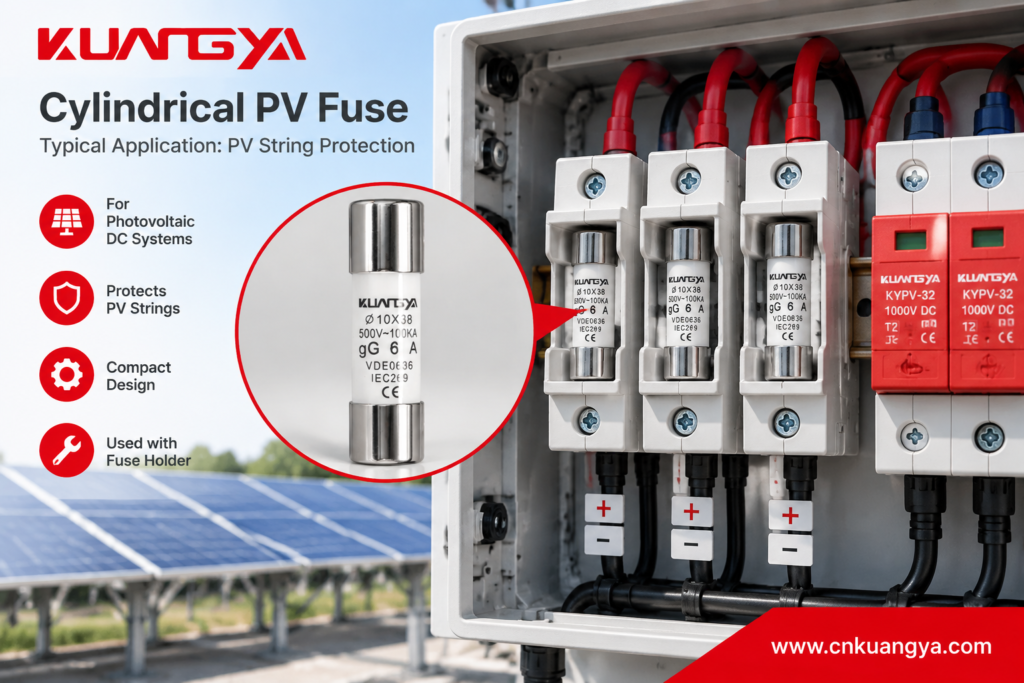
A cylindrical gPV fuse is worth considering when the circuit design calls for a compact, modular fuse arrangement.
Cylindrical fuse holders can fit into modular DIN-rail layouts. This can simplify the arrangement of multiple individual string-protection circuits in a combiner box.
However, the complete installation space must include the holder, wiring, terminal clearances, heat dissipation, and access for replacement.
Cylindrical gPV fuses are commonly used in PV string circuits where individual branch protection is required by the system design.
The selected fuse must be coordinated with the string’s calculated current, the PV module manufacturer’s maximum series-fuse rating, cable ampacity, and the expected fault current.
Do not select a fuse based on physical size alone.
Where a design uses separate fuse holders for individual circuits, a compatible cylindrical fuse link can be replaced without changing the overall mounting arrangement.
Before ordering replacements, verify the exact dimensions, rated voltage, rated current, DC breaking capacity, and fuse-holder compatibility.
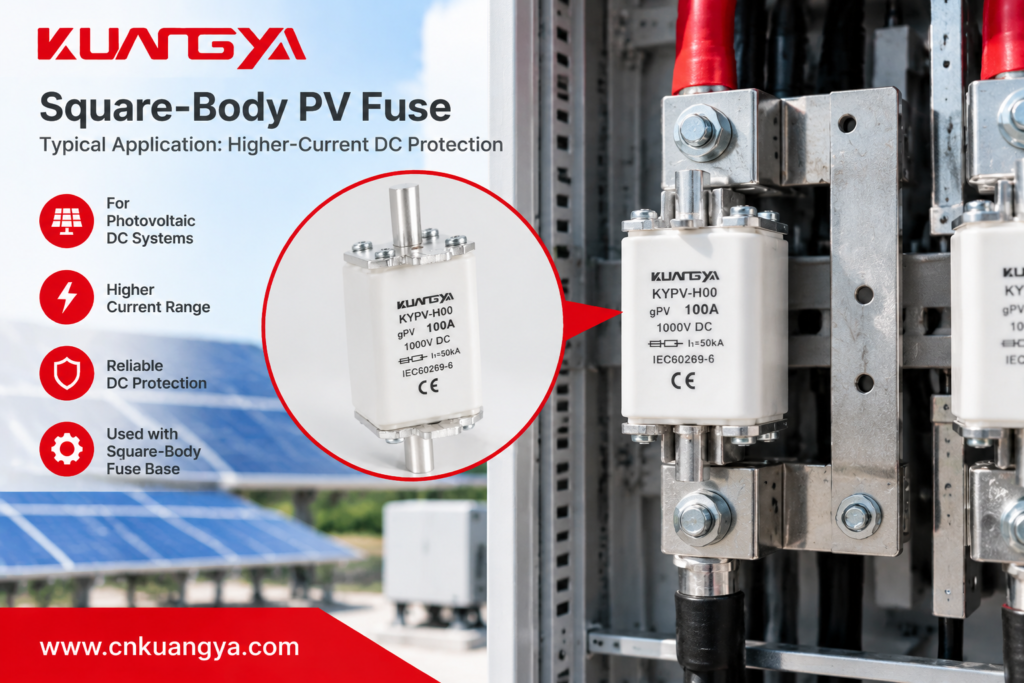
Square-body gPV fuses are often considered for higher-current circuits where their blade-contact design and compatible fuse bases suit the equipment layout.
Square-body models are commonly used for selected combiner box output circuits, central inverter DC inputs, and main DC distribution connections.
Frame size alone does not determine the permissible current. The fuse’s actual current rating, voltage rating, breaking capacity, and operating conditions must all be suitable for the circuit.
Some square-body fuse bases are designed to integrate with larger electrical assemblies and busbar arrangements.
Buyers should confirm the mounting dimensions, terminal arrangement, conductor or busbar connection requirements, tightening torque, and maintenance clearances before selecting a replacement.
Square-body gPV fuses may be appropriate for selected high-current circuits in utility-scale PV systems and energy storage systems.
However, PV and battery circuits can have different fault-current characteristics. A fuse suitable for a PV array is not automatically suitable for a battery circuit. Verify the fuse’s intended application and ratings against the actual system design.
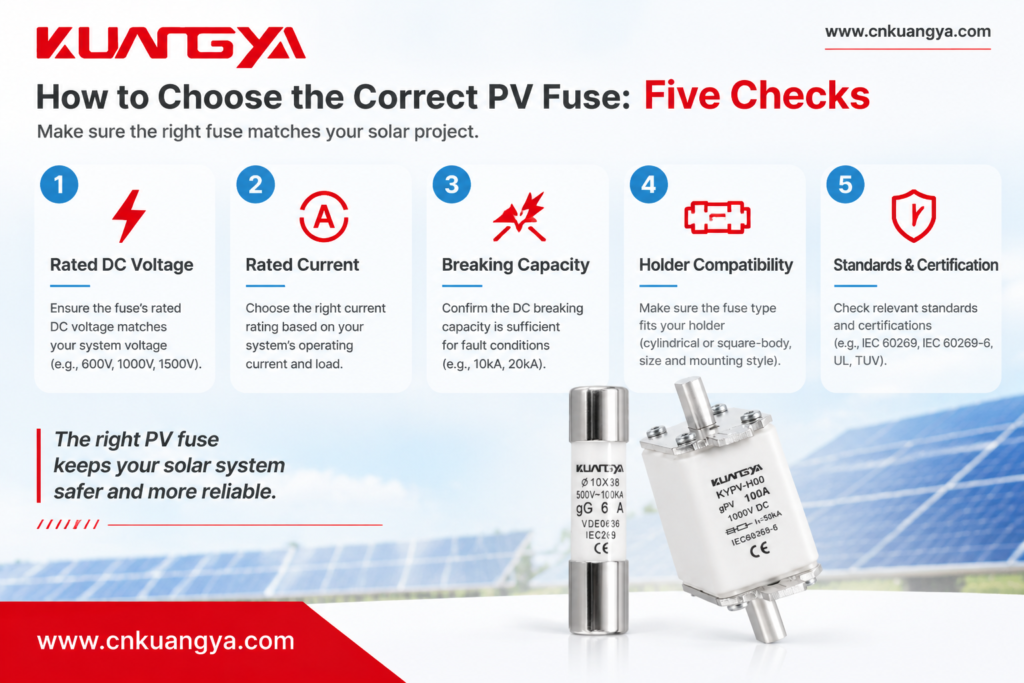
The physical format is only one part of fuse selection. Before placing an order, verify the following five items.
The fuse’s rated DC voltage must be suitable for the maximum voltage that can occur in the circuit.
For PV arrays, this calculation must account for the module’s open-circuit voltage and the expected minimum operating temperature. The nominal system voltage alone is not sufficient.
KUANGYA offers PV fuse products in different voltage classes, including 1000 V DC and 1500 V DC models. Availability and specifications vary by product.
The fuse current rating must be selected according to the circuit design, including:
A higher current rating is not automatically safer. Oversizing can reduce the effectiveness of circuit protection, while undersizing may cause unwanted fuse operation.
Breaking capacity indicates the maximum fault current a fuse is rated to interrupt under specified conditions.
The selected fuse must have an adequate DC breaking capacity for the prospective fault current at its installation point.
Do not compare breaking-capacity figures without checking the applicable voltage and test conditions.
A fuse link and its holder must be mechanically and electrically compatible.
For cylindrical models, verify the exact fuse dimensions and compatible holder. For square-body models, confirm the frame size, contact geometry, mounting arrangement, and compatible fuse base.
Also check terminal torque, conductor size, clearances, and installation instructions.
Never assume that two fuses are interchangeable simply because their rated current and voltage are the same.
For photovoltaic fuse links, IEC 60269-6 specifies supplementary requirements for fuses protecting PV strings and PV arrays in DC circuits up to 1500 V.
The IEC standard can be reviewed here:
IEC 60269-6 — Low-voltage fuses for photovoltaic applications
Buyers should request the relevant datasheet and applicable test or certification documents for the exact model being purchased. Confirm that the documentation covers the required product and rating rather than relying on a general statement about the manufacturer’s product range.
Two fuses with the same current rating may have different dimensions, DC breaking capacities, voltage ratings, and time-current characteristics.
Better approach: Compare the complete datasheets before approving a substitute.
A cylindrical fuse cannot be installed in an NH-style fuse base, and square-body fuse links require a compatible mounting arrangement.
Better approach: Confirm the existing holder model, fuse dimensions, and contact design before ordering replacement parts.
The gPV designation identifies a photovoltaic fuse category, but it does not mean every model has identical electrical ratings or interruption performance.
Better approach: Check the specific model’s voltage, current, breaking capacity, time-current characteristics, and applicable standards.
A fuse with a higher current rating may not provide the protection required by the cables, modules, or other connected equipment.
Better approach: Have the replacement reviewed against the circuit design and applicable requirements.
Enclosure temperature, adjacent components, terminal connections, and mounting conditions can affect the performance of a fuse assembly.
Better approach: Follow the manufacturer’s derating guidance, installation instructions, and terminal torque specifications.
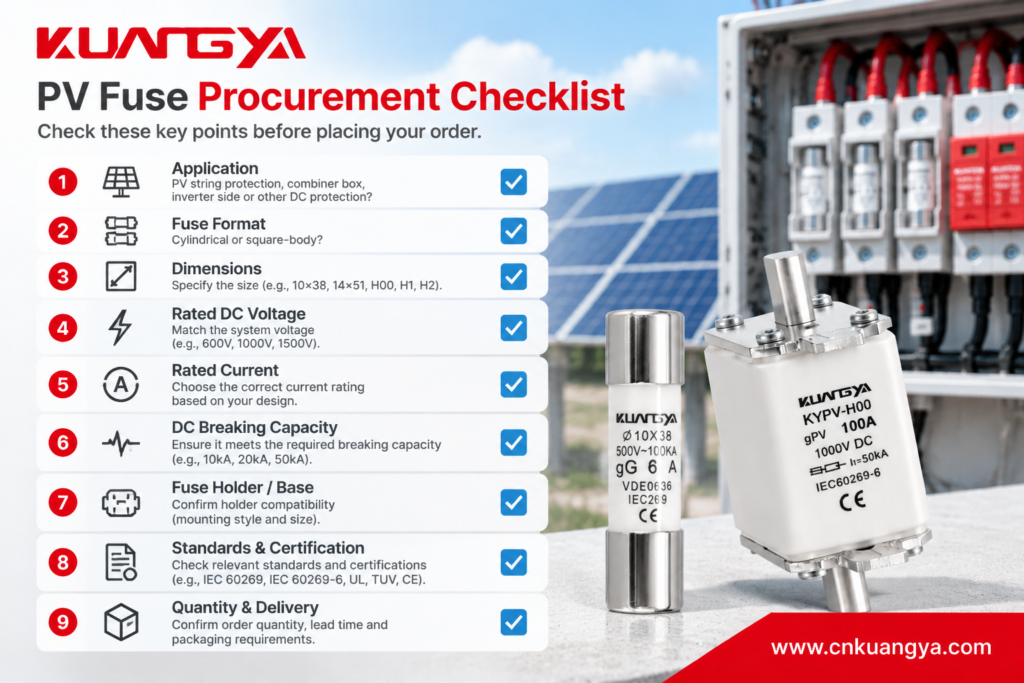
Before requesting a quotation, prepare the following information.
| Item | Information to Confirm |
|---|---|
| Application | PV string, combiner output, inverter input, or DC bus |
| Fuse format | Cylindrical or square-body |
| Dimensions | Exact size or frame designation |
| Rated voltage | Required DC voltage |
| Rated current | Required current based on engineering calculations |
| Breaking capacity | Required DC fault-current interruption capability |
| Fuse holder | Existing model or required compatible base |
| Standards | Applicable standard and required documentation |
| Quantity | Required quantity and expected order schedule |
| Custom requirements | Labeling, packaging, or other confirmed specifications |
Providing these details helps suppliers identify a suitable model and reduces the risk of ordering an incompatible replacement.
KUANGYA supplies photovoltaic DC fuse links and compatible fuse holders for different solar protection applications.
The product range includes cylindrical gPV formats such as 10×38 mm and 14×51 mm, as well as selected high-voltage cylindrical formats. Square-body options include H0–H3 and selected XL series.
The suitable model depends on the required voltage, current, breaking capacity, physical dimensions, and installation arrangement.
Explore the product range:
For OEM requirements or project-specific selections, provide the circuit ratings, existing fuse or holder model, and intended application so the specifications can be reviewed before ordering.
Neither format is universally better. Cylindrical designs are commonly used in compact string-protection circuits, while square-body designs are often selected for higher-current circuits. The correct format depends on the system requirements and compatible mounting arrangement.
Not as a direct physical replacement. The two formats use different mounting and contact arrangements. Any change requires a compatible fuse base and an engineering review of the electrical ratings and equipment design.
No. Square-body models are commonly available for higher-current applications, but ratings vary by model. Check the manufacturer’s datasheet rather than assuming performance from the body shape alone.
Only if its rated DC voltage and other specifications are suitable for the application. A fuse rated for 1000 V DC should not be assumed suitable for a 1500 V DC circuit.
IEC 60269-6 specifies supplementary requirements for fuse links used to protect photovoltaic strings and arrays. Other standards or certifications may be required depending on the destination market and project specifications.
Provide the application, rated DC voltage, required current, breaking-capacity requirement, fuse dimensions or frame size, compatible holder, quantity, and any required standards or documentation.
Choosing between cylindrical and square-body PV fuses is not simply a matter of selecting the smaller or larger design. Both formats serve useful roles in photovoltaic DC protection, but they differ in physical construction, installation requirements, and typical applications.
For a reliable selection, verify the electrical ratings, breaking capacity, holder compatibility, thermal conditions, and applicable standards before ordering.
Need help selecting a PV fuse for your project? Contact KUANGYA with your system requirements and existing fuse or holder model to discuss a suitable product configuration.

