웽양 공업구 웨칭 원저우 325000
근무 시간
월요일~금요일: 오전 7시~오후 7시
주말: 주말: 오전 10시 - 오후 5시
웽양 공업구 웨칭 원저우 325000
근무 시간
월요일~금요일: 오전 7시~오후 7시
주말: 주말: 오전 10시 - 오후 5시

소개
RCBO (과전류 잔류 전류 차단기) | 안전하고 신뢰할 수 있는 쿠앙야
Residual Current Circuit Breakers (RCCBs) are among the most important safety devices used in modern electrical installations. Their primary purpose is to protect people and property from electric shock, earth leakage faults, and fire hazards caused by insulation failures.
However, not all RCCBs are designed to detect the same type of leakage current. As electrical systems become increasingly dependent on power electronics, variable frequency drives (VFDs), EV chargers, solar inverters, and industrial automation equipment, choosing the correct RCCB type becomes critical.
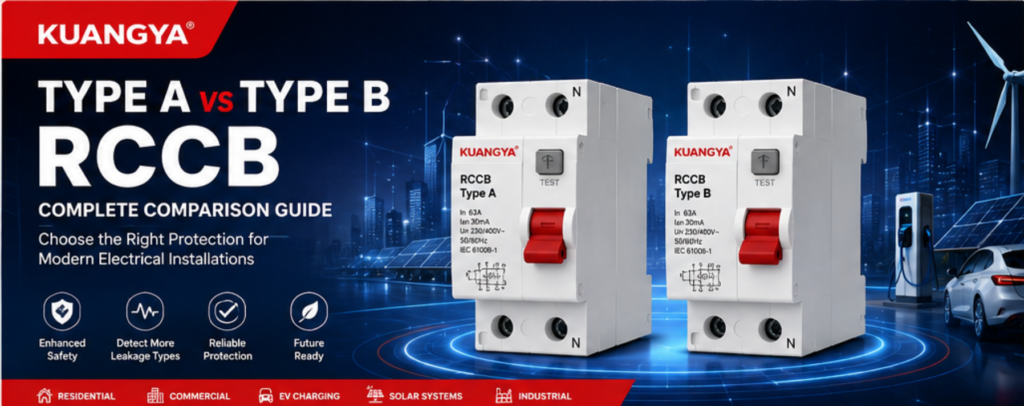
Among the most commonly discussed options are A형 RCCB 및 유형 B RCCB. While both provide residual current protection, their detection capabilities differ significantly.
Choosing the wrong type may result in:
In this guide, we will explain the differences between Type A and Type B RCCBs, their operating principles, applications, advantages, limitations, and selection criteria.
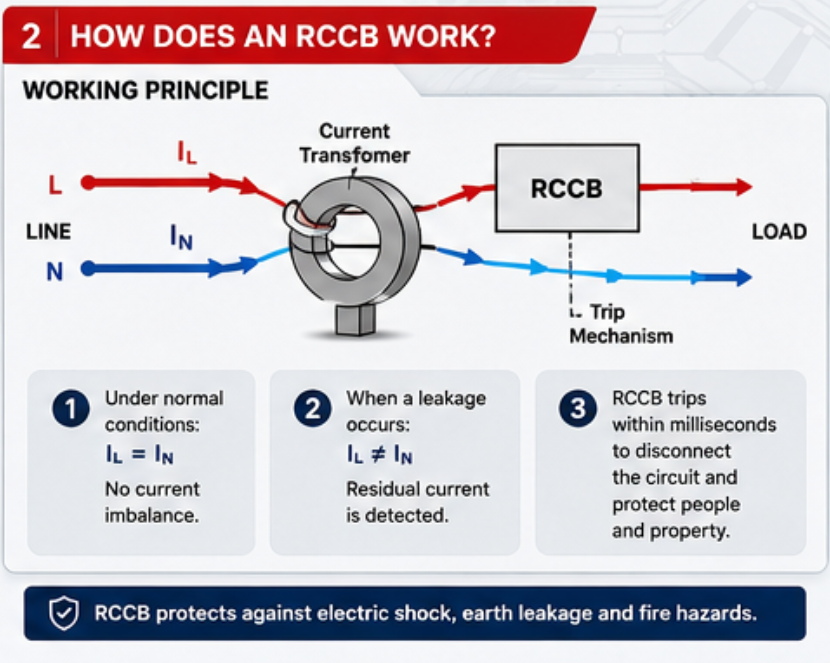
An RCCB (Residual Current Circuit Breaker) continuously monitors the current flowing through live and neutral conductors.
정상적인 조건에서:
Current entering = Current leaving
When an insulation fault or electric shock occurs:
Current entering ≠ Current leaving
The RCCB detects this imbalance and disconnects the circuit within milliseconds.
Unlike MCBs, RCCBs do not provide overload or short-circuit protection. Therefore, they are usually installed together with an MCB or integrated into an RCBO.
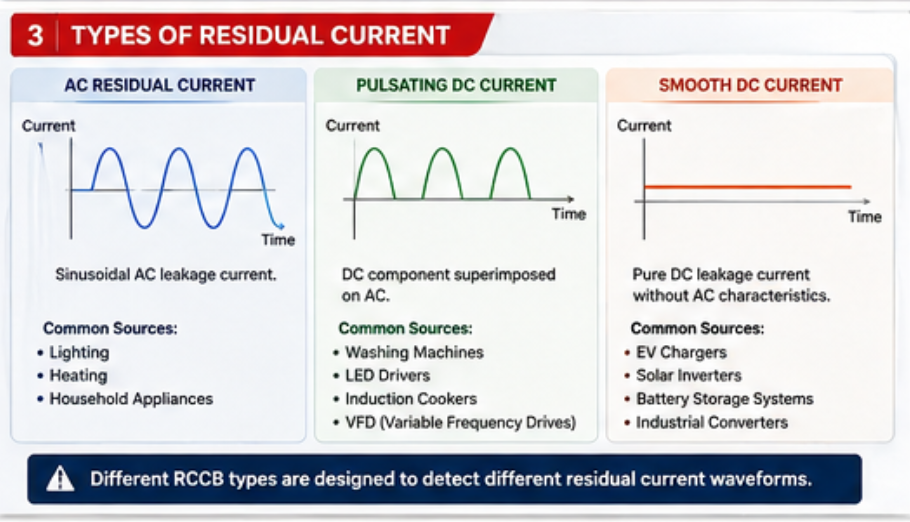
Before comparing Type A and Type B RCCBs, it is important to understand the different forms of residual current.
Modern electrical equipment can generate:
Traditional sinusoidal alternating current leakage.
Common sources:
Leakage current containing a DC component superimposed on AC.
Common sources:
Pure DC leakage current without AC characteristics.
Common sources:
Different RCCB types are designed to detect different combinations of these currents.
RCBO (과전류 잔류 전류 차단기) | 안전하고 신뢰할 수 있는 쿠앙야
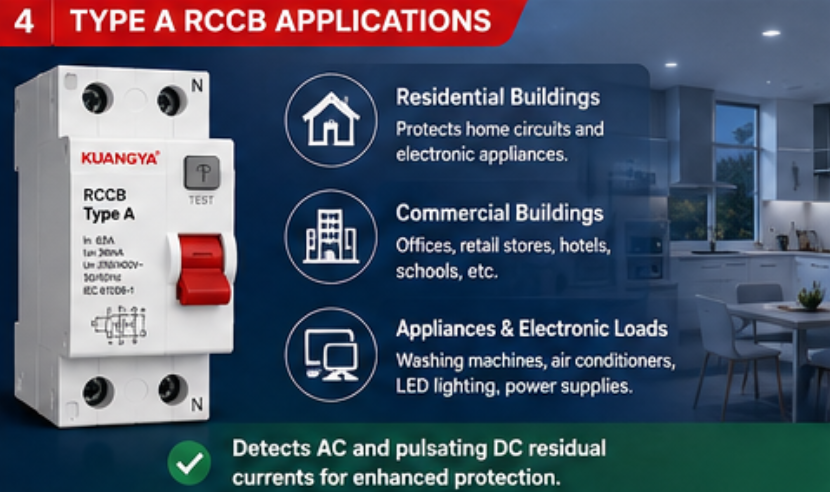
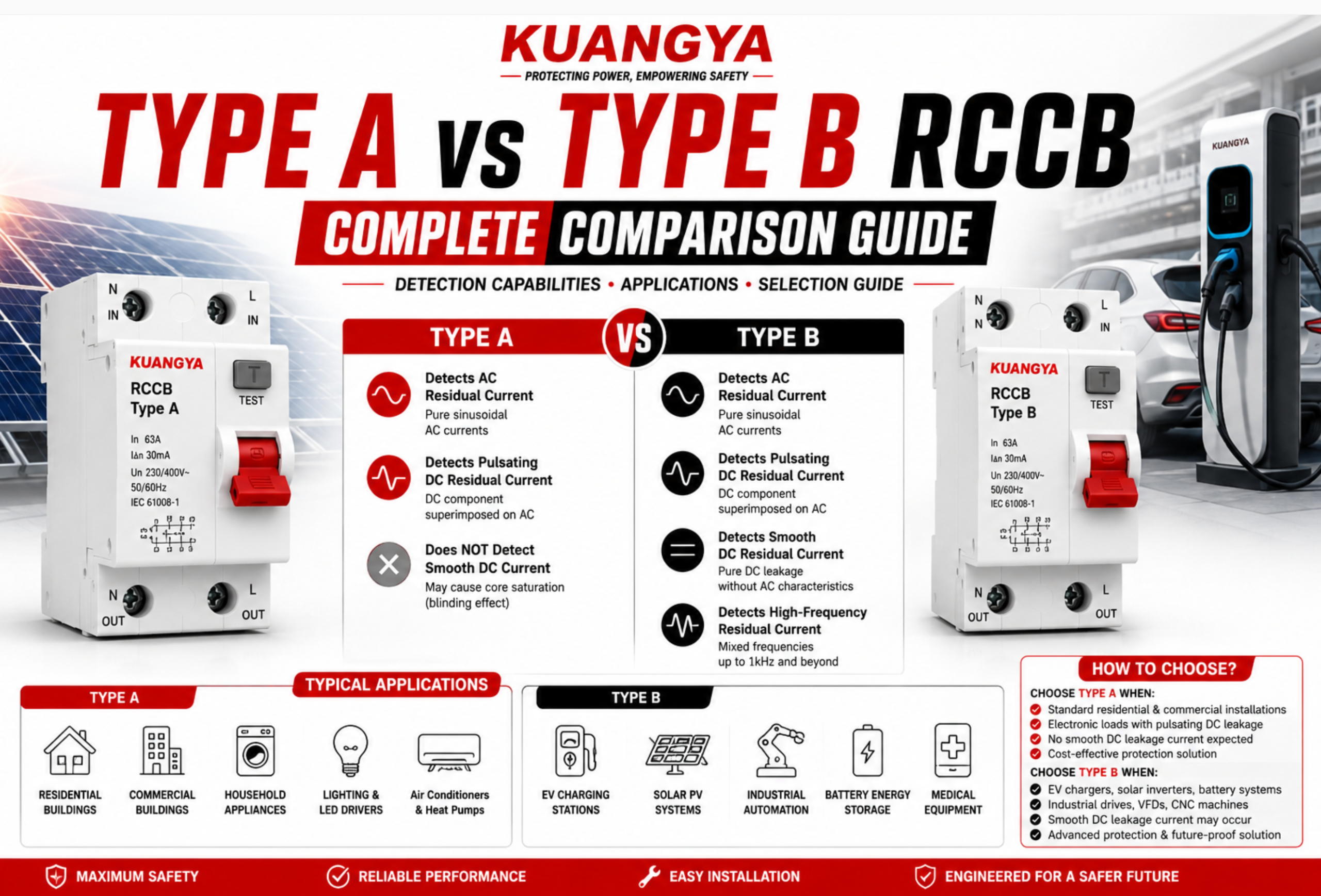
A Type A RCCB can detect:
✔ Sinusoidal AC residual currents
맥동 DC 잔류 전류
It provides improved protection compared to the older Type AC RCCB.
Type A RCCB responds to:
Type A RCCBs are widely used in:
Detects both AC and pulsating DC leakage currents.
Lower cost compared to Type B RCCBs.
Suitable for most residential and commercial applications.
Easy replacement and maintenance.
Type A RCCBs cannot reliably detect:
In such applications, Type B RCCBs are required.
RCBO (과전류 잔류 전류 차단기) | 안전하고 신뢰할 수 있는 쿠앙야
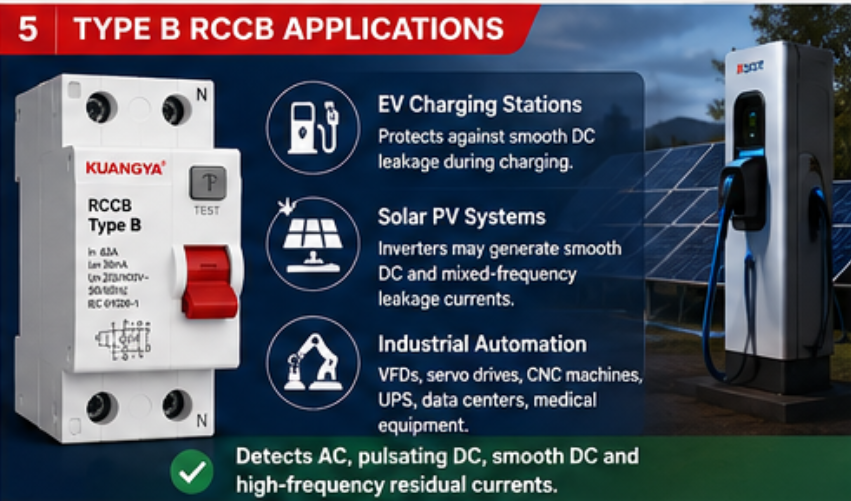
Type B RCCBs are the most advanced RCCB category.
감지할 수 있습니다:
AC 잔류 전류
맥동 DC 잔류 전류
부드러운 DC 잔류 전류
✔ Mixed-frequency leakage currents
고주파 잔류 전류 ✔ 고주파 잔류 전류
Type B RCCBs provide protection against:
Type B RCCBs are commonly installed in:
Provides the highest level of residual current detection.
Compatible with modern power electronics.
Reduces undetected leakage faults.
Required by many EV charging and renewable energy standards.
Type B RCCBs are significantly more expensive.
May require additional panel space.
Often requires specialist design considerations.
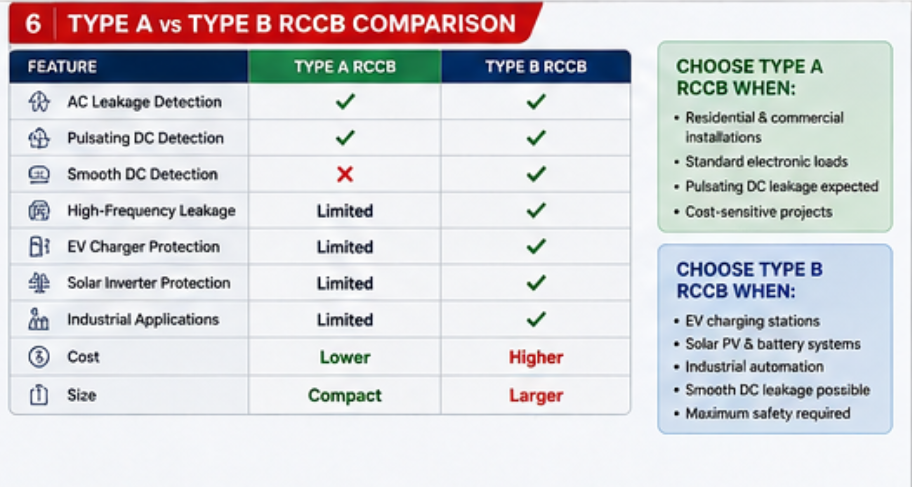
| 기능 | A형 RCCB | 유형 B RCCB |
|---|---|---|
| AC 누전 감지 | ✔ | ✔ |
| 맥동 DC 감지 | ✔ | ✔ |
| 부드러운 DC 감지 | ✘ | ✔ |
| High-Frequency Leakage | 제한적 | ✔ |
| EV Charger Protection | 제한적 | ✔ |
| 태양광 인버터 보호 | 제한적 | ✔ |
| Variable Frequency Drives | 제한적 | ✔ |
| 주거용 | ✔ | ✔ |
| 산업용 | 제한적 | ✔ |
| 비용 | Lower | 더 높음 |
Modern electronic equipment often uses rectifiers, inverters, and switching power supplies.
These devices can generate smooth DC leakage currents.
A major problem occurs when smooth DC current reaches a standard RCCB.
The DC component can saturate the magnetic core of the sensing transformer.
As a result:
This phenomenon is often called:
RCCB blinding
Type B RCCBs are specifically designed to prevent this issue.
Most modern homes contain appliances generating pulsating DC currents.
예를 들면 다음과 같습니다:
Type A RCCBs are generally recommended for residential installations.
Suitable for:
Any application where pulsating DC leakage may occur but smooth DC leakage is unlikely.
Electric vehicle chargers use AC/DC conversion technology.
Smooth DC leakage can occur during charging.
Many international standards require Type B protection or equivalent DC monitoring.
Solar inverters generate DC and AC components simultaneously.
Leakage currents may contain:
Type B RCCBs provide comprehensive protection.
Industrial equipment often includes:
These devices frequently generate DC leakage currents.
Critical medical equipment demands reliable fault detection.
Type B RCCBs offer enhanced safety.
Several standards define RCCB performance requirements.
Specifies requirements for RCCBs without integral overcurrent protection.
Defines advanced residual current devices including:
Provides installation guidance for low-voltage electrical systems.
Many EV charging regulations reference:
These often require Type B RCCBs or equivalent DC fault monitoring.
✔ Residential applications
✔ Commercial buildings
✔ Standard electronic appliances
✔ Cost-sensitive projects
✔ No smooth DC leakage expected
✔ EV charging stations
✔ Solar PV installations
✔ Battery storage systems
✔ Industrial automation
✔ Variable frequency drives
✔ Medical equipment
✔ Smooth DC leakage may occur
Many installers still use outdated Type AC RCCBs.
This can leave electronic loads insufficiently protected.
EV charging systems may generate smooth DC leakage currents.
A Type A RCCB alone may become ineffective.
Equipment manufacturers often specify the required RCCB type.
Failure to follow recommendations may void warranties.
RCCBs should be coordinated with:
Proper selectivity improves system reliability.
Electrical systems continue to evolve.
Key trends include:
Millions of EV chargers are being installed worldwide.
Demand for Type B RCCBs continues to rise.
Residential and commercial solar installations require advanced protection.
Building automation systems increasingly rely on power electronics.
Battery technologies introduce additional DC leakage risks.
As a result, Type B RCCBs are becoming more common in modern electrical infrastructure.
꼭 그렇지는 않습니다.
Type B offers broader protection but is only necessary when smooth DC leakage currents may occur.
For standard residential installations, Type A is usually sufficient.
아니요.
If smooth DC leakage is possible, Type A cannot provide the required protection.
In many installations, yes.
Local regulations and charger specifications should always be checked.
Type B RCCBs require advanced sensing technology capable of detecting multiple residual current waveforms and frequencies.
Yes, technically.
However, the additional cost is often unnecessary for ordinary residential circuits.
Understanding the differences between Type A and Type B RCCBs is essential for designing safe and compliant electrical systems.
Type A RCCBs are ideal for most residential and commercial applications, providing protection against AC and pulsating DC leakage currents. They offer an excellent balance between safety and cost.
Type B RCCBs deliver the highest level of protection by detecting AC, pulsating DC, smooth DC, and high-frequency residual currents. They are indispensable for EV charging stations, solar power systems, industrial automation, and other advanced electrical installations.
As renewable energy, electric vehicles, and power electronics become increasingly common, selecting the correct RCCB type is more important than ever. Investing in the right protection device ensures electrical safety, regulatory compliance, equipment reliability, and long-term system performance.

