温州市岳陽工業区 325000
勤務時間
月曜日~金曜日:午前7時~午後7時
週末午前10時~午後5時
温州市岳陽工業区 325000
勤務時間
月曜日~金曜日:午前7時~午後7時
週末午前10時~午後5時

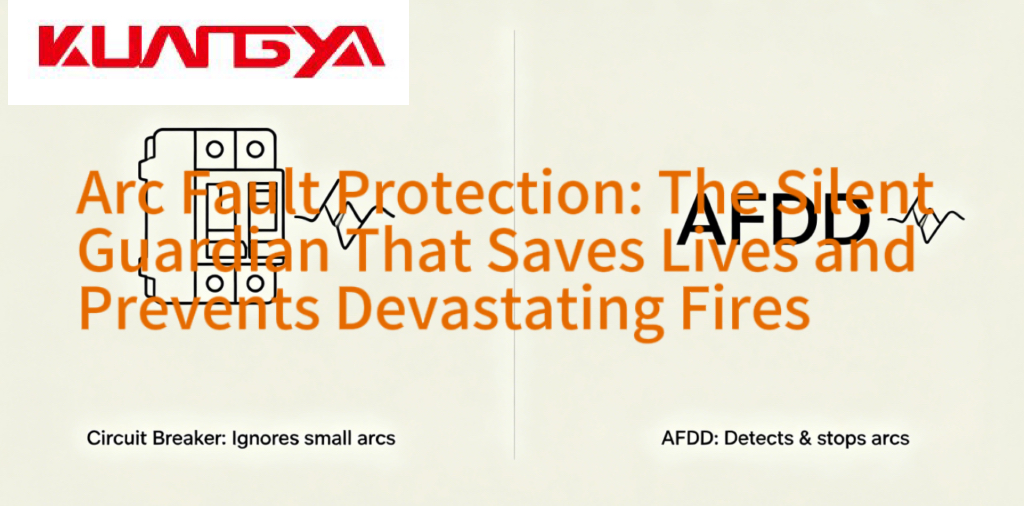
Every year, electrical fires cause thousands of deaths, injuries, and billions of dollars in property damage worldwide. The majority of these fires start with a dangerous electrical phenomenon called an arc fault.
Arc fault protection is the only technology specifically designed to detect and stop these invisible, deadly hazards before they ignite fires. It is one of the most critical safety innovations in modern electrical engineering.
Most people are familiar with circuit breakers and fuses, but these traditional devices cannot detect the low-current arcs that cause most electrical fires. This is where アークフォルト保護 becomes indispensable.
In this comprehensive guide, we will explore everything you need to know about アークフォルト保護, from how it works to where it is required, how to install it, and how to maintain it properly. We will reference leading industry standards from organizations like the 全米防火協会(NFPA) そして 国際電気標準会議(IEC) to ensure the most accurate and up-to-date information.
によると 全米防火協会(NFPA), electrical distribution or lighting equipment was involved in 44% of home structure fires in the United States between 2015 and 2019.
These fires resulted in an average of 420 deaths, 1,360 injuries, and $1.5 billion in direct property damage each year. Approximately 60% of these electrical fires are caused by arc faults that traditional protection devices fail to detect.
について 国際電気標準会議(IEC) reports similar statistics globally, with electrical fires accounting for 20-30% of all building fires in most countries.
These numbers highlight the urgent need for widespread adoption of アークフォルト保護 technology in both residential and commercial buildings. The Occupational Safety and Health Administration (OSHA) also recognizes arc faults as a significant workplace hazard, requiring appropriate protection measures in many industrial settings.

Arc fault protection refers to a set of technologies designed to detect abnormal electrical arcs in wiring systems and interrupt the circuit before the arc can ignite a fire.
The primary device used for this purpose is the Arc Fault Detection Device (AFDD), also known as an Arc Fault Circuit Interrupter (AFCI) in North America. These devices must meet strict performance standards set by Underwriters Laboratories (UL) and the IEC.
Arc fault protection devices continuously monitor the electrical current flowing through a circuit, looking for the unique waveform patterns that indicate an arc fault is occurring.
When a dangerous arc is detected, the device trips within milliseconds, cutting off power to the circuit and preventing a potential fire.
An electrical arc is a high-temperature discharge of electricity that jumps between two conductors. Arcs can reach temperatures of up to 35,000°F (19,400°C), which is hotter than the surface of the sun.
Even a small arc can ignite nearby combustible materials like wood, plastic, and insulation in less than a second. The Institute of Electrical and Electronics Engineers (IEEE) has published extensive research on the physics of electrical arcs and their fire ignition potential.
Arcs can occur for many reasons, including damaged wiring, loose connections, overloaded circuits, and damaged electrical cords.
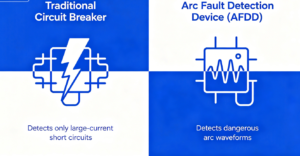
Unlike short circuits, which cause a large surge in current that traditional circuit breakers can detect, many dangerous arcs occur at normal current levels, making them invisible to conventional protection devices.
モダン アークフォルト保護 devices use advanced microprocessor technology to analyze the electrical waveform thousands of times per second.
They look for specific characteristics that distinguish dangerous arcs from normal arcing that occurs in everyday devices like light switches, motors, and vacuum cleaners.
These characteristics include:
When the device detects a pattern that matches a dangerous arc, it triggers an internal mechanism to open the circuit, typically within 25 milliseconds. The UL 1699 standard specifies the performance requirements for these detection algorithms to ensure both effectiveness and reliability.

Series arcs occur when there is a break in a single conductor, causing current to jump across the gap.
These are the most common type of arc fault and the most dangerous because they often occur at normal current levels that do not trip traditional circuit breakers.
Series arcs can be caused by:
A series arc drawing only 5 amps can generate enough heat to ignite most building materials. The NFPA Electrical Safety Foundation provides detailed information about how series arcs develop and how to prevent them.
Parallel arcs occur between two conductors of opposite polarity, such as a hot wire and a neutral wire or a hot wire and a ground wire.
These arcs typically draw higher currents than series arcs and may eventually trip a traditional circuit breaker.
However, even a parallel arc can generate enough heat to ignite a fire before the circuit breaker trips.
Parallel arcs are often caused by:
Ground arcs occur between a hot wire and a grounded surface, such as a metal electrical box or conduit.
These arcs are particularly dangerous because they can occur without drawing enough current to trip a traditional circuit breaker.
Ground arcs are a common cause of fires in older buildings with metal conduit systems. The IEC 60364 standard provides guidance on protecting against ground faults and arc faults in electrical installations.
| Arc Fault Type | 現在の範囲 | Detection Difficulty | 火災リスク | Common Causes |
|---|---|---|---|---|
| Series Arc | 5-30 amps | Very high | エクストリーム | Damaged wires, loose connections |
| Parallel Arc | 30-1000+ amps | 中程度 | 高い | Insulation breakdown, damaged cables |
| Ground Arc | 5-100 amps | 高い | Very high | Metal conduit contact, water intrusion |

Traditional circuit breakers are designed to protect against two conditions: overcurrent and short circuits.
They work by detecting when the current flowing through the circuit exceeds a predetermined threshold and tripping to prevent overheating of the wiring.
However, they cannot detect the low-current arcs that cause most electrical fires. A circuit breaker may never trip even as an arc is actively burning and generating enough heat to ignite a fire.
In fact, tests conducted by UL Laboratories have shown that a 15-amp circuit breaker will not trip even when a 10-amp series arc is burning continuously.

Residual Current Devices (RCDs), also known as Ground Fault Circuit Interrupters (GFCIs), are designed to detect current leakage to ground.
They are excellent at preventing electric shock, but they cannot detect series arcs or most parallel arcs.
Arc fault protection and RCD protection work together to provide comprehensive electrical safety. Arc fault protection prevents fires, while RCDs prevent electric shock.
Many modern devices combine both アークフォルト保護 and RCD protection in a single unit, providing complete circuit protection. The IEC 61008 standard defines the performance requirements for RCDs.
| Protection Device | Detects Overcurrent | Detects Short Circuits | Detects Arc Faults | Detects Ground Faults | 主な目的 |
|---|---|---|---|---|---|
| ヒューズ | はい | はい | いいえ | いいえ | 過電流保護 |
| Circuit Breaker (MCB) | はい | はい | いいえ | いいえ | 過電流保護 |
| RCD/GFCI | いいえ | いいえ | いいえ | はい | Electric shock prevention |
| AFDD/AFCI | はい | はい | はい | いいえ | Fire prevention |
| アールシーボ | はい | はい | いいえ | はい | Overcurrent + shock protection |
| AFDD+RCBO | はい | はい | はい | はい | Complete circuit protection |
In the United States and Canada, the 米国電気工事規定(NEC) has required アークフォルト保護 in residential bedrooms since 2002.
Subsequent code updates have expanded the requirement to include:
As of the 2023 NEC, アークフォルト保護 is required in virtually all areas of residential buildings, with very few exceptions.
The NEC requires combination-type AFCI devices that detect both series and parallel arcs, certified to the UL 1699B standard.
について 国際電気標準会議(IEC) published the first international standard for アークフォルト保護 devices in 2010: IEC 62606.
This standard defines the performance requirements and test methods for AFDDs for use in residential and similar applications.
Many European countries have adopted IEC 62606 into their national standards and have begun requiring アークフォルト保護 in new construction.
Germany was the first European country to mandate アークフォルト保護 in residential buildings, starting in 2017. Other countries, including France, Italy, and Spain, have since followed suit. The European Committee for Electrotechnical Standardization (CENELEC) has also adopted IEC 62606 as a European standard.
| 地域 | スタンダード | Mandatory Since | Required Locations | Device Type Required |
|---|---|---|---|---|
| 米国 | NEC 2023 | 2002 (expanded since) | All habitable rooms | Combination-type AFCI (UL 1699B) |
| Canada | CSA C22.1 | 2002 | All habitable rooms | Combination-type AFCI |
| ドイツ | DIN VDE 0100 | 2017 | All residential circuits | IEC 62606 compliant AFDD |
| France | NF C 15-100 | 2020 | All residential circuits | IEC 62606 compliant AFDD |
| United Kingdom | BS 7671 | 2022 | Most residential circuits | IEC 62606 compliant AFDD |
| オーストラリア | AS/NZS 3000 | 2023 | All habitable rooms | IEC 62606 compliant AFDD |

Arc fault protection is most commonly used in residential buildings, where it has been proven to significantly reduce the risk of electrical fires.
It should be installed on all circuits that power:
Even in older homes that were built before アークフォルト保護 was required, retrofitting AFDDs is a highly recommended safety upgrade. The NFPA recommends that all homes have AFCI protection installed in all bedrooms and living areas.
www.cnkuangya.com offers a complete range of residential アークフォルト保護 devices that are easy to install and compatible with most existing electrical systems.
一方 アークフォルト保護 is most commonly associated with residential buildings, it is also extremely important in commercial and industrial settings.
Commercial buildings that benefit from アークフォルト保護 include:
In industrial settings, アークフォルト保護 can help prevent fires in:
について OSHA Electrical Safety Standard requires employers to provide a safe workplace, which includes protecting against electrical hazards like arc faults.
www.cnkuangya.com provides industrial-grade アークフォルト保護 solutions designed to withstand the harsh conditions of industrial environments.
Arc fault protection is also used in a variety of specialized applications, including:
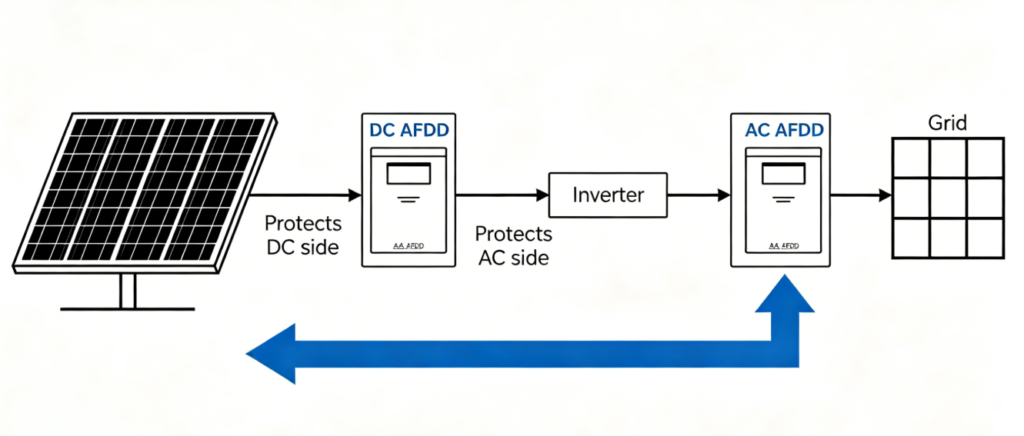
In each of these applications, アークフォルト保護 provides an additional layer of safety that traditional protection devices cannot match. For solar systems, the IEC 62548 standard specifically requires arc fault protection on both the DC and AC sides of photovoltaic installations.
Understanding the common causes of arc faults can help you prevent them from occurring in your home or business.
The most common causes include:
について Electrical Safety Foundation International (ESFI) provides a comprehensive list of arc fault causes and prevention strategies.
一方 アークフォルト保護 is the best defense against electrical fires caused by arcs, there are also steps you can take to prevent arcs from occurring in the first place.
| Common Cause | Prevention Method | 警告のサイン |
|---|---|---|
| 配線の損傷 | Regular inspections, avoid drilling into walls | Flickering lights, burning smells |
| 接続の緩み | Tighten connections, use proper wire nuts | Warm outlets, buzzing sounds |
| Overloaded circuits | Distribute loads across multiple circuits | Frequently tripping breakers |
| Damaged cords | Replace damaged cords immediately | Exposed wires, cracked insulation |
| Water intrusion | Keep electrical systems dry, install GFCI protection | Tripping GFCI outlets |

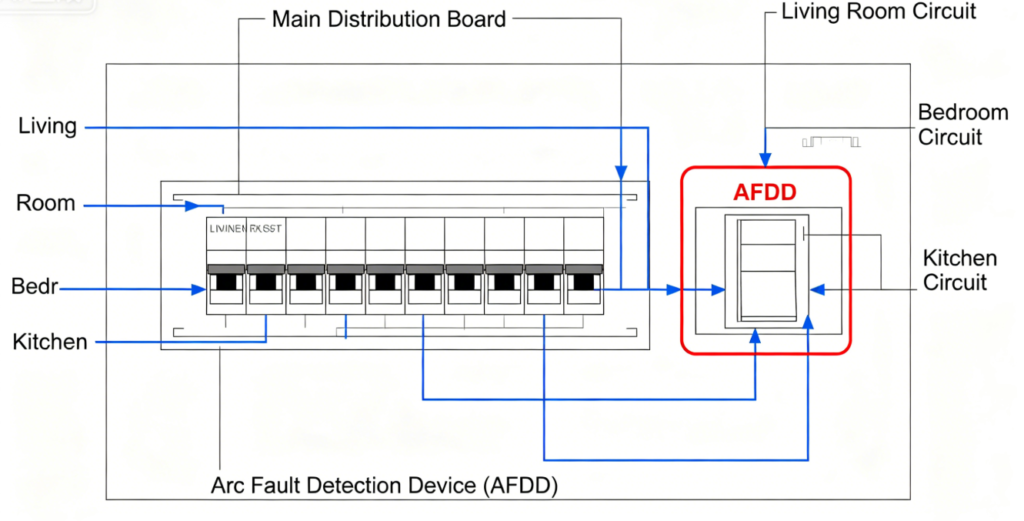
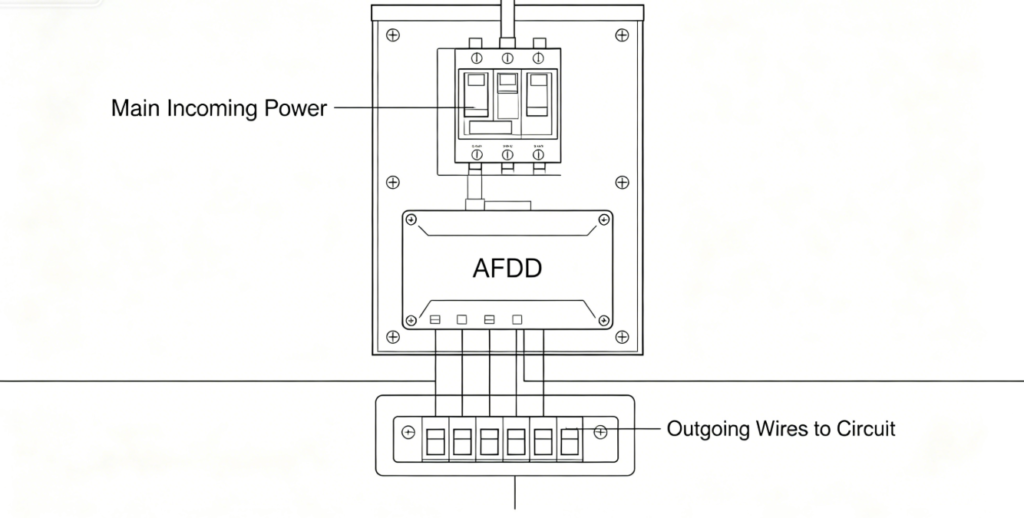
Arc fault protection devices should be installed by a licensed electrician who is familiar with local electrical codes and regulations.
The installation process typically involves:
It is important to use only アークフォルト保護 devices that are listed by a recognized testing laboratory, such as UL, 南部連合, あるいは 国際電気標準会議.
www.cnkuangya.com offers a wide selection of tested and certified アークフォルト保護 devices that meet all international safety standards.
Arc fault protection devices should be tested monthly to ensure they are working properly.
Most devices have a test button that simulates an arc fault and verifies that the device will trip when an arc is detected. The NFPA recommends monthly testing of all AFCI devices.
To test an AFDD/AFCI:
In addition to monthly testing, アークフォルト保護 devices should be inspected annually by a licensed electrician.
One common issue with アークフォルト保護 devices is nuisance tripping, which occurs when the device trips even though there is no dangerous arc present.
Nuisance tripping can be caused by:
について UL White Paper on Nuisance Tripping provides detailed guidance on identifying and resolving this issue. Using ENERGY STAR certified LED lights and appliances can also help reduce nuisance tripping.
If you experience nuisance tripping, try the following:
A: Yes, modern combination-type アークフォルト保護 devices can detect series arcs in extension cords, as long as the arc occurs on the load side of the device.
However, the ability to detect arcs decreases as the length of the extension cord increases. For this reason, it is recommended to use the shortest possible extension cord for your needs. The IEC 62606 standard specifies the maximum cord length for reliable arc detection.
It is also important to note that アークフォルト保護 cannot detect arcs that occur on the line side of the device, such as in the wiring between the main panel and the AFDD.
A: Arc fault protection devices sometimes trip with LED lights because many LED drivers generate electrical noise that can mimic the waveform of an arc fault.
This is particularly common with cheaper, non-certified LED lights that do not have proper filtering to reduce electrical noise. The IEEE Transactions on Power Electronics has published research on this phenomenon and how to mitigate it.
To prevent this issue, use only LED lights that are certified as compatible with アークフォルト保護 devices. You can also try installing a line filter on the circuit to reduce electrical noise.
A: Yes, アークフォルト保護 devices can be used with solar photovoltaic systems, but special considerations must be taken.
Solar systems generate DC power, which has different arcing characteristics than AC power. Therefore, special DC アークフォルト保護 devices are required for the DC side of solar systems. The NEC 690.11 requires DC arc fault protection for all residential solar systems installed after 2014.
The AC side of solar systems can be protected with standard AC アークフォルト保護 devices. www.cnkuangya.com offers both DC and AC アークフォルト保護 solutions for solar applications.
A: No, it is not safe or legal to replace an アークフォルト保護 device with a regular circuit breaker in locations where アークフォルト保護 is required by code.
Doing so removes the only protection against arc faults and significantly increases the risk of an electrical fire. It may also void your insurance coverage in the event of a fire. The NFPA warns against removing or bypassing AFCI devices.
If you are experiencing nuisance tripping, consult a licensed electrician to identify and resolve the issue rather than replacing the AFDD with a regular breaker.
A: Arc fault protection devices have a typical lifespan of 10-15 years, similar to other circuit breakers.
However, they should be replaced immediately if:
について UL Product Safety Guide recommends replacing all electrical protection devices every 10-15 years to ensure optimal performance.
Regular testing and maintenance will help ensure that your アークフォルト保護 devices continue to provide reliable protection for many years.
Arc fault protection technology is constantly evolving, with manufacturers developing more advanced detection algorithms that can better distinguish between dangerous arcs and normal arcing.
Newer devices use artificial intelligence and machine learning to analyze electrical waveforms with greater accuracy, reducing nuisance tripping while improving detection of dangerous arcs. The IEEE Power & Energy Society is actively researching new arc fault detection technologies.
Future アークフォルト保護 devices may also be able to:
The integration of アークフォルト保護 with smart home technology is one of the most exciting developments in the field.
Smart AFDDs can connect to your home’s Wi-Fi network and send alerts to your smartphone or tablet when an arc fault is detected.
They can also provide detailed information about the circuit, including energy usage, voltage levels, and the number of times the device has tripped.
This allows homeowners to monitor their electrical system remotely and address potential issues before they become dangerous. Several leading manufacturers have already introduced smart AFDD products that integrate with popular smart home platforms.
As the benefits of アークフォルト保護 become more widely recognized, more countries around the world are adopting mandatory requirements for its installation.
The IEC estimates that by 2030, アークフォルト保護 will be required in new residential construction in more than 50 countries worldwide.
This widespread adoption will help save thousands of lives and prevent billions of dollars in property damage each year. The World Health Organization (WHO) has also recognized electrical fires as a significant public health issue and supports the adoption of arc fault protection measures.
www.cnkuangya.com is committed to developing and manufacturing high-quality アークフォルト保護 devices that meet the evolving needs of the global market.
Arc fault protection is not just another electrical code requirement – it is a life-saving technology that has been proven to reduce the risk of electrical fires by up to 80%.
Traditional electrical protection devices like circuit breakers and fuses are simply not designed to detect the low-current arcs that cause most electrical fires. Only アークフォルト保護 can provide this critical layer of safety.
Whether you are building a new home, renovating an existing one, or upgrading your commercial electrical system, installing アークフォルト保護 devices is one of the most important investments you can make in the safety of your family, employees, and property.
As アークフォルト保護 technology continues to advance and become more affordable, there is no reason not to have it installed in every circuit in your home or business.
についての詳細はこちら アークフォルト保護 製品とソリューション www.cnkuangya.com today. Their team of experienced professionals can help you select the right アークフォルト保護 devices for your specific needs and ensure they are installed correctly.
Don’t wait until it’s too late. Protect your home, your family, and your business with アークフォルト保護 – the silent guardian that saves lives.