Zone industrielle WengYang Yueqing Wenzhou 325000
Heures de travail
Du lundi au vendredi : de 7h00 à 19h00
Le week-end : 10H00 - 17H00
Zone industrielle WengYang Yueqing Wenzhou 325000
Heures de travail
Du lundi au vendredi : de 7h00 à 19h00
Le week-end : 10H00 - 17H00

Introduction
RCBO (Residual Current Breaker with Overcurrent) | Sûr et fiable Kuangya
Les disjoncteurs à courant résiduel (RCCB) font partie des dispositifs de sécurité les plus importants utilisés dans les installations électriques modernes. Leur objectif premier est de protéger les personnes et les biens contre les chocs électriques, les défauts de fuite à la terre et les risques d'incendie causés par les défauts d'isolation.
Cependant, tous les RCCB ne sont pas conçus pour détecter le même type de courant de fuite. Les systèmes électriques devenant de plus en plus dépendants de l'électronique de puissance, des variateurs de fréquence (VFD), des chargeurs de véhicules électriques, des onduleurs solaires et des équipements d'automatisation industrielle, le choix du bon type de RCCB devient critique.
Parmi les options les plus couramment discutées, on peut citer Type A RCCB et Type B RCCB. Bien qu'ils offrent tous deux une protection contre les courants résiduels, leurs capacités de détection diffèrent considérablement.
Le choix d'un mauvais type peut entraîner :
Dans ce guide, nous expliquerons les différences entre les RCCB de type A et de type B, leurs principes de fonctionnement, leurs applications, leurs avantages, leurs limites et leurs critères de sélection.
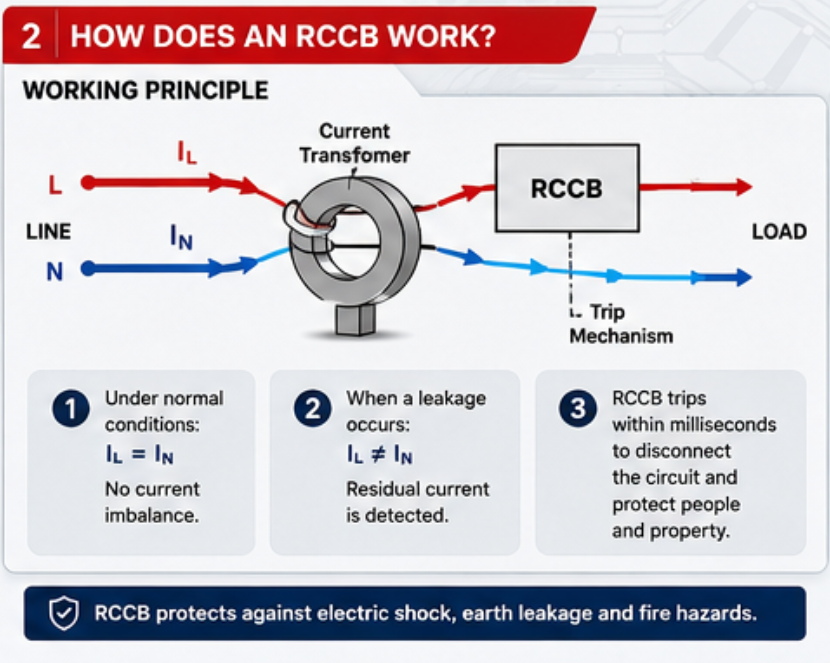
Un RCCB (Residual Current Circuit Breaker) surveille en permanence le courant circulant dans les conducteurs sous tension et neutres.
Dans des conditions normales :
Entrée actuelle = Sortie actuelle
En cas de défaut d'isolation ou de choc électrique :
Courant entrant ≠ Courant sortant
Le RCCB détecte ce déséquilibre et déconnecte le circuit en quelques millisecondes.
Contrairement aux MCB, les RCCB ne fournissent pas de protection contre les surcharges ou les courts-circuits. C'est pourquoi ils sont généralement installés avec un MCB ou intégrés dans un RCBO.
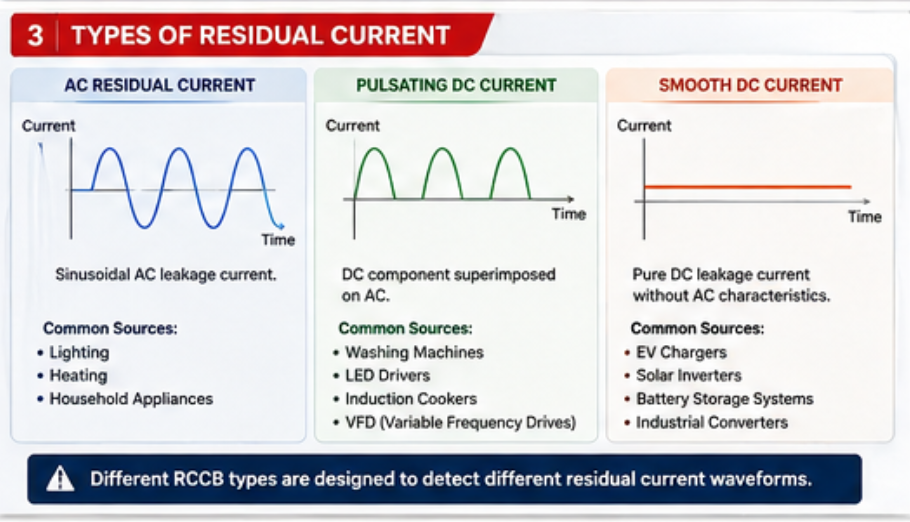
Avant de comparer les RCCB de type A et de type B, il est important de comprendre les différentes formes de courant résiduel.
Les équipements électriques modernes peuvent générer :
Fuite de courant alternatif sinusoïdal traditionnel.
Sources communes :
Courant de fuite contenant une composante continue superposée à une composante alternative.
Sources communes :
Courant de fuite en courant continu pur sans caractéristiques en courant alternatif.
Sources communes :
Les différents types de RCCB sont conçus pour détecter différentes combinaisons de ces courants.
RCBO (Residual Current Breaker with Overcurrent) | Sûr et fiable Kuangya
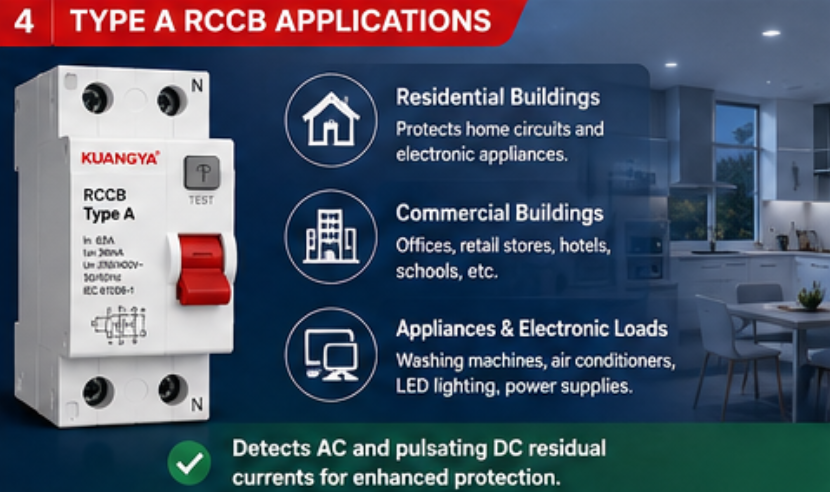
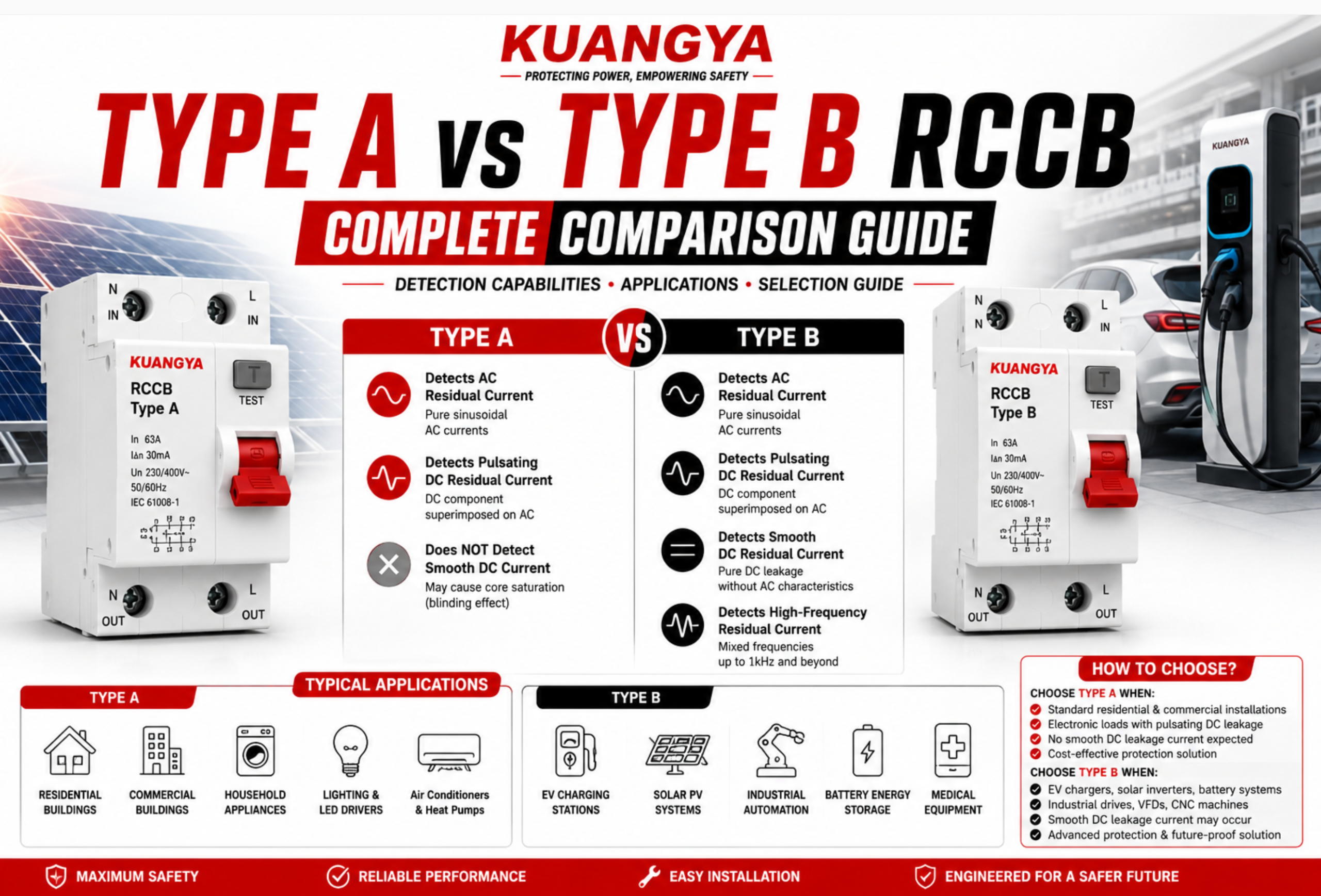
Un RCCB de type A peut détecter :
✔ Courants résiduels sinusoïdaux en courant alternatif
✔ Courants résiduels continus pulsés
Il offre une protection améliorée par rapport à l'ancien RCCB de type AC.
Le RCCB de type A répond à :
Les RCCB de type A sont largement utilisés dans :
Détecte les courants de fuite alternatifs et les courants continus pulsés.
Coût inférieur à celui des RCCB de type B.
Convient à la plupart des applications résidentielles et commerciales.
Remplacement et entretien faciles.
Les RCCB de type A ne peuvent pas détecter de manière fiable :
Dans ces applications, des RCCB de type B sont nécessaires.
RCBO (Residual Current Breaker with Overcurrent) | Sûr et fiable Kuangya
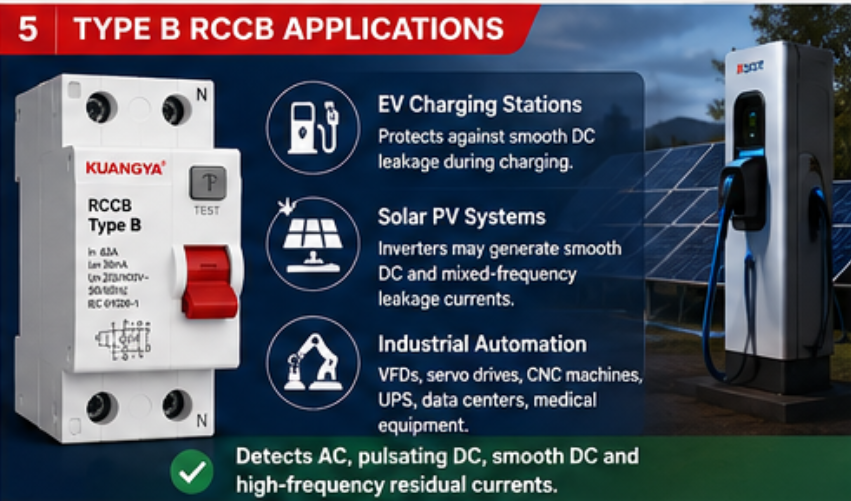
Les RCCB de type B constituent la catégorie de RCCB la plus avancée.
Ils peuvent détecter :
✔ Courants résiduels en courant alternatif
✔ Courants résiduels continus pulsés
✔ Courants résiduels continus lisses
✔ Courants de fuite à fréquence mixte
✔ Courants résiduels à haute fréquence
Les RCCB de type B offrent une protection contre :
Les RCCB de type B sont généralement installés dans :
Fournit le plus haut niveau de détection de courant résiduel.
Compatible avec l'électronique de puissance moderne.
Réduit les défauts d'étanchéité non détectés.
Exigée par de nombreuses normes relatives à la recharge des VE et aux énergies renouvelables.
Les RCCB de type B sont nettement plus chères.
Peut nécessiter un espace supplémentaire sur le panneau.
Il faut souvent faire appel à des spécialistes pour la conception.
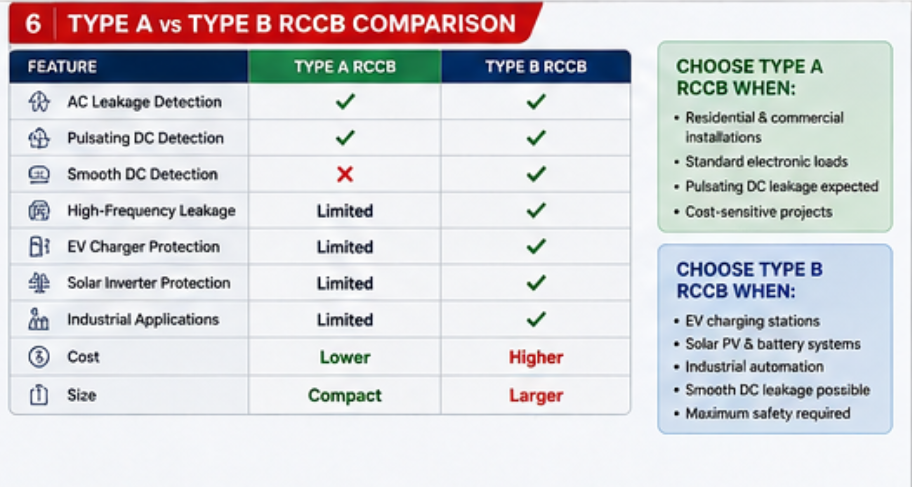
| Fonctionnalité | Type A RCCB | Type B RCCB |
|---|---|---|
| Détection des fuites de courant alternatif | ✔ | ✔ |
| Détection de courant continu pulsé | ✔ | ✔ |
| Détection régulière du courant continu | ✘ | ✔ |
| Fuites à haute fréquence | Limitée | ✔ |
| Protection des chargeurs de VE | Limitée | ✔ |
| Protection de l'onduleur solaire | Limitée | ✔ |
| Entraînements à fréquence variable | Limitée | ✔ |
| Usage résidentiel | ✔ | ✔ |
| Utilisation industrielle | Limitée | ✔ |
| Coût | Plus bas | Plus élevé |
Les équipements électroniques modernes utilisent souvent des redresseurs, des onduleurs et des alimentations à découpage.
Ces dispositifs peuvent générer des courants de fuite continus réguliers.
Un problème majeur se pose lorsqu'un courant continu régulier atteint un RCCB standard.
La composante continue peut saturer le noyau magnétique du transformateur de détection.
En conséquence :
Ce phénomène est souvent appelé :
RCCB à l'aveugle
Les RCCB de type B sont spécifiquement conçues pour éviter ce problème.
La plupart des maisons modernes contiennent des appareils générant des courants continus pulsés.
En voici quelques exemples :
Les RCCB de type A sont généralement recommandés pour les installations résidentielles.
Convient pour :
Toute application où des fuites de courant continu pulsé peuvent se produire, mais où des fuites de courant continu régulier sont peu probables.
Les chargeurs de véhicules électriques utilisent la technologie de conversion AC/DC.
Des fuites de courant continu peuvent se produire pendant la charge.
De nombreuses normes internationales exigent une protection de type B ou une surveillance équivalente du courant continu.
Les onduleurs solaires génèrent simultanément des composantes de courant continu et de courant alternatif.
Les courants de fuite peuvent contenir :
Les RCCB de type B offrent une protection complète.
Les équipements industriels comprennent souvent
Ces dispositifs génèrent souvent des courants de fuite en courant continu.
Les équipements médicaux critiques exigent une détection fiable des défaillances.
Les RCCB de type B offrent une sécurité accrue.
Plusieurs normes définissent les exigences de performance des RCCB.
Spécifie les exigences relatives aux RCCB sans protection intégrée contre les surintensités.
Définit les dispositifs à courant différentiel résiduel avancés, notamment
Fournit des conseils d'installation pour les systèmes électriques à basse tension.
De nombreuses réglementations relatives à la recharge des VE font référence :
Ceux-ci nécessitent souvent des RCCB de type B ou une surveillance équivalente des défauts de courant continu.
✔ Applications résidentielles
✔ Bâtiments commerciaux
✔ Appareils électroniques standard
✔ Projets sensibles aux coûts
✔ Aucune fuite de courant continu n'est attendue
✔ Bornes de recharge pour véhicules électriques
✔ Installations photovoltaïques
✔ Systèmes de stockage par batterie
✔ Automatisation industrielle
✔ Entraînements à fréquence variable
✔ Matériel médical
✔ Des fuites de courant continu peuvent se produire
De nombreux installateurs utilisent encore des RCCB de type AC obsolètes.
Les charges électroniques peuvent ainsi être insuffisamment protégées.
Les systèmes de charge des VE peuvent générer des courants de fuite continus réguliers.
Un RCCB de type A seul peut devenir inefficace.
Les fabricants d'équipement spécifient souvent le type de RCCB requis.
Le non-respect des recommandations peut entraîner l'annulation des garanties.
Les RCCB devraient être coordonnées avec :
Une bonne sélectivité améliore la fiabilité du système.
Les systèmes électriques continuent d'évoluer.
Les principales tendances sont les suivantes :
Des millions de chargeurs de VE sont en cours d'installation dans le monde entier.
La demande de RCCB de type B continue d'augmenter.
Les installations solaires résidentielles et commerciales nécessitent une protection avancée.
Les systèmes d'automatisation des bâtiments reposent de plus en plus sur l'électronique de puissance.
Les technologies des batteries présentent des risques supplémentaires de fuite de courant continu.
Par conséquent, les RCCB de type B sont de plus en plus courants dans les infrastructures électriques modernes.
Pas nécessairement.
Le type B offre une protection plus large mais n'est nécessaire que lorsque des courants de fuite continus lisses peuvent se produire.
Pour les installations résidentielles standard, le type A est généralement suffisant.
Non.
Si une fuite régulière de courant continu est possible, le type A ne peut pas fournir la protection requise.
Dans de nombreuses installations, oui.
Les réglementations locales et les spécifications du chargeur doivent toujours être vérifiées.
Les RCCB de type B nécessitent une technologie de détection avancée capable de détecter plusieurs formes d'ondes et fréquences de courant résiduel.
Oui, techniquement.
Toutefois, le coût supplémentaire est souvent inutile pour les circuits résidentiels ordinaires.
Il est essentiel de comprendre les différences entre les RCCB de type A et de type B pour concevoir des systèmes électriques sûrs et conformes.
Les RCCB de type A sont idéaux pour la plupart des applications résidentielles et commerciales, car ils offrent une protection contre les courants de fuite alternatifs et continus pulsés. Ils offrent un excellent équilibre entre sécurité et coût.
Les RCCB de type B offrent le niveau de protection le plus élevé en détectant le courant alternatif, le courant continu pulsé, le courant continu régulier et les courants résiduels à haute fréquence. Ils sont indispensables pour les stations de recharge de véhicules électriques, les systèmes d'énergie solaire, l'automatisation industrielle et d'autres installations électriques de pointe.
Les énergies renouvelables, les véhicules électriques et l'électronique de puissance devenant de plus en plus courants, il est plus important que jamais de sélectionner le bon type de RCCB. Investir dans le bon dispositif de protection garantit la sécurité électrique, la conformité réglementaire, la fiabilité de l'équipement et la performance à long terme du système.

