Zona industrial de WengYang Yueqing Wenzhou 325000
Horas de trabajo
De lunes a viernes: de 7.00 a 19.00 horas
Fin de semana: 10.00 A 17.00 HORAS
Zona industrial de WengYang Yueqing Wenzhou 325000
Horas de trabajo
De lunes a viernes: de 7.00 a 19.00 horas
Fin de semana: 10.00 A 17.00 HORAS

¿Por qué se dispara un RCCB o RCBO cuando un ATS cambia a energía de generador? Compare las disposiciones de neutro, la puesta a tierra y las rutas de fuga, luego siga una lista de comprobación de diagnóstico segura respaldada por las directrices del fabricante.
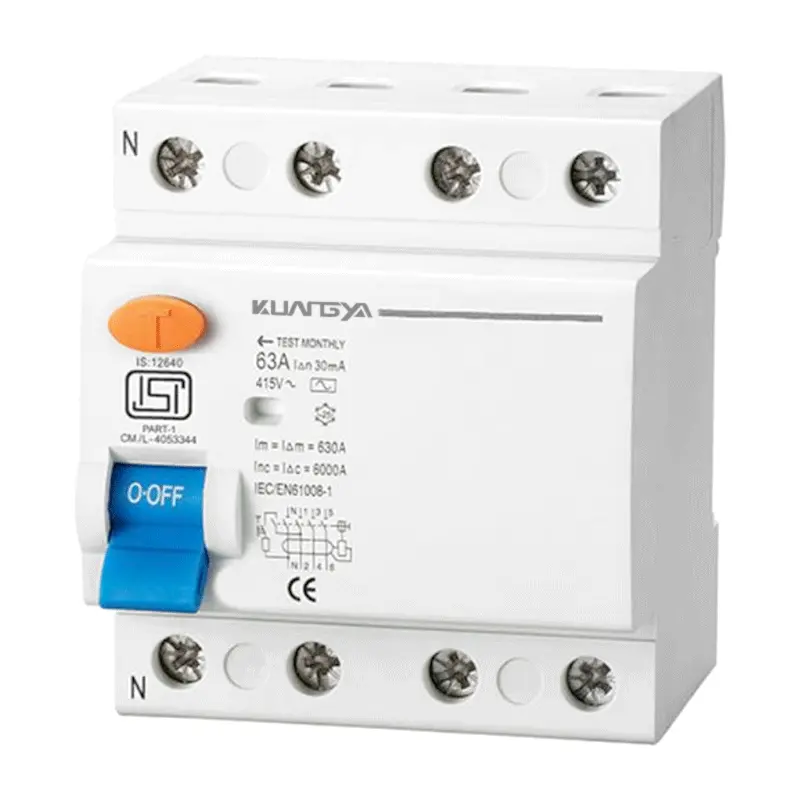
Respuesta rápida: If an RCCB or RCBO trips when an automatic transfer switch (ATS) moves a load from utility power to a generator, do not simply fit a less sensitive device. The electrician should trace both source paths and check neutral switching, neutral-to-earth bonding, all conductors passing through the residual-current sensor, connected equipment leakage and the device’s exact operating conditions. A trip can indicate a real fault or an unintended return path; the symptom alone cannot identify which.
An RCD compares current flowing through all active conductors of the protected circuit, including the neutral where present. If some current returns by another path, the imbalance can cause a trip. Schneider Electric’s RCD explanation describes this sensing principle. During transfer, the source, neutral connection and earthing arrangement may change. Generator start-up can also bring loads back online together; a faulty appliance or cumulative leakage may appear at that moment. These are possibilities to test, not a diagnosis from the timing alone.
| Arrangement | What changes | Review before selecting the RCD |
|---|---|---|
| Solid neutral ATS | The load neutral remains connected to the normal-source neutral while phase conductors transfer. | Where is the intended neutral-to-earth bond? Is there another bond at the generator that creates parallel return paths? |
| Switched neutral ATS | The neutral is transferred with the phase conductors. | How is the generator source bonded when selected? Are earthing and protective conductors continuous as required? |
Neither option is automatically correct for every installation. The arrangement depends on the system earthing design, generator configuration, national rules and the transfer equipment. Schneider Electric’s generator grounding example explains how a solid neutral and a switched neutral lead to different source-grounding schemes. Its ASCO neutral-switching white paper documents the design choice. These are third-party application examples, not proof that one Kuangya model is approved for a specific ATS.
Victron Energy’s Wiring Unlimited guidance explains why a neutral-to-earth link and the source mode matter for RCD operation in generator or inverter systems. It also warns that a TEST button check is not a test of the complete installation. The exact bonding point and method must follow local wiring rules and the actual equipment design.
En RCCB provides residual-current protection but needs appropriate overcurrent protection. An RCBO combines residual-current and overcurrent functions in one device. Neither fixes a neutral-bonding error. Larger systems may also use separate ground-fault sensing and protective coordination; do not treat a small final-circuit RCCB as interchangeable with that scheme. The Guía de RCCB frente a RCBO covers the functional difference, while our TEST-button guide explains the limits of that check.
Schneider Electric describes real transfer-switch design configurations with either a solid or switched neutral and relates them to generator grounding and ground-fault sensing. Victron documents the source-bonding issue in generator and inverter installations. Together, these published engineering examples show why a trip after transfer calls for a system review. We do not have a verified Kuangya customer installation, measured leakage record or before-and-after repair report for this exact symptom, so no such result is claimed here.
Send the single-line diagram, supply and generator voltage, earthing arrangement, ATS pole count and neutral configuration, generator bonding instructions, circuit loads, prospective fault current, required residual-current protection and the location of each proposed RCCB/RCBO. Ask for the exact product datasheet, wiring instructions and market-specific certification evidence. The SPD placement guide for generator and ATS systems covers the separate surge-protection question.
Do not change sensitivity as a shortcut. Protection requirements depend on circuit purpose and local rules. First locate the fault or unintended current path; have a qualified designer assess any protection change.
No. A switched neutral may be appropriate for a separately derived arrangement, but it must be coordinated with the generator bond and the whole earthing scheme. An unrelated appliance fault or shared downstream neutral can still trip an RCD.
No. It checks part of the device’s mechanism under the specified conditions. It does not prove the complete fault path, earthing arrangement, operating time or protection of every circuit.
Editorial responsibility: elaine, Kuangya Electric. This article summarizes the cited manufacturer guidance for engineering review. It is not a site-specific wiring instruction; isolation, testing and correction of mains or generator circuits belong to qualified electrical personnel.

