Zona industrial de WengYang Yueqing Wenzhou 325000
Horas de trabajo
De lunes a viernes: de 7.00 a 19.00 horas
Fin de semana: 10.00 A 17.00 HORAS
Zona industrial de WengYang Yueqing Wenzhou 325000
Horas de trabajo
De lunes a viernes: de 7.00 a 19.00 horas
Fin de semana: 10.00 A 17.00 HORAS

Introducción
RCBO (Interruptor diferencial con sobreintensidad) | Kuangya seguro y fiable
Los interruptores diferenciales son uno de los dispositivos de seguridad más importantes utilizados en las instalaciones eléctricas modernas. Su objetivo principal es proteger a las personas y los bienes de las descargas eléctricas, las fugas a tierra y los riesgos de incendio causados por fallos de aislamiento.
Sin embargo, no todos los interruptores diferenciales están diseñados para detectar el mismo tipo de corriente de fuga. A medida que los sistemas eléctricos dependen cada vez más de la electrónica de potencia, los variadores de frecuencia (VFD), los cargadores de vehículos eléctricos, los inversores solares y los equipos de automatización industrial, la elección del tipo de RCCB correcto se vuelve fundamental.
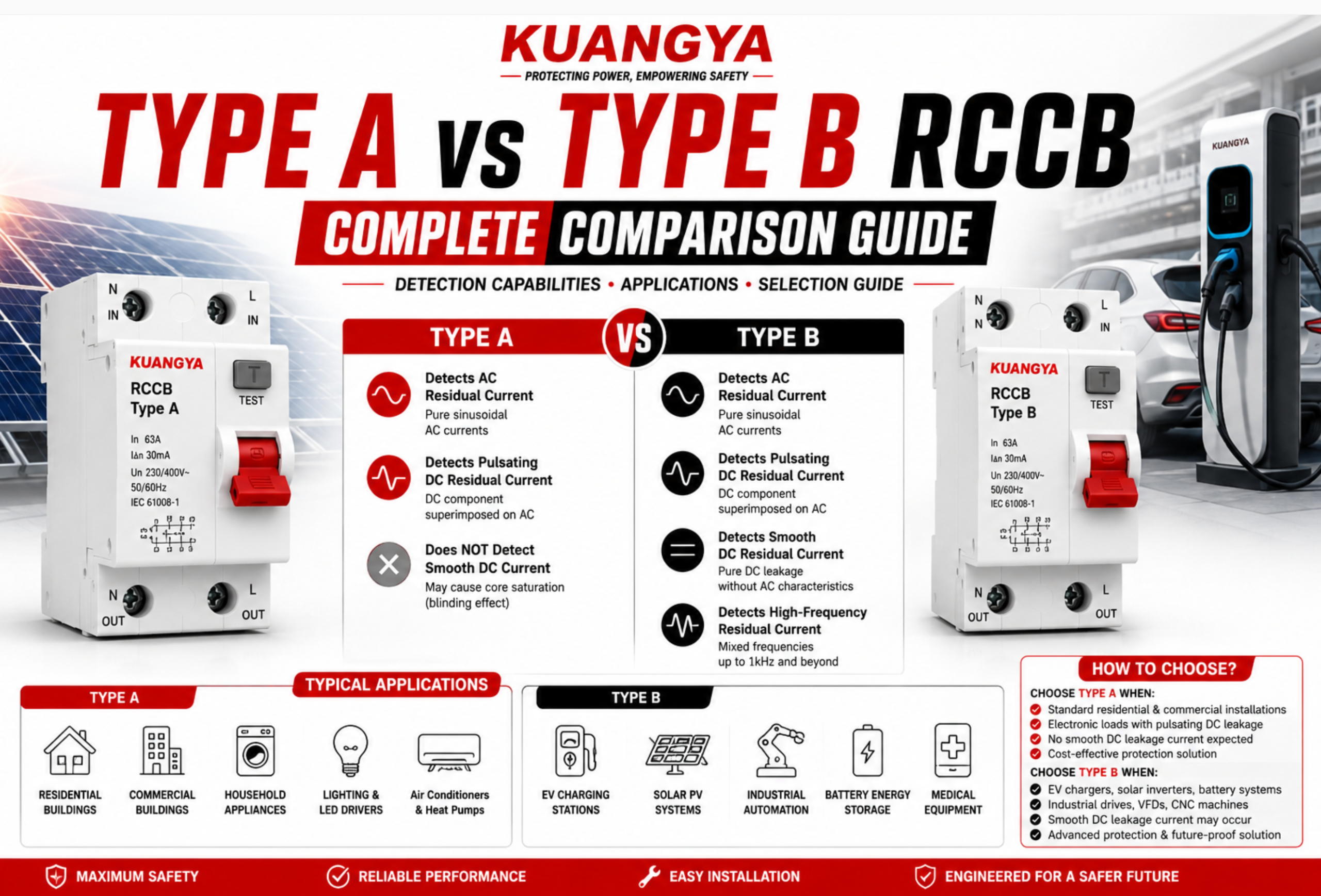
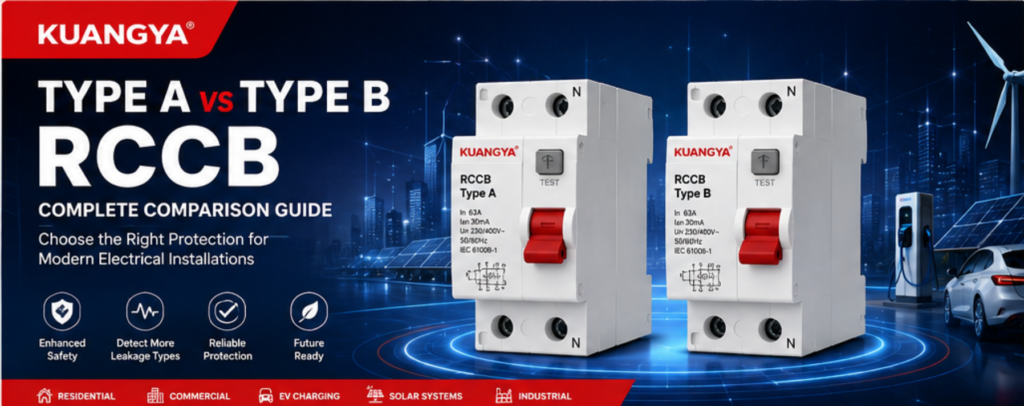
Entre las opciones más discutidas se encuentran Tipo A RCCB y Tipo B RCCB. Aunque ambos proporcionan protección diferencial, sus capacidades de detección difieren significativamente.
Elegir el tipo incorrecto puede provocar:
En esta guía, explicaremos las diferencias entre los RCCB de tipo A y de tipo B, sus principios de funcionamiento, aplicaciones, ventajas, limitaciones y criterios de selección.
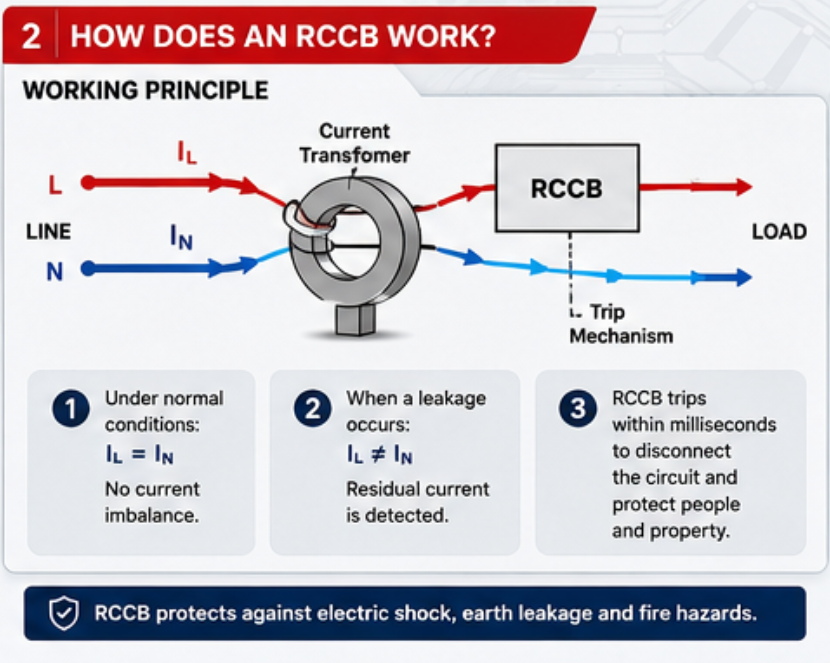
Un RCCB (interruptor diferencial residual) supervisa continuamente la corriente que circula por los conductores vivos y neutros.
En condiciones normales:
Corriente que entra = Corriente que sale
Cuando se produce un fallo de aislamiento o una descarga eléctrica:
Corriente que entra ≠ Corriente que sale
El RCCB detecta este desequilibrio y desconecta el circuito en milisegundos.
A diferencia de los MCB, los RCCB no proporcionan protección contra sobrecargas o cortocircuitos. Por lo tanto, suelen instalarse junto con un MCB o integrados en un RCBO.
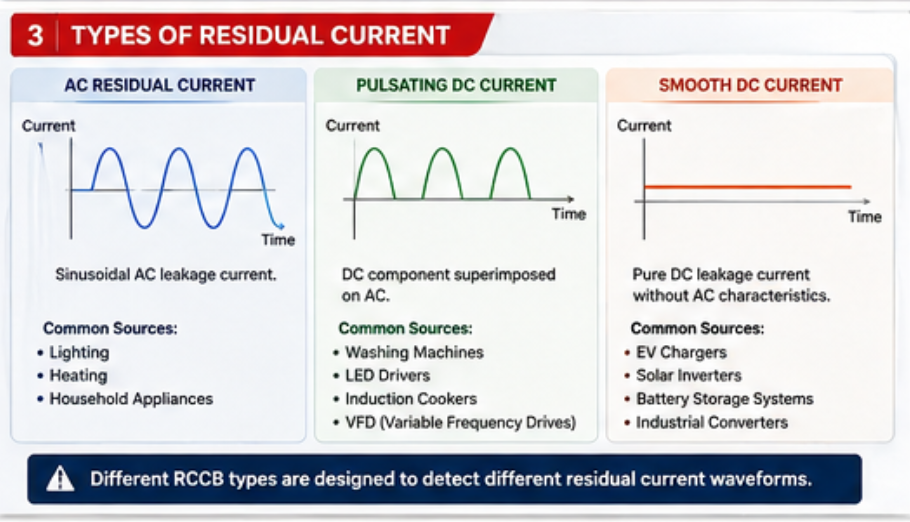
Antes de comparar los RCCB de tipo A y de tipo B, es importante comprender las diferentes formas de corriente residual.
Los equipos eléctricos modernos pueden generar:
Fuga de corriente alterna sinusoidal tradicional.
Fuentes comunes:
Corriente de fuga que contiene una componente de CC superpuesta a la de CA.
Fuentes comunes:
Corriente de fuga de CC pura sin características de CA.
Fuentes comunes:
Los distintos tipos de RCCB están diseñados para detectar diferentes combinaciones de estas corrientes.
RCBO (Interruptor diferencial con sobreintensidad) | Kuangya seguro y fiable
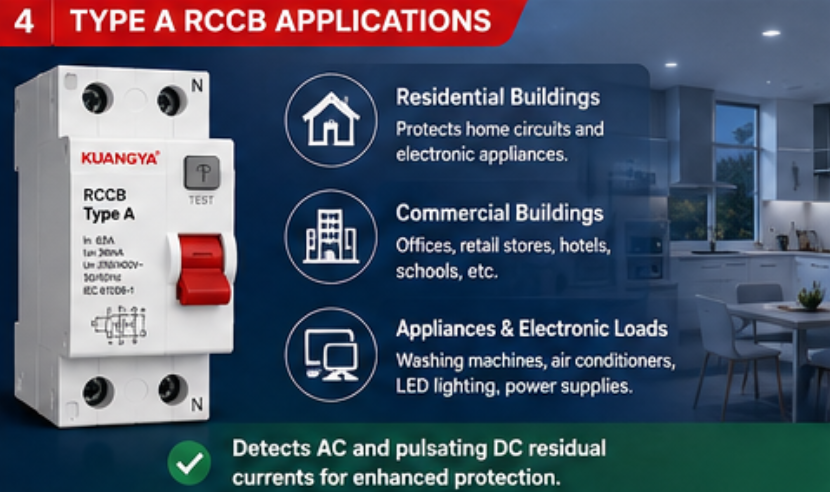
Un RCCB de tipo A puede detectar:
✔ Corrientes residuales de CA sinusoidales
✔ Corrientes residuales de CC pulsantes
Proporciona una protección mejorada en comparación con el antiguo tipo AC RCCB.
Tipo A RCCB responde a:
Los RCCB de tipo A se utilizan ampliamente en:
Detecta corrientes de fuga tanto de CA como de CC pulsante.
Menor coste en comparación con los RCCB de tipo B.
Adecuado para la mayoría de aplicaciones residenciales y comerciales.
Fácil sustitución y mantenimiento.
Los RCCB de tipo A no pueden detectar con fiabilidad:
En tales aplicaciones, se requieren RCCB de tipo B.
RCBO (Interruptor diferencial con sobreintensidad) | Kuangya seguro y fiable
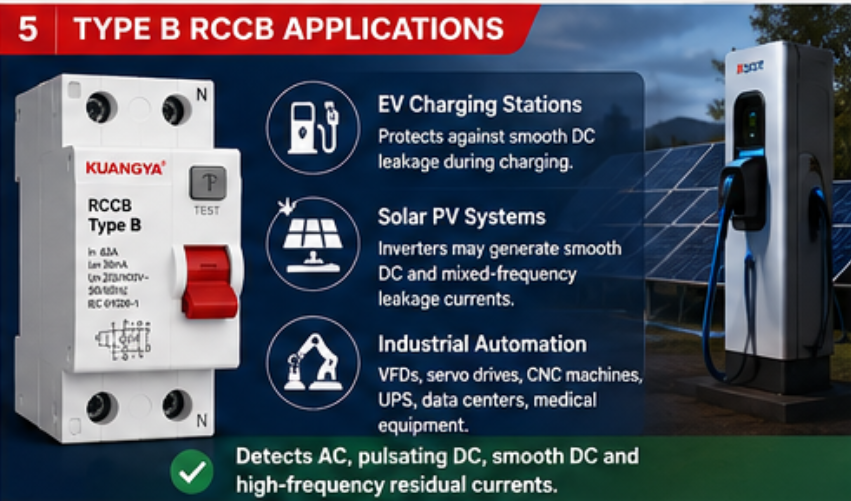
Los RCCB de tipo B son la categoría de RCCB más avanzada.
Pueden detectar:
✔ Corrientes residuales de CA
✔ Corrientes residuales de CC pulsantes
✔ Corrientes residuales de CC suaves
✔ Corrientes de fuga de frecuencia mixta
✔ Corrientes residuales de alta frecuencia
Los RCCB de tipo B proporcionan protección contra:
Los RCCB de tipo B suelen instalarse en:
Proporciona el más alto nivel de detección de corriente residual.
Compatible con la electrónica de potencia moderna.
Reduce los fallos de fuga no detectados.
Exigido por muchas normas de recarga de vehículos eléctricos y energías renovables.
Los RCCB de tipo B son bastante más caros.
Puede requerir espacio adicional en el panel.
A menudo requiere consideraciones de diseño especializadas.
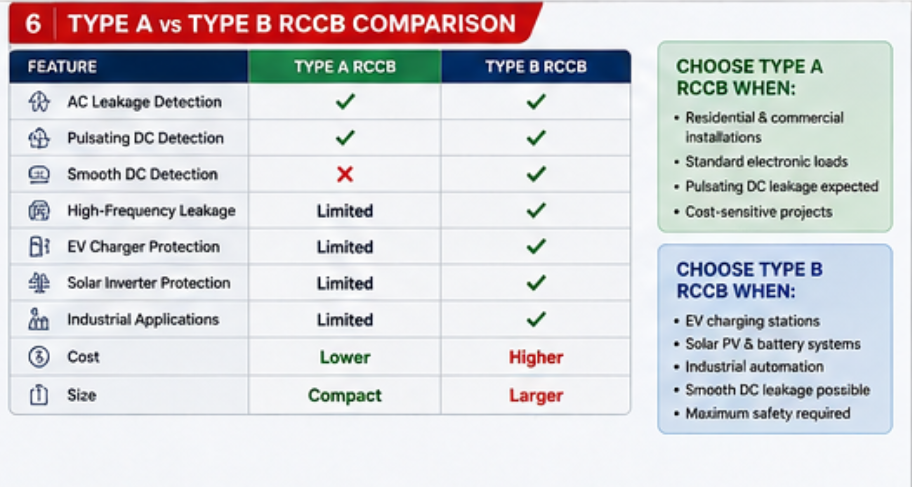
| Característica | Tipo A RCCB | Tipo B RCCB |
|---|---|---|
| Detección de fugas de CA | ✔ | ✔ |
| Detección de CC pulsante | ✔ | ✔ |
| Detección suave de CC | ✘ | ✔ |
| Fuga de alta frecuencia | Limitado | ✔ |
| Protección de cargadores de VE | Limitado | ✔ |
| Protección del inversor de conexión a red | Limitado | ✔ |
| Variadores de frecuencia | Limitado | ✔ |
| Uso residencial | ✔ | ✔ |
| Uso industrial | Limitado | ✔ |
| Coste | Baja | Más alto |
Los equipos electrónicos modernos suelen utilizar rectificadores, inversores y fuentes de alimentación conmutadas.
Estos dispositivos pueden generar corrientes de fuga de CC suaves.
Un problema importante se produce cuando la corriente continua suave llega a un RCCB estándar.
La componente de CC puede saturar el núcleo magnético del transformador de detección.
Como resultado:
Este fenómeno suele denominarse:
Cegamiento RCCB
Los RCCB de tipo B están diseñados específicamente para evitar este problema.
La mayoría de los hogares modernos contienen electrodomésticos que generan corrientes continuas pulsantes.
Algunos ejemplos son:
Los RCCB de tipo A se recomiendan generalmente para instalaciones residenciales.
Adecuado para:
Cualquier aplicación en la que puedan producirse fugas de CC pulsantes pero sea improbable que se produzcan fugas de CC suaves.
Los cargadores de vehículos eléctricos utilizan tecnología de conversión CA/CC.
Durante la carga pueden producirse fugas de CC suaves.
Muchas normas internacionales exigen una protección de tipo B o un control de CC equivalente.
Los inversores solares generan componentes de CC y CA simultáneamente.
Las corrientes de fuga pueden contener:
Los RCCB de tipo B proporcionan una protección completa.
El equipamiento industrial suele incluir:
Estos dispositivos suelen generar corrientes de fuga de CC.
Los equipos médicos críticos exigen una detección de fallos fiable.
Los RCCB de tipo B ofrecen mayor seguridad.
Varias normas definen los requisitos de rendimiento de los RCCB.
Especifica los requisitos para los RCCB sin protección de sobreintensidad integrada.
Define los dispositivos de corriente residual avanzados, incluidos:
Proporciona orientación para la instalación de sistemas eléctricos de baja tensión.
Muchas normativas sobre recarga de VE hacen referencia:
Estos suelen requerir RCCB de tipo B o un control de fallos de CC equivalente.
✔ Aplicaciones residenciales
✔ Edificios comerciales
✔ Aparatos electrónicos estándar
Proyectos sensibles a los costes
✔ No se esperan fugas de CC suaves
✔ Estaciones de recarga de VE
Instalaciones solares fotovoltaicas
✔ Sistemas de almacenamiento de baterías
✔ Automatización industrial
✔ Variadores de frecuencia
Equipos médicos
✔ Pueden producirse fugas de CC suaves
Muchos instaladores siguen utilizando RCCB de tipo AC obsoletos.
Esto puede dejar las cargas electrónicas insuficientemente protegidas.
Los sistemas de carga de VE pueden generar corrientes de fuga de CC suaves.
Un RCCB de tipo A por sí solo puede resultar ineficaz.
Los fabricantes de equipos suelen especificar el tipo de RCCB necesario.
El incumplimiento de las recomendaciones puede anular las garantías.
Los RCCB deben coordinarse con:
Una selectividad adecuada mejora la fiabilidad del sistema.
Los sistemas eléctricos siguen evolucionando.
Las principales tendencias son:
Se están instalando millones de cargadores de vehículos eléctricos en todo el mundo.
La demanda de RCCB de tipo B sigue aumentando.
Las instalaciones solares residenciales y comerciales requieren una protección avanzada.
Los sistemas de automatización de edificios dependen cada vez más de la electrónica de potencia.
Las tecnologías de baterías introducen riesgos adicionales de fuga de CC.
Como resultado, los RCCB de tipo B son cada vez más comunes en las infraestructuras eléctricas modernas.
No necesariamente.
El tipo B ofrece una protección más amplia, pero sólo es necesario cuando pueden producirse corrientes de fuga de CC suaves.
Para instalaciones residenciales estándar, el tipo A suele ser suficiente.
No.
Si es posible una fuga suave de CC, el tipo A no puede proporcionar la protección requerida.
En muchas instalaciones, sí.
Siempre deben comprobarse las normativas locales y las especificaciones del cargador.
Los RCCB de tipo B requieren una tecnología de detección avanzada capaz de detectar múltiples formas de onda y frecuencias de corriente residual.
Sí, técnicamente.
Sin embargo, el coste adicional suele ser innecesario para los circuitos residenciales ordinarios.
Comprender las diferencias entre los RCCB de tipo A y de tipo B es esencial para diseñar sistemas eléctricos seguros y conformes.
Los interruptores diferenciales de tipo A son ideales para la mayoría de las aplicaciones residenciales y comerciales, ya que proporcionan protección contra corrientes de fuga de CA y CC pulsante. Ofrecen un excelente equilibrio entre seguridad y coste.
Los interruptores diferenciales de tipo B ofrecen el máximo nivel de protección al detectar corriente alterna, corriente continua pulsante, corriente continua suave y corrientes residuales de alta frecuencia. Son indispensables para estaciones de carga de vehículos eléctricos, sistemas de energía solar, automatización industrial y otras instalaciones eléctricas avanzadas.
Dado que las energías renovables, los vehículos eléctricos y la electrónica de potencia son cada vez más comunes, seleccionar el tipo de RCCB correcto es más importante que nunca. Invertir en el dispositivo de protección adecuado garantiza la seguridad eléctrica, el cumplimiento de la normativa, la fiabilidad de los equipos y el rendimiento del sistema a largo plazo.

