Zona industrial de WengYang Yueqing Wenzhou 325000
Horas de trabajo
De lunes a viernes: de 7.00 a 19.00 horas
Fin de semana: 10.00 A 17.00 HORAS
Zona industrial de WengYang Yueqing Wenzhou 325000
Horas de trabajo
De lunes a viernes: de 7.00 a 19.00 horas
Fin de semana: 10.00 A 17.00 HORAS


As electric vehicle adoption accelerates across Europe, the question of proper residual current protection has become critical for installers, facility managers, and EV charging infrastructure developers. The choice between Tipo B RCCB (Residual Current Circuit Breaker) and Type A RCD combined with RDC-DD (Residual Direct Current Detecting Device) represents more than a technical decision—it’s a balance between comprehensive protection, regulatory compliance, and cost-effectiveness that will define the safety and reliability of EV charging installations through 2026 and beyond.
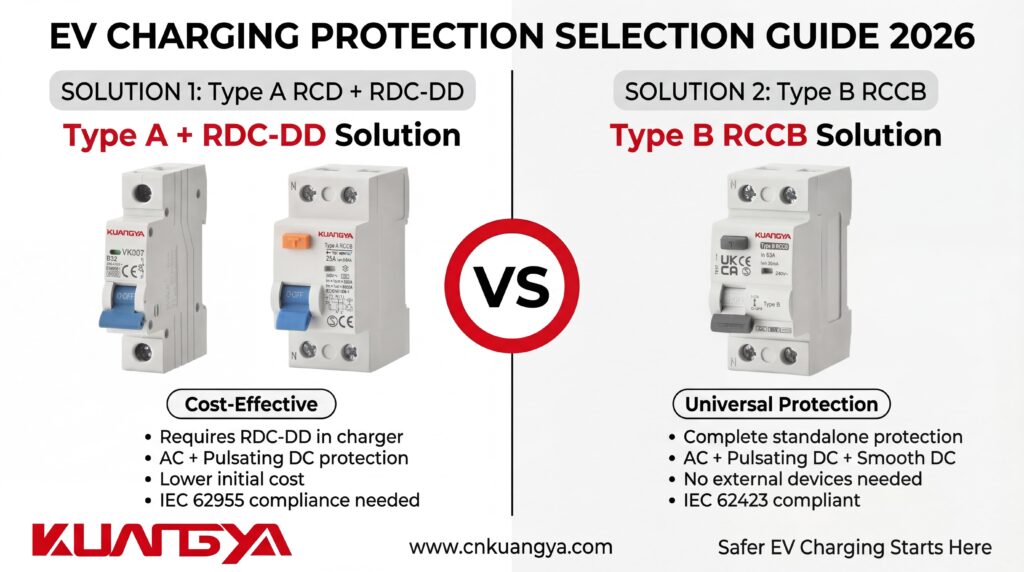
Type B RCCB stands as the most comprehensive protection solution available for electric vehicle charging applications. Unlike conventional Type AC or Type A RCDs, which were designed for traditional household loads, Type B devices are specifically engineered to detect the full spectrum of fault currents that modern power electronics can generate.
The defining characteristic of Type B RCCB lies in its ability to detect smooth DC residual currents—a capability that sets it apart from all other RCD types. When an EV charger’s rectifier circuit develops a fault, it can produce a smooth DC leakage current with minimal ripple. This type of current poses a severe risk: it can magnetically saturate the toroidal transformer core in standard Type A or Type AC RCDs, effectively “blinding” them and preventing detection of even life-threatening AC faults. cita
Los RCCB de tipo B proporcionan protección contra:
This comprehensive detection capability makes Type B RCCBs compliant with IEC 62423 and IEC 61008-1 standards, positioning them as the universal solution for installations where DC fault currents are present or anticipated. cita
Type B RCCBs typically operate with a rated residual operating current (I∆n) of 30mA for personnel protection, though higher ratings (100mA, 300mA) are available for fire protection and selective coordination in tiered distribution systems. The device must trip within specified time limits when residual current exceeds the rated threshold, with typical response times under 40 milliseconds for 30mA devices—fast enough to prevent ventricular fibrillation in electric shock scenarios. cita
The smooth DC detection threshold is particularly important: Type B RCCBs are designed to maintain their AC fault detection capability even when subjected to DC residual currents up to their rated DC non-operating current (typically 10mA). This ensures that the device remains functional and protective even in the presence of DC contamination that would disable lesser protection devices.
The combination of Type A RCD with RDC-DD represents a modular approach to EV charging protection that has gained significant traction in European markets, particularly for single-phase residential and light commercial installations. This solution divides the protection function into two specialized components: the Type A RCD handles AC and pulsating DC faults, while the RDC-DD monitors specifically for smooth DC leakage currents.
An RDC-DD (Residual Direct Current Detecting Device) is a monitoring device, not a protective device in itself. It continuously measures DC residual current in the protected circuit and triggers an external switching device—typically a contactor or the charging station’s internal relay—when DC leakage exceeds 6mA. This 6mA threshold is notably lower than the 10mA minimum for Type B RCCBs, providing an additional safety margin specifically tuned to prevent upstream RCD blinding.
The RDC-DD operates according to IEC 62955 and BS IEC 62955 standards, which define performance requirements for residual direct current detecting devices used in conjunction with RCDs. When integrated into an EV charging station, the RDC-DD typically connects to the charger’s control board, which then commands the main contactor to open when a DC fault is detected, effectively disconnecting the supply.
The Type A RCD in this configuration provides protection against AC sinusoidal residual currents and pulsating DC residual currents—the types of faults that can occur from phase-controlled equipment and half-wave rectification. While Type A devices are blind to smooth DC currents, they remain effective for AC faults as long as they haven’t been saturated by DC contamination. This is precisely why the RDC-DD’s 6mA detection threshold is critical: it ensures disconnection before DC current reaches levels that could compromise the Type A RCD’s functionality.
Tipo B RCCB offers universal, single-device protection with no dependencies on external monitoring systems. It detects all fault types simultaneously within a single magnetic circuit, eliminating potential gaps in protection that could arise from coordination failures between separate devices. The integrated design means there are no communication delays, no additional failure points, and no reliance on the charging station’s control electronics for safety-critical protection functions.
Type A + RDC-DD provides equivalent protection when properly implemented, but introduces system complexity. The protection function depends on correct integration of the RDC-DD with the charging station’s control system, proper wiring of the contactor control circuit, and reliable operation of the switching device. Field experience has shown that installations with poorly integrated RDC-DD systems can experience nuisance tripping or, worse, protection gaps if the detection signal fails to reach the switching device.
The cost differential between these solutions has narrowed considerably as Type B RCCB production has scaled up to meet growing EV infrastructure demand. As of 2026, typical pricing in European markets shows:
Type B RCCB (40A, 30mA, 2-pole): €180-280 depending on brand and features\
Type A RCCB (40A, 30mA, 2-pole): €45-75\
RDC-DD module (IEC 62955 compliant): €60-120\
Integration and installation labor: €40-80 additional for Type A + RDC-DD systems
The total installed cost for Type A + RDC-DD typically ranges from €145-275, making it competitive with Type B solutions in many scenarios. However, the cost equation shifts when considering:
Tipo B RCCB installation follows standard electrical protection practices. The device mounts in the distribution board like any other RCCB, requires no additional control wiring, and operates independently of the charging station’s electronics. This simplicity reduces installation time, minimizes potential wiring errors, and allows for straightforward testing and maintenance. Electricians familiar with standard RCD installation can work with Type B devices without additional training.
Type A + RDC-DD systems require careful integration. The RDC-DD must be correctly wired to the charging station’s control board, the contactor control circuit must be properly configured, and the entire protection chain must be tested to verify that DC fault detection reliably triggers disconnection. This integration is typically performed by the charging station manufacturer, but field modifications or troubleshooting can be complex. The advantage lies in flexibility: charging stations with integrated RDC-DD can be installed with standard Type A protection already present in many distribution boards, reducing upgrade costs in existing installations.
Both solutions meet the requirements of IEC 61851-1, the international standard for EV conductive charging systems, which specifies two acceptable protection options:
European installations must also comply with local electrical codes, such as BS 7671:2018+A2:2022 in the UK, which mandates individual RCD protection for each charging point with 30mA sensitivity. The regulation explicitly allows Type A, Type F, or Type B RCDs, provided that DC fault protection is addressed either through the RCD itself (Type B) or through integrated detection devices (RDC-DD).
A critical consideration often overlooked in initial planning is the interaction with upstream protection devices. If an EV charging circuit protected by Type B RCCB is installed downstream of an existing Type A main RCD, DC fault currents passing through the Type B device can still saturate the upstream Type A RCD, potentially disabling protection for other circuits in the installation. Best practice dictates that EV circuits should be connected in parallel to other circuits rather than downstream of a general Type A RCCB, or the main switch should be upgraded to Type B or a non-RCD device where system earthing permits.
The Type A + RDC-DD solution addresses this concern by disconnecting the supply before DC current reaches levels that could affect upstream devices, provided the RDC-DD operates correctly and the disconnection is fast enough.
Selecting the optimal protection solution requires systematic evaluation of installation characteristics, cost constraints, and long-term operational requirements. The following framework guides this decision:
Step 1: Assess Charger Integration
Step 2: Evaluate Existing Infrastructure
Step 3: Consider Installation Scale
Step 4: Calculate Total Cost of Ownership
Recomendado: Type A RCD + RDC-DD (if charger has integrated RDC-DD) or Type B RCCB
For homeowners installing a single wallbox charger, the choice depends on the charging station’s built-in protection. Modern residential chargers from reputable manufacturers increasingly include IEC 62955-compliant RDC-DD, making Type A protection acceptable and cost-effective. If the charger lacks certified DC fault detection, Type B RCCB is mandatory.
CNKuangya Product Selection:
Recomendado: Type B RCCB (4-pole)
Three-phase installations benefit significantly from Type B RCCB’s integrated protection. The complexity of implementing RDC-DD across three phases, combined with the higher power levels and increased fault current potential, makes the comprehensive protection of Type B devices the preferred choice for commercial applications.
CNKuangya Product Selection:
Recomendado: Type B RCCB with selective coordination
Parking facilities with multiple charging points require protection architecture that prevents a fault on one charger from disrupting service to all stations. Each charging point should have individual 30mA Type B protection, with upstream selective (S-Type) RCCBs rated at 100-300mA providing backup protection and preventing total system shutdown.
CNKuangya Product Selection:
Recomendado: Verify charger RDC-DD compliance or upgrade to Type B
When adding EV charging to an existing installation with Type A main RCD, the most cost-effective approach is to select a charging station with certified integrated RDC-DD and install it on a dedicated circuit with Type A protection. If upgrading the main RCD to Type B is feasible, this provides better long-term protection for the entire installation as more power electronics are added over time.
CNKuangya Product Selection:
| Modelo | Postes | Corriente nominal (A) | Sensitivity (mA) | Capacidad de rotura | Normas | Aplicación típica |
|---|---|---|---|---|---|---|
| KY-B2-40/30 | 2P | 40 | 30 | 6kA | IEC 61008-1, IEC 62423 | Single-phase residential EV chargers ≤7.4kW |
| KY-B2-63/30 | 2P | 63 | 30 | 6kA | IEC 61008-1, IEC 62423 | Single-phase commercial chargers ≤11kW |
| KY-B4-40/30 | 4P | 40 | 30 | 6kA | IEC 61008-1, IEC 62423 | Three-phase commercial chargers 11-22kW |
| KY-B4-63/30 | 4P | 63 | 30 | 6kA | IEC 61008-1, IEC 62423 | Three-phase high-power chargers up to 22kW |
| KY-B4-63/100-S | 4P | 63 | 100 | 10kA | IEC 61008-1, IEC 62423 | Selective main protection for multi-station installations |
Key Features:
| Modelo | Postes | Corriente nominal (A) | Sensitivity (mA) | Capacidad de rotura | Normas | Aplicación típica |
|---|---|---|---|---|---|---|
| KY-A2-40/30 | 2P | 40 | 30 | 6kA | IEC 61008-1 | Single-phase chargers with integrated RDC-DD |
| KY-A2-63/30 | 2P | 63 | 30 | 6kA | IEC 61008-1 | Single-phase chargers with integrated RDC-DD |
| KY-A4-40/30 | 4P | 40 | 30 | 6kA | IEC 61008-1 | Three-phase chargers with integrated RDC-DD |
| KY-A4-63/30 | 4P | 63 | 30 | 6kA | IEC 61008-1 | Three-phase chargers with integrated RDC-DD |
Key Features:
Rated Current Selection:\
The RCCB rated current must be equal to or greater than the circuit breaker (MCB) rating protecting the charging circuit. For continuous loads like EV chargers, the circuit breaker should be rated at 125% of the maximum charging current. Example: A 32A EV charger requires a 40A MCB and therefore a 40A or 63A RCCB.
Pole Configuration:
Sensitivity Selection:
No, this is a serious safety violation. IEC 61851-1 and European electrical codes explicitly require protection against DC fault currents exceeding 6mA for EV charging installations. Type A RCDs cannot detect smooth DC currents and will become “blinded” when DC saturation occurs, leaving the installation unprotected against even life-threatening AC faults.
If your charging station does not have certified RDC-DD compliant with IEC 62955, you must install a Type B RCCB. This is not optional—it’s a fundamental safety requirement. Field investigations have documented cases where Type A RCCBs failed to trip due to DC saturation, resulting in equipment damage, fire risk, and potential electrocution hazards.
When evaluating whether your charger has adequate DC fault protection, check the technical datasheet for explicit reference to IEC 62955 compliance and RDC-DD functionality. Marketing terms like “built-in protection” or “smart safety features” are insufficient—you need documented compliance with the specific standard. If in doubt, specify Type B RCCB for guaranteed protection.
The price premium for Type B RCCBs reflects their sophisticated magnetic circuit design, which must accurately detect and discriminate between multiple types of residual currents across a wide frequency range (DC to 1000 Hz) while maintaining immunity to normal operational transients. The toroidal transformer, electronic detection circuitry, and trip mechanism must work together with precision to provide reliable protection without nuisance tripping.
However, the cost gap has narrowed significantly. In 2026, the total installed cost difference between Type B RCCB and Type A + RDC-DD systems is often less than €50-100 for residential installations. The value proposition of Type B includes:
Simplicity and reliability: No dependency on charging station electronics or control wiring for safety-critical protection. The device works independently, reducing failure points.
Future-proofing: As you add more power electronics to your installation (solar inverters, battery storage, heat pumps), Type B protection covers all of them without modification.
Reduced maintenance complexity: Single-device testing and verification rather than coordinating multiple protection elements.
Upstream compatibility: Properly selected Type B protection can work in installations with existing Type A main RCDs without creating protection gaps (though parallel connection is still preferred).
For commercial and multi-station installations, Type B RCCBs typically prove more cost-effective when considering total system cost, installation labor, and long-term maintenance. For residential single-charger installations where the charging station has certified RDC-DD, Type A + RDC-DD can be appropriate and economical.
Main Distribution Board
│
├─ Main Switch (Non-RCD or Type B)
│
├─ Circuit 1: Lighting & Sockets ──→ Type A RCCB (30mA)
│
├─ Circuit 2: Kitchen Appliances ──→ Type A RCCB (30mA)
│
└─ Circuit 3: EV Charging ──→ Type B RCCB (30mA) ──→ MCB (40A) ──→ EV Charger
                                        ↓
                              Detects AC + Pulsating DC + Smooth DC
                              No external devices required
                              Independent operation
                              Suitable for any EV charger
Key Characteristics:
Main Distribution Board
│
├─ Main Switch (Type A or Non-RCD)
│
├─ Circuit 1: Lighting & Sockets ──→ Type A RCCB (30mA)
│
├─ Circuit 2: Kitchen Appliances ──→ Type A RCCB (30mA)
│
└─ Circuit 3: EV Charging ──→ Type A RCCB (30mA) ──→ MCB (40A) ──→ EV Charger
                                        ↓                              │
                              Detects AC + Pulsating DC                │
                                                                        │
                                                           ┌────────────┴────────────┐
                                                           │  Charging Station       │
                                                           │  with Integrated RDC-DD │
                                                           │  (IEC 62955)            │
                                                           │                         │
                                                           │  Monitors DC > 6mA      │
                                                           │  Commands contactor     │
                                                           │  to disconnect supply   │
                                                           └─────────────────────────┘
Key Characteristics:
The decision between Type B RCCB and Type A + RDC-DD is not merely about choosing between two equivalent protection methods—it’s about understanding the specific requirements of your installation and selecting the solution that provides optimal safety, reliability, and value over the system’s operational lifetime.
Type B RCCB represents the universal solution: comprehensive, independent, and future-proof. It requires no coordination with charging station electronics, works with any EV charger regardless of manufacturer or model, and provides protection that extends beyond EV charging to cover all power electronics in your installation. For commercial installations, multi-station facilities, three-phase systems, and scenarios where long-term reliability is paramount, Type B RCCB is the clear choice.
Type A RCD + RDC-DD offers a cost-optimized alternative for specific applications, particularly residential single-phase installations where the charging station includes certified IEC 62955-compliant DC fault detection. This solution can reduce initial equipment costs while maintaining adequate protection, provided the RDC-DD integration is properly implemented and maintained. However, it introduces system complexity and dependencies that must be carefully managed.
As Europe’s EV charging infrastructure continues to expand through 2026 and beyond, the foundation of electrical safety must be engineered for the unique demands of power electronics. The protection devices you specify today will safeguard users, property, and electrical systems for decades to come. Choose based on thorough understanding of your installation requirements, verify compliance with applicable standards, and never compromise on the fundamental principle that guides all electrical protection: safety first, always.
For technical consultation on RCCB selection for your EV charging project, detailed product specifications, or assistance with protection system design, visit cnkuangya.com or contact our engineering support team. We provide comprehensive selection tools, installation guides, and ongoing technical support to ensure your EV charging infrastructure delivers safe, reliable service throughout its operational life.
This guide is based on IEC 61851-1:2017, IEC 62423, IEC 61008-1, IEC 62955, and BS 7671:2018+A2:2022 standards current as of March 2026. Always consult local electrical codes and regulations for specific installation requirements in your jurisdiction.

