WengYang Industriegebiet Yueqing Wenzhou 325000
Arbeitszeiten
Montag bis Freitag: 7AM - 7PM
Am Wochenende: 10AM - 5PM
WengYang Industriegebiet Yueqing Wenzhou 325000
Arbeitszeiten
Montag bis Freitag: 7AM - 7PM
Am Wochenende: 10AM - 5PM

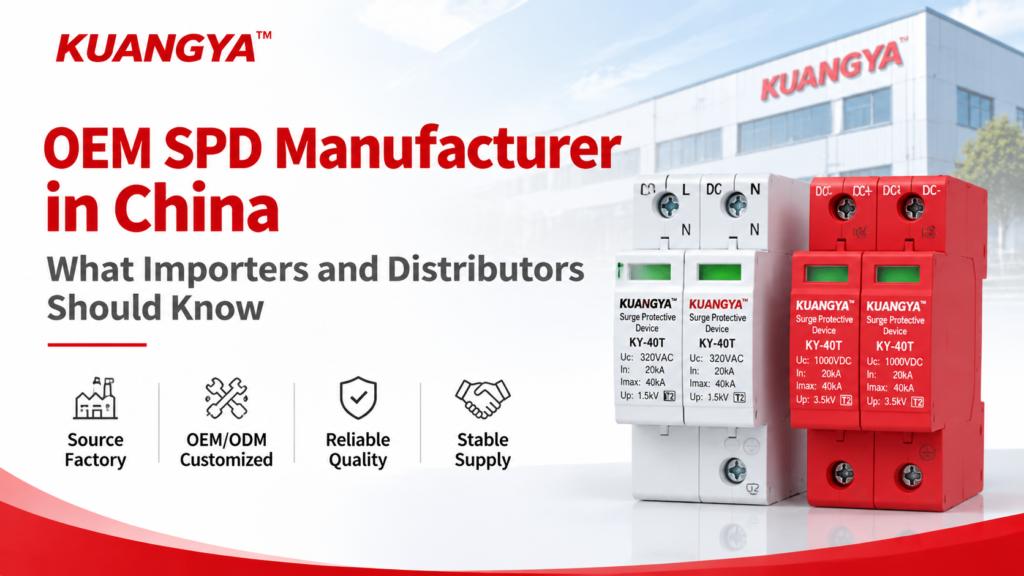
Einen zuverlässigen OEM-Hersteller von SPDs in China zu finden, ist ein wichtiger Schritt für Elektrogroßhändler, Importeure, Anbieter von Solarausrüstung und Unternehmen, die eigene Produktlinien für den Überspannungsschutz entwickeln möchten.
Obwohl der Preis oft ein entscheidendes Kriterium ist, erfordert eine erfolgreiche langfristige Beschaffung mehr, als nur das günstigste Angebot zu finden. Käufer müssen außerdem Produktspezifikationen, OEM-Anpassungsmöglichkeiten, gleichbleibende Qualität, technische Dokumentation und Anforderungen an Großbestellungen bewerten.
Ganz gleich, ob Sie AC-Überspannungsschutzgeräte für elektrische Verteilungssysteme oder DC-SPDs für Photovoltaikanwendungen beschaffen: Die Zusammenarbeit mit einem geeigneten Fertigungspartner kann Ihren Beschaffungsprozess vereinfachen.
In diesem Leitfaden erläutern wir, was internationale Käufer vor einer OEM-SPD-Bestellung wissen sollten und wie sie potenzielle Lieferanten bewerten können.
Ein OEM SPD-Hersteller (Original Equipment Manufacturer) bietet Überspannungsschutzgeräte an, die unter der eigenen Marke eines Kunden geliefert werden können, vorbehaltlich der verfügbaren Anpassungsoptionen des Herstellers und der geltenden Produktanforderungen.
OEM-Dienstleistungen können Folgendes umfassen:
Für Elektrogroßhändler und Importeure kann eine OEM-Kooperation dazu beitragen, eine einheitliche Produktidentität in ihren lokalen Märkten zu etablieren.
Es besteht jedoch ein wichtiger Unterschied zwischen einer einfachen Private-Label-Lösung und einer technischen Produktanpassung.
Eine Änderung des Logos oder der Verpackungsgestaltung unterscheidet sich in der Regel von einer Änderung des internen Stromkreises, der Schutzkomponenten oder der elektrischen Nennwerte.
Jede technische Änderung muss bewertet werden, um festzustellen, ob zusätzliche Prüfungen, Tests oder Zertifizierungen erforderlich sind.
Unter KUANGYA, wir liefern elektrische Schutzprodukte für internationale Kunden, darunter AC- und DC-Überspannungsschutzgeräte, und unterstützen OEM-Kooperationen entsprechend den Produkt- und Auftragsanforderungen.
Vor der Besprechung eines OEM-Brandings sollten Käufer zunächst festlegen, welche Überspannungsschutzgeräte sie anbieten möchten.
AC- und DC-Überspannungsschutzgeräte sind für unterschiedliche Anwendungen vorgesehen und sollten nicht ausschließlich anhand ihres äußeren Erscheinungsbilds ausgewählt werden.
Überspannungsschutzgeräte für Wechselstrom werden häufig in Niederspannungsanlagen eingesetzt, zum Beispiel in:
Bei der Beschaffung von Überspannungsschutzgeräten für Wechselstrom sind unter anderem folgende Spezifikationen wichtig:
Beispielsweise benötigen Käufer möglicherweise unterschiedliche AC-Überspannungsschutzgeräte-Konfigurationen für ein- und dreiphasige elektrische Systeme.
Bei der Auswahl sollten auch die Erdungsanlage der elektrischen Installation und die geltenden lokalen Anforderungen berücksichtigt werden.
Entdecken Sie unser Sortiment an AC-Überspannungsschutzgeräten mit verfügbaren Produkten und Konfigurationen.
DC-Überspannungsschutzgeräte sind insbesondere in Photovoltaikanlagen wichtig, da der Gleichstromkreis unter anderen elektrischen Bedingungen betrieben wird als herkömmliche AC-Installationen.
Typische Anwendungen sind:
Zu den gängigen Spannungsklassen für DC-SPDs gehören 600 V DC, 1000 V DC und 1500 V DC, abhängig vom verfügbaren Modell und dem vorgesehenen Anwendungsbereich.
Die richtige Bemessungsspannung muss entsprechend der maximalen DC-Spannung des Systems und den Herstellerangaben des SPD ausgewählt werden.
Für Photovoltaiksysteme, Ucpv ist ein wichtiger Parameter, anhand dessen sich feststellen lässt, ob der SPD für den vorgesehenen PV-Stromkreis geeignet ist.
Käufer können unser DC SPD-Produktportfolio erkunden oder Ansicht eines Überspannungsschutzgeräts Typ 2 für PV-Anlagen für weitere Produktinformationen.
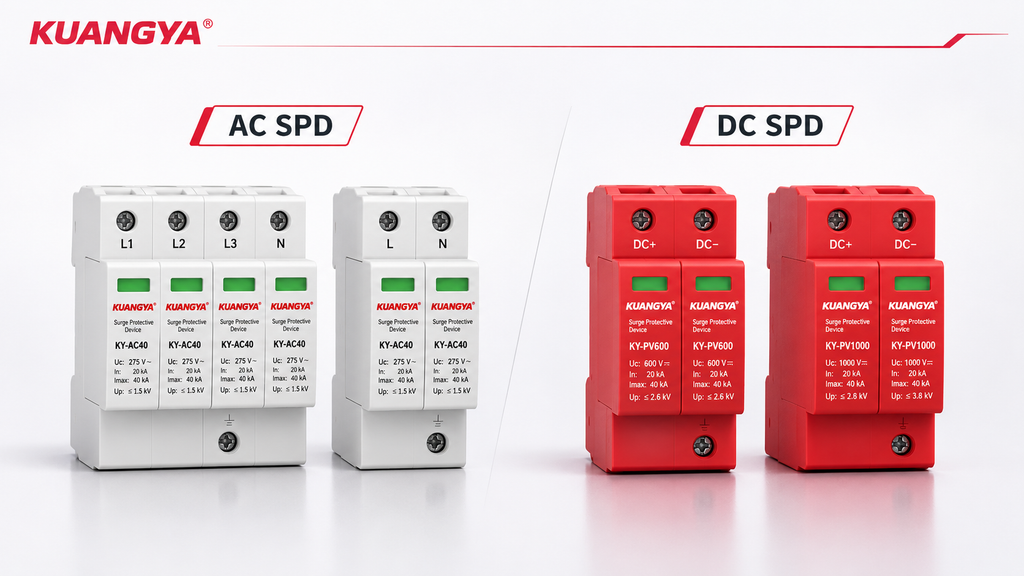
| Merkmal | AC SPD | DC SPD |
|---|---|---|
| Hauptanwendung | AC-Stromverteilungssysteme | Solar-PV- und DC-Elektrosysteme |
| Nennspannung | Auswahl entsprechend der AC-Systemspannung | Ausgewählt nach maximaler DC-Systemspannung |
| Häufige Konfigurationen | 1P, 2P, 3P, 4P und andere Anordnungen | 2P, 3P und anwendungsspezifische Anordnungen |
| Schutzart | Typ 1, Typ 2, Typ 1+2 | Typ 1, Typ 2, Typ 1+2 wo zutreffend |
| Wichtige Parameter | Uc, In, Imax, Iimp, Up | Ucpv, In, Imax, Iimp, Up |
| Einschlägige Normen | IEC 61643-11 | IEC 61643-31 für PV-Anwendungen |
Obwohl AC- und DC-Überspannungsschutzgeräte (SPDs) äußerlich ähnlich aussehen können, können sich ihre internen Designs und elektrischen Anforderungen erheblich unterscheiden.
Käuferhinweis: Bestätigen Sie immer die Anwendung, die Spannungsbewertung, die Polkonfiguration und die erforderlichen Schutzeigenschaften, bevor Sie ein Angebot von einem OEM anfordern.
Einer der Hauptgründe, warum internationale Händler mit einem OEM-SPD-Hersteller zusammenarbeiten, besteht darin, Überspannungsschutzgeräte unter ihrer eigenen Marke zu entwickeln.
Die verfügbaren Anpassungsoptionen können jedoch zwischen den Lieferanten und Produktmodellen variieren.
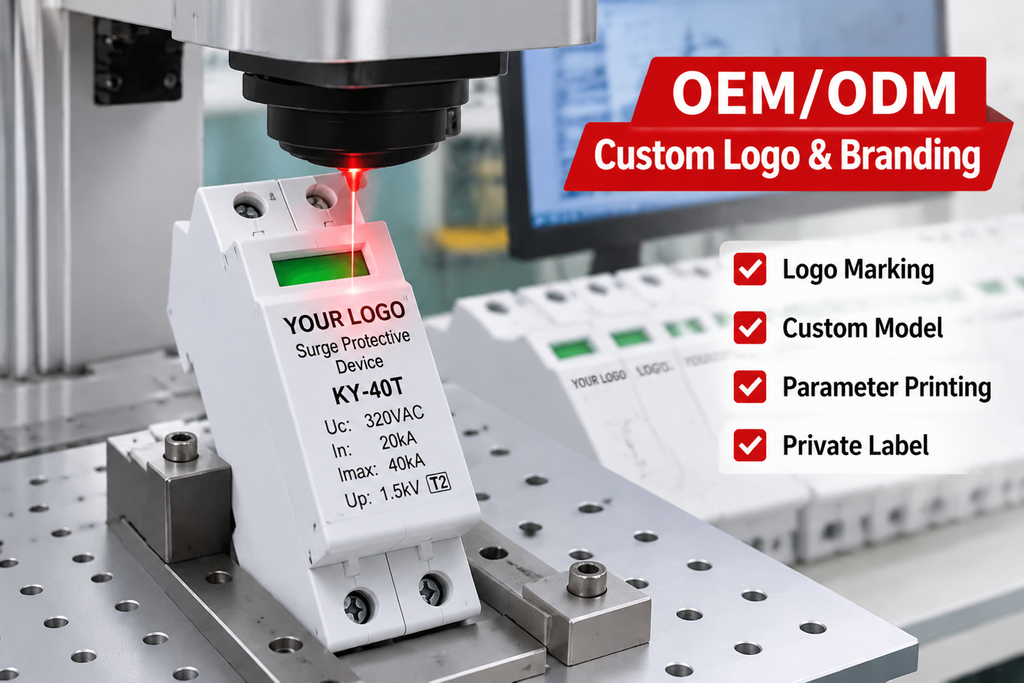
Ein Hersteller kann eine Kundenmarkierung auf dem SPD-Gehäuse anbieten.
Je nach Produkt und Druckverfahren können die Branding-Optionen eine Laserbeschriftung oder andere geeignete Kennzeichnungsmethoden umfassen.
Das kundenspezifische Etikett kann folgende Angaben enthalten:
Alle technischen Angaben müssen die freigegebene Produktkonfiguration korrekt wiedergeben.
Einige Käufer bevorzugen eine bestimmte Produkterscheinung, um die Konsistenz in ihrem Sortiment an elektrischen Schutzprodukten zu wahren.
Je nach den verfügbaren Designs des Herstellers kann die Anpassung die Gehäusefarbe, das Layout des Frontpanels oder das Erscheinungsbild des Produkts betreffen.
Vor der Bestätigung einer Bestellung sollten Käufer überprüfen, ob die angeforderten Änderungen des Erscheinungsbilds die Produktionsanforderungen, Mindestbestellmengen oder technische Prüfungen beeinflussen.
Verpackung ist ein weiterer wichtiger Teil der OEM-Zusammenarbeit.
Distributoren können anfordern:
Klare und konsistente Verpackung kann Produkte in verschiedenen Märkten leichter identifizierbar und verteilbar machen.
Bei OEM-Bestellungen ist es nützlich, das Produktlabel und die Verpackungsgestaltung vor der Massenproduktion zu bestätigen.
| Personalisierung | Beschreibung | Überlegungen für Käufer |
|---|---|---|
| Individuelles Logo | Customer brand on SPD housing | Logo artwork and marking method |
| Product Label | Customized branding and identification | Accurate electrical ratings |
| Housing Appearance | Available colors and front-panel designs | Model availability and MOQ |
| Individual Packaging | Branded product boxes | Artwork and packaging requirements |
| Carton Labels | Custom outer-carton identification | Model and quantity verification |
| Product Documentation | Agreed branding and product information | Technical and regulatory accuracy |
Not all customization options are available for every SPD model. Buyers should confirm feasibility, MOQ, and artwork requirements before finalizing their OEM project.
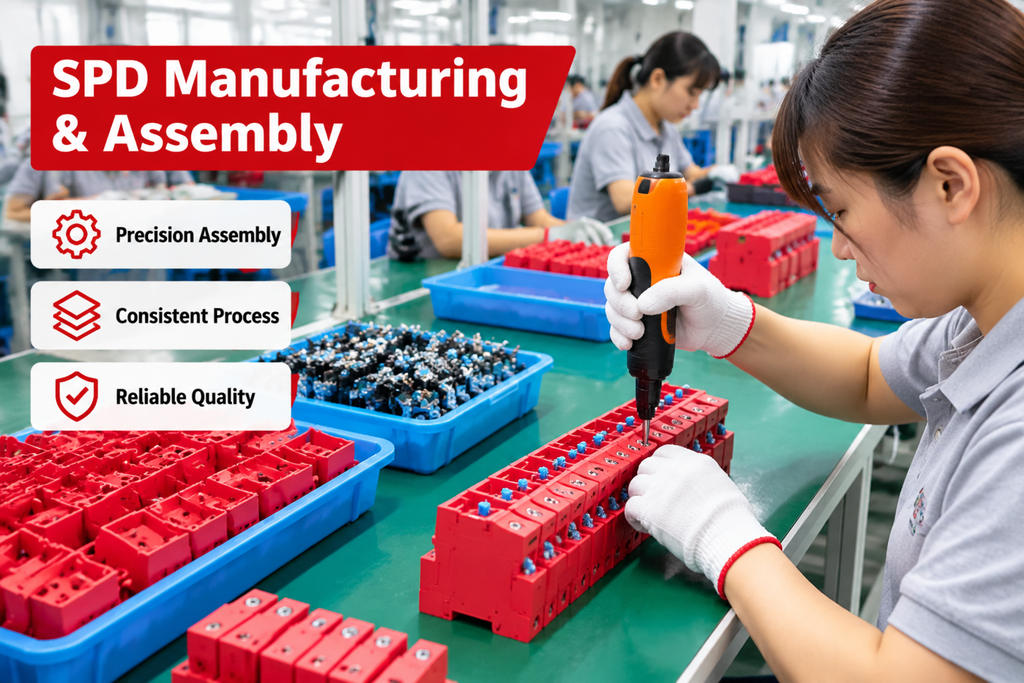
Inside KUANGYA’s SPD Manufacturing Process
Take a closer look at how our surge protective devices are manufactured.
From internal component installation and product assembly to final inspection and packaging, this video shows different stages of KUANGYA’s SPD manufacturing process.
We focus on manufacturing consistency, precise assembly, and attention to detail throughout production.
Product quality is one of the most important factors in long-term SPD sourcing.
Surge protective devices are designed to respond to transient overvoltages, making correct electrical design and suitable verification essential.
When evaluating an OEM SPD manufacturer, buyers should carefully consider the following areas to ensure product quality and long-term supply reliability.
The protection components must be suitable for the intended voltage, discharge current ratings, and product design.
Depending on the circuit configuration, SPDs may incorporate metal oxide varistors (MOVs), gas discharge tubes (GDTs), and disconnection mechanisms.
Not all SPDs use identical internal components.
A well-managed manufacturing process should maintain consistency in component positioning, electrical connections, mechanical assembly, and product identification.
Buyers may ask manufacturers about their assembly procedures, inspection arrangements, and production controls.
Relevant factory quality checks may include visual inspection, marking verification, mechanical checks, and suitable electrical inspections.
These routine checks should not be confused with formal SPD type testing.
Manufacturers should be able to explain which checks apply to the proposed model and provide supporting documentation where available.
Before importing SPDs, buyers should request model-specific technical information and applicable conformity documents.
A useful reference is the IEC 61643-11:2025 standard, which specifies requirements and test methods for SPDs connected to AC low-voltage power systems.
For photovoltaic applications, IEC 61643-31 addresses requirements and test methods for SPDs intended for PV installations.
The applicable standard edition, market requirements, and certification status should be confirmed for the exact product model.
For a more detailed procurement review, read our SPD Manufacturer Documents Checklist.
For importers developing a new product line, sample evaluation is an important step before committing to a larger order.
Samples allow buyers to examine the physical product and verify whether it matches their expectations.
During sample evaluation, consider checking:
Electrical performance and conformity should be evaluated using appropriate evidence and qualified testing rather than appearance alone.
For OEM products, it is also important to confirm the final artwork before bulk manufacturing.
A clear sample approval process helps reduce misunderstandings regarding product specifications, labeling, and packaging.
Purchasing tip: Ask the supplier whether the approved sample configuration will be used as the reference for the production order.
When sourcing SPDs from China, importers often focus on unit price.
However, the final cost of an OEM order can depend on several factors:
The minimum order quantity depends on the manufacturer, model, and requested customization.
Standard products with simple logo customization may have different MOQ requirements from products requiring new components, packaging, or technical modifications.
Instead of assuming a fixed MOQ, buyers should provide their expected purchase quantity and customization requirements.
To receive an accurate quotation, include as much technical information as possible.
| Required Information | Beispiel |
|---|---|
| Produkt | DC SPD |
| Anmeldung | Solar PV system |
| Spannung | 1000V DC |
| SPD-Typ | Typ 2 |
| Konfiguration der Pole | 2P or required protection configuration |
| Surge Ratings | Required In / Imax |
| Menge | 500 Stück |
| Branding | Customer logo |
| Packaging | Standard or customized |
These examples are illustrative. Final specifications must be confirmed according to the intended electrical system.
For international orders, buyers should also confirm the applicable Incoterms, payment arrangements, production lead time, and shipping requirements.
A clear purchasing process can make cooperation with a new manufacturer more efficient.
Here is a practical sourcing workflow.
| Schritt | Process | What Buyers Should Prepare |
|---|---|---|
| 1 | Product Selection | AC/DC type, voltage, poles, specifications |
| 2 | OEM Requirements | Logo, label, packaging artwork |
| 3 | Quotation | Quantity, technical requirements, destination |
| 4 | Sample Evaluation | Product and labeling approval |
| 5 | Order Confirmation | Final specifications, commercial terms |
| 6 | Production & Shipment | Approved order and shipping arrangements |
Following these steps helps buyers communicate their requirements clearly and reduces the risk of specification or labeling errors.
For repeat orders, maintaining a consistent approved product configuration can also make future purchasing easier.
Choosing a reliable OEM SPD manufacturer in China involves evaluating both product suitability and the supplier’s ability to support your business.
KUANGYA is a China-based manufacturer specializing in electrical protection and power distribution products.
Our product portfolio includes:
We work with customers seeking electrical protection products for distribution, photovoltaic applications, and related equipment projects.
Our AC and DC SPD categories allow customers to review products for different electrical systems.
Explore:
We understand that international distributors may need products that match their own branding requirements.
KUANGYA supports OEM cooperation, including customized branding and labeling options subject to the selected product and order requirements.
Customers can share their logos, preferred product configurations, and packaging requirements for evaluation.
Selecting a suitable SPD involves more than choosing a voltage rating.
Our team can discuss your required product specifications, including AC or DC application, pole configuration, surge current ratings, and available models.
For electrical distributors, maintaining consistent specifications across repeat orders is important.
We welcome discussions with importers, wholesalers, OEM brands, and equipment suppliers seeking a long-term source of electrical protection products.
Mehr erfahren Über KUANGYA.
An OEM SPD manufacturer supplies surge protective devices under a customer’s brand, according to agreed product specifications and customization requirements. OEM options may include logos, product labels, packaging, and other available branding services.
Yes. OEM SPD suppliers may offer custom logos, labels, and packaging for compatible AC and DC SPD models. Available options depend on the product design, customization method, and order quantity.
The minimum order quantity depends on the SPD model, requested customization, and manufacturing requirements. Buyers should contact the supplier with their estimated quantity to confirm the applicable MOQ.
Buyers should check the standards and conformity requirements applicable to their destination market. IEC 61643-11 is relevant to AC low-voltage SPDs, while IEC 61643-31 covers SPDs for photovoltaic installations. Request documentation for the exact model being purchased.
The choice depends on the electrical application. AC SPDs are intended for suitable AC power systems, while DC SPDs are designed for specific DC applications such as photovoltaic installations. Always verify voltage, system configuration, and protection ratings.
You can contact KUANGYA with your required SPD type, voltage rating, pole configuration, surge current ratings, estimated quantity, and OEM branding requirements.
Visit our Kontakt page or email info@cnkuangya.com for further information.
Are you looking for an OEM-Hersteller von SPDs in China for your electrical distribution or solar protection business?
KUANGYA welcomes inquiries from international importers, wholesalers, electrical distributors, and OEM brands.
Whether you need AC SPDs, DC SPDs, or customized surge protection products, our team can help review your purchasing requirements and available product options.
To request a quotation, please share:
Kontaktieren Sie KUANGYA
Website: www.cnkuangya.com
E-Mail: info@cnkuangya.com
WhatsApp: +86 13606875281
Contact KUANGYA for an OEM SPD Quotation
Choosing the right OEM SPD manufacturer in China requires careful consideration of product specifications, customization options, quality verification, documentation, and bulk purchasing requirements.
For importers and electrical distributors, a reliable sourcing process begins with selecting the right product and confirming clear expectations before production.
By evaluating samples, reviewing relevant technical evidence, and establishing consistent order requirements, buyers can reduce procurement risks and build more stable supplier relationships.
If you are planning to expand your surge protection product range or develop your own private-label SPD line, contact KUANGYA to discuss your AC and DC SPD sourcing needs.

