WengYang Industrial Zone Yueqing Wenzhou 325000
Work Hours
Monday to Friday: 7AM - 7PM
Weekend: 10AM - 5PM
WengYang Industrial Zone Yueqing Wenzhou 325000
Work Hours
Monday to Friday: 7AM - 7PM
Weekend: 10AM - 5PM

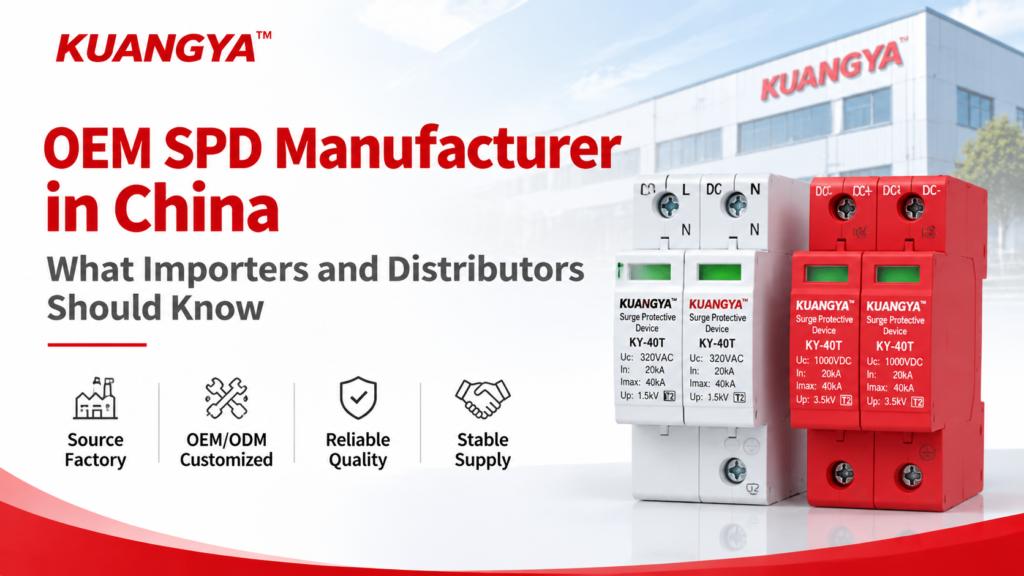
Finding a reliable OEM SPD manufacturer in China is an important step for electrical distributors, importers, solar equipment suppliers, and businesses looking to develop their own surge protection product lines.
While price is often a key consideration, successful long-term sourcing requires more than finding the lowest quotation. Buyers also need to evaluate product specifications, OEM customization options, quality consistency, technical documentation, and bulk order requirements.
Whether you are sourcing AC surge protective devices for electrical distribution systems or DC SPDs for photovoltaic applications, working with a suitable manufacturing partner can help simplify your procurement process.
In this guide, we explain what international buyers should know before placing an OEM SPD order and how to evaluate potential suppliers.
An OEM SPD manufacturer (Original Equipment Manufacturer) provides surge protective devices that can be supplied under a customer’s own brand, subject to the manufacturer’s available customization options and applicable product requirements.
OEM services may include:
For electrical distributors and importers, OEM cooperation can help establish a consistent product identity in their local markets.
However, there is an important difference between simple private labeling and technical product customization.
Changing a logo or packaging design is generally different from modifying the internal circuit, protection components, or electrical ratings.
Any technical modification must be evaluated to determine whether additional verification, testing, or certification is required.
At KUANGYA, we supply electrical protection products for international customers, including AC and DC surge protective devices, and support OEM cooperation based on product and order requirements.
Before discussing OEM branding, buyers should first identify which SPD products they want to offer.
AC and DC surge protective devices serve different applications and should not be selected solely based on their external appearance.
AC SPDs are commonly used in low-voltage electrical installations, such as:
When sourcing AC SPDs, important specifications include:
For example, buyers may need different AC SPD configurations for single-phase and three-phase electrical systems.
The selection should also account for the electrical installation’s earthing arrangement and applicable local requirements.
Explore our AC Surge Protective Device range for available products and configurations.
DC SPDs are particularly important in photovoltaic systems, where the DC circuit operates under different electrical conditions from conventional AC installations.
Typical applications include:
Common DC SPD voltage classes include 600V DC, 1000V DC, and 1500V DC, depending on the available model and intended application.
The correct voltage rating must be selected according to the system’s maximum DC voltage and the SPD manufacturer’s specifications.
For photovoltaic systems, Ucpv is an important parameter that helps determine whether the SPD is suitable for the intended PV circuit.
Buyers can explore our DC SPD product range or view a Type 2 PV Surge Protective Device for further product information.
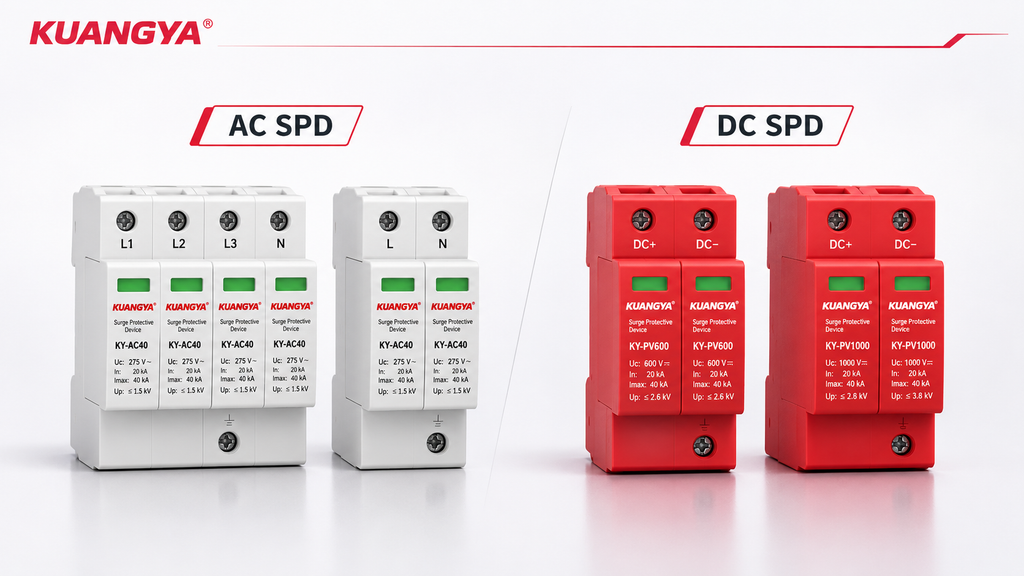
| Feature | AC SPD | DC SPD |
|---|---|---|
| Main Application | AC power distribution systems | Solar PV and DC electrical systems |
| Voltage Rating | Selected according to AC system voltage | Selected according to maximum DC system voltage |
| Common Configurations | 1P, 2P, 3P, 4P and other arrangements | 2P, 3P and application-specific arrangements |
| Protection Type | Type 1, Type 2, Type 1+2 | Type 1, Type 2, Type 1+2 where applicable |
| Key Parameters | Uc, In, Imax, Iimp, Up | Ucpv, In, Imax, Iimp, Up |
| Relevant Standards | IEC 61643-11 | IEC 61643-31 for PV applications |
Although AC and DC SPDs may have similar external appearances, their internal designs and electrical requirements can differ significantly.
Buyer tip: Always confirm the application, voltage rating, pole configuration, and required protection characteristics before requesting an OEM quotation.
One of the main reasons international distributors work with an OEM SPD manufacturer is to develop surge protective devices under their own brand.
However, the available customization options can vary between suppliers and product models.
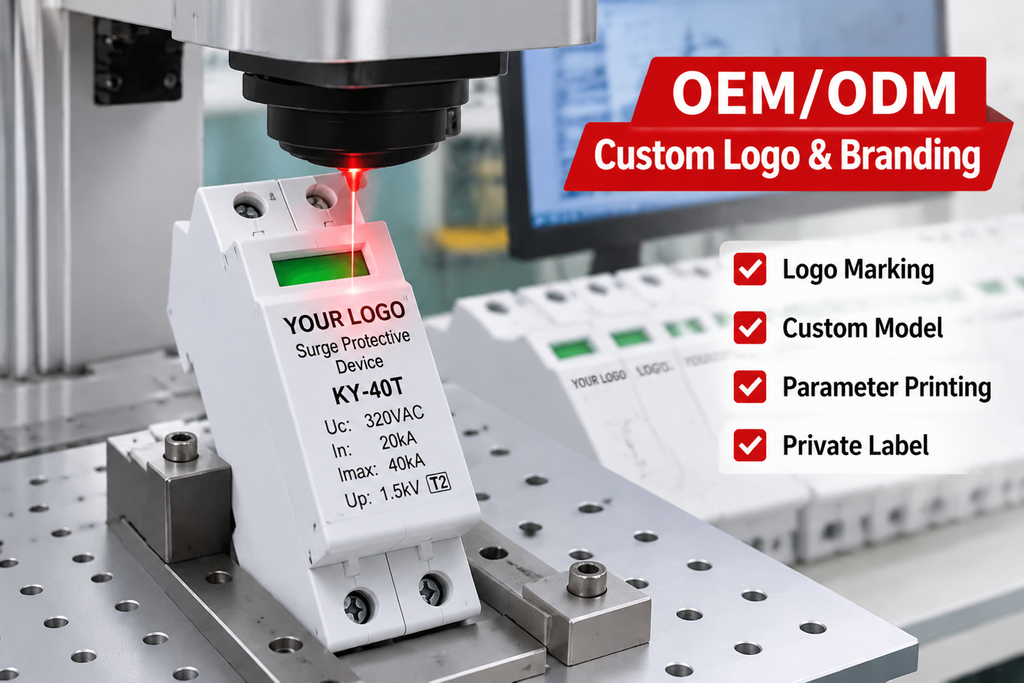
A manufacturer may offer customer branding on the SPD housing.
Depending on the product and printing process, branding options may include laser marking or other suitable marking methods.
The customized label may contain:
All technical information must accurately reflect the approved product configuration.
Some buyers prefer a specific product appearance to maintain consistency across their electrical protection product range.
Depending on the manufacturer’s available designs, customization may involve housing color, front-panel layout, or product appearance.
Before confirming an order, buyers should check whether the requested appearance changes affect production requirements, minimum order quantities, or technical verification.
Packaging is another important part of OEM cooperation.
Distributors may request:
Clear and consistent packaging can make products easier to identify and distribute in different markets.
For OEM orders, it is useful to confirm the product label and packaging artwork before mass production.
| Customization | Description | Buyer Considerations |
|---|---|---|
| Custom Logo | Customer brand on SPD housing | Logo artwork and marking method |
| Product Label | Customized branding and identification | Accurate electrical ratings |
| Housing Appearance | Available colors and front-panel designs | Model availability and MOQ |
| Individual Packaging | Branded product boxes | Artwork and packaging requirements |
| Carton Labels | Custom outer-carton identification | Model and quantity verification |
| Product Documentation | Agreed branding and product information | Technical and regulatory accuracy |
Not all customization options are available for every SPD model. Buyers should confirm feasibility, MOQ, and artwork requirements before finalizing their OEM project.
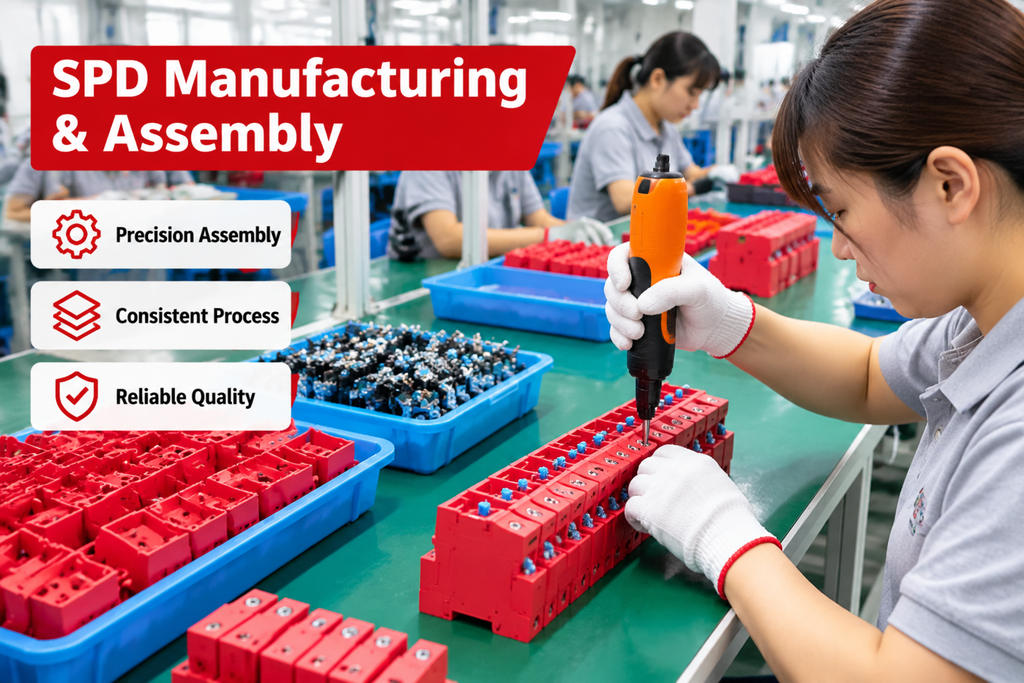
Inside KUANGYA’s SPD Manufacturing Process
Take a closer look at how our surge protective devices are manufactured.
From internal component installation and product assembly to final inspection and packaging, this video shows different stages of KUANGYA’s SPD manufacturing process.
We focus on manufacturing consistency, precise assembly, and attention to detail throughout production.
Product quality is one of the most important factors in long-term SPD sourcing.
Surge protective devices are designed to respond to transient overvoltages, making correct electrical design and suitable verification essential.
When evaluating an OEM SPD manufacturer, buyers should carefully consider the following areas to ensure product quality and long-term supply reliability.
The protection components must be suitable for the intended voltage, discharge current ratings, and product design.
Depending on the circuit configuration, SPDs may incorporate metal oxide varistors (MOVs), gas discharge tubes (GDTs), and disconnection mechanisms.
Not all SPDs use identical internal components.
A well-managed manufacturing process should maintain consistency in component positioning, electrical connections, mechanical assembly, and product identification.
Buyers may ask manufacturers about their assembly procedures, inspection arrangements, and production controls.
Relevant factory quality checks may include visual inspection, marking verification, mechanical checks, and suitable electrical inspections.
These routine checks should not be confused with formal SPD type testing.
Manufacturers should be able to explain which checks apply to the proposed model and provide supporting documentation where available.
Before importing SPDs, buyers should request model-specific technical information and applicable conformity documents.
A useful reference is the IEC 61643-11:2025 standard, which specifies requirements and test methods for SPDs connected to AC low-voltage power systems.
For photovoltaic applications, IEC 61643-31 addresses requirements and test methods for SPDs intended for PV installations.
The applicable standard edition, market requirements, and certification status should be confirmed for the exact product model.
For a more detailed procurement review, read our SPD Manufacturer Documents Checklist.
For importers developing a new product line, sample evaluation is an important step before committing to a larger order.
Samples allow buyers to examine the physical product and verify whether it matches their expectations.
During sample evaluation, consider checking:
Electrical performance and conformity should be evaluated using appropriate evidence and qualified testing rather than appearance alone.
For OEM products, it is also important to confirm the final artwork before bulk manufacturing.
A clear sample approval process helps reduce misunderstandings regarding product specifications, labeling, and packaging.
Purchasing tip: Ask the supplier whether the approved sample configuration will be used as the reference for the production order.
When sourcing SPDs from China, importers often focus on unit price.
However, the final cost of an OEM order can depend on several factors:
The minimum order quantity depends on the manufacturer, model, and requested customization.
Standard products with simple logo customization may have different MOQ requirements from products requiring new components, packaging, or technical modifications.
Instead of assuming a fixed MOQ, buyers should provide their expected purchase quantity and customization requirements.
To receive an accurate quotation, include as much technical information as possible.
| Required Information | Example |
|---|---|
| Product | DC SPD |
| Application | Solar PV system |
| Voltage | 1000V DC |
| SPD Type | Type 2 |
| Pole Configuration | 2P or required protection configuration |
| Surge Ratings | Required In / Imax |
| Quantity | 500 pcs |
| Branding | Customer logo |
| Packaging | Standard or customized |
These examples are illustrative. Final specifications must be confirmed according to the intended electrical system.
For international orders, buyers should also confirm the applicable Incoterms, payment arrangements, production lead time, and shipping requirements.
A clear purchasing process can make cooperation with a new manufacturer more efficient.
Here is a practical sourcing workflow.
| Step | Process | What Buyers Should Prepare |
|---|---|---|
| 1 | Product Selection | AC/DC type, voltage, poles, specifications |
| 2 | OEM Requirements | Logo, label, packaging artwork |
| 3 | Quotation | Quantity, technical requirements, destination |
| 4 | Sample Evaluation | Product and labeling approval |
| 5 | Order Confirmation | Final specifications, commercial terms |
| 6 | Production & Shipment | Approved order and shipping arrangements |
Following these steps helps buyers communicate their requirements clearly and reduces the risk of specification or labeling errors.
For repeat orders, maintaining a consistent approved product configuration can also make future purchasing easier.
Choosing a reliable OEM SPD manufacturer in China involves evaluating both product suitability and the supplier’s ability to support your business.
KUANGYA is a China-based manufacturer specializing in electrical protection and power distribution products.
Our product portfolio includes:
We work with customers seeking electrical protection products for distribution, photovoltaic applications, and related equipment projects.
Our AC and DC SPD categories allow customers to review products for different electrical systems.
Explore:
We understand that international distributors may need products that match their own branding requirements.
KUANGYA supports OEM cooperation, including customized branding and labeling options subject to the selected product and order requirements.
Customers can share their logos, preferred product configurations, and packaging requirements for evaluation.
Selecting a suitable SPD involves more than choosing a voltage rating.
Our team can discuss your required product specifications, including AC or DC application, pole configuration, surge current ratings, and available models.
For electrical distributors, maintaining consistent specifications across repeat orders is important.
We welcome discussions with importers, wholesalers, OEM brands, and equipment suppliers seeking a long-term source of electrical protection products.
Learn more About KUANGYA.
An OEM SPD manufacturer supplies surge protective devices under a customer’s brand, according to agreed product specifications and customization requirements. OEM options may include logos, product labels, packaging, and other available branding services.
Yes. OEM SPD suppliers may offer custom logos, labels, and packaging for compatible AC and DC SPD models. Available options depend on the product design, customization method, and order quantity.
The minimum order quantity depends on the SPD model, requested customization, and manufacturing requirements. Buyers should contact the supplier with their estimated quantity to confirm the applicable MOQ.
Buyers should check the standards and conformity requirements applicable to their destination market. IEC 61643-11 is relevant to AC low-voltage SPDs, while IEC 61643-31 covers SPDs for photovoltaic installations. Request documentation for the exact model being purchased.
The choice depends on the electrical application. AC SPDs are intended for suitable AC power systems, while DC SPDs are designed for specific DC applications such as photovoltaic installations. Always verify voltage, system configuration, and protection ratings.
You can contact KUANGYA with your required SPD type, voltage rating, pole configuration, surge current ratings, estimated quantity, and OEM branding requirements.
Visit our Contact Us page or email info@cnkuangya.com for further information.
Are you looking for an OEM SPD manufacturer in China for your electrical distribution or solar protection business?
KUANGYA welcomes inquiries from international importers, wholesalers, electrical distributors, and OEM brands.
Whether you need AC SPDs, DC SPDs, or customized surge protection products, our team can help review your purchasing requirements and available product options.
To request a quotation, please share:
Contact KUANGYA
Website: www.cnkuangya.com
Email: info@cnkuangya.com
WhatsApp: +86 13606875281
Contact KUANGYA for an OEM SPD Quotation
Choosing the right OEM SPD manufacturer in China requires careful consideration of product specifications, customization options, quality verification, documentation, and bulk purchasing requirements.
For importers and electrical distributors, a reliable sourcing process begins with selecting the right product and confirming clear expectations before production.
By evaluating samples, reviewing relevant technical evidence, and establishing consistent order requirements, buyers can reduce procurement risks and build more stable supplier relationships.
If you are planning to expand your surge protection product range or develop your own private-label SPD line, contact KUANGYA to discuss your AC and DC SPD sourcing needs.

