WengYang Industriegebiet Yueqing Wenzhou 325000
Arbeitszeiten
Montag bis Freitag: 7AM - 7PM
Am Wochenende: 10AM - 5PM
WengYang Industriegebiet Yueqing Wenzhou 325000
Arbeitszeiten
Montag bis Freitag: 7AM - 7PM
Am Wochenende: 10AM - 5PM

Zuletzt aktualisiert: Juli 2026
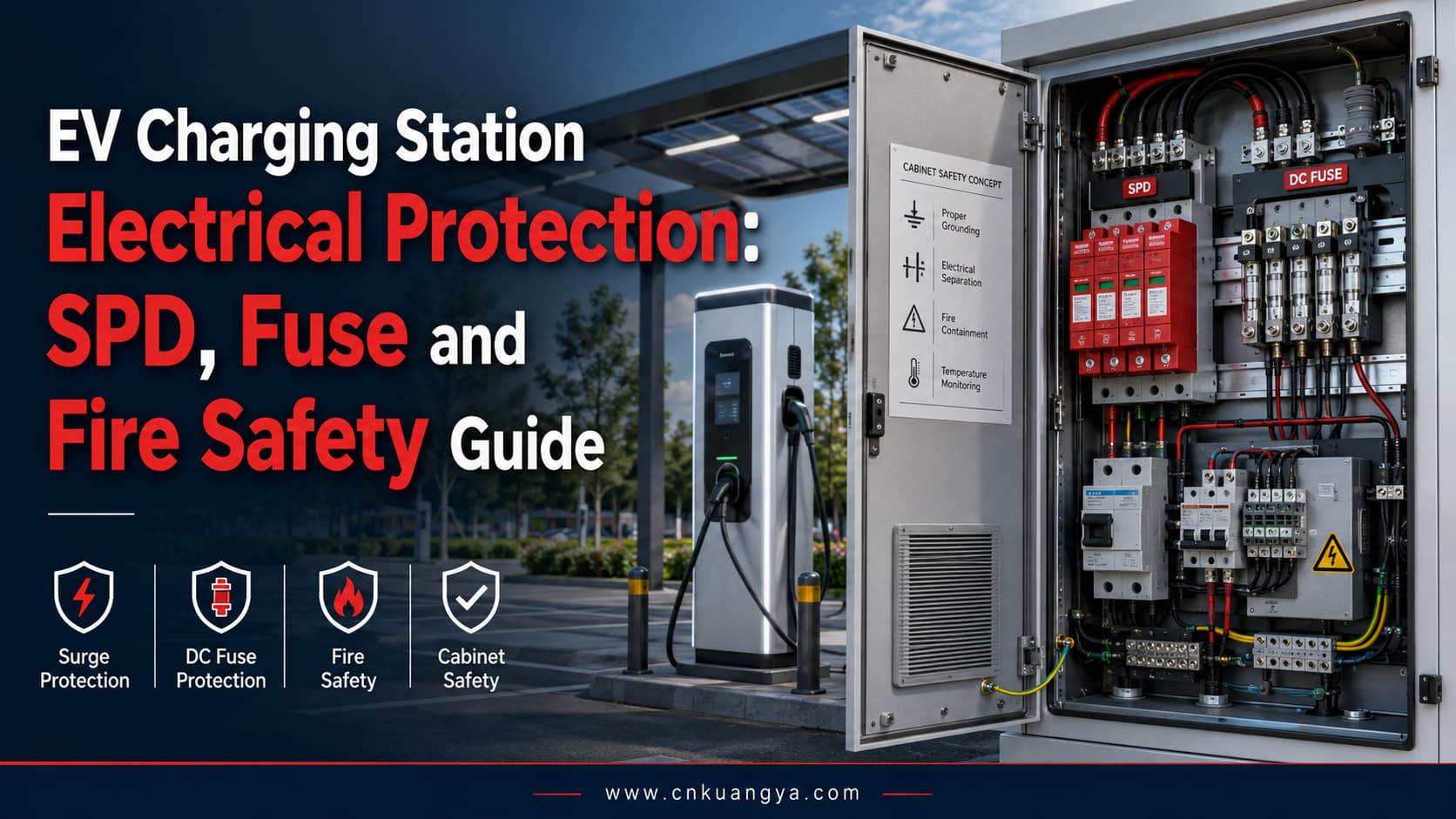
EV charging stations are no longer simple power outlets. A modern EV charging site includes AC input distribution, DC fast charging modules, power conversion units, control boards, communication modules, cables, connectors, and outdoor electrical cabinets.
Because of this complexity, Elektrischer Schutz von Ladestationen für Elektrofahrzeuge must be designed as a complete system, not as a single protection device.
A reliable EV charging protection strategy should include:
The goal is not only to avoid fire. The real goal is to improve uptime, protect expensive charging equipment, reduce maintenance cost, and support safer EV charging infrastructure for EPC projects, operators, and electrical engineers.
EV charging infrastructure is expanding quickly across highways, commercial parking areas, shopping centers, logistics depots, residential communities, and public transport sites. As charging power increases, the electrical protection design becomes more important.
A low-power AC charger and a high-power DC fast charging station do not face the same level of electrical stress. DC fast chargers often work with higher voltage, higher current, more power modules, more heat, and more complex cabinet structures.
International standards also show that EV charging systems are treated as dedicated electrical equipment, not ordinary sockets. EV supply equipment should be designed with reference to IEC 61851-1, which covers general requirements for electric vehicle conductive charging systems. IEC 61851-1 applies to EV supply equipment for electric road vehicles, with rated supply voltage up to 1,000 V AC or 1,500 V DC and output voltage up to 1,000 V AC or 1,500 V DC. IEC 61851-23 applies to DC EV supply equipment with rated voltage up to 1,000 V AC or 1,500 V DC on the supply side and up to 1,500 V DC on the EV side.
This means Elektrischer Schutz von Ladestationen für Elektrofahrzeuge must consider both AC-side and DC-side risks.
A complete protection system should answer these questions:
For charging station owners, the consequence of poor protection is not only equipment damage. It can also mean charger downtime, customer complaints, repair cost, brand damage, and project operation risk.
In the United States, the National Electric Vehicle Infrastructure final rule established that each charging port must have an average annual uptime greater than 97%. This shows that reliability is becoming a key requirement for public charging infrastructure, not only a marketing promise.
For this reason, Elektrischer Schutz von Ladestationen für Elektrofahrzeuge should be considered from the beginning of the project, not added after failures occur.
EV charging stations usually operate in demanding environments. Some are installed outdoors. Some are installed near roads, parking areas, industrial zones, coastal areas, or high-temperature regions. These environments can increase electrical and mechanical stress.
The main electrical risks include:
| Risiko-Typ | Typische Ursache | Mögliche Folgen |
|---|---|---|
| Surge overvoltage | Lightning, grid switching, nearby electrical faults | Damaged control board, power module failure, communication failure |
| Kurzschluss | Insulation failure, wiring fault, component breakdown | Equipment damage, fire risk, system shutdown |
| Überstrom | Abnormal load, internal failure, incorrect protection coordination | Cable overheating, fuse operation, breaker trip |
| Überhitzung | Poor ventilation, dust, high ambient temperature, loose terminal | Insulation aging, component failure, fire risk |
| Arc fault | Loose connection, damaged cable, poor installation | Heat concentration, carbonization, fire ignition |
| Cabinet fire | Internal electrical fault, overheated component, delayed fault isolation | Equipment loss, service interruption, safety incident |
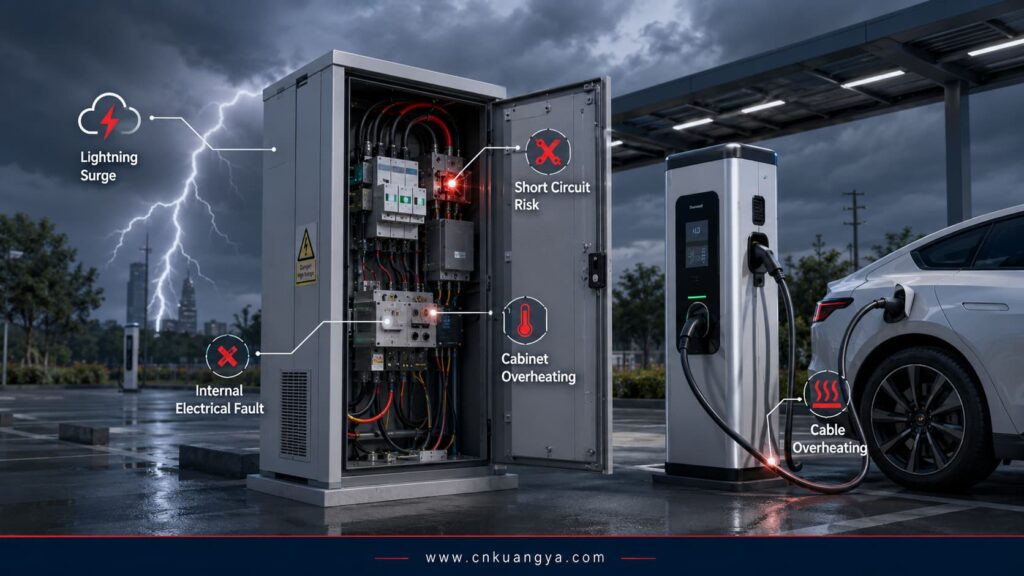
A reliable EV charging station should not depend on only one protection layer. A circuit breaker alone cannot solve surge damage. An SPD alone cannot isolate a short circuit. A fuse alone cannot suppress an early-stage cabinet fire. Fire suppression alone cannot prevent electrical faults from happening.
That is why Elektrischer Schutz von Ladestationen für Elektrofahrzeuge should be designed as a layered system.
Die grundlegende Schutzlogik lautet:
Surge protection first. Fault isolation second. Cabinet fire safety third. Maintenance and inspection always.
This layered logic is especially important for DC fast charging stations because the equipment value is higher and downtime is more expensive.
A 2024 NREL report on EV charging station reliability noted that public charging station issues affect EV adoption and that reliability, resilience, codes, standards, weather, and deployment conditions all influence charging infrastructure performance.
For EPC contractors and charging network operators, protection design is not only a safety issue. It is also part of long-term asset reliability.
Forschung zu Zuverlässigkeit von EV-Ladestationen also shows that charger uptime, resilience, standards, and deployment conditions directly affect charging infrastructure performance.
Surge protection is one of the most important parts of Elektrischer Schutz von Ladestationen für Elektrofahrzeuge.
For outdoor EV chargers, a properly selected DC-Überspannungsschutzgerät can help reduce transient overvoltage risk in high-voltage DC and renewable energy infrastructure.
EV charging stations are exposed to transient overvoltage from several sources:
Even when lightning does not directly hit the charging station, nearby lightning activity can induce voltage surges into power cables, communication cables, or grounding systems.
IEC 61643-11:2025 applies to devices for surge protection against indirect and direct effects of lightning or other transient overvoltages. IEC 61643-01:2024 defines common requirements for SPDs connected to circuits or equipment rated up to 1,000 V AC or 1,500 V DC.
For EV charging stations, SPD selection should consider:
The AC side is usually connected to the utility grid or site distribution board. It may include AC input breakers, metering, contactors, and power conversion modules.
AC-side SPDs help protect the charger from grid-side overvoltage and lightning-induced surges.
For commercial distribution cabinets and EV charger input panels, an AC surge protective device is commonly used to reduce grid-side surge damage.
Typische Anwendungen sind:
For sites with high lightning exposure, long cable routes, or external lightning protection systems, a Type 1 + Type 2 SPD coordination design may be considered according to project requirements.
For many commercial EV charging stations, Type 2 SPD protection is commonly used inside the distribution cabinet or charger cabinet to reduce transient overvoltage risk.
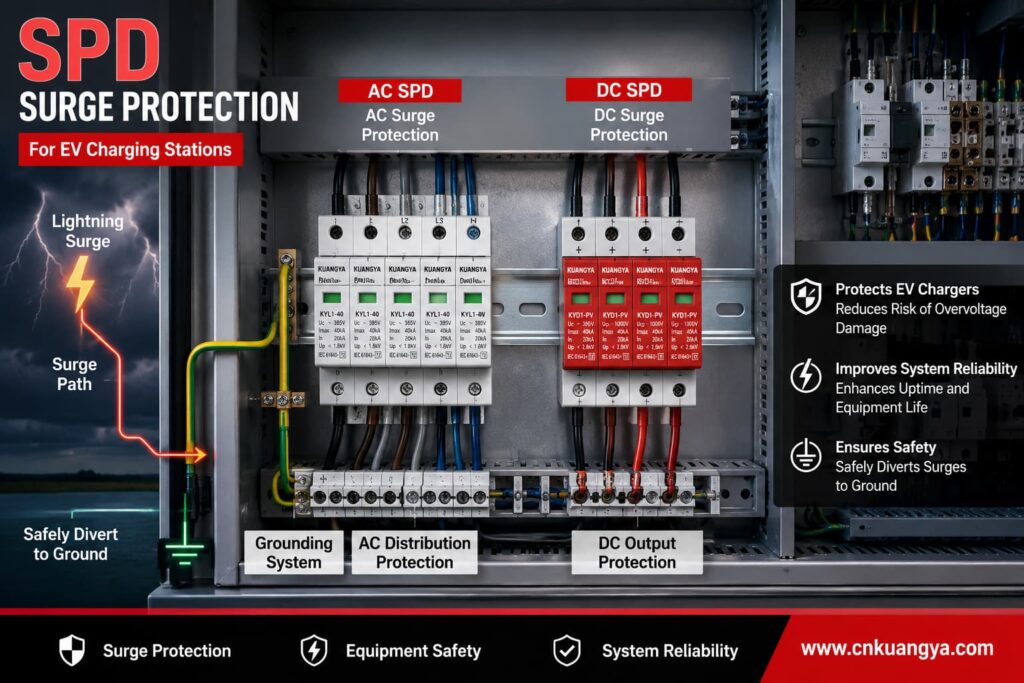
DC fast chargers include rectifier modules and DC output circuits. Depending on the charger design, DC-side protection may be required to protect sensitive DC circuits and downstream equipment.
DC-side surge protection is especially important when:
DC SPDs should be selected according to the system voltage, expected surge exposure, and project design requirements.
Modern EV charging stations often use communication systems for payment, monitoring, OCPP connection, remote diagnosis, and energy management.
Surge protection should not only focus on power cables. Communication lines, signal cables, and control circuits may also introduce transient voltage into the system.
For high-reliability sites, engineers should evaluate whether communication line surge protection is necessary.
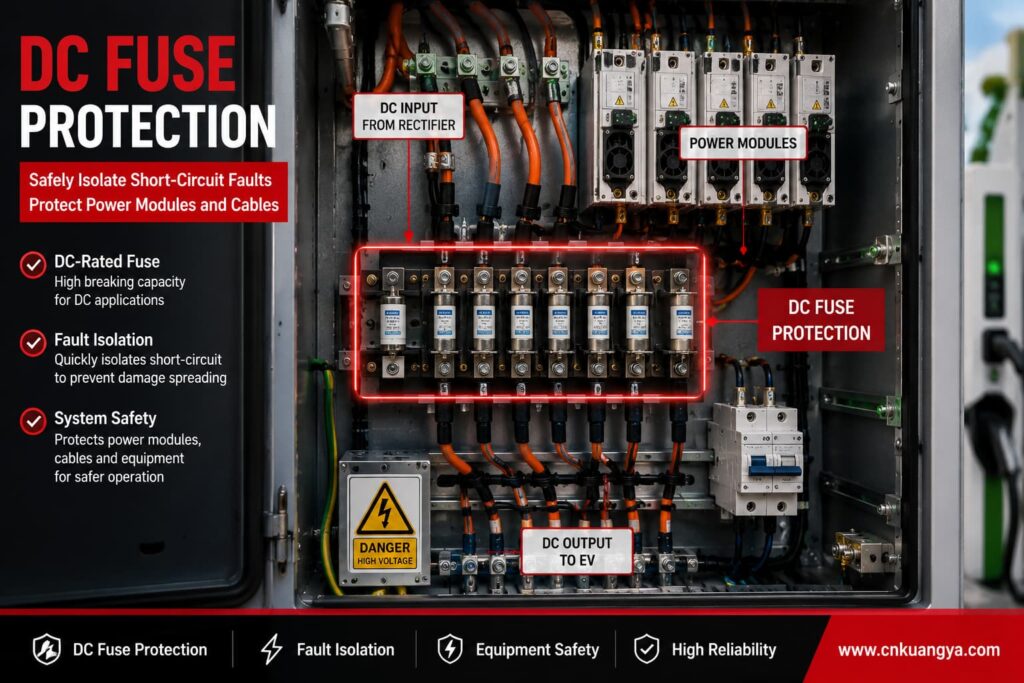
Fuse protection is another core part of Elektrischer Schutz von Ladestationen für Elektrofahrzeuge.
In high-voltage EV charging and energy infrastructure, DC-Absicherung helps isolate short-circuit faults and protect power modules, cables, and internal circuits.
SPDs reduce transient overvoltage. Fuses isolate overcurrent and short-circuit faults. These two devices solve different problems and should not replace each other.
In EV charging equipment, fuses may be used in:
A fuse must be selected according to voltage, current, breaking capacity, time-current characteristics, and application environment.
For DC fast charging systems, DC fault current behavior is different from AC fault current. DC arcs are more difficult to extinguish because the current does not naturally cross zero like AC current. Therefore, DC-rated fuses are necessary where the circuit requires DC fault interruption.
A poor fuse selection can lead to several problems:
Fuse coordination is not only about choosing the correct current rating. It is about making sure the correct protection device operates at the correct time.
For example, if a small internal module fault causes the whole charging station to shut down, the protection design may be too broad. If a serious short circuit is not isolated quickly, the protection design may be too weak.
A good fuse strategy helps:
For EV charger manufacturers and EPC engineers, fuse protection should be reviewed together with cable size, expected load current, fault current level, thermal conditions, and enclosure design.
| Selection Item | Warum es wichtig ist |
|---|---|
| Nennspannung | Must match or exceed system voltage |
| Nennstrom | Must match normal operating current and derating conditions |
| Ausschaltvermögen | Must interrupt available fault current safely |
| AC/DC rating | DC circuits require DC-rated protection |
| Fuse type | Different applications require different fuse characteristics |
| Kompatibilität der Halterung | Poor contact increases heat and failure risk |
| Temperature derating | Outdoor cabinets may operate under high temperature |
| Maintenance access | Easy replacement reduces downtime |
Für Elektrischer Schutz von Ladestationen für Elektrofahrzeuge, fuses should not be selected only by price. A low-quality fuse may look acceptable at the quotation stage but create higher maintenance cost later.
Fire safety is still important, but it should be treated as one part of the overall electrical protection system.
An EV charging cabinet may contain:
Inside a closed electrical cabinet, several conditions may increase fire risk:
The U.S. Fire Administration states that certified EV charging equipment improves safety and that charging equipment should be maintained according to manufacturer guidelines. It also notes that signs of excessive wear may indicate a potential shock hazard and that damaged chargers should not be used.
For outdoor EV charging stations, cabinet fire safety should include both prevention and early response.
The U.S. Fire Administration also recommends using certified charging equipment and maintaining charging station components according to manufacturer guidelines as part of EV charging fire safety.
Prevention means reducing the chance of fault ignition. Early response means reducing the damage if an internal fault begins to generate smoke, heat, or flame.
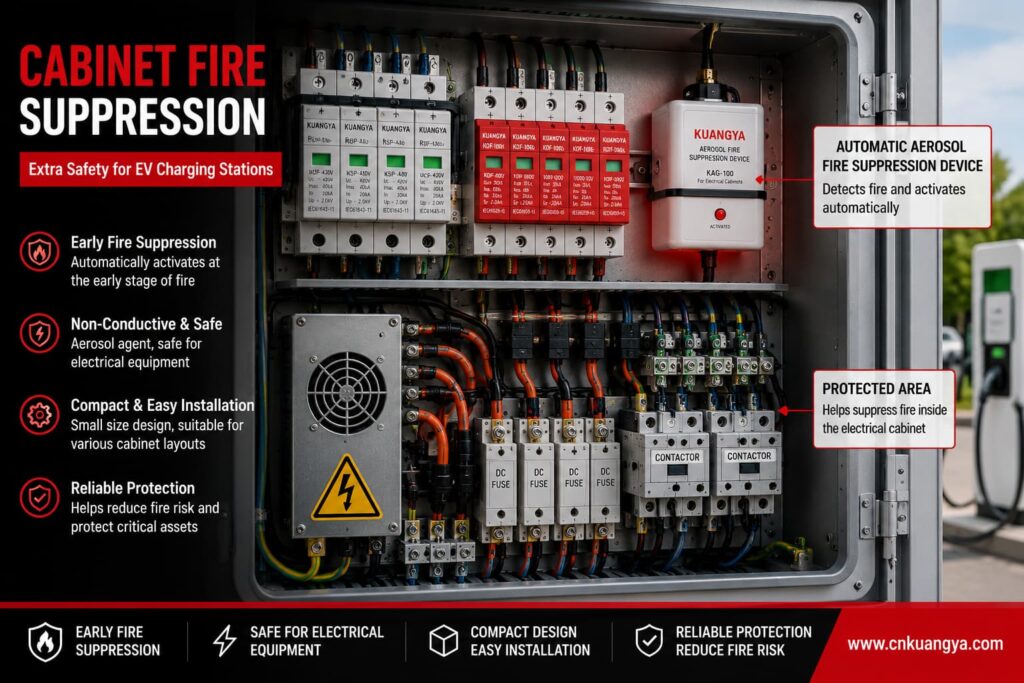
A cabinet automatic fire suppression device is not designed to replace electrical protection devices. It is a final protection layer for enclosed electrical equipment.
For compact EV charger cabinets, a cabinet automatic fire suppression device can provide an additional safety layer inside enclosed electrical equipment.
It can help reduce early-stage fire risk inside cabinets when used together with proper electrical design, temperature management, inspection, and maintenance.
For EV charging cabinets, automatic aerosol fire suppression may be considered in:
The advantage of cabinet-level fire suppression is that it can respond inside the enclosure before the fire spreads outside the cabinet.
However, engineers should avoid a wrong mindset:
Fire suppression does not solve poor wiring. Fire suppression does not replace SPD. Fire suppression does not replace fuse protection.
It is an additional layer inside a complete Elektrischer Schutz von Ladestationen für Elektrofahrzeuge strategy.
A complete EV charging station usually includes different electrical zones. Each zone needs different protection logic.
Similar protection logic is also used in Schutz von Solarwechselrichtern, where DC-side SPD, fuse coordination, and cabinet safety are critical for PV system reliability.
EV charger installation requirements should also be reviewed against the latest NEC Artikel 625 für Ladestationen für Elektrofahrzeuge, especially for conductors, equipment, and site-level electrical safety.
The grid input side may experience switching surges, overvoltage, overcurrent, and grounding faults.
Recommended protection considerations:
The charger cabinet input is where utility power enters the charger. This area is critical because a failure here may stop the entire charging system.
Recommended protection considerations:
The power conversion module is one of the most expensive parts of a DC fast charger.
Recommended protection considerations:
The DC output side delivers power to the electric vehicle. It may involve high voltage and high current.
Recommended protection considerations:
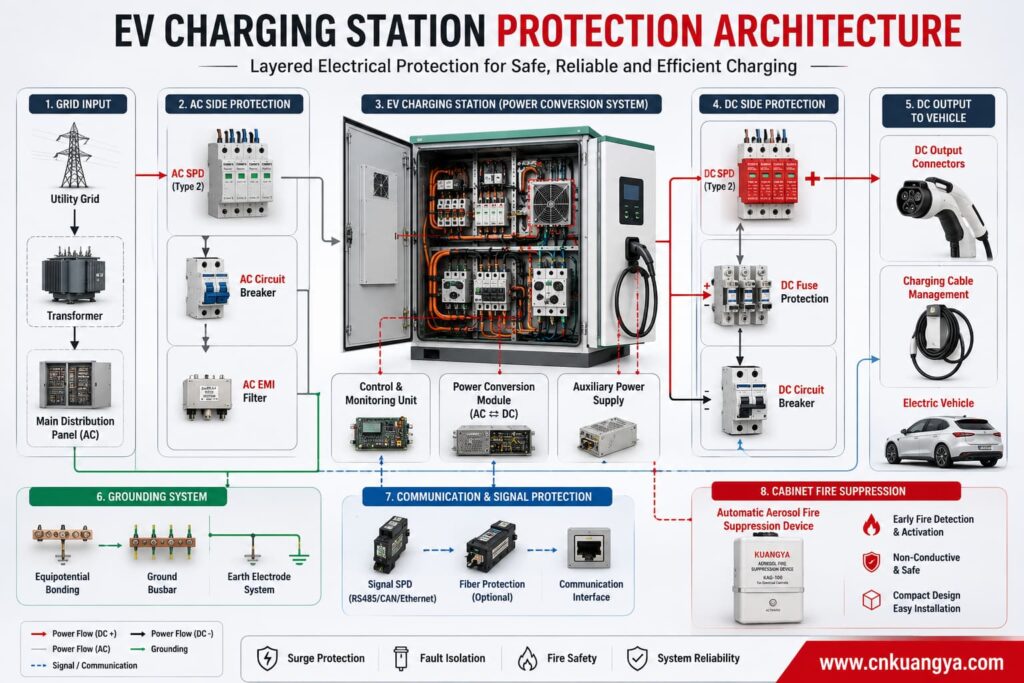
A charger can fail even when the power circuit is healthy. Screens, payment systems, network boards, and control systems can also cause downtime.
A field study of public DC fast chargers in the Greater Bay Area evaluated 657 CCS connectors across 181 open public DCFC stations and found that 72.5% were functional during the evaluation. Non-functioning cases included screen, payment, charge initiation, network, and connector problems.
This shows that charger reliability is not only about power components. It also depends on control systems, communication stability, user interface, connectors, and maintenance.
Für Elektrischer Schutz von Ladestationen für Elektrofahrzeuge, engineers should also consider:
For EPC contractors, electrical engineers, and procurement teams, product selection should not start with price. It should start with system requirements.
The right question is not:
“What is the cheapest SPD or fuse?”
The right question is:
“What protection level does this EV charging project require?”
For North American EV charging projects, UL 2202 for DC charging equipment is commonly referenced when evaluating DC fast charger safety and performance requirements.
Different charging stations require different protection designs.
| Ladegerät Typ | Typical Risk Level | Fokus Schutz |
|---|---|---|
| AC wallbox | Unter | AC protection, residual current protection, cable safety |
| AC commercial charger | Mittel | AC SPD, breaker, grounding, enclosure protection |
| DC fast charger | Hoch | AC/DC SPD, fuse, thermal control, cabinet fire safety |
| Highway charging site | Hoch | Lightning protection, uptime, outdoor cabinet protection |
| Fleet charging depot | Hoch | Load management, fuse coordination, cabinet safety |
| Solar + EV charging station | Hoch | PV-side SPD, DC fuse, inverter protection, EV charger protection |
EV charging sites combined with battery storage should also evaluate battery energy storage fire protection because BESS cabinets introduce additional DC fault and thermal risks.
SPD and fuse selection depends heavily on electrical parameters.
For each project, confirm:
Outdoor EV chargers face harsher conditions than indoor equipment.
Important environmental factors include:
In coastal or desert regions, enclosure sealing, corrosion resistance, and thermal management become especially important.
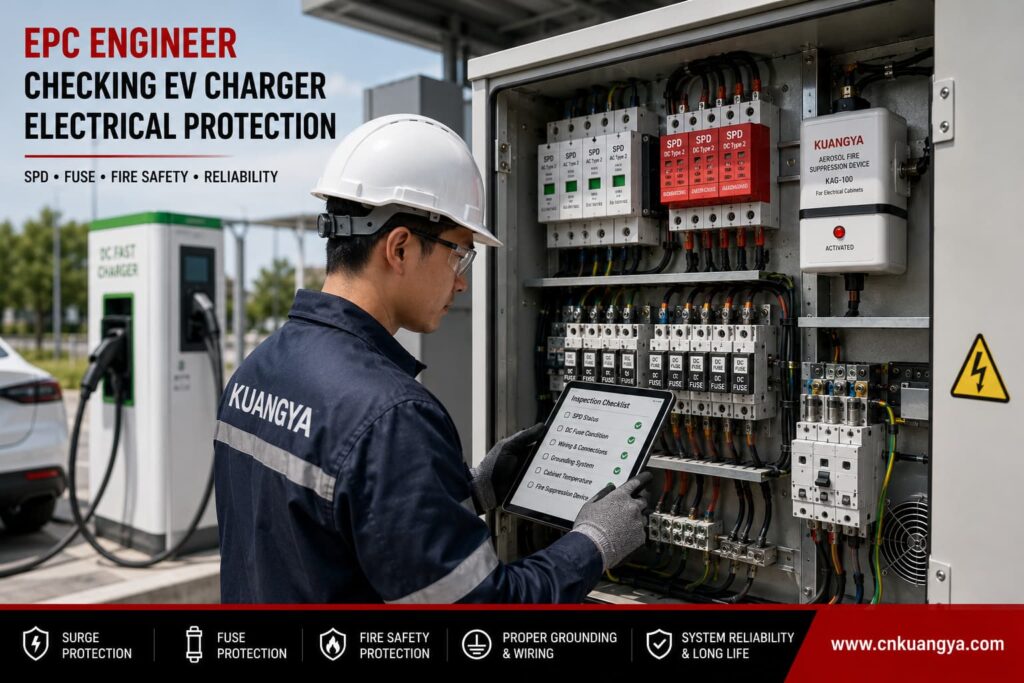
Protection devices should be selected for real maintenance conditions.
Ask these questions:
A good Elektrischer Schutz von Ladestationen für Elektrofahrzeuge design should reduce downtime, not make maintenance more difficult.
Some projects install SPD protection only at the AC input and ignore other sensitive circuits.
This may not be enough for complex charging systems. Surge energy can enter through different paths, including power cables, grounding paths, signal cables, and nearby induced voltage.
A complete design should evaluate both AC and DC circuits.
DC circuits require protection devices that can safely interrupt DC fault current. Using a fuse without the proper DC rating can create serious safety risk.
For DC fast charging systems, fuse voltage rating, breaking capacity, and DC application suitability must be checked carefully.
Cabinet fire suppression is important, but it is not the first protection layer.
The first protection layer is good electrical design. The second layer is correct protection device selection. The third layer is monitoring and maintenance. Fire suppression is an additional cabinet-level safety layer.
Many EV charger failures are related to heat, even when they do not immediately become fire incidents.
Heat can come from:
Thermal inspection should be part of maintenance planning.
A protection system is not a collection of random parts. SPD, fuse, breaker, grounding, cable, and cabinet design must be coordinated.
Poor coordination can cause:
Low-price components may reduce initial cost, but they can increase long-term operation cost.
For EPC projects, the more important cost is often:
A reliable protection device is not only a component. It is part of the charging station’s operating stability.
A practical Elektrischer Schutz von Ladestationen für Elektrofahrzeuge solution can be built around three main product groups:
This layered approach is similar to a complete SPD, fuse and fire suppression protection strategy used in solar PV and other high-voltage electrical systems.
SPD is used to reduce transient overvoltage caused by lightning, grid switching, and electrical disturbances.
Recommended application areas:
Key selection points:
Fuse protection helps isolate short circuits and protect cables, modules, and internal circuits.
Recommended application areas:
Key selection points:
Cabinet fire suppression provides an additional safety layer for enclosed electrical equipment.
Recommended application areas:
Key selection points:
The complete solution should follow this logic:
SPD reduces surge damage. Fuse protection isolates fault current. Cabinet fire suppression helps reduce early-stage fire spread inside the enclosure.
Together, these products support a stronger EV charging station safety and reliability design.
For EPC contractors, charging station manufacturers, and project procurement teams, KUANGYA can support product selection for:
A typical DC fast charging station may include the following protection layers:
| System Area | Schutzvorrichtung | Zweck |
|---|---|---|
| Main AC input | AC SPD + breaker | Reduce surge and overcurrent risk |
| Charger cabinet | Typ 2 SPD | Protect power electronics |
| DC output circuit | DC-Sicherung | Isolate DC fault current |
| Power module branch | Fuse protection | Limit damage to failed branch |
| Control circuit | Signal protection where required | Reduce communication failure risk |
| Cabinet interior | Automatic fire suppression | Reduce early-stage cabinet fire risk |
| Grounding system | Proper earthing | Provide fault and surge discharge path |
| Maintenance system | Inspection and monitoring | Improve long-term reliability |
This type of layered design is more effective than relying on one device.
A charger installed without proper SPD may suffer repeated control board failures. A charger installed without correct fuse coordination may experience larger damage during internal faults. A charger installed without cabinet-level fire safety may have higher risk if an internal electrical fault develops into ignition.
The best design is not the most complicated one. The best design is the one that matches the actual site risk.
EV Charging Station Electrical Protection refers to the complete protection design used to reduce electrical risks in EV charging equipment. It includes surge protection, fuse protection, grounding, cable protection, thermal management, cabinet fire safety, and maintenance planning.
EV charging stations need SPDs because lightning, grid switching, and transient overvoltage can damage power modules, control boards, communication systems, and other sensitive electrical components. SPD protection helps reduce this risk.
It depends on the charger design, site risk, system voltage, cable length, and local electrical requirements. Many projects use AC-side SPD protection, while DC-side surge protection may also be considered for high-voltage or high-risk installations.
EV charging systems may use AC or DC fuses depending on the circuit. DC fast charging circuits require protection devices suitable for DC voltage and DC fault interruption. Fuse voltage rating, current rating, breaking capacity, and application type must be checked carefully.
Not always. Circuit breakers and fuses have different protection characteristics. In some circuits, fuses provide fast fault isolation and high breaking capacity. The correct choice depends on the circuit design and fault current level.
EV charger cabinets contain power modules, terminals, cables, fans, control boards, and communication devices. Overheating, loose connections, dust, poor ventilation, or electrical faults can create fire risk inside the cabinet. Cabinet fire safety helps reduce this risk.
No. Fire suppression does not replace SPD or fuse protection. SPD reduces surge damage, fuses isolate fault current, and cabinet fire suppression provides an additional safety layer if an internal fire begins.
Common causes include surge damage, overheating, connector damage, cable wear, communication failure, payment system failure, power module failure, poor maintenance, and environmental stress.
EPC contractors can improve reliability by selecting correct SPDs and fuses, designing proper grounding, using suitable cable sizes, improving ventilation, adding cabinet fire safety where needed, and planning regular inspection and maintenance.
KUANGYA can provide surge protective devices, DC fuses, fuse holders, circuit protection components, and cabinet automatic fire suppression devices for EV charging, solar PV, BESS, telecom, data center, and industrial electrical protection projects.
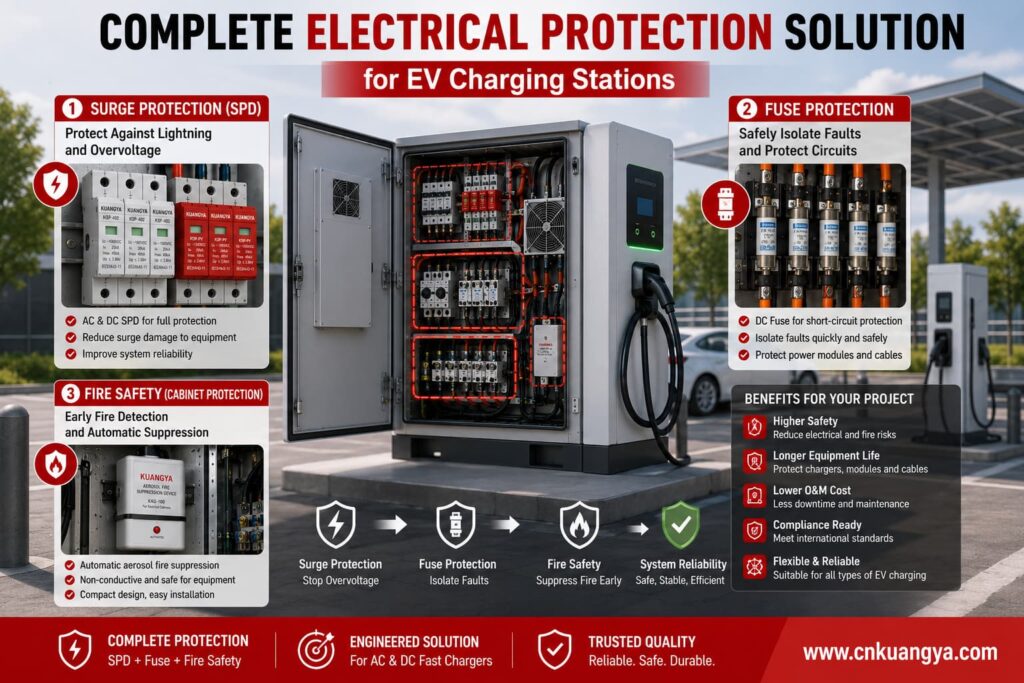
EV charging stations are becoming more powerful, more complex, and more important to modern energy infrastructure. As charging networks expand, reliability and safety will become key factors for project success.
Eine vollständige Elektrischer Schutz von Ladestationen für Elektrofahrzeuge design should not depend on one device. It should combine SPD protection, fuse protection, grounding, cable protection, thermal management, cabinet fire safety, and regular maintenance.
For engineers, EPC contractors, charging station manufacturers, and procurement teams, this layered protection strategy can help reduce equipment failure, improve uptime, support safer operation, and lower long-term maintenance cost.
KUANGYA provides electrical protection components for EV charging and energy infrastructure projects, including SPDs, DC fuses, fuse holders, and cabinet automatic fire suppression devices.
For project selection, OEM cooperation, or technical datasheets, contact KUANGYA for EV charging station electrical protection solutions.

