WengYang Industrial Zone Yueqing Wenzhou 325000
Work Hours
Monday to Friday: 7AM - 7PM
Weekend: 10AM - 5PM
WengYang Industrial Zone Yueqing Wenzhou 325000
Work Hours
Monday to Friday: 7AM - 7PM
Weekend: 10AM - 5PM

Whole-house SPD or plug-in surge protector? Compare what each protects, when to use both, and what to check before choosing an AC SPD.
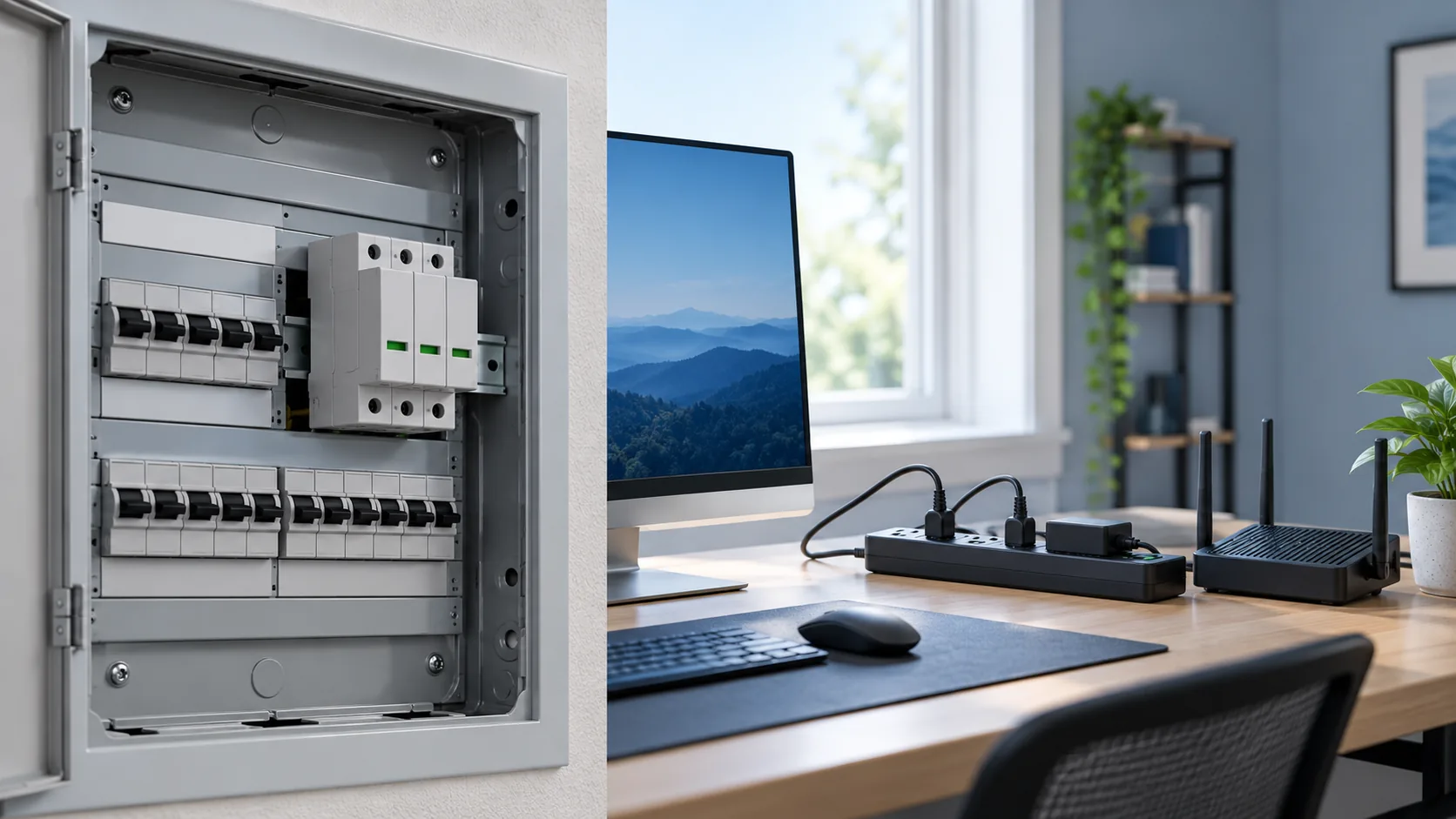
Quick answer: a whole-house surge protector (SPD) protects the electrical installation at the panel, including hardwired loads. A plug-in surge protector protects only equipment connected to its outlets. For valuable electronics, the strongest practical approach is often both layers—provided each product is correctly specified and installed. A plain power strip may offer no surge protection at all.
That distinction matters when you are protecting a home office, heat pump, inverter, refrigerator or other equipment that cannot all share one plug-in strip. This guide explains the different jobs, what to check before buying, and when an electrician should review the installation.
| Question | Whole-house SPD | Plug-in surge protector |
|---|---|---|
| Where is it installed? | At the service equipment or distribution panel, as permitted by its listing and local rules | At a receptacle, close to the equipment |
| What can it cover? | Circuits served by the protected panel, including many hardwired appliances | Only the devices plugged into it |
| Who installs it? | A qualified electrician | The user, following the product instructions |
| Does it provide backup power? | No | No |
| Can one replace the other? | Not always; sensitive electronics may benefit from a second point-of-use layer | No; it does not protect hardwired loads or the entire panel |
Schneider Electric explains that panel-mounted whole-home SPDs help protect appliances that cannot be plugged into a surge strip, while point-of-use protection remains useful for sensitive electronics. Its guidance supports a layered approach rather than treating either device as universal protection.
A multi-outlet strip distributes power; that alone does not mean it limits transient overvoltage. Check the label and manufacturer documentation for an explicit surge-protection function, an applicable certification or standard, electrical ratings, and a protection-status indicator. UL Solutions distinguishes ordinary power strips from surge protectors and warns against overloading either with high-power appliances.
A protection light also needs interpretation: follow the manufacturer’s instructions if it changes color or turns off. For panel SPDs, read our guide on signs that an SPD may need replacement.
A panel SPD is connected to the building distribution system, so it can provide a first layer for circuits supplying lighting, HVAC or heat pumps, kitchen appliances, routers and office outlets. A plug-in protector cannot cover a hardwired air conditioner or an appliance connected elsewhere. That does not mean every surge is eliminated: the result depends on the installation, earthing, surge path, device ratings and the equipment’s withstand level.
If your installation also has solar PV or an energy-storage inverter, the AC panel SPD is only one part of the design. DC-side protection may need a separate, PV-rated device. See our inverter SPD guide before assuming a built-in SPD covers every exposure.
Avoid assuming that stacking multiple plug-in protectors improves safety. Follow each product’s connection and load instructions, and never use a power strip as a substitute for fixed wiring.
For commercial or residential AC panels, explore KUANGYA’s AC surge protective device range. The correct model depends on the actual system and its protection study; ask for the datasheet rather than choosing by kA alone.
SPDs are designed for transient surges. They do not regulate sustained high or low supply voltage, repair poor grounding, prevent every direct-lightning consequence, or supply backup energy. If you are troubleshooting recurring abnormal voltage, see surges vs temporary overvoltage and have the electrical fault investigated.
For sensitive electronics, it can be useful as a second layer. Check the panel SPD coverage, the plug-in product’s actual surge-protection rating, and all manufacturer instructions.
Only equipment connected to a genuine surge-protecting strip can receive that strip’s protection, and high-power appliances may be unsuitable for plug-in strips. A qualified electrician can assess panel-level protection for hardwired or dedicated-circuit loads.
Panel work exposes hazardous voltage and must follow local rules and the product instructions. Use a qualified electrician to select, connect and verify the device.
List the equipment you need to protect, note whether it is hardwired or plugged in, and record your supply voltage and panel details. Then contact KUANGYA with those details to discuss a suitable AC SPD and supporting documentation.

