WengYang Industrial Zone Yueqing Wenzhou 325000
Work Hours
Monday to Friday: 7AM - 7PM
Weekend: 10AM - 5PM
WengYang Industrial Zone Yueqing Wenzhou 325000
Work Hours
Monday to Friday: 7AM - 7PM
Weekend: 10AM - 5PM

PV connector pairs at a combiner box need documented compatibility, not just a matching shape. Check ratings, cable termination, field evidence and safe replacement steps.
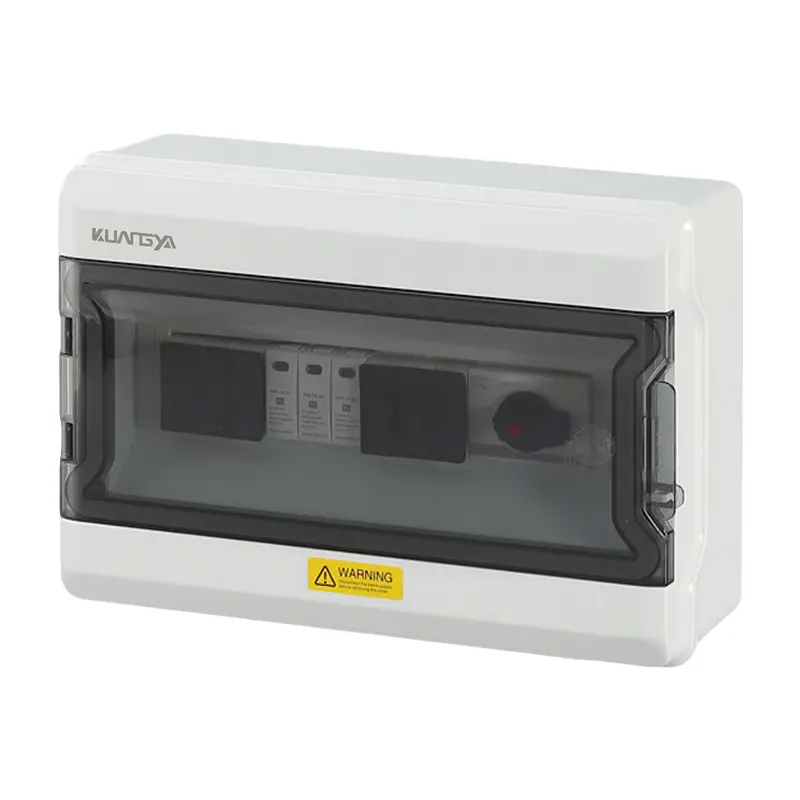
Quick answer: A PV connector pair that clicks together is not automatically compatible. At a combiner-box input, record both manufacturers and exact models, then confirm that the specific pair is approved by the relevant manufacturer and accepted under the project’s applicable rules. If compatibility cannot be documented, do not energize that connection. This guide covers procurement, commissioning and maintenance decisions for EPC teams and PV plant owners.
A string extension cable can arrive with a connector that looks like the module lead or the combiner-box tail but uses a different contact, seal or tolerance. IEA PVPS identifies string ends, inverter connections and combiner boxes as common locations for such cross-mating. Its failure fact sheet links incompatible pairs to poor sealing, corrosion, rising contact resistance, arcing and possible fire. The failure can develop over time rather than at initial startup.
The issue is separate from selecting the combiner box’s internal fuses, SPD and DC switch. Those devices have different protective functions; none makes an incompatible connector pair acceptable.
| Item | What to verify | Why it matters |
|---|---|---|
| Exact identity | Manufacturer, model and version of both mating halves; approval for that exact combination | “MC4-style” or matching shape is insufficient. |
| Electrical rating | Rated DC voltage and current at the installed cable size and conditions | A nominal array value is not the maximum design condition. |
| Cable and termination | Permitted cable size, insulation diameter, contact and approved crimp tool/process | Poor crimping or sealing can create resistance or water entry. |
| Environment | Installed ingress rating, UV exposure, temperature and cable support per instructions | A component rating depends on correct assembly and use. |
| Evidence | Manufacturer instructions, compatibility declaration where applicable, purchase records and inspection photos | Enables the operator to verify and replace the same approved part later. |
IEC 62852 addresses PV connector safety requirements, while the complete array design and installation must be checked against the applicable PV array and local electrical rules. A connector’s individual certificate does not by itself prove that two different products are approved as a mated pair.
Before ordering, ask for the exact tail connector model and compare it with the string extension and module connector schedule. If they differ, obtain documented approval for the pair or specify matching components. Include the interface schedule in the combiner-box enquiry.
Isolate and verify the affected circuit under the site procedure. A qualified PV technician should determine the cause, inspect adjacent cable and contacts, and replace damaged or unapproved pairs according to the equipment instructions. Do not simply cut off the visibly burned half and mate a replacement of unknown origin. If water ingress is involved, inspect the combiner box after heavy rain and the entry sealing as well.
Require connector identity and termination records in the cable submittal. Treat “universal compatible” as a claim requiring evidence for the actual pair, not as a specification. Compare like-for-like string current and temperature after commissioning; investigate a persistent outlier using the site procedure. Our string-current mismatch guide explains why low current alone does not identify the connector as the cause.
The US Department of Energy’s PV System Owner’s Guide to Identifying, Assessing, and Addressing Weather Vulnerabilities, Risks, and Impacts includes a photograph of a failed PV connector and says the damage was possibly due to cross-mating and/or poor installation. The guide does not establish a single definitive cause for that photographed failure. Its practical lesson is to preserve the failed pair, identify both parts, and investigate termination and installation conditions before drawing a conclusion.
Separately, the IEA PVPS PV failure fact sheet on DC connector mismatch describes actual field-observed failure patterns and recommends replacing nonmatching connectors. Sandia National Laboratories’ PV connector reliability project documents why field inspections record connector make, model, condition and thermal evidence. These third-party sources support the inspection method; they do not certify any particular Kuangya connector pairing.
A mechanical fit answers only whether the two housings can be joined. An approved pair requires evidence for the contact, sealing and operating conditions of the specific products. If a replacement part has the same general appearance but lacks that evidence, do not treat it as equivalent. Record the decision in the as-built documentation so future maintenance teams do not unknowingly reintroduce cross-mating.
PV DC conductors may remain energized in daylight even when the inverter is off. Never unplug a connector under load unless the equipment and approved procedure explicitly permit it. Installation, fault-finding and electrical tests belong to qualified personnel.
No. Ask for approval of the specific mating models; a similar profile or click does not demonstrate safe intermatability.
They address different hazards. Neither is a substitute for a properly selected and assembled connection. For broader protection coordination, see the PV electrical protection guide.
No. It shows an abnormal temperature pattern under the measurement conditions. Confirm part identity, termination, current and surrounding conditions before assigning a root cause.
Send the string count, maximum design DC voltage, design current, cable dimensions, environmental conditions and the exact module/extension connector schedule. Request the proposed mating connector model and written installation instructions before approval.
Editorial note: This article summarizes published third-party evidence and a procurement workflow. It is not a Kuangya field case, a test report for a specific product, or a substitute for the actual manufacturer’s instructions and local code review.

