WengYang Industrial Zone Yueqing Wenzhou 325000
Work Hours
Monday to Friday: 7AM - 7PM
Weekend: 10AM - 5PM
WengYang Industrial Zone Yueqing Wenzhou 325000
Work Hours
Monday to Friday: 7AM - 7PM
Weekend: 10AM - 5PM

SPD vs AFDD explained: compare surge protection with arc fault detection, see when both may be specified, and check the AC circuit and product ratings before selection.
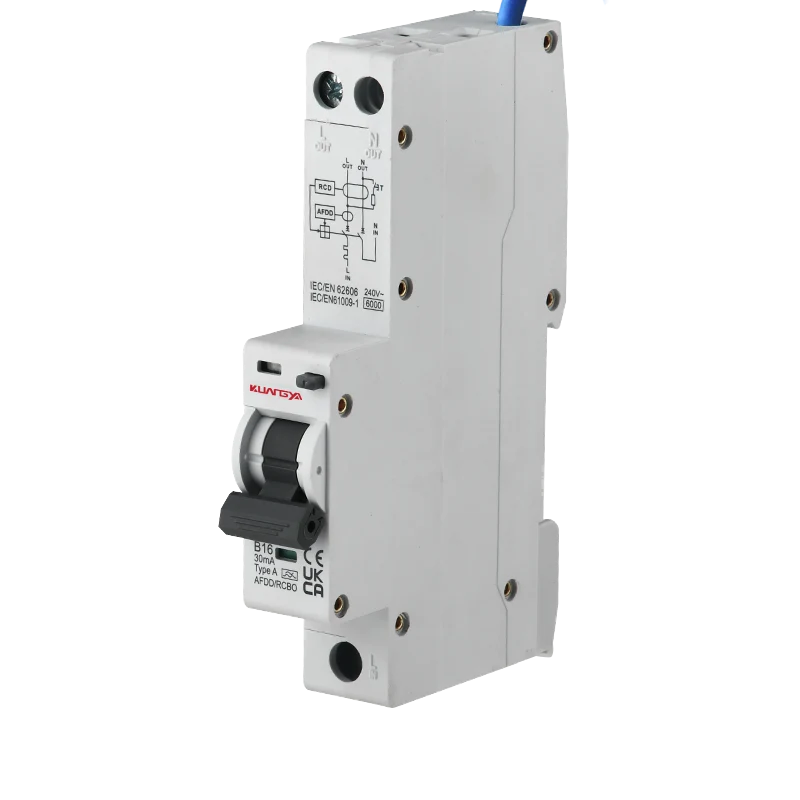
Quick answer: A surge protective device (SPD) limits short-duration overvoltages and diverts surge current. An arc fault detection device (AFDD) detects specified arcing conditions in an AC circuit and opens that circuit. They address different hazards. A properly designed installation may need both, together with the appropriate overcurrent and residual-current protection.
| Question | SPD | AFDD |
|---|---|---|
| Primary problem | Transient overvoltage from lightning effects or switching | Potentially dangerous arcing in a protected AC circuit |
| Normal response | Limits surge voltage and diverts surge current | Detects specified arc faults and disconnects the circuit |
| Typical position | At a distribution board, with additional coordinated protection where needed | On the final circuit it protects |
| Relevant product standard | IEC 61643-11 for AC power SPDs | IEC 62606 for household and similar AC AFDDs |
The exact installation arrangement depends on the electrical system, local rules and the selected device instructions. The table describes functions, not a universal wiring diagram.
An AC SPD is designed to limit transient surge voltage and divert surge current. Lightning effects and switching events can create these fast overvoltages. An SPD is selected for the supply and exposure: its continuous operating voltage (Uc), voltage protection level (Up), discharge ratings, short-circuit conditions and coordination with other protection all matter. IEC 61643-11:2025 sets requirements and test methods for AC low-voltage SPDs; IEC 61643-12 gives selection and application guidance.
An SPD cannot detect arc faults. It also should not be described as a substitute for a circuit breaker or an RCD. Explore our AC SPD range and our SPD basics guide. If an SPD indicator changes, use our SPD red-light troubleshooting guide to plan the next check.
An AFDD monitors the protected AC circuit for the electrical signatures of specified arc faults and opens the circuit when its operating criteria are met. Arcing can arise from damaged conductors, loose connections or insulation defects. IEC 62606 covers AFDDs for household and similar AC circuits. It allows different device constructions: an AFDD may have its own opening means, integrate another protective device, or be assembled with a declared protective device.
Do not assume every AFDD also provides overload, short-circuit or residual-current protection. Check the particular model. For example, our AFDD-1 product page describes an integrated device; that specification must not be generalized to every AFDD. See our AFDD range and AFDD introduction. For unexplained trips, read our AFDD nuisance-tripping guide.
Consider a distribution board feeding an AC final circuit with sensitive equipment. The SPD addresses transient overvoltage at the selected point in the installation. The AFDD addresses specified arcing in its protected final circuit. The need for an SPD is assessed separately from the need for an AFDD; an AFDD does not inherently require an external SPD. The circuit still needs the overcurrent and residual-current functions required by its design and local rules. If an integrated AFDD provides some of those functions, verify the exact ratings and approvals before selecting it.
Neither device guarantees that every electrical fault or fire will be prevented. Correct wiring, earthing, conductor sizing, device coordination and periodic inspection remain essential.
No. Arc fault detection does not perform the SPD’s surge-limiting function.
An SPD is not designed to identify and disconnect the specified arc faults that an AFDD addresses.
The AC SPD and IEC 62606 AFDD discussed here concern AC applications. DC PV surge protection and DC arc fault protection have different equipment and applicable standards; do not transfer an AC device specification to a PV DC circuit.
Send us the supply voltage, earthing arrangement, circuit diagram, installation market and required protection functions. Contact Kuangya for model-specific information and documentation.
Technical references: IEC 61643-11:2025; IEC 61643-12:2020; IEC 62606 consolidated edition; BEAMA AFDD application guide.

