Промышленная зона Вэньян Юэцин Вэньчжоу 325000
Рабочие часы
Понедельник - пятница: 7AM - 7PM
Выходные: 10AM - 5PM
Промышленная зона Вэньян Юэцин Вэньчжоу 325000
Рабочие часы
Понедельник - пятница: 7AM - 7PM
Выходные: 10AM - 5PM

MCB 2026 Guide: Expert Selection, Safety Standards & Troubleshooting | KUANGYA
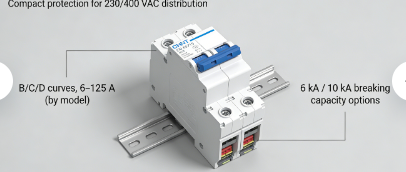
A Miniature Circuit Breaker is an automatically operated electrical switch engineered to protect circuits from damage caused by overload or short circuit. Unlike fuses that require replacement after a single operation, this device is reusable, making it the cornerstone of modern low-voltage distribution systems. Operating within the voltage range of 230V/400V AC (50/60Hz) and current ratings up to 125A, these units have evolved from simple on-off switches to sophisticated safety devices compliant with global standards like IEC 60898-1 and GB/T 10963.1-2020 🌟.
In 2026, the global market for these devices is projected to grow alongside the expansion of residential construction and industrial automation, with Asia-Pacific leading the demand 🌏. As a critical component in electrical panels, the unit acts as the first line of defense against electrical fires, equipment burnout, and wiring degradation. Its compact design – typically measuring just a few inches in width – allows for high-density installation in distribution boards, making it indispensable in both space-constrained residential settings and large-scale industrial facilities.
At its heart, a miniature circuit breaker combines two protective mechanisms: thermal tripping for overloads and magnetic tripping for short circuits. The thermal element uses a bimetallic strip that bends when heated by excessive current – a result of prolonged overload – triggering the breaker to trip. The magnetic element, meanwhile, uses an electromagnet that activates instantaneously when exposed to high short-circuit currents (typically 5-20 times the rated current), rapidly interrupting the circuit to prevent catastrophic damage 🔌.
Modern units also feature advanced arc suppression systems. When contacts open, an electric arc forms; these devices use metal 栅片 (metal grids) to split and cool this arc, extinguishing it within milliseconds. This arc quenching capability is critical for maintaining safety, especially in high short-circuit capacity applications. Additionally, these devices are designed with mechanical durability, offering a mechanical life of over 20,000 operations, ensuring reliable performance for years with minimal maintenance.
Not all miniature circuit breakers are created equal. These devices are classified by their tripping characteristics, which determine their suitability for specific loads. The four primary types – B, C, D, and K – are defined by the ratio of the tripping current to the rated current (In), making type selection critical to avoid nuisance tripping or inadequate protection 🛡️.
B-Type units trip at 3-5 times the rated current (3In-5In), making them ideal for circuits with low inrush currents. They are the go-to choice for purely resistive loads like lighting circuits, incandescent lamps, and small electronic devices. With a tripping time of 0.04-13 seconds, B-type units offer gentle protection, making them perfect for residential lighting circuits and sensitive electronic equipment where false tripping must be minimized 💡.
C-Type units trip at 5-10 times the rated current (5In-10In), the most versatile option for general-purpose circuits. They are designed to handle moderate inrush currents from common loads like power outlets, small motors, and air conditioners. Widely used in residential, commercial, and light industrial settings, C-type units strike a balance between protection and reliability, making them the default choice for most standard electrical installations 🏢.
D-Type units trip at 10-20 times the rated current (10In-20In), engineered for circuits with high inrush currents. They are essential for inductive loads like large motors, transformers, welding machines, and compressors, where temporary current surges during startup could trigger a nuisance trip. With a fast tripping time (0.04-3 seconds), D-type units provide robust protection without interrupting normal operation during startup, making them indispensable in industrial environments 🏭.
K-Type units trip at 8-12 times the rated current (8In-12In) with ultra-fast response (<0.1 seconds). Designed for applications with high surge currents like motor drives, UPS systems, and power factor correction capacitors, K-type units offer enhanced protection against transient overcurrents. Their specialized design makes them a niche but critical choice in industrial settings where equipment is prone to sudden current spikes ⚡.
A common confusion in electrical protection is distinguishing between a Miniature Circuit Breaker and an MCCB (Molded Case Circuit Breaker). While both protect against overcurrents, their design, capacity, and applications differ drastically, making proper selection vital for compliance and safety 📊.
表格
| Параметр | Миниатюрный автоматический выключатель | MCCB |
|---|---|---|
| Текущий рейтинг | До 125 А | 10A to 2500A |
| Tripping Adjustability | Fixed (non-adjustable) | Adjustable (thermal/magnetic settings) |
| Разрывная способность | 6kA to 25kA | 10kA to 200kA |
| Шкаф | Plastic casing | Molded metal casing |
| Первичное применение | Branch circuit protection | Main circuit/feeder protection |
| Стоимость | Lower, cost-effective | Higher, heavy-duty |
The key takeaway: these devices are designed for small-scale, low-current applications like residential lighting and small appliances, while MCCBs are built for high-current industrial systems. For example, a home distribution board uses these units to protect individual circuits, while a factory’s main power supply relies on MCCBs to handle high current loads. Misapplying these devices can lead to inadequate protection or system failure – a critical consideration for global electrical engineers and contractors 🛠️.
In international projects, compliance with regional standards further differentiates usage. In Europe, IEC 60898 governs these units, while IEC 60947-2 regulates MCCBs. In North America, UL 489 covers these units, and UL 1009 applies to MCCBs. Understanding these regional standards is essential for ensuring product compliance and market acceptance, especially for exporters targeting global markets 🗺️.
Global safety standards for these devices ensure uniform protection across international markets, with IEC 60898-1 being the most widely recognized benchmark. Published in 2015 and updated in 2019, IEC 60898-1 specifies requirements for AC units rated up to 440V and 125A, covering design, performance, and testing criteria 📜.
IEC 60898-1 mandates rigorous testing for these units, including:
For the European market, these units must carry the CE mark, demonstrating compliance with IEC 60898-1 and EU safety directives. In the UK, additional BS EN 60898 standards apply, while in Australia, AS/NZS 60898 is the regulatory benchmark. For North America, UL 489 certification is mandatory for these units sold in the US and Canada, with testing criteria aligned with IEC standards but with regional modifications 🇺🇸🇨🇦.
| Регион | Primary Standard | Key Requirements |
|---|---|---|
| EU/EEU | IEC 60898-1 + CE Mark | Compliance with Low Voltage Directive (LVD) |
| ВЕЛИКОБРИТАНИЯ | BS EN 60898 | Additional testing for UK wiring regulations |
| US/Canada | UL 489 | High short-circuit capacity testing (up to 10kA) |
| Австралия/Новая Зеландия | AS/NZS 60898 | Strict environmental durability requirements |
| Middle East | IEC 60898-1 + GCC Conformity | High dust and temperature resistance certification |
For manufacturers like KUANGYA, adhering to these global standards is not just a regulatory requirement but a competitive advantage. Units that meet multiple international certifications can access broader markets, reduce trade barriers, and build trust with global customers. In 2026, as cross-border electrical project demand rises, certified units will be the preferred choice for contractors and engineers worldwide ✅.
Selecting the right unit requires a systematic approach, considering load characteristics, environmental conditions, and regional standards. A poorly chosen device can lead to nuisance tripping, equipment damage, or safety hazards – making this process critical for electrical designers, installers, and project managers 📋.
The foundation of selection is determining the load current. For resistive loads (lighting, heaters), the rated current should be 1.25 times the continuous load current. For inductive loads (motors), factor in the startup inrush current:
For example, a 1.5kW air conditioner (120V) draws ~10A, requiring a 16A C-type unit to handle startup surges without tripping. A 100W LED lighting circuit with 5A continuous load uses a 6A B-type unit for precise protection 💡.
As discussed earlier, tripping characteristics (B, C, D, K) must align with load type to avoid false trips:
A common mistake is using a B-type unit for a motor circuit, which will trip during startup. Conversely, a D-type unit in a lighting circuit may fail to trip during a short circuit, posing a safety risk 🚫.
The short-circuit breaking capacity (Icn) is the maximum fault current a unit can safely interrupt. It must be equal to or greater than the available short-circuit current at the installation point:
For high-risk environments like data centers or industrial plants, units with higher Icn ratings (15kA+) are essential to handle potential short-circuit currents generated by large transformers or power systems 📈.
Device performance varies with temperature, humidity, and dust. For harsh environments:
KUANGYA’s industrial-grade units, for example, feature robust casings and anti-corrosion components, making them suitable for Middle Eastern and Asian industrial sites with extreme environmental conditions 🌡️.
Even the highest-quality units can experience issues during installation or operation. Understanding common problems and their solutions is critical for minimizing downtime and ensuring safety – a key concern for global electrical contractors and maintenance teams 🛠️.
Symptoms: The unit trips unexpectedly during normal operation, without overload or short circuit.
Causes:
Symptoms: The unit does not trip during overload or short circuit, posing fire risk.
Causes:
Symptoms: The unit handle is hard to move, or fails to stay in the “ON” position.
Causes:
Symptoms: Discoloration of terminals, burning smell, or tripping under light load.
Causes:
For global users, troubleshooting these issues requires adherence to local electrical codes and safety protocols. In regions like the EU and US, qualified electricians must perform repairs to ensure compliance and safety – a critical consideration for international project teams 🧑🔧.
The market for these devices is evolving rapidly, driven by the demand for smart homes, industrial automation, and energy efficiency. In 2026, we’re seeing a shift from traditional units to smart models – integrated with IoT technology for remote monitoring and control – that offer enhanced safety and efficiency 📱.
Smart units leverage IoT sensors and wireless communication (Zigbee, Wi-Fi, Bluetooth) to provide real-time data on circuit performance, including current draw, temperature, and fault alerts. Key benefits include:
Leading manufacturers like Schneider Electric, ABB, and KUANGYA are investing heavily in smart unit technology, with products like KUANGYA’s Smart MCB offering 4G/5G connectivity and cloud-based analytics for global users. In the Middle East and Asia, where smart city projects are booming, smart units are becoming a standard requirement for new construction 🏙️.
According to Grand View Research’s 2026 Global MCB Market Report, the global market is expected to reach $XX billion by 2030, with a CAGR of 5.2% from 2026 to 2030. This growth is fueled by the increasing adoption of renewable energy systems and the need for reliable circuit protection in smart cities and industrial facilities 🌱

