Промышленная зона Вэньян Юэцин Вэньчжоу 325000
Рабочие часы
Понедельник - пятница: 7AM - 7PM
Выходные: 10AM - 5PM
Промышленная зона Вэньян Юэцин Вэньчжоу 325000
Рабочие часы
Понедельник - пятница: 7AM - 7PM
Выходные: 10AM - 5PM

Прерыватели постоянного тока обеспечивают быстрый сброс, многоразовую защиту и более низкие долгосрочные затраты по сравнению с предохранителями. Ознакомьтесь с 3 ключевыми отличиями для ваших потребностей в цепях постоянного тока.

You will notice three main differences between DC Breakers and fuses: how you reset or reuse them, how they protect your dc circuits, and what they cost to buy and maintain. These differences affect your safety, the time it takes to fix problems, and your overall expenses. Understanding these points helps you pick the best protection for your system.
DC circuit breakers can be reset quickly after a fault, saving time and reducing downtime.
Fuses must be replaced after blowing, which can take longer and increase system downtime.
DC breakers are more practical for systems with frequent faults, while fuses are better for simple, low-cost protection.
Choose the right protection device based on your system’s voltage, current, and fault frequency.
DC circuit breakers have higher upfront costs but lower long-term expenses due to their reusability.
Fuses react faster to extreme short circuits, making them suitable for critical applications.
Regular maintenance is essential for both devices to ensure safety and reliability.
Combining fuses and circuit breakers can provide optimal protection and control for your system.
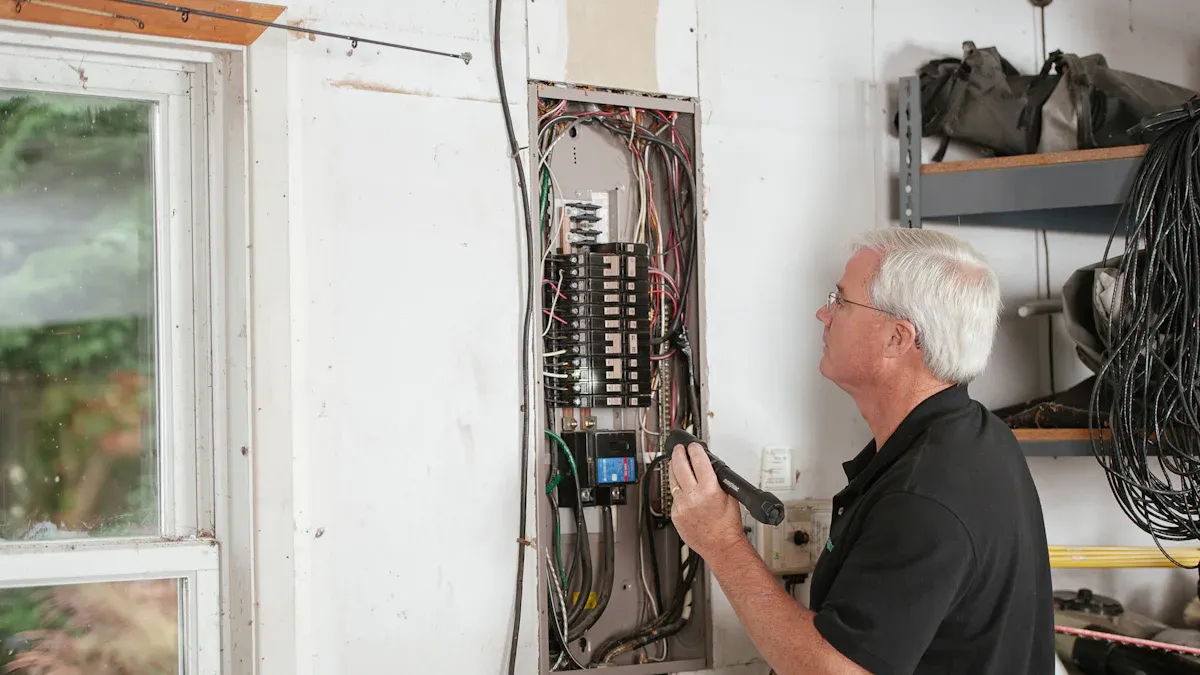
When you use dc circuit breakers, you gain the ability to reset them after a fault. You can do this either manually by flipping a switch or, in some advanced models, the breaker resets automatically once the overcurrent condition clears. This feature means you do not need to replace any parts after a trip. The mechanical switch inside the breaker interrupts the circuit and then allows you to restore power quickly. This process usually takes only a few seconds and does not require special tools.
Совет: Automatic reset breakers can restore your system without you being present, which is helpful in remote or hard-to-reach installations.
A fuse works differently. It protects your dc circuits by melting a thin wire inside when too much current flows. This action breaks the circuit and stops the flow of electricity. However, once a fuse blows, you cannot reuse it. You must replace the fuse with a new one before your system can work again. This process often takes much longer than resetting a breaker. You may need to turn off the power, find the correct replacement, and install it safely. In some cases, replacing a fuse can take 45 minutes or more, especially if the fuse is in a difficult-to-access location.
Here is a quick comparison:
Характеристика | Предохранитель | Автоматический выключатель |
|---|---|---|
Resetting | Must be replaced after blowing | Can be reset and reused |
Операция | Melts a wire to break the circuit | Uses a mechanical switch to interrupt circuit |
Practicality | Less practical for frequent tripping | More practical for applications with frequent tripping |
The way you reset or replace these devices affects your experience. Resetting dc circuit breakers is fast and simple. You can restore power in seconds, which reduces downtime and keeps your system running smoothly. If your system trips often, breakers save you time and effort. On the other hand, fuses require more work. You must carry spare fuses and know how to replace them safely. This process increases downtime and can be frustrating, especially if you need to wait for a technician.
Примечание: Both breakers and fuses require you to check the circuit before restoring power. This step ensures your system is safe and prevents repeated faults.
Safety is always important. Both resetting a breaker and replacing a fuse carry risks if you do not follow proper procedures. Only qualified personnel should handle these tasks to avoid electric shock. You should always evaluate the circuit before turning it back on.
If you want to learn more about choosing between fuses and breakers for your dc system, you can visit this guide on circuit protection devices for further details.
You rely on dc circuit breakers to protect your system from dangerous faults. These devices use advanced internal mechanisms to sense and stop abnormal current flow. Inside, you find three main types: thermal, magnetic, and electronic. Each type detects overcurrent in a unique way.
Thermal mechanisms use a bimetallic strip that bends when heated by excess current. This bending action triggers the breaker to open the circuit.
Magnetic mechanisms respond to sudden surges. When a high current flows, a magnetic field forms and pulls a lever to trip the breaker.
Electronic mechanisms use sensors and microchips to monitor current. If the current goes above a set limit, the electronics send a signal to trip the breaker.
The process inside dc circuit breakers follows several steps:
Шаг | Описание |
|---|---|
1 | The breaker monitors current flow continuously. |
2 | It detects unusual conditions, such as a spike or overload. |
3 | The sensing mechanism sends a signal to the trip unit. |
4 | The trip unit checks if the current exceeds safe limits. |
5 | If needed, the trip unit sends a trip signal. |
6 | The operating mechanism separates the contacts to stop current. |
7 | Arc suppression methods extinguish any electrical arc. |
This design allows you to reset the breaker after fixing the problem, making it reusable and convenient.
A fuse protects your circuit in a much simpler way. When too much current flows, the thin metal strip inside the fuse heats up and melts. This action breaks the circuit and stops the flow of electricity. You cannot reuse a fuse after it blows. You must replace it with a new one.
Fuses also include arc protection. When the metal strip melts, a small arc forms. The fuse body and filler material help absorb the arc and prevent it from damaging other parts of your system. This feature is important for safety, especially in high-voltage dc circuits and solar power systems.
Here is a quick comparison of how fuses and circuit breakers work:
Характеристика | Предохранители | Circuit Breakers |
|---|---|---|
Тип | Single-use device | Reusable mechanical switch |
Operating Principle | Melts a fusible link to break the circuit | Uses thermal and magnetic mechanisms to trip |
Reset Mechanism | Must be replaced after blowing | Can be reset by flipping a switch or button |
Speed of Response | Slower, designed for prolonged overloads | Faster, designed for immediate short circuit protection |
You want your protection device to act quickly during a fault. The speed of response can make a big difference in safety and equipment life. Fuses react very fast to extreme short circuits. For example, a fuse can respond in 0.002 to 0.004 seconds, while a miniature circuit breaker (MCB) might take 0.02 to 0.1 seconds. This means a fuse can be 5 to 25 times faster in these situations.
Состояние неисправности | Fuse Response Time | MCB Response Time | Speed Advantage |
|---|---|---|---|
Extreme Short Circuit | 0.002-0.004 sec | 0.02-0.1 sec | Fuse 5-25× faster |
High Short Circuit | 0.004-0.01 sec | 0.05-0.2 sec | Fuse 5-20× faster |
Moderate Overload | 1-60 sec | 0.5-30 sec | MCB 2× faster |
However, for moderate overloads, dc circuit breakers often trip faster than fuses. This makes breakers more reliable for protecting sensitive electronics and solar fuses in solar power systems. You should always match the protection device to your system’s needs, considering voltage, current, and the type of load.
Совет: Choose the right device for your application. Fuses work best for fast-acting protection against severe faults. DC breakers offer quick reset and better performance for repeated overcurrent events.
When you choose protection for your DC system, you must consider how each device handles high current and start-up loads. These situations often occur in solar PV installations, battery banks, and electric vehicle charging stations. The right choice helps you avoid damage and keeps your system safe.
DC circuit breakers and fuses work differently when faced with sudden surges or inrush currents. The nature of DC makes it harder to manage these events because DC does not have a zero-crossing point. Unlike AC, DC does not self-extinguish arcs. Breakers in DC circuits need special designs to suppress arcs and protect your equipment. You will find that DC circuit breakers use advanced components to handle these challenges, making them suitable for repeated start-up loads and maintenance tasks.
Fuses provide strong overcurrent protection and excellent arc suppression in DC circuits. When a high current flows, the fuse melts and stops the flow instantly. This action protects your system from overloads, short circuits, and reverse currents. Fuses work well in solar PV systems, where fast response is critical. You should use string fuses to protect individual solar panel strings. These fuses react quickly to faults and prevent damage to your panels.
You may want to combine both devices for the best results. Many experts recommend using string fuses for protection and a main DC breaker for easy disconnection during maintenance. This setup gives you fast fault response and convenient system control. Standard AC breakers do not work well in DC applications. You must use DC circuit breakers and DC-rated fuses to ensure safety and reliability.
Here are some key points to help you decide:
DC circuit breakers allow you to disconnect circuits easily for maintenance or emergencies.
Fuses offer superior protection against overcurrent and arc faults in DC systems.
Protecting DC circuits in photovoltaic systems prevents overloads, short circuits, and reverse currents.
Using both string fuses and a main DC breaker provides complete protection and control.
Совет: Always match your protection device to your system’s voltage, current, and load type. This step ensures maximum safety and performance.
If you want to learn more about DC protection devices for solar PV systems, you can visit this detailed guide on solar circuit protection (dofollow). For technical standards on DC breakers, you may refer to this IEC resource (nofollow).
When you compare the upfront cost of dc circuit breakers and fuses, you see a clear difference. DC breakers usually cost much more than fuses. You might pay $30 to $100 for a single dc circuit breaker, depending on the rating and features. In contrast, a fuse often costs less than $5. If you need to protect many circuits, the total price for breakers can add up quickly. Fuses offer a budget-friendly solution for basic protection, especially in small systems.
Тип устройства | Typical Price Range (USD) |
|---|---|
Автоматический выключатель постоянного тока | $30 – $100 |
Предохранитель | $1 – $5 |
If you want to save money on initial setup, fuses give you a low-cost option. DC circuit breakers require a higher investment but provide extra features.
You should think about long-term expenses when choosing between a fuse and a breaker. Fuses are single-use devices. Every time a fuse blows due to overcurrent, you must buy and install a new one. This recurring cost can add up, especially if your system trips often. You also need to keep spare fuses on hand for quick replacement.
DC circuit breakers work differently. You can reset them after a fault, so you do not need to buy new devices each time. This feature lowers your recurring costs over time. If you have a system that experiences frequent faults, breakers help you avoid the hassle and expense of constant replacements.
Tip: For large installations or systems with frequent overcurrent events, dc circuit breakers can save you money in the long run.
You must inspect both fuses and dc circuit breakers regularly to keep your system safe. Fuses need visual checks to make sure they have not blown. You should also check for signs of overheating or damage. Keeping spare fuses nearby helps you restore protection quickly.
DC circuit breakers require different maintenance. You need to test the breaker’s operation and look for wear on the contacts. Some breakers have indicators that show their status. You should clean and inspect these devices to prevent dust or corrosion from affecting performance. If a breaker fails, you may need to replace it, but this happens less often than with fuses.
Задача по обслуживанию | Предохранитель | Автоматический выключатель постоянного тока |
|---|---|---|
Визуальный осмотр | Да | Да |
Spare Parts Needed | Yes (fuses) | Rarely (breaker) |
Status Indicator | Нет | Иногда |
Cleaning Required | Минимум | Иногда |
Note: Following technical standards for inspection and maintenance improves safety and reliability. You can find more details in IEC standards for DC protection devices .
Regular maintenance keeps your protection devices working well. You reduce the risk of faults and improve safety for your dc system.
When you choose between dc circuit breakers and fuses, you need to think about how each affects system downtime. Downtime means the period your equipment stays off after a fault. This time can impact your productivity, safety, and even your costs.
If you use dc circuit breakers, you can restore power quickly after an overcurrent event. When a breaker trips, you only need to check the circuit, fix the problem, and reset the breaker. Most of the time, you flip a switch or press a button. This process takes just a few seconds or minutes. You do not need special tools or replacement parts. In many cases, you can handle the reset yourself, which saves you from waiting for a technician.
Fuses work differently. When a fuse blows, you must replace it before your system can run again. First, you need to turn off the power and find the blown fuse. Then, you must get a new fuse with the correct rating. Sometimes, you may not have the right fuse on hand, which adds more delay. After you replace the fuse, you can turn the system back on. This process often takes much longer than resetting a breaker. If the fuse is hard to reach or if you need to call a technician, downtime can stretch to an hour or more.
Here is a quick comparison:
Task | Автоматический выключатель постоянного тока | Предохранитель |
|---|---|---|
Restoration Time | Seconds to minutes | 15-60 minutes or more |
Labor Needed | Minimal, often user-only | May need technician |
Spare Parts Required | Нет | Yes (replacement fuse) |
Tools Needed | Usually none | Sometimes tools required |
Совет: If your system is in a remote or critical location, dc circuit breakers help you reduce downtime and labor costs. You can restore protection fast and keep your equipment running.
You should also consider safety. Quick restoration with breakers means less time working near live circuits. This lowers your risk of accidents. Fuses require more handling and increase your exposure to electrical hazards, especially if you need to replace them often.
You want to know how easy it is to get your system running after an overcurrent event. DC circuit breakers give you a clear advantage. You can reset a breaker by flipping a switch or pressing a button. This process takes only seconds. You do not need to buy or install new parts. Breakers are designed for repeated use, so you can rely on them for many cycles.
Fuses work differently. When a fuse blows, you must replace it. This means you need to keep spare fuses on hand. If you do not have the right fuse, your system stays down longer. Solar fuses are single-use, so every overcurrent event means a new fuse. This can be inconvenient, especially in remote solar power systems.
Характеристика | Автоматические выключатели постоянного тока | Предохранители |
|---|---|---|
Resetting | Manual/automatic reset | Must replace |
Возможность многократного использования | 50,000+ cycles | Single-use |
Downtime | Seconds to minutes | 15-60 minutes |
If you want less downtime and more convenience, choose breakers for your dc system.
You need fast and reliable protection for your equipment. DC circuit breakers use thermal, magnetic, or electronic mechanisms to detect and stop dangerous currents. These mechanisms respond quickly to moderate overloads and short circuits. Breakers also handle high voltage and arc suppression, which is important for dc safety.
Fuses protect your system by melting a thin wire inside. This action breaks the circuit almost instantly during severe faults. Fuses react faster than breakers in extreme short circuit conditions. However, for moderate overloads, dc circuit breakers often trip sooner. Both devices help prevent damage, but you should match the device to your system’s needs.
Характеристика | Автоматические выключатели постоянного тока | Предохранители |
|---|---|---|
Метод обнаружения | Thermal, magnetic, electronic | Melting element |
Response to Overcurrent | Fast (moderate overloads) | Fastest (severe faults) |
Подавление дуги | Built-in for dc | Fuse body/filler |
Best Use | Frequent trips, maintenance | Severe faults, simple systems |
Tip: For solar power systems, use fuses for string protection and a breaker for main disconnect.
You want to keep costs low and maintenance simple. DC circuit breakers cost more upfront, but you can use them for over 50,000 cycles with little maintenance. You only need to inspect and test them occasionally. This makes breakers cost-effective over time, especially in stable environments.
Fuses cost less to buy, but you must replace them every time they blow. In renewable energy systems, you may need to change fuses every 7-9 years, even if there are no faults. This leads to recurring costs and more maintenance work. You also need to keep spare fuses available.
Характеристика | Автоматические выключатели постоянного тока | Предохранители |
|---|---|---|
Upfront Cost | Выше | Нижний |
Replacement Cost | Rare | Frequent |
Техническое обслуживание | Минимум | Regular replacement |
Продолжительность жизни | 50,000+ cycles | 7-9 years (typical) |
Note: Breakers help you save money and time in the long run, especially if your system trips often or is hard to access.
You now know the three main differences: resetting and reusability, protection speed, and cost. To choose the right overcurrent protection, consider these factors:
Check your system voltage, current rating, and interrupt rating.
Think about how often faults happen, your budget, and your ability to maintain equipment.
Fuses offer lower upfront costs but need frequent replacement. DC breakers cost more at first but last longer and make maintenance easier. Both options improve safety aspects, so match your choice to your system’s needs.
You can reset circuit breakers quickly after a fault. You do not need to buy new parts. This feature saves you time and reduces downtime in your system.
You should check your system’s voltage, current, and how often faults happen. If you want fast restoration and easy maintenance, choose circuit breakers. For simple, low-cost protection, fuses work well.
You should not use AC circuit breakers in DC systems. DC requires special designs to handle arc suppression. Always select devices rated for DC applications. Learn more in this IEC guide .
You should inspect fuses regularly for damage or overheating. Replace them after every fault or every 7-9 years, even if no faults occur. Keeping spare fuses helps you restore protection quickly.
Circuit breakers offer safer and faster restoration. You spend less time near live circuits. Предохранители require more handling, which increases your risk. Both devices protect your system, but breakers reduce exposure to electrical hazards.
Fuses cost less to buy. You pay more for circuit breakers at first, but you save money over time because you do not need frequent replacements. For a detailed cost comparison, visit this solar protection guide .
You can combine both for better protection. Use fuses for fast fault response and circuit breakers for easy disconnection during maintenance. This setup gives you complete control and safety.
You should check your circuit for faults before restoring power. Fix any problems first. Reset the breaker or replace the fuse only when you know your system is safe.
Why KUANGYA RCCB Is Essential For Home And Business Protection

