WengYang Industrial Zone Yueqing Wenzhou 325000
Horas de trabalho
De segunda a sexta-feira: das 7h às 19h
Fim de semana: 10:00 - 17:00
WengYang Industrial Zone Yueqing Wenzhou 325000
Horas de trabalho
De segunda a sexta-feira: das 7h às 19h
Fim de semana: 10:00 - 17:00

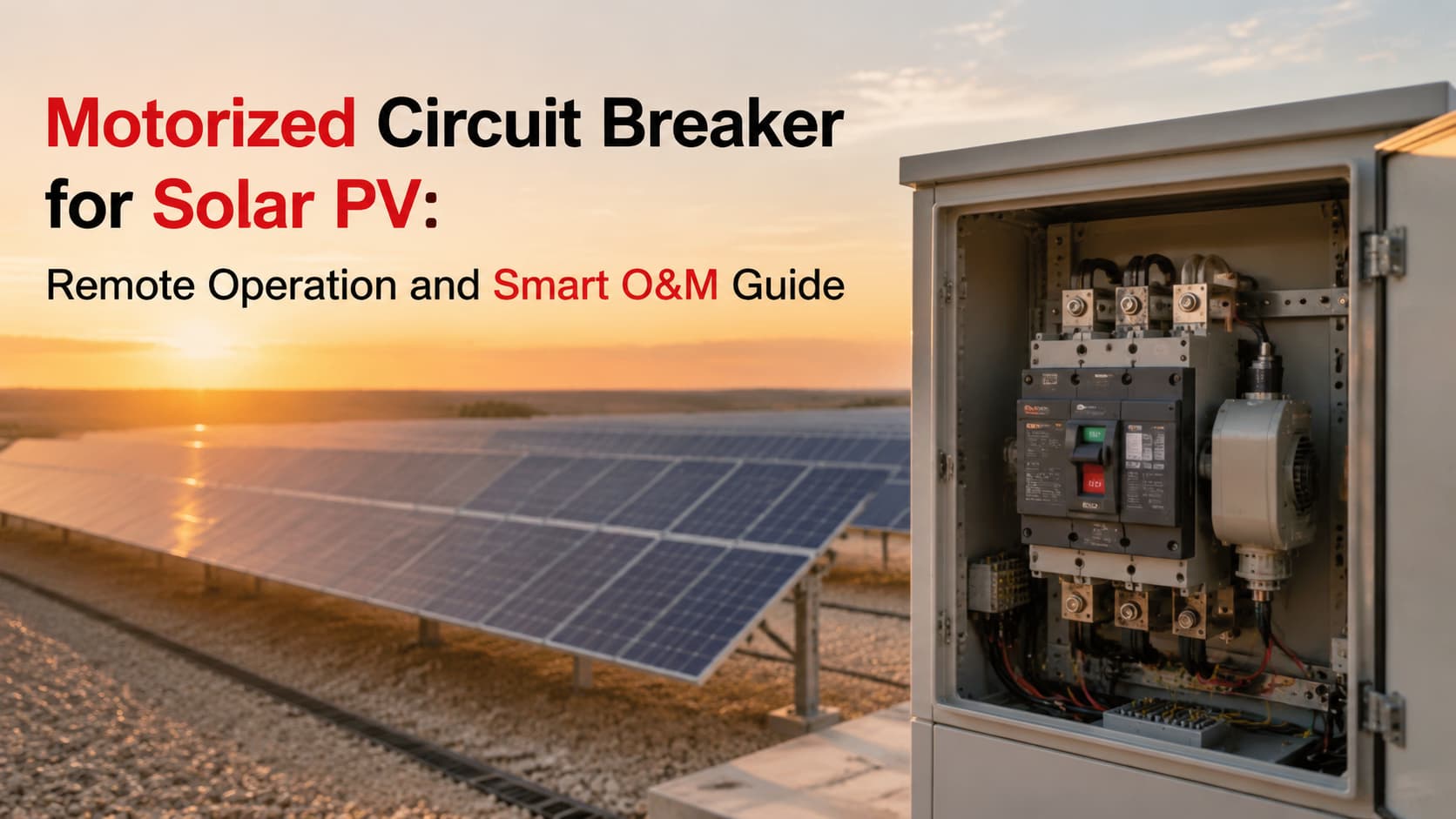
As usinas solares fotovoltaicas estão crescendo rapidamente. Um único local de escala industrial pode agora abranger centenas de hectares, com milhares de caixas combinadoras, inversores e quadros de distribuição espalhados por terrenos remotos. À medida que as instalações crescem, o custo e a complexidade de enviar técnicos para operar e manter esses equipamentos aumentam a cada megawatt. O controle remoto deixou de ser uma conveniência para se tornar uma necessidade, e no centro dessa mudança está o disjuntor motorizado para energia solar fotovoltaica — um dispositivo que transforma um interruptor físico em um comando executado a partir de uma sala de controle, às vezes a centenas de quilômetros de distância.
Este guia explica o que os disjuntores motorizados fazem em sistemas fotovoltaicos, como funcionam, onde se encaixam nos lados CC e CA e por que estão se tornando a espinha dorsal da operação e manutenção solar inteligente.
Durante décadas, operar um disjuntor significava que uma pessoa ia até ele, segurava uma alavanca e a empurrava. Em um sistema residencial de telhado, isso é aceitável. Em uma usina solar de 500 MW com caixas combinadoras espalhadas por um deserto, isso representa um sério gargalo operacional.
Os problemas com a operação manual tradicional agravam-se à medida que o tamanho da instalação aumenta:
A operação remota resolve estes problemas ao transferir a ação de comutação para um ecrã SCADA, um PLC ou um sistema de gestão de energia. A comparação abaixo torna a diferença concreta:
| Item | Operação Manual | Operação Motorizada |
|---|---|---|
| Local de operação | No local, junto ao dispositivo | Sala de controlo ou terminal remoto |
| Tempo de resposta | Minutos a horas | Segundos |
| Custo de manutenção | Elevado custo de mão de obra e deslocação | Redução de visitas ao local |
| Capacidade de automação | Nenhum | Integração total com a lógica de controlo |
| Controlo remoto | Não é possível | Funcionalidade padrão |
A diferença não é marginal. Num cenário de falha, reduzir o tempo de isolamento de duas horas para dez segundos protege o equipamento, limita o tempo de inatividade e mantém o restante da rede em funcionamento.
Um disjuntor motorizado não é apenas um disjuntor com um motor acoplado. É um conjunto de comutação integrado projetado para realizar remotamente o que um técnico faria manualmente — abrir e fechar um circuito sob comando, com a classificação de proteção de um disjuntor convencional e a controlabilidade de um dispositivo automatizado.
No contexto solar fotovoltaico, sua função é específica: fornecer comutação e proteção seguras e controláveis remotamente em pontos-chave na cadeia de distribuição de corrente contínua (CC) e corrente alternada (CA). Um sistema completo inclui quatro partes funcionais:
| Componente | Função |
|---|---|
| Disjuntor | Proteção contra sobrecorrente e curto-circuito |
| Mecanismo de operação motorizado (operador motorizado) | Executa comandos remotos de abertura/fechamento |
| Contato auxiliar | Envia feedback do status do disjuntor para o sistema de controle |
| CLP / SCADA | Emite comandos e registra operações |
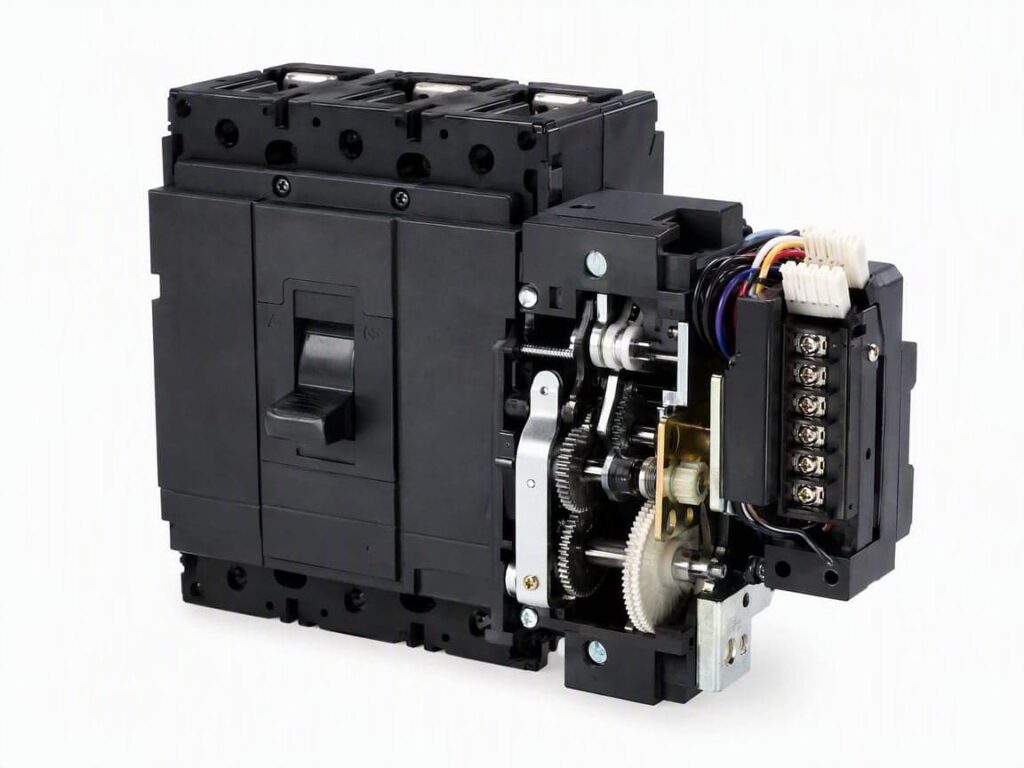
O mecanismo de operação motorizado é o coração do sistema. Ele recebe um sinal elétrico, converte-o em movimento mecânico através de um conjunto de engrenagens e articulações, e aciona a alavanca do disjuntor para a posição aberta ou fechada. Os contatos auxiliares confirmam então que o disjuntor realmente atingiu o estado pretendido e enviam esse status de volta para o sistema superior. Este ciclo de feedback fechado é o que diferencia um disjuntor motorizado de um simples interruptor remoto — o sistema de controle sempre conhece a posição real dos contatos, não apenas o comando que enviou.
Compreender a sequência de operação ajuda tanto engenheiros quanto equipes de compras a avaliar a compatibilidade com sua arquitetura de controle. O processo possui cinco etapas:
Etapa 1 — Comando de Controle. O sistema CLP ou SCADA emite um sinal de abertura ou fechamento, normalmente via contato seco ou módulo de saída digital.
Passo 2 — Ativação do motor. O motor de acionamento do operador motorizado recebe energia e começa a girar.
Step 3 — Mechanical Transmission. Gears, cams, and linkages convert the motor’s rotation into the linear or rotary motion needed to move the breaker operating shaft.
Step 4 — Circuit Breaker Operation. The mechanism drives the breaker to its open or closed position, completing or interrupting the circuit.
Step 5 — Status Feedback. Auxiliary contacts change state and report the breaker’s new position back to the control system, closing the loop.
Video Demonstration: Remote Opening and Closing of Circuit Breaker Motor Operator Watch the motor operator drive the breaker through a complete open-close cycle — the mechanical transmission and contact action are visible in real time.
The critical detail is that this entire sequence happens in a fraction of a second, without a human hand on the device. And because the motor operator is mechanically coupled to the same operating shaft a technician would use manually, the protection tripping function of the breaker itself is never bypassed — if a fault occurs, the breaker trips on its protection curve regardless of motor state.
This is where motorized breakers earn their place in a PV design. They are not abstract automation concepts; they solve concrete switching problems on both the DC and AC sides, and increasingly in energy storage.
On the DC side, motorized breakers handle isolation and control between the PV array and the inverter. Typical installation points:
| Aplicativo | Finalidade |
|---|---|
| Caixa combinadora DC | Remote isolation of faulty strings without visiting the array |
| DC Distribution Cabinet | Centralized control of multiple array feeders |
| Battery Storage System (DC) | Safe rapid shutdown of battery circuits |
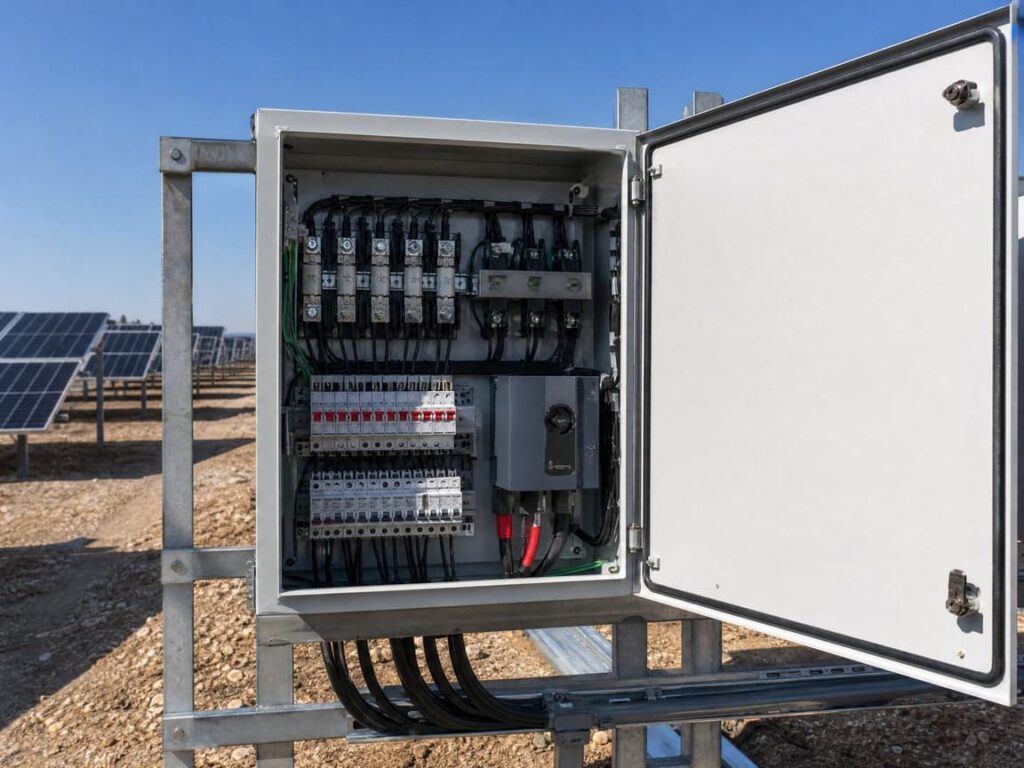
DC-side remote switching is especially valuable for fault isolation. A ground fault or arc event on a specific string can be disconnected from the control room, letting the rest of the caixa combinadora continue operating instead of taking the whole box offline for a site visit.
On the AC side, motorized breakers manage the interface between inverters, distribution, and the grid:
| Aplicativo | Função |
|---|---|
| Inverter Output Cabinet | Remote switching of inverter feeders for maintenance or curtailment |
| Grid Connection Cabinet | Controlled connection and disconnection from the grid |
| AC Distribution Panel | Intelligent operation of downstream loads and feeders |
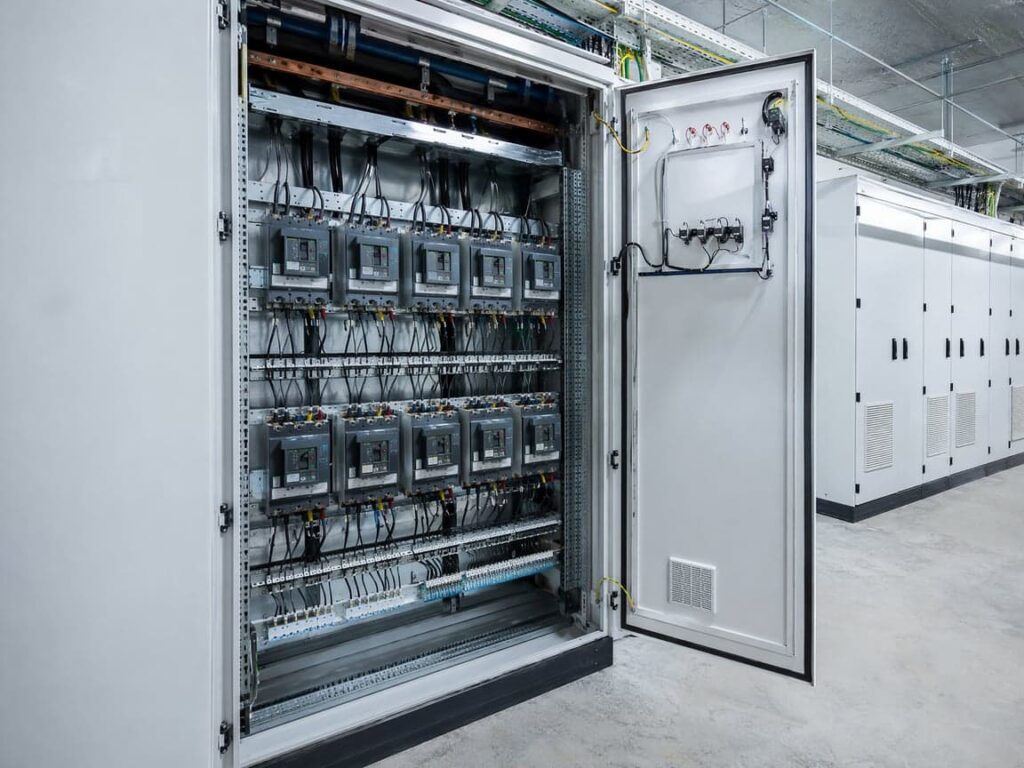
Grid-connection cabinets benefit most. Coordinated, remotely commanded switching lets operators comply with grid-code disconnect requirements within the time utilities demand — something manual operation simply cannot guarantee consistently. This same coordination principle extends to proteção do inversor solar, where breaker status and switching commands integrate into the inverter’s protection zone.
As solar projects increasingly pair generation with BESS (Battery Energy Storage Systems), motorized breakers take on a new role: managing the charge and discharge circuits of battery racks under EMS (Energy Management System) control. Remote isolation of battery strings is a safety requirement in many storage standards, and motorized operation allows the EMS to disconnect a degraded or overheating rack without dispatching a technician — a capability that matters most during thermal events when every second counts.
A modern solar plant is no longer just a generator. It is an intelligent energy system, and motorized breakers are the physical actuators that let software act on the hardware. The control hierarchy looks like this:
SCADA / EMS → PLC → Motor Operator → Disjuntor → Feedback
At the top, SCADA and EMS platforms manage plant-wide logic — generation targets, grid dispatch commands, fault response. The PLC translates these high-level instructions into device-level commands. The motor operator executes. The breaker switches. Status flows back up the chain.

This architecture is what makes a solar plant “smart” rather than merely automated. It allows:
The result is a PV plant that can be operated, optimized, and audited from a single interface.
This is the section that answers the question every plant owner eventually asks: what is the actual return? The efficiency gains fall into four areas.
Routine switching and inspection no longer require a truck roll. Operators can verify status and perform switching remotely, cutting the number of physical visits to remote or hazardous locations dramatically.
When a fault occurs, the affected circuit can be isolated in seconds rather than the hours a site visit would take. That speed limits equipment damage, reduces fire risk, and shrinks generation losses.
Because breaker status and operation history are logged automatically, maintenance teams can plan interventions based on data — actuations, last operation date, fault history — instead of calendar-based inspection schedules.
For distributed and remote installations, motorized breakers make true unattended operation feasible. A small regional site can be monitored and controlled from a central O&M center, with on-site visits reserved for physical maintenance only.
| Traditional O&M | Intelligent O&M with Motorized Breakers |
|---|---|
| Inspeção manual | Monitoramento remoto |
| Local operation | Controlo remoto |
| High labor cost | Reduced workload |
| Reactive fault response | Proactive, data-driven |
The cumulative effect: lower O&M cost per megawatt, higher availability, and safer operating conditions for staff.
A motorized breaker does not work in isolation. It is one node in a complete PV electrical protection system, and understanding that system helps with both design and troubleshooting.
| Dispositivo | Function in the PV System |
|---|---|
| Fusível CC | Overcurrent protection on PV strings |
| DC SPD (Surge Protective Device) | Surge and lightning protection |
| Seccionadora CC | Safe manual isolation for maintenance |
| Caixa combinadora | String aggregation, monitoring, and protection |
| Disjuntor | Switching and overcurrent protection |
| Motor Operator | Remote operation of the breaker |
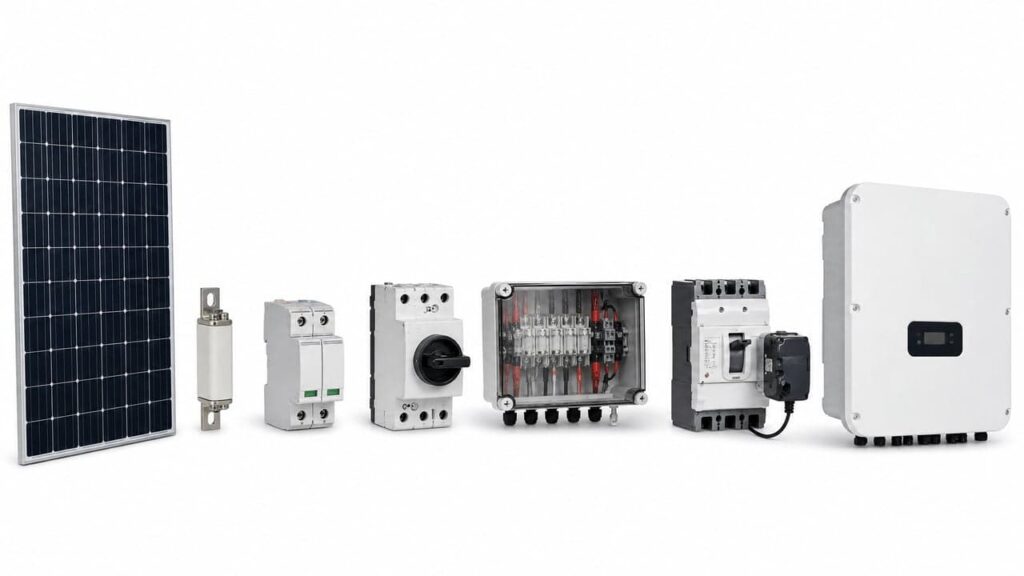
Designing motorized breakers into this stack means accounting for coordination — ensuring that when the motor operator opens a breaker, the upstream fuses and DC SPDs are still correctly rated, the Disjuntor CC is properly coordinated, and that the isolation points remain compliant with maintenance safety standards. Internally linking related product pages — DC SPD, PV combiner box, DC fuses, and the broader solar PV electrical protection overview — helps engineers and buyers navigate the full solution rather than sourcing components piecemeal.
For teams evaluating an upgrade, the decision often comes down to a feature-by-feature comparison:
| Recurso | Traditional Breaker | Motorized Breaker |
|---|---|---|
| Controlo remoto | Not available | Padrão |
| Automation | Manual only | PLC/SCADA integrated |
| Status feedback | Visual only | Electrical signal to control system |
| Manutenção | Calendar-based | Data-driven |
| Smart system integration | Nenhum | Completo |
The cost premium of a motorized unit is typically recovered within the first year of operation on any mid-to-large plant through reduced labor and faster fault response alone.
Selecting the right motor operator starts with matching it to the breaker and the application. To get an accurate specification and quotation, provide the following:
| Information Needed | Por que é importante |
|---|---|
| Breaker model / frame size | Ensures mechanical compatibility with the motor operator |
| Rated voltage (AC/DC) | Confirms the breaker suits the application |
| Corrente nominal | Determines the correct breaker specification |
| Control voltage (e.g. 24V DC, 230V AC) | Selects the correct motor operator variant |
| Application (combiner, inverter, grid, BESS) | Allows solution-level design support |
| Quantidade | Enables bulk pricing and delivery planning |
Supplying these details up front prevents the most common procurement errors — mismatched motor operators, wrong control voltages, and incompatible mounting — and shortens lead time substantially.
Remote control is powerful, but it is not the same as automatic reclosing. A motorized breaker executes a command; it does not decide whether closing is safe. Before issuing a close command after a trip, operators should verify:
| Verificar | Finalidade |
|---|---|
| Fault analysis | Confirm the fault has cleared; avoid closing into a live fault |
| Equipment inspection | Ensure cables, breakers, and connections are not damaged |
| Protection status | Verify protection devices are healthy and reset |
| Interlocking and authorization | Confirm the close is permitted by system interlocks and authorized personnel |
The discipline here matters because closing a breaker remotely into a fault can cause far more damage than the original event. Motorized operation removes the travel time; it does not remove the engineering judgment — particularly when operations must comply with IEC 60947-2 circuit breaker safety requirements.
1. What is a motorized circuit breaker? A circuit breaker fitted with a motorized operating mechanism that allows it to be opened and closed remotely via an electrical control signal, while retaining its full protection function.
2. How does a motor operator work? A control signal activates a motor, which through gears and linkages drives the breaker’s operating shaft to the open or closed position. Auxiliary contacts then report the new status back to the control system.
3. Can circuit breakers be controlled remotely? Yes, when equipped with a motor operator (for open/close) or a shunt trip release (for remote tripping only). Full remote open and close requires a motorized operating mechanism.
4. Are motorized breakers suitable for solar farms? They are ideal for solar farms, where equipment is dispersed and site visits are costly. Remote switching improves fault response time and supports unattended operation.
5. What control voltage does a motor operator need? Common control voltages are 24V DC, 48V DC, 110V DC, 230V AC, and 400V AC. The correct option depends on the site’s auxiliary power supply and control system design.
6. Can motorized breakers connect with SCADA systems? Yes. Through auxiliary contacts and PLC integration, breaker status and operation commands integrate directly into SCADA and EMS platforms.
7. What is the difference between a motor operator and a shunt trip? A shunt trip can only open (trip) a breaker remotely. A motor operator can both open and close remotely, making it suitable for full remote switching operation.
8. Where are motorized breakers installed in PV systems? On the DC side: combiner boxes, DC distribution cabinets, and battery circuits. On the AC side: inverter output cabinets, grid connection cabinets, and AC distribution panels.
9. How do motorized breakers improve solar maintenance? By reducing site visits, speeding up fault isolation, enabling data-driven maintenance planning, and supporting unattended plant operation.
10. What information is needed to select a motor operator? Breaker model, rated voltage and current, control voltage, application, and quantity — enough to confirm compatibility and provide an accurate quotation.
The motorized circuit breaker for solar PV is not an accessory. It is the device that makes remote operation and intelligent O&M possible across the DC and AC sides of a modern solar plant — from combiner boxes to grid connection cabinets and battery storage systems. By replacing slow, costly manual switching with seconds-fast remote control and closed-loop status feedback, it lowers O&M cost, raises availability, and turns a dispersed array of breakers into a coordinated, software-driven system.
KUANGYA supplies motorized operating mechanisms and complete PV distribution solutions, with OEM customization and bulk supply for solar projects of any scale. To get the right motor operator for your breakers, contact KUANGYA with:
Share these details and our engineering team will confirm compatibility and deliver a specification and quotation tailored to your project.

