WengYang Industrial Zone Yueqing Wenzhou 325000
Horas de trabalho
De segunda a sexta-feira: das 7h às 19h
Fim de semana: 10:00 - 17:00
WengYang Industrial Zone Yueqing Wenzhou 325000
Horas de trabalho
De segunda a sexta-feira: das 7h às 19h
Fim de semana: 10:00 - 17:00

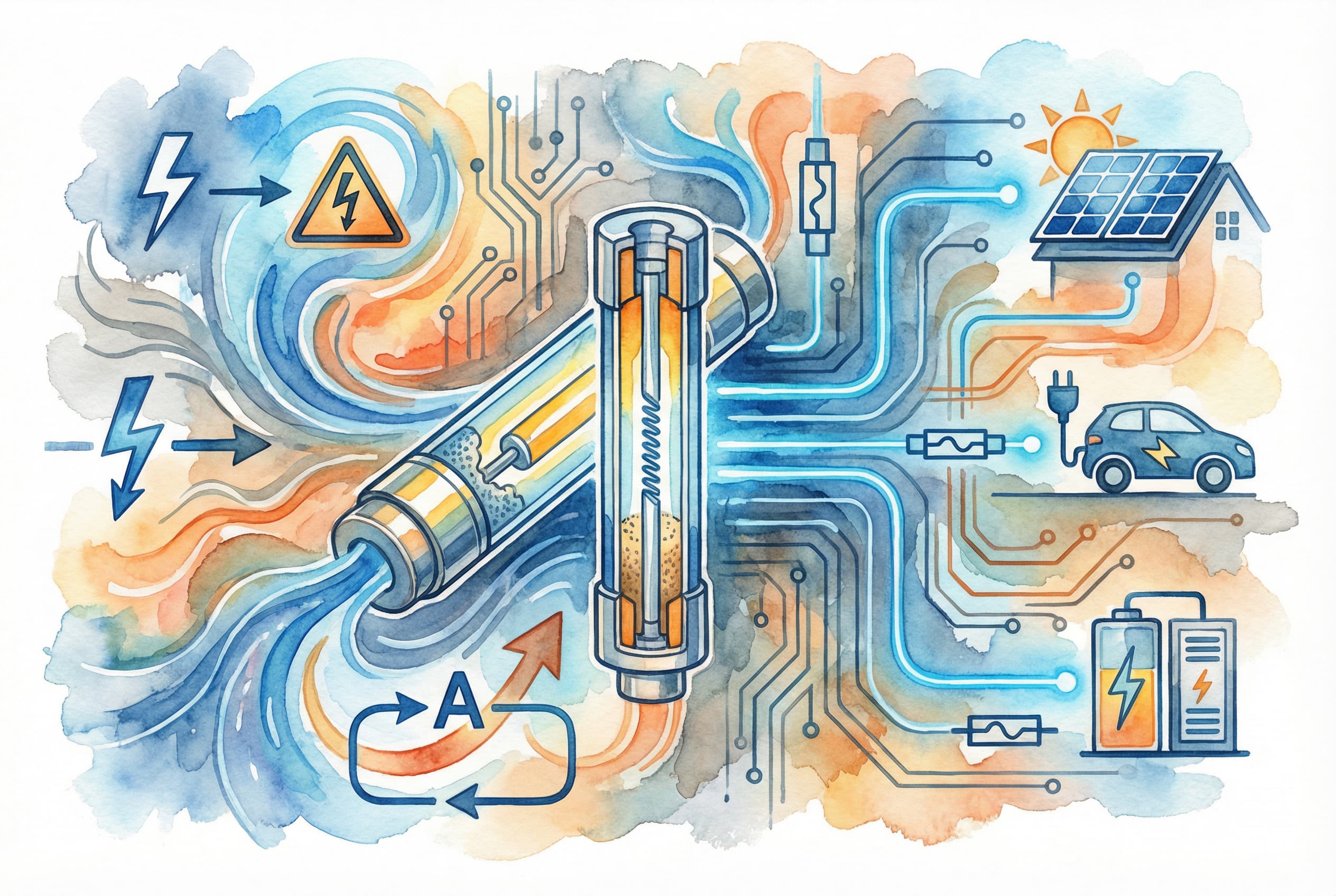
To select a fuse, do not use voltage and current alone. A safe selection also requires the correct fuse class, AC/DC rating, breaking capacity, time-current curve, I²t, conductor and equipment coordination, ambient-temperature correction, holder compatibility, and the locally adopted standard.
Safety note: This guide is a screening aid. Final fuse selection and fault-current calculations must be completed by a qualified designer using the equipment instructions, fuse manufacturer data, and applicable rules.
This tool identifies missing design inputs; it does not output an approved fuse size.
A fuse does not simply protect “the circuit.” Identify the limiting component and the fault conditions it must clear. Cable protection, motor short-circuit protection, semiconductor protection, PV reverse-current protection, and battery protection require different characteristics.
| Typical category | Primary use | Important limitation |
|---|---|---|
| gG | General full-range cable and equipment protection | Must coordinate with conductor ampacity and disconnection requirements |
| aM | Motor-circuit short-circuit protection | Partial-range; normally requires separate overload protection |
| aR/gR | Semiconductor protection | Requires I²t and device coordination; categories vary by standard/system |
| gPV | PV string and array protection | Use a DC/PV-rated fuse covered by IEC 60269-6 or applicable regional standard |
| Battery-system fuse | Batteries and energy-storage DC circuits | Verify DC voltage, fault energy, time constant, standards and equipment instructions |
The fuse voltage rating must be equal to or greater than the maximum available circuit voltage. DC interruption is generally more demanding because there is no natural current zero to help extinguish the arc. Do not assume that an AC rating is valid on DC; use the exact manufacturer-declared DC rating and polarity/application restrictions.
For PV systems, calculate the maximum array open-circuit voltage at the lowest design temperature and follow the module, inverter, fuse and applicable PV design-standard requirements. See the DC fuse product range only after the electrical requirements are known.
There is no single global formula that says every fuse equals load current × 1.25. That factor appears in particular applications and regulatory systems, while electronic fuses, IEC installation fuses, motors, PV strings and batteries use different methods. Start with design current, then apply the selected fuse manufacturer’s loading and temperature guidance plus the locally adopted rules.
Breaking capacity (interrupting rating) is the maximum prospective fault current the fuse can safely interrupt at its rated voltage and specified conditions. It is different from current rating. Calculate or obtain the available fault current at the installation point, then select a fuse with adequate rated breaking capacity under the applicable standard. “Oversize it” is not a substitute for the calculation or for verifying voltage and current-limiting performance.
Two fuses with the same ampere rating can operate very differently. Compare the manufacturer’s time-current curve with allowable overload duration, cable thermal withstand, motor starting profile, semiconductor limits and upstream/downstream devices. For energy-sensitive components, compare pre-arcing and total clearing I²t with the protected device’s withstand data.
The fuse and holder form a system. Confirm physical format, utilization category, voltage, current, power dissipation, terminal size, conductor material, torque, touch protection, environmental rating and manufacturer compatibility. Do not mix fuse links and bases only because they physically fit.
Determine whether reverse-current protection is required from the array configuration and module series-fuse rating. Where required, select a gPV fuse using maximum PV voltage at minimum temperature, string current factors, parallel-string contribution, cable ampacity, fuse-holder rating and IEC 60269-6 or the applicable regional requirements.
Account for starting current and duration. An aM fuse is generally intended for short-circuit protection and must be coordinated with an overload protective device. Use the motor starter and fuse manufacturer’s coordination tables rather than a fixed multiplier.
Select a fast semiconductor fuse using voltage, operating current, prospective fault current, circuit inductance, pre-arcing and total I²t, peak let-through current and the semiconductor manufacturer’s limits. Ampere rating alone is insufficient.
Battery systems can deliver very high DC fault current. Verify maximum DC voltage, prospective current, time constant, cable and busbar withstand, contactor coordination, service disconnect arrangement and the relevant battery-fuse product/application standard.
Often the voltage rating may exceed the circuit voltage, but only if the fuse class, current, breaking capacity, physical system and manufacturer requirements also match. Do not infer AC/DC interchangeability from the number alone.
Only when the equipment manufacturer or a documented protection study approves the substitute. A different time-current characteristic can cause nuisance operation or inadequate protection.
The rating must safely exceed the verified prospective fault current, but the complete product and coordination requirements still apply. A high breaking capacity does not compensate for the wrong voltage, class, curve or holder.
Correct fuse selection is a coordination task, not a two-number lookup. Define the application, choose the proper fuse class, verify AC/DC voltage and fault-current capability, calculate loading with product-specific derating, review time-current and I²t performance, and confirm the fuse-holder system. Use the screening tool to expose missing inputs, then approve only an exact model supported by manufacturer data and the applicable standard.

