Endereço
304 North Cardinal
St. Dorchester Center, MA 02124
Horas de trabalho
De segunda a sexta-feira: das 7h às 19h
Fim de semana: 10:00 - 17:00
Endereço
304 North Cardinal
St. Dorchester Center, MA 02124
Horas de trabalho
De segunda a sexta-feira: das 7h às 19h
Fim de semana: 10:00 - 17:00

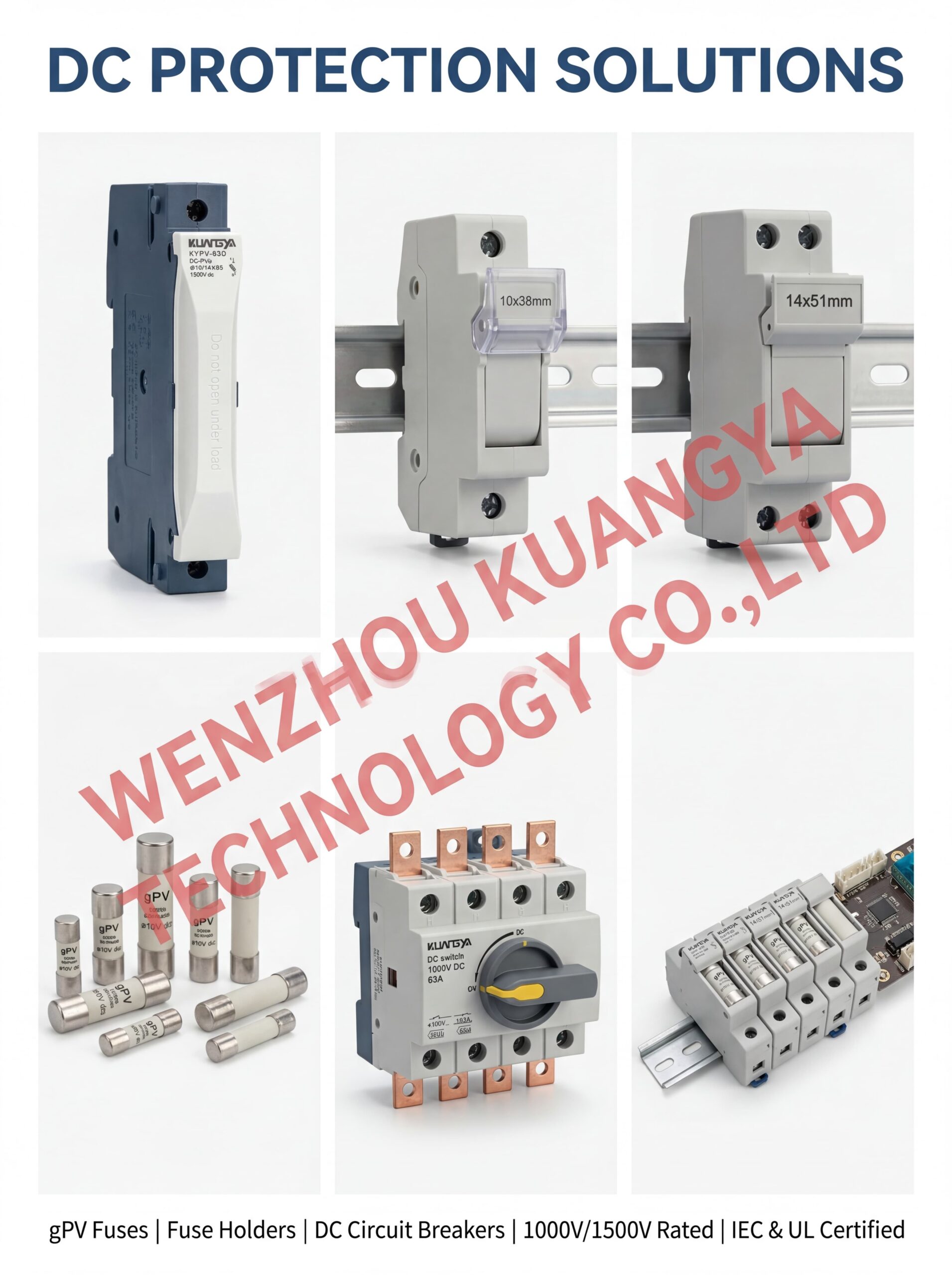
As a procurement manager developing new energy electrical products, selecting the right low-voltage fuse protection is critical for system reliability, safety compliance, and long-term operational cost control. This guide provides a comprehensive framework for evaluating fuse technologies, understanding selection criteria, and leveraging OEM/ODM partnerships to accelerate product development. With the rapid growth of photovoltaic systems, energy storage solutions, and electric vehicle infrastructure, DC-rated fuses—particularly gPV-certified products—have become essential components that demand careful technical and commercial evaluation.
Modern fuse selection extends beyond simple current ratings. Procurement managers must balance multiple factors: interrupting capacity for high-energy fault scenarios, I²t let-through characteristics for semiconductor protection, thermal derating in enclosed environments, and compliance with evolving international standards. The choice between standard catalog products and customized OEM solutions can significantly impact both time-to-market and total cost of ownership. This guide examines these considerations through the lens of cnkuangya.com‘s product portfolio, which spans compact cylindrical gPV fuses for string-level protection to high-current square-body designs for utility-scale applications.
Low-voltage fuses operate in systems below 1000V AC or 1500V DC, serving as sacrificial overcurrent protection devices that physically interrupt fault currents before downstream equipment suffers damage. Unlike circuit breakers that can be reset, fuses provide one-time protection through controlled melting of an internal element, offering inherently faster response times and higher interrupting ratings in compact form factors. citação
The fundamental challenge in fuse design lies in managing the arc that forms when the element melts. In AC circuits, the natural current zero-crossing every half-cycle aids arc extinction. DC circuits present a far more demanding scenario—without zero-crossing, the arc can sustain itself as a plasma channel exceeding 10,000°C, requiring specialized arc-quenching media and robust construction to safely interrupt the circuit. This distinction drives the critical requirement for DC-rated fuses in photovoltaic, battery storage, and EV charging applications. citação
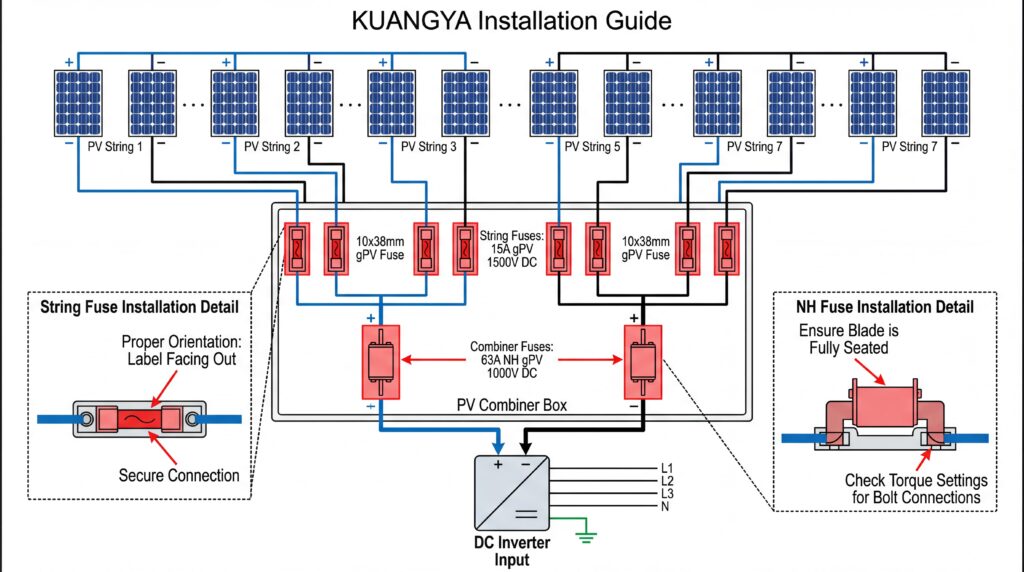
The voltage rating difference between AC and DC fuses of identical physical size illustrates the technical challenge. A standard 14×51mm fuse might be rated 690V AC but only 500V DC, while specialized gPV designs achieve 1000V or 1500V DC through enhanced arc-quenching chambers filled with high-purity quartz sand. When the fuse element melts under DC fault conditions, this sand melts into a glass-like fulgurite that smothers the arc and provides electrical insulation. citação
For procurement managers, this translates to a fundamental rule: never substitute an AC-rated fuse in a DC application, regardless of current rating compatibility. The consequences include sustained arcing, equipment destruction, and fire hazards. Conversely, DC-rated fuses can typically be used in AC circuits of equivalent or lower voltage, though this may not be cost-effective.
The “gPV” marking indicates a fuse specifically designed for photovoltaic applications, certified to IEC 60269-6 and UL 248-19 standards. These fuses feature optimized time-current characteristics that tolerate normal irradiance fluctuations and module mismatch currents while providing fast interruption for reverse-current faults that occur when a shaded or failed string becomes a load rather than a source. citação
Standard gPV fuses deliver three key performance advantages: low I²t let-through energy to protect sensitive power electronics, high interrupting capacity (typically 10kA to 30kA at rated voltage) to handle multi-string fault scenarios, and extended thermal endurance in the elevated ambient temperatures common in combiner boxes and rooftop installations. For new energy product development, specifying gPV-rated fuses ensures compatibility with evolving solar and ESS standards while providing margin for system expansion.
The choice between 1000V and 1500V fuse ratings directly impacts system architecture, efficiency, and scalability. Commercial and residential photovoltaic installations traditionally operate at 1000V DC maximum system voltage, driven by inverter availability and electrical code requirements. Utility-scale solar farms and large energy storage systems increasingly adopt 1500V architectures to reduce conductor costs, minimize resistive losses, and enable longer string configurations. citação
From a procurement perspective, 1500V-rated fuses provide future-proofing for product lines that may scale from commercial to utility applications. The voltage rating must exceed the system’s maximum open-circuit voltage under worst-case cold-temperature conditions, typically requiring a 20-25% safety margin. For example, a string with 1200V maximum Voc should use 1500V-rated fuses rather than 1000V products, even if nominal operating voltage remains below 1000V.
Fuse current ratings follow a counterintuitive principle: the marked rating represents the maximum continuous current the fuse can carry indefinitely at a reference temperature (typically 25°C ambient) without premature failure, not the current at which it will blow. Actual melting current is typically 1.35× to 1.6× the rated current, depending on fuse characteristic and time duration. citação
For photovoltaic string protection, the standard sizing methodology multiplies the module short-circuit current (Isc) by 1.56 per NEC 690.8, then selects the next standard fuse rating. However, this calculation assumes ideal conditions. Procurement managers must account for additional derating factors that reduce effective fuse capacity: ambient temperature above 25°C (common in combiner boxes, which may see 60-70°C), enclosure heating from adjacent fuses, and altitude effects above 2000 meters. A fuse rated 20A at 25°C may need to be derated to 16A effective capacity at 60°C ambient.
Cylindrical fuse sizes follow standardized dimensions that determine both current-handling capacity and required panel space. The progression from 10×38mm through 14×51mm, 10×85mm, 14×85mm, to 22×125mm reflects increasing thermal mass and arc-interruption volume. Smaller formats suit string-level protection in dense combiner boxes, while larger formats provide the thermal margin needed for high-current feeders and central inverter protection. citação
Square-body fuses in H0 through H3 sizes (and extended XL variants) address applications beyond the reach of cylindrical formats, handling currents from 100A to 1600A in utility-scale PV arrays and battery energy storage systems. These designs feature bolted connections rather than clip contacts, providing lower contact resistance and better thermal stability under sustained high-current operation.
Cnkuangya’s cylindrical gPV fuse range covers the most common photovoltaic string protection requirements, with current ratings from 2A to 50A in 1000V and 1500V voltage classes. These products utilize copper or silver-plated element construction with high-purity quartz sand arc-quenching media, providing interrupting ratings of 10kA to 30kA depending on size and voltage class. The compact 10×38mm and 14×51mm formats integrate seamlessly into standard DIN-rail mounted fuse holders, enabling high-density combiner box layouts. citação
For procurement managers evaluating string-level protection, these fuses offer several advantages: IEC 60269-6 and UL 248-19 compliance for global market access, low I²t characteristics to protect downstream inverter electronics, and consistent manufacturing quality suitable for high-volume production. The availability of 1500V ratings in compact formats provides design flexibility for next-generation high-voltage string inverter systems.
The square-body H0 through H3 series addresses central inverter DC bus protection, battery rack overcurrent protection, and main feeder circuits in utility-scale installations. These fuses handle currents from 100A to 400A in standard formats, with XL variants extending capacity to 630A and beyond. The robust construction features bolted blade terminals, ceramic or composite bodies, and enhanced arc-quenching chambers designed for the extreme energy levels present in multi-megawatt fault scenarios. citação
From a product development standpoint, square-body fuses enable simplified high-current protection architectures that would otherwise require parallel cylindrical fuses or expensive electronic protection devices. The single-point failure mode and predictable time-current characteristics simplify coordination studies and reduce system complexity. Procurement managers should note that these products require matching fuse bases with proper creepage and clearance distances—the fuse and holder must be specified as a system to ensure safety compliance.
Cnkuangya’s fuse holder portfolio includes DIN-rail mount designs for cylindrical fuses and panel-mount bases for square-body formats. The DIN-rail holders feature finger-safe construction, tool-free fuse replacement, and optional blown-fuse indication contacts for remote monitoring integration. Proper holder selection is critical—contact resistance, creepage distance, and thermal rating must match or exceed the fuse specifications to prevent premature failure or safety hazards. citação
New product development should treat the fuse holder as an integral component rather than an afterthought. Holder contact resistance contributes to total circuit heating and can affect fuse performance. Procurement specifications should require holders tested and certified with the specific fuse models being used, particularly for high-current applications where contact resistance of even a few milliohms can cause significant power dissipation.
Cnkuangya’s OEM/ODM services enable procurement managers to specify non-standard current ratings optimized for specific applications, eliminating the need to oversize to the next standard rating. For example, a battery management system requiring 45A protection can use a custom 45A fuse rather than oversizing to 50A, providing tighter protection coordination and potentially reducing conductor sizing requirements. Custom voltage ratings address niche applications such as 900V or 1200V DC systems that fall between standard 1000V and 1500V products. citação
The minimum order quantities for custom ratings vary with the degree of customization. Fuses using standard element designs with modified ratings may require only 1,000-5,000 piece minimums, while entirely new element designs for specialized characteristics require engineering investment and higher volumes. Procurement managers should engage with technical sales early in the product development cycle to understand feasibility and lead times.
Private labeling and custom packaging transform commodity fuse components into branded product differentiators. Cnkuangya offers laser marking or pad printing of company logos, part numbers, and certification marks directly on fuse bodies, creating a professional appearance and supporting traceability requirements. Custom packaging options range from modified labeling on standard boxes to fully designed retail packaging with product-specific documentation. citação
For procurement managers developing complete system products—such as combiner boxes, inverters, or ESS enclosures—branded fuses reinforce quality perception and support aftermarket parts programs. The ability to control the entire supply chain presentation, from component marking through end-user documentation, provides competitive advantages in markets where brand recognition drives purchasing decisions.
OEM partnerships should include comprehensive technical documentation packages : detailed datasheets with time-current curves, I²t let-through data, temperature derating tables, and mechanical drawings. Cnkuangya provides certification support for products requiring third-party testing, including coordination with UL, TÜV, and other certification bodies. This service is particularly valuable for procurement managers developing products for multiple international markets with varying compliance requirements. citação
The documentation package should also include application notes specific to your product category. For example, a combiner box manufacturer needs different technical guidance than an ESS integrator, even when using the same fuse models. Procurement specifications should explicitly require application-specific documentation as part of the OEM agreement, ensuring your engineering team has the information needed for proper integration and certification.
| Aplicativo | Tipo de fusível recomendado | Classificação da tensão | Faixa atual | Tamanho físico | Principais critérios de seleção |
|---|---|---|---|---|---|
| PV String Protection | Cylindrical gPV | 1000V / 1500V | 2A – 50A | 10×38, 14×51, 10×85 | Match to module Isc × 1.56; verify holder compatibility |
| Saída da caixa combinadora | Cylindrical gPV | 1000V / 1500V | 30A – 125A | 14×51, 10×85, 22×125 | Sum of string currents; coordinate with downstream protection |
| Central Inverter DC Input | Square-Body gPV (H0-H3) | 1000V / 1500V | 100A – 400A | H0, H1, H2, H3 | High interrupting capacity; low contact resistance holder |
| Proteção do rack de bateria | Square-Body gPV (XL) | 1000V / 1500V | 200A – 630A | H1-XL, H2-XL, H3-XL | Continuous duty rating; thermal management in enclosure |
| DC Bus / Main Feeder | Square-Body gPV (XL) | 1000V / 1500V | 400A – 1600A | H2-XL, H3-XL, Custom | Selective coordination; fault current analysis required |
| Residential Inverter | Cylindrical gPV | 1000V | 15A – 63A | 10×85, 14×85 | Compact size; finger-safe holder; easy replacement |
| Environmental Condition | Fator de derivação | Application Notes | Procurement Consideration |
|---|---|---|---|
| Ambient Temperature 40°C | 0.95× | Typical outdoor combiner box | Standard rating usually sufficient |
| Ambient Temperature 50°C | 0.88× | Enclosed combiner box, moderate solar loading | Upsize one rating increment |
| Ambient Temperature 60°C | 0.80× | Enclosed combiner box, high solar loading | Upsize one or two rating increments |
| Ambient Temperature 70°C | 0.70× | Worst-case enclosed scenario | Consider active cooling or larger fuse format |
| Altitude 2000m – 3000m | 0.95× | Reduced air cooling effectiveness | Verify with manufacturer data |
| Altitude 3000m – 4000m | 0.90× | Significant air density reduction | May require special high-altitude ratings |
| Multiple Fuses in Enclosure | 0.85× – 0.95× | Depends on spacing and ventilation | Thermal modeling recommended for >10 fuses |
| Continuous vs Intermittent Load | 1.0× / 1.1× | Fuses tolerate brief overloads better | Size for continuous worst-case current |
| Padrão | Geographic Scope | Foco no aplicativo | Key Requirements | cnkuangya Compliance |
|---|---|---|---|---|
| IEC 60269-6 | Internacional | Photovoltaic gPV fuses | Time-current curves, I²t limits, DC interrupting capacity | ✓ Certified |
| UL 248-19 | América do Norte | DC fuses for PV systems | Construction, performance, marking requirements | ✓ Referenced |
| NEC Article 690 | United States | PV system installation | Fuse sizing, OCPD requirements, conductor protection | ✓ Compliant |
| IEC 61439 | Internacional | Low-voltage switchgear assemblies | Integration into combiner boxes and switchgear | ✓ Compatible |
| EN 50521 | Europa | Connectors for PV systems | When integrated with fused connectors | ✓ Compatible |
| UL 1741 | América do Norte | Inverter certification | Fuse coordination with inverter protection | ✓ Tested |
| IEC 62109 | Internacional | Power converter safety | Overcurrent protection coordination | ✓ Verified |
| Service Level | Minimum Order Quantity | Lead Time | Customization Scope | Ideal para |
|---|---|---|---|---|
| Standard Catalog | 100 – 500 pieces | 2 – 4 weeks | None; off-the-shelf products | Prototyping, low-volume production, standard applications |
| Private Label | 1,000 – 5,000 pieces | 4 – 6 weeks | Logo marking, custom packaging, documentation | Branded product lines, aftermarket parts programs |
| Custom Rating | 5,000 – 10,000 pieces | 6 – 10 weeks | Non-standard current/voltage, modified characteristics | Optimized protection for specific equipment ratings |
| Full Custom Design | 10,000+ pieces | 12 – 16 weeks | Unique form factors, specialized characteristics, new certifications | Proprietary systems, high-volume production, competitive differentiation |
Fuse and holder connection integrity directly impacts both safety and performance. Under-torqued connections create high contact resistance, leading to localized heating that can cause premature fuse operation or holder damage. Over-torqued connections can crack ceramic fuse bodies or deform holder contacts, compromising current-carrying capacity. Cnkuangya specifies torque values for each fuse and holder combination—typically 1.2 to 2.0 N⋅m for cylindrical fuse clips and 10 to 25 N⋅m for square-body bolted connections. citação
Procurement specifications for system integrators should mandate calibrated torque tools and documented torque verification during production. For high-volume manufacturing, consider fuse holders with spring-loaded contacts that provide consistent contact force without torque-critical assembly steps. This reduces manufacturing variability and field failure rates.
Fuses rarely operate in isolation—they must coordinate with upstream and downstream protection devices to ensure selective operation. In a typical PV system, string fuses must clear faults without causing combiner box main fuses or inverter input breakers to trip, preserving system availability. This requires careful analysis of time-current curves and I²t let-through characteristics. citação
Procurement managers should request coordination studies as part of the OEM partnership, particularly for complex systems with multiple protection layers. Cnkuangya can provide time-current curve overlays and I²t data to verify that the proposed fuse selections will coordinate properly. This analysis should cover both normal operating conditions and worst-case fault scenarios, including multi-string faults and ground faults.
Fuse current ratings assume free air circulation at reference temperature. Real-world installations in combiner boxes, inverter enclosures, and ESS cabinets create thermal challenges that can significantly reduce effective fuse capacity. Heat generated by the fuse itself, adjacent fuses, and other components accumulates in enclosed spaces, raising ambient temperature and reducing the fuse’s ability to dissipate heat. citação
Procurement specifications should require thermal analysis for any enclosure containing multiple fuses operating at high current levels. Solutions include forced ventilation, increased spacing between fuses, heat sinks on fuse holders, or upsizing to larger fuse formats with greater thermal mass. For high-density combiner boxes, consider alternating loaded and unloaded fuse positions to reduce thermal coupling between adjacent devices.
Safe fuse replacement requires complete de-energization and verification of zero voltage before accessing fuse holders. In DC systems, capacitive stored energy can persist even after source disconnection, requiring explicit discharge procedures. Replacement fuses must match the original specifications exactly—same voltage rating, current rating, gPV characteristic, and interrupting capacity. Using incorrect replacement fuses is a leading cause of system failures and safety incidents. citação
Procurement managers developing serviceable products should specify fuse holders with clear marking of required fuse specifications, ideally molded or engraved directly on the holder body. Provide clear documentation with replacement procedures, including lockout/tagout requirements, voltage verification steps, and torque specifications. Consider designing systems with test points that allow voltage verification without exposing personnel to live conductors.
When a fuse operates, it indicates an overcurrent condition that requires investigation before simply replacing the fuse. Common causes include ground faults, short circuits from damaged cables or failed components, reverse-current faults in PV strings, and sustained overload from system misconfiguration. Operating a fuse repeatedly without addressing the root cause will lead to continued failures and potential equipment damage. citação
Procurement specifications for monitoring-enabled systems should include fuse status indication—either mechanical blown-fuse indicators or electronic current monitoring that can detect fuse operation and alert maintenance personnel. This enables proactive maintenance and reduces system downtime. For critical applications, consider redundant protection paths that maintain partial system operation even when one fuse has cleared.
Fuse technology evolves slowly, but specific models do become obsolete as standards change and manufacturers consolidate product lines. Procurement managers should establish relationships with suppliers that provide advance notification of product changes and support transition planning. Cnkuangya’s OEM/ODM services can include long-term supply agreements that guarantee availability of specific fuse models for the lifecycle of your product, typically 10-15 years for industrial equipment. citação
Maintain strategic inventory of critical fuse types, particularly for fielded systems that may require replacement parts years after initial production. The cost of holding spare fuse inventory is minimal compared to the cost of system downtime or emergency redesign if a critical fuse model becomes unavailable. For high-volume products, negotiate consignment inventory arrangements where the supplier maintains stock at your facility or nearby distribution centers.
Fuse procurement decisions should evaluate total cost of ownership rather than simply unit price. A lower-cost fuse that requires frequent replacement due to marginal sizing or poor quality will ultimately cost more than a properly specified premium product. Consider these cost factors: initial purchase price, inventory carrying costs, warranty claims from premature fuse operation, field service costs for replacement, and system downtime costs. citação
For example, specifying a fuse with 20% higher current rating than minimum requirements may increase unit cost by 15%, but can reduce nuisance operations by 80% in high-temperature environments. The avoided service calls and improved customer satisfaction easily justify the higher component cost. Procurement managers should work with engineering to establish sizing guidelines that balance protection performance with reliability and cost.
Fuse pricing follows typical volume discount curves, with significant price breaks at 1,000, 5,000, 10,000, and 50,000 piece quantities. However, procurement managers must balance volume pricing against inventory carrying costs and obsolescence risk. For products with uncertain demand or rapid design iteration, smaller frequent orders may be more cost-effective than large inventory commitments. citação
Consider establishing blanket purchase orders with scheduled releases that lock in volume pricing while maintaining inventory flexibility. Cnkuangya’s OEM/ODM services can include vendor-managed inventory programs where the supplier maintains stock based on your forecast and ships against actual demand. This approach provides volume pricing benefits without the cash flow impact of large inventory purchases.
Reducing the number of unique fuse types across your product portfolio generates significant cost savings through volume consolidation, simplified inventory management, and reduced engineering complexity. Procurement managers should work with engineering to identify opportunities for standardization—for example, using the same 1500V fuse family across both 1000V and 1500V products, or standardizing on a single holder design that accommodates multiple fuse sizes. citação
The cost savings from standardization extend beyond procurement. Manufacturing benefits from reduced part number complexity and simplified assembly procedures. Field service benefits from reduced spare parts inventory and simplified training. Quality assurance benefits from focused validation efforts on fewer component types. A well-executed standardization program can reduce total fuse-related costs by 20-30% while improving reliability.
Battery energy storage systems present unique protection challenges that make gPV fuses the preferred choice despite the “PV” designation. While gPV fuses were originally developed for photovoltaic applications, their characteristics—low I²t let-through energy, high DC interrupting capacity, and fast fault clearing—align perfectly with battery protection requirements. Battery fault currents can be extremely high due to low internal impedance, often exceeding 10kA even in residential-scale systems. General-purpose DC fuses may lack sufficient interrupting capacity and can allow excessive let-through energy that damages battery cells or power electronics.
The key selection criteria for ESS applications include: voltage rating must exceed maximum battery stack voltage with appropriate safety margin (typically 1500V fuses for 1000V nominal battery systems), current rating should be based on maximum continuous charge/discharge current with appropriate derating for ambient temperature and enclosure heating, and interrupting capacity must exceed the maximum available fault current calculated from battery short-circuit specifications. For battery rack protection, square-body gPV fuses in the H1-XL through H3-XL range provide the high current capacity (200A-630A) needed for multi-module parallel configurations while maintaining the fast-clearing characteristics essential for battery safety.
Procurement managers should also consider the coordination requirements between battery management system (BMS) contactors and fuse protection. The fuse serves as backup protection for BMS failures or faults that exceed the contactor’s interrupting capacity. Request coordination studies from your fuse supplier to verify that the selected fuse will clear high-magnitude faults before battery damage occurs while allowing the BMS to handle normal operating transients and controlled shutdown scenarios.
Comprehensive documentation and certification packages are essential for products entering multiple markets, as fuse requirements vary significantly between regions. At minimum, require complete technical datasheets including: rated voltage and current with all applicable standards references (IEC 60269-6, UL 248-19), time-current characteristic curves covering the full range from 0.01 seconds to 10,000 seconds, I²t let-through data for coordination studies, temperature derating curves from -40°C to +85°C, mechanical drawings with all critical dimensions and tolerances, and material declarations for RoHS and REACH compliance.
For certification documentation, require copies of third-party test reports from recognized certification bodies—TÜV, UL, CSA, or equivalent—that verify compliance with applicable standards. These reports should cover construction examination, performance testing (including interrupting capacity verification at maximum rated voltage), temperature rise testing, and endurance testing. The supplier should provide a certificate of conformity for each production batch that references the type-test reports and confirms the production units match the tested design.
For OEM/ODM products with custom specifications, clarify certification responsibility early in the partnership. Standard options include: supplier provides fully certified products with their certifications extended to cover your private label (simplest but may limit customization), supplier provides test reports and technical files that you submit for your own certification (provides maximum control but requires certification expertise and budget), or hybrid approach where supplier handles component-level certification while you handle system-level certification for the complete product. Cnkuangya offers certification support services that can guide procurement managers through these options and coordinate with certification bodies to streamline the approval process. citação
Additionally, require application notes specific to your target markets—for example, NEC 690 compliance guidance for US solar installations, EN 50521 connector integration notes for European markets, or AS/NZS 5033 sizing guidance for Australian PV systems. These application-specific documents demonstrate the supplier’s expertise in your target markets and provide valuable technical support for your engineering and certification teams.
Effective fuse procurement for new energy electrical products requires balancing technical performance, regulatory compliance, supply chain reliability, and total cost of ownership. The rapid evolution of photovoltaic, energy storage, and electric vehicle technologies demands protection components that can adapt to increasing voltage levels, higher current densities, and more stringent safety requirements. Procurement managers who develop strategic partnerships with capable OEM/ODM suppliers like cnkuangya.com gain competitive advantages through customized solutions, technical support, and supply chain flexibility that commodity purchasing cannot provide.
The key to successful fuse procurement lies in early engagement with suppliers during the product development phase. By involving fuse suppliers in design reviews, coordination studies, and certification planning, procurement managers can avoid costly redesigns and accelerate time-to-market. The investment in comprehensive technical documentation, custom ratings optimized for specific applications, and long-term supply agreements pays dividends through improved product reliability, reduced warranty costs, and enhanced customer satisfaction.
As new energy technologies continue to advance, fuse protection will evolve to meet emerging challenges—higher DC voltages for improved efficiency, smart fuses with integrated monitoring and communication capabilities, and hybrid protection devices that combine fuse and semiconductor technologies. Procurement managers who establish strong technical partnerships with forward-looking suppliers will be positioned to leverage these innovations and maintain competitive advantages in rapidly evolving markets.
For technical consultation, OEM/ODM inquiries, and product samples, contact cnkuangya.com:

