WengYang Industrial Zone Yueqing Wenzhou 325000
Horas de trabalho
De segunda a sexta-feira: das 7h às 19h
Fim de semana: 10:00 - 17:00
WengYang Industrial Zone Yueqing Wenzhou 325000
Horas de trabalho
De segunda a sexta-feira: das 7h às 19h
Fim de semana: 10:00 - 17:00

Long SPD connecting leads raise the voltage seen by equipment during a surge. Learn how to measure the full path, shorten wiring, and review coordinated protection.
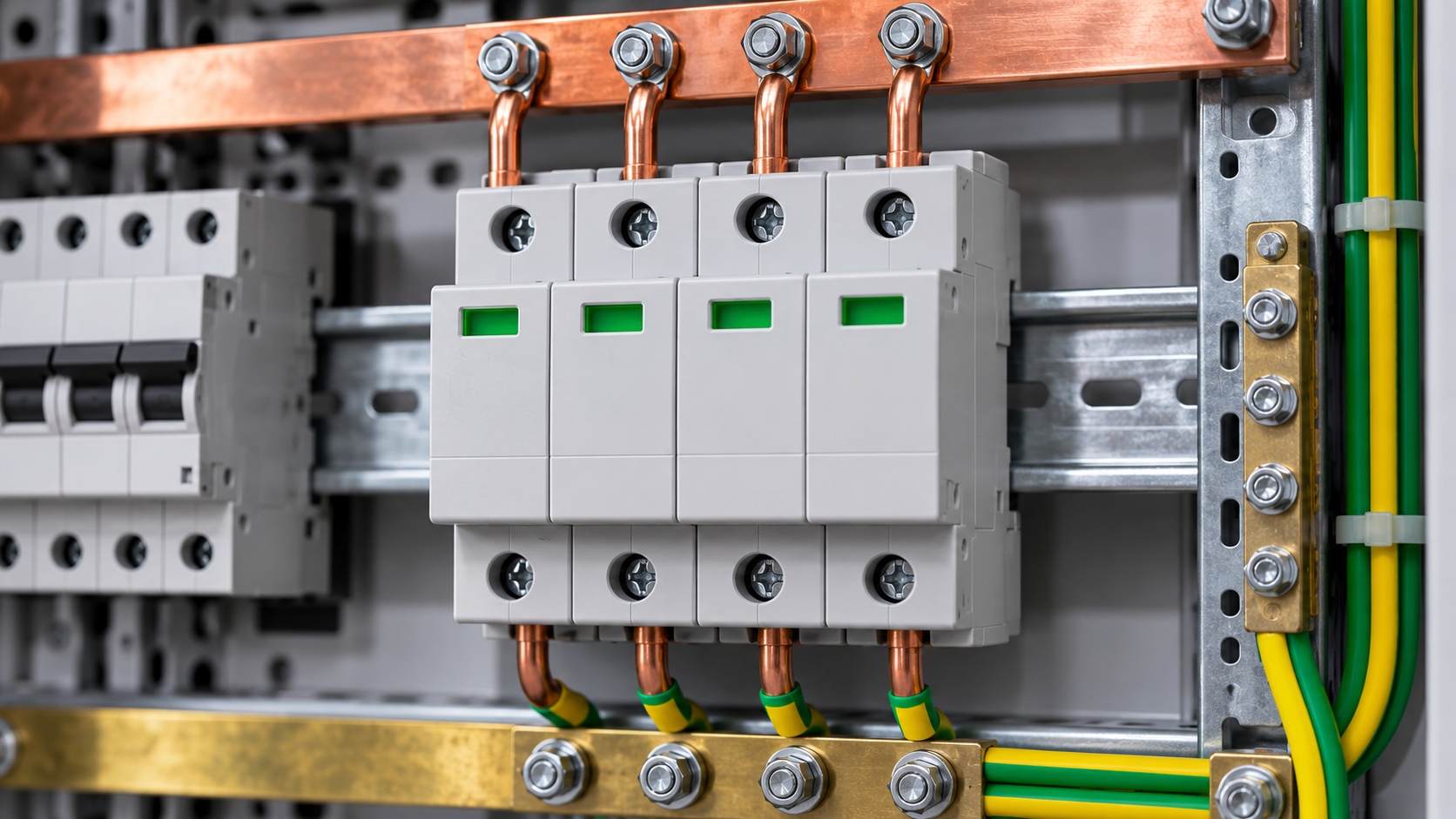
Resposta rápida: An SPD can have a low published voltage protection level (Up) yet provide weaker protection when its connecting conductors are long. During a fast surge, the leads add an inductive voltage rise. Keep the path from the circuit connection to the SPD and back to PE short and direct, and follow the device instructions and local electrical rules.
A surge protective device diverts transient current through its protection path. The protected equipment experiences the SPD’s own limiting voltage mais voltage developed along the conductors and connections. Because surge current changes very quickly, even a short lead can contribute a meaningful extra voltage. Bends and unnecessary loops also complicate the path. The result is that the installed protection level can be higher than the value printed on the SPD datasheet.
Schneider Electric explains the effect in its SPD wire-length guidance. DEHN likewise advises that, for its cited installation condition, the combined active-conductor and PE connection length should be limited to 0.5 m, and that longer connections require additional design measures. See the DEHN technical FAQ. The 0.5 m figure is a useful design target for many IEC-style installations, but the applicable standard, SPD type, panel design and manufacturer instructions govern the actual installation.
Measure the complete surge-current connection path, rather than only the visible earth wire. In a typical parallel-connected AC SPD, that means the conductor from the phase or neutral connection point to the SPD, plus the conductor from the SPD to the PE or earthing bar. If a separate backup protective device is in the path, include its connecting conductors when evaluating the layout. The equipment’s distance from the panel is a different question: a distant load may need a coordinated SPD closer to it.
| Pergunta | Practical check |
|---|---|
| Is the SPD physically close to its connection point? | Place it near the relevant busbar and PE bar, with a short, direct route. |
| Are the leads bundled into loops? | Remove spare length; avoid routing that adds unnecessary bends or large loops. |
| Is the protected equipment far downstream? | Review coordination and whether an additional downstream SPD is required. |
| Does the product specify conductor size and backup protection? | Use the exact manufacturer’s wiring and overcurrent-protection instructions. |
Up is measured under specified test conditions at the device. A lower Up can help, but it does not erase the voltage rise in long connecting leads. Compare SPDs only after checking their test class, system voltage, earthing arrangement, discharge rating and installation conditions. A very short connection to an appropriately selected device can protect more effectively than a nominally lower-Up device connected with avoidably long wires.
Phoenix Contact notes that connection length changes the effective protection level and describes a 0.5 m phase-to-PE connection requirement in the DIN VDE 0100-534 context; see its main distribution guidance. Do not transfer one jurisdiction’s numerical rule to every installation without checking local requirements.
Short, direct connections matter in both AC distribution boards and PV DC combiner boxes. The SPD itself must still match the circuit. For PV, confirm the maximum continuous operating voltage (Ucpv), system configuration, applicable SPD type and backup protection. See our SPD placement near an inverter e o guia de fusíveis de reserva para DPS. In an AC panel, also check the earthing system and the device’s declared connection arrangement.
Do not relocate an SPD or change conductor size solely to satisfy an article. An electrician or qualified panel designer should check the actual installation, fault level, conductor routing, terminal torque and the manufacturer’s instructions.
No universal limit applies to every product and jurisdiction. The 0.5 m guidance appears in specific IEC-style installation contexts and manufacturer publications. Use the standard and device instructions applicable to your project.
Correct conductor size is essential, but a larger cross-section is not a substitute for a short, direct surge path. Check both requirements.
Not necessarily. Cable runs and equipment impulse withstand affect the outcome. Assess SPD coordination and whether a second device is needed near the load.
For a panel or PV combiner-box project, send Kuangya the wiring arrangement and equipment ratings so the appropriate SPD documentation can be reviewed before selection.

